


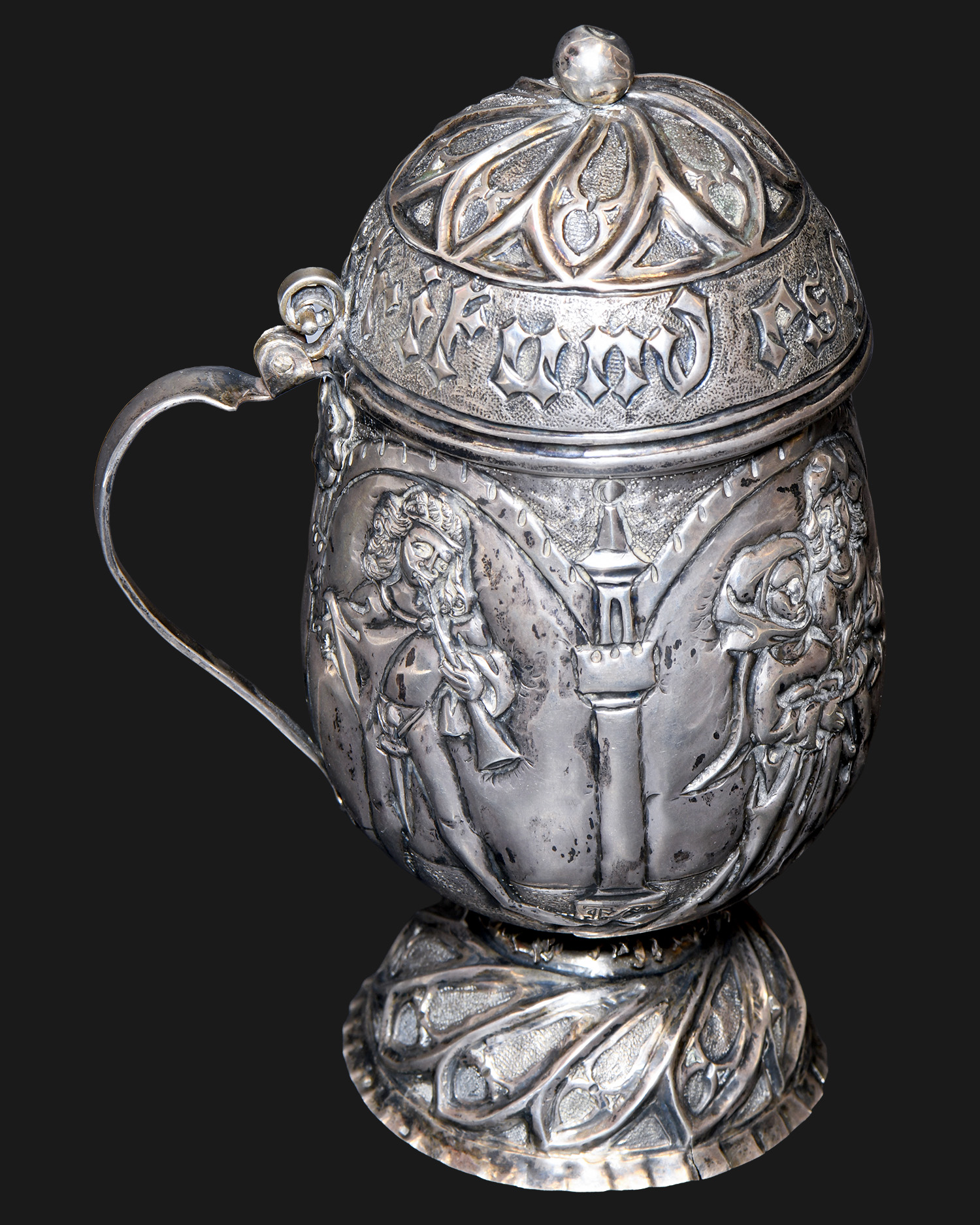
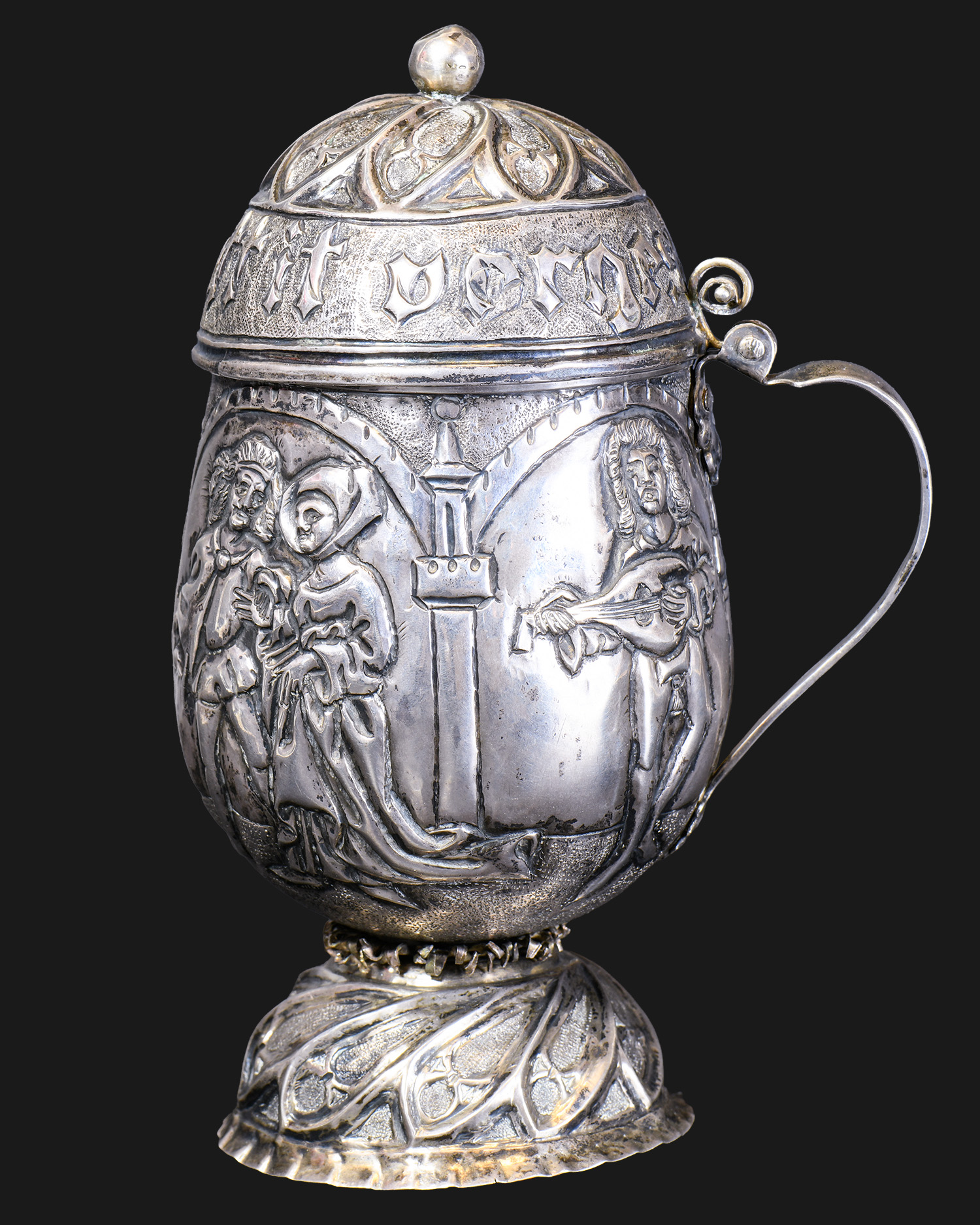
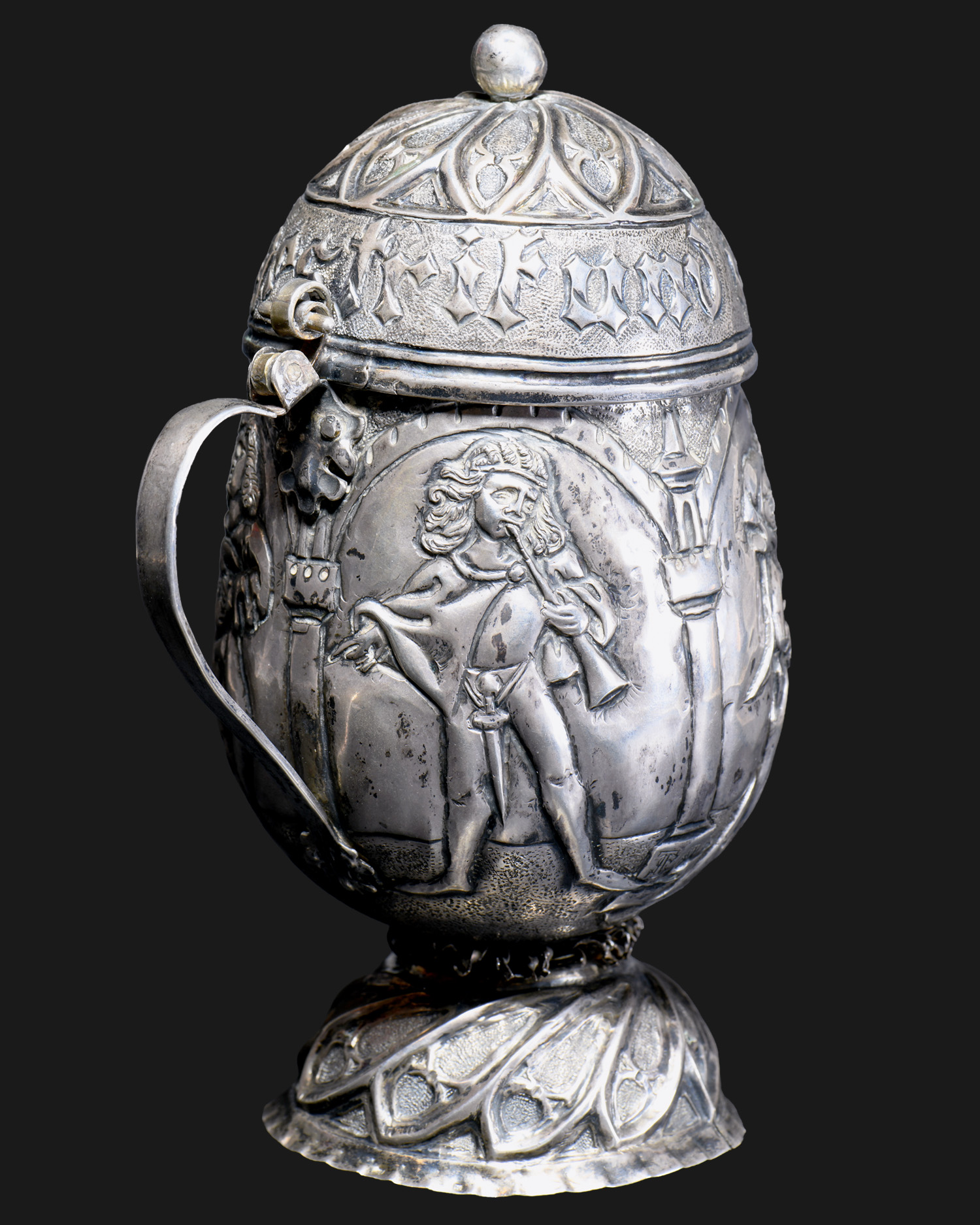

Friedrich Schmidt the Elder or the Younger, lidded tankard, silver-gilt, Germany (Nuremberg), 2nd half of the 17th century.
6000,00 zł
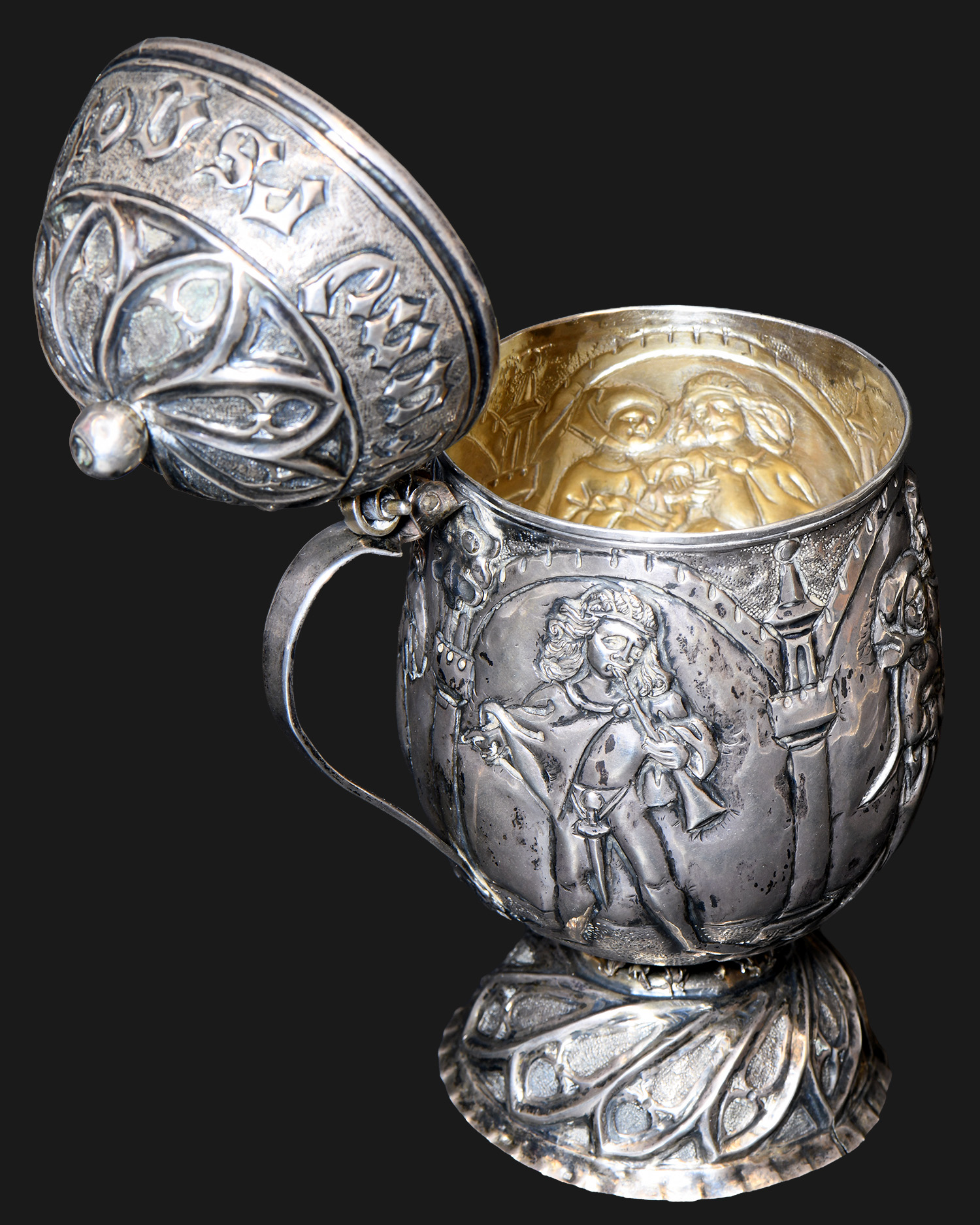
Crafted from silver and gilt on the interior, this Baroque lidded tankard (or goblet) is by the Nuremberg silversmith Friedrich Schmidt the Elder (active from 1653) or the Younger (active in the 2nd half of the 17th century). The vessel is distinguished by a form characteristic of the artistic craftsmanship of the period and a rich iconographic program. It was executed in a style referred to in art history as Baroque Gothic Revival or the gotisierend trend.
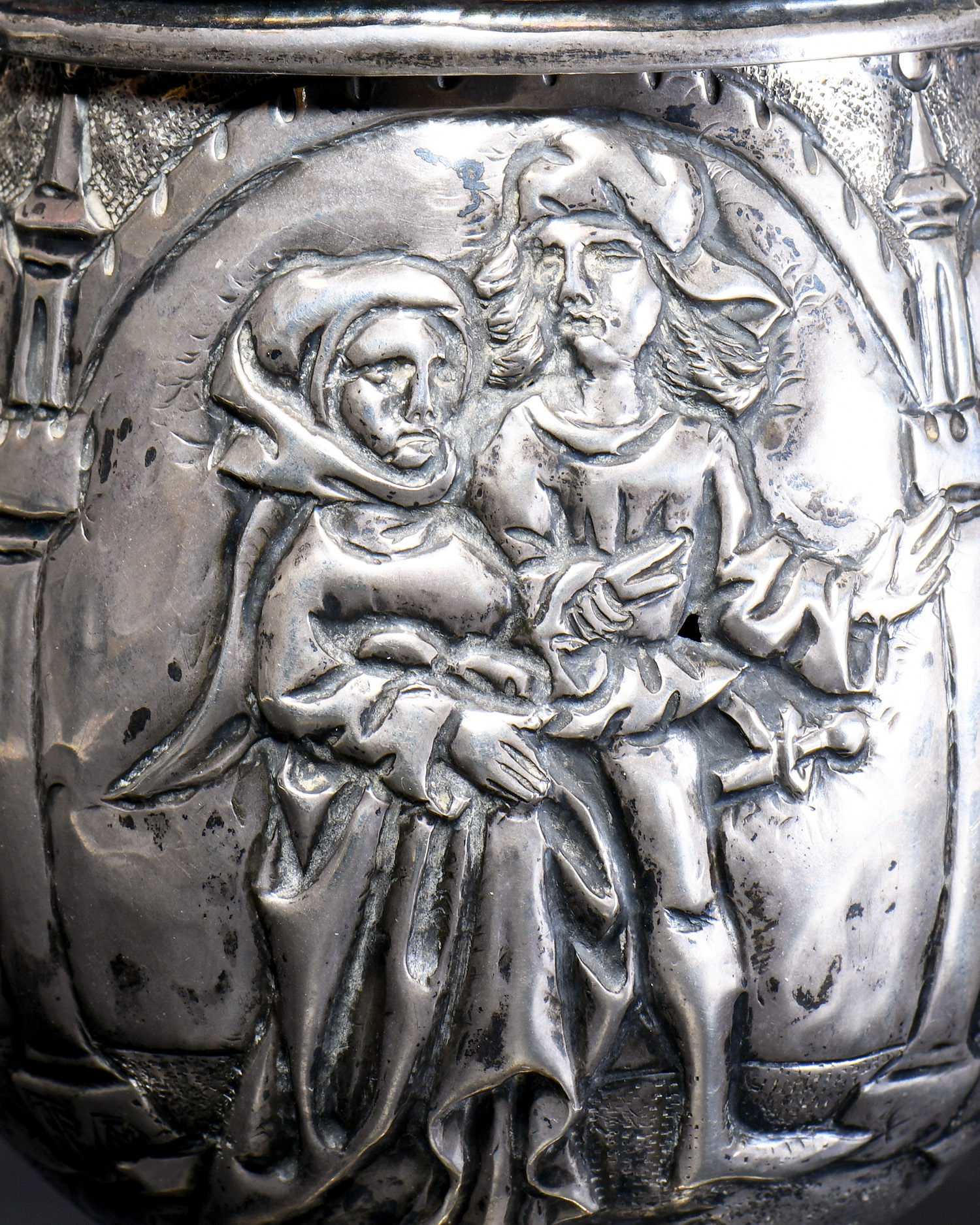
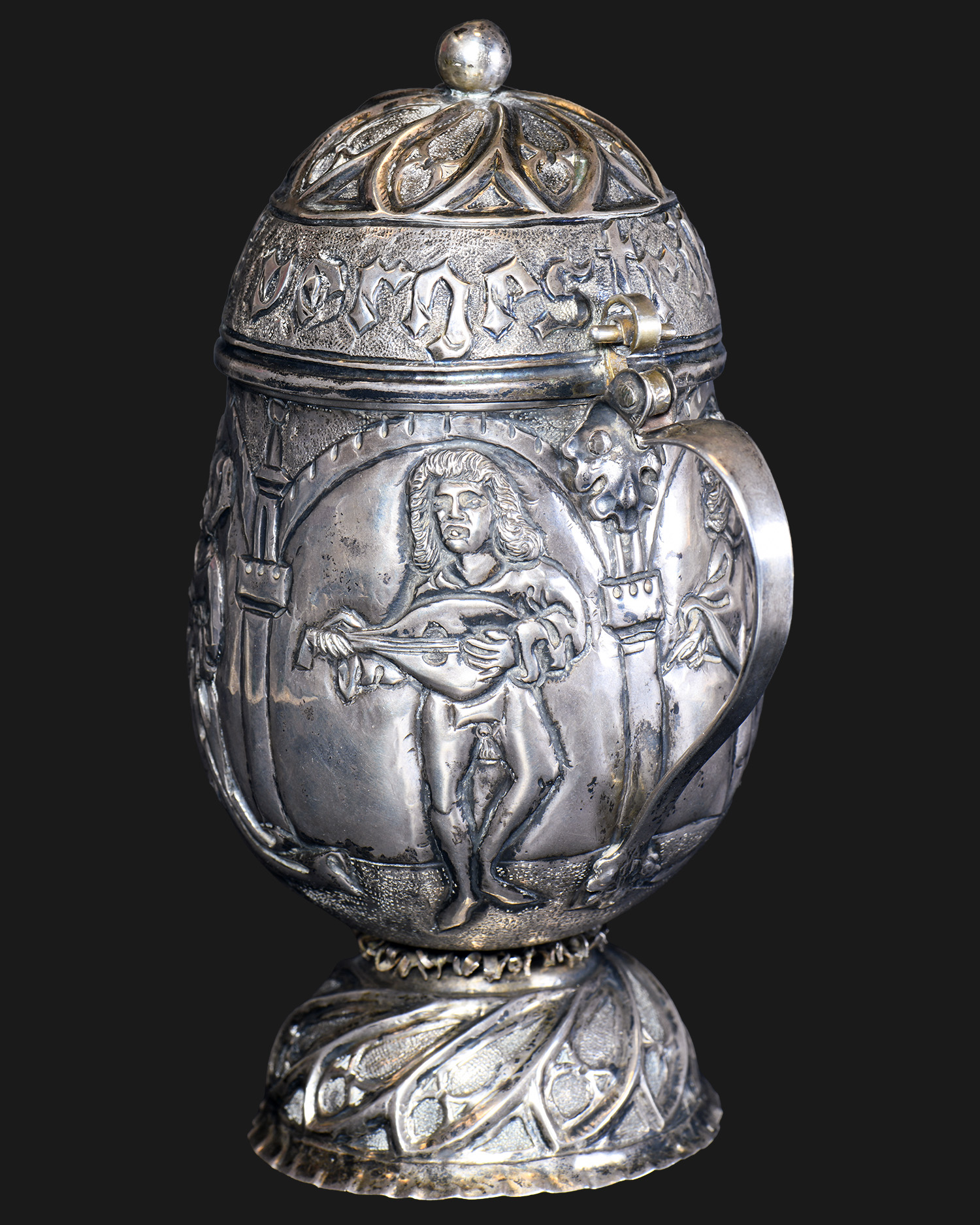
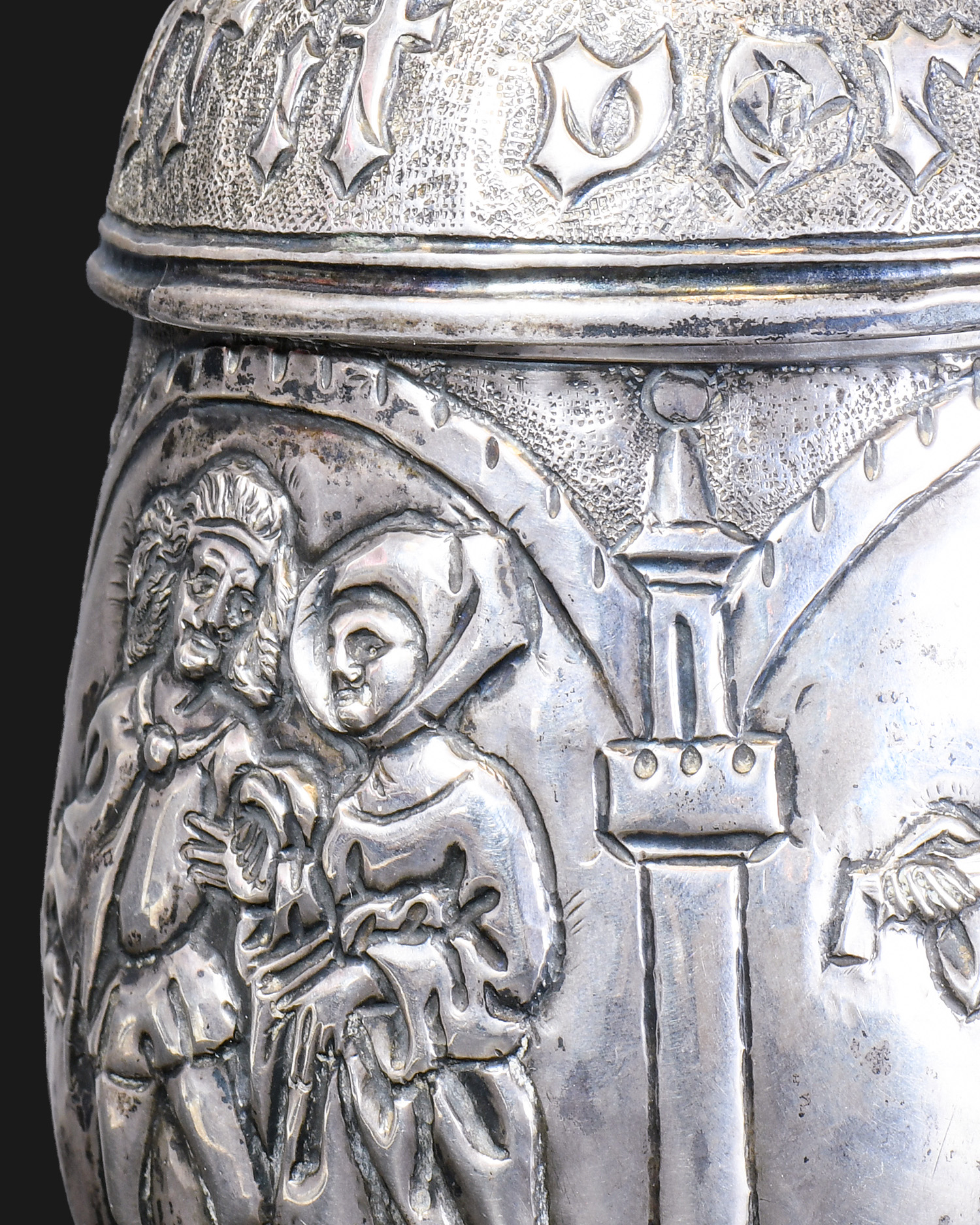
The tankard’s body (corpus) has a slightly bulbous, ovoid shape, tapering downwards, set on a distinct foot. The central part of the body features a wide frieze with a repoussé figural scene. It depicts figures in historical or courtly attire, placed under arcades supported by columns. Two arcades are occupied by single male figures playing instruments, while the other two feature pairs – a woman and a man. At the base of one of the small columns separating the arcades, two engraved intertwined monograms are visible: TS and MJ (?), which likely represent the signature of the owners, donors, or patrons of this vessel.
The vessel’s lid is high, domed, and crowned with a decorative finial (stopper) in the form of an ornate knob. Its circumference is adorned with an inscribed band featuring stylized Gothic script/Fraktur: “es gott it vergestrit und”. The upper parts of the lid are decorated with pointed arch motifs, referencing Gothic architecture.
The large, S-shaped handle is made of a smooth silver band, strongly curved into a heart shape. It is topped with a hinge shield, characteristic of Baroque vessels, and a shaped thumb-piece (pusher) facilitating the lifting of the lid.
The foot is round, profiled, and strongly flared downwards. It is covered with relief decoration featuring “architectural” motifs, harmonizing with the ornamentation of the lid. On the undulating edge, two hallmarks are visible: the Nuremberg city mark (letter N) and the silversmith’s maker’s mark (FS).
Dimensions: 17 cm (height) x 11 cm (width with handle) x 8 cm (width without handle)
Weight: 165 g
1 in stock
| Weight | 0,165 kg |
|---|---|
| Dimensions | 17 × 11 × 8 cm |
| Type |
Vessel |
| Form |
Lidded Tankard |
| Materiał |
Silver gilt |
| Kolorystyka |
Gold ,Silver |
| Technika |
Chiseling ,Repousing ,Riting |
| Czas powstania |
2nd half. 17th century |
| Era |
Baroque |
| Kraj pochodzenia |
Germany (Nuremberg) |
| Autor |
Friedrich Schmidt the Elder or the Younger |
| State of preservation |
Slightly deformed base, worn interior gilding, otherwise very good |
Related products
Charles Julius Minter (1812 – 1892), Casket with lid in the form of a tombstone of King Stefan Batory, tin
Ivan Khlebnikov, Kovsh with horse’s head, silver, enamel, gilt, Moscow, 1860-1918
Monstrance, brass with silver-plated elements, France, ca. 1860-1890
Nuremberg basin (Beckenschlägerschüssel) with memento mori decoration, brass, Germany (Nuremberg), 15th-16th century
Round basin, deep; the surface of the mirror slightly convex, passing with an oblique fold into the side wall; in the center of the mirror a repoussed, stylized human skull above crossed tibias, all around a bordure of fleur-de-lis punched with punctures; a narrow, slightly oblique collar with the same ornament at the edge. Edge curled outward, probably reinforced with wire. In places, especially in the recesses, visible remnants of a coating of white metal - most likely tin.
Przeworsk belt buckle, gilt silver, Poland, 17th century.
Table spoon, silver, Poland, ca. 1650
Tablespoon, silver, Poland, c. mid-17th century.
Wooden Spoon with ‘V’ Initial, Germany, 19th Century.
This hand-carved wooden spoon, 23 cm long, originates from Poland and is dated to the 19th century or earlier. The deep, functional bowl shows clear signs of use. The handle is adorned with serrated line carvings and a 'V' initial, likely for owner identification. A leather strap with an old collector's paper tag remains attached to the end.
In the 19th century in Poland, spoons of this type were among the basic items of everyday use on rural and pastoral farms. They were made by hand from a single piece of wood, which was part of the tradition of Polish folk craftsmanship, based on simple, durable materials.
Copies with preserved markings are rare today, documenting the development of Polish material culture and everyday practices of village life.