


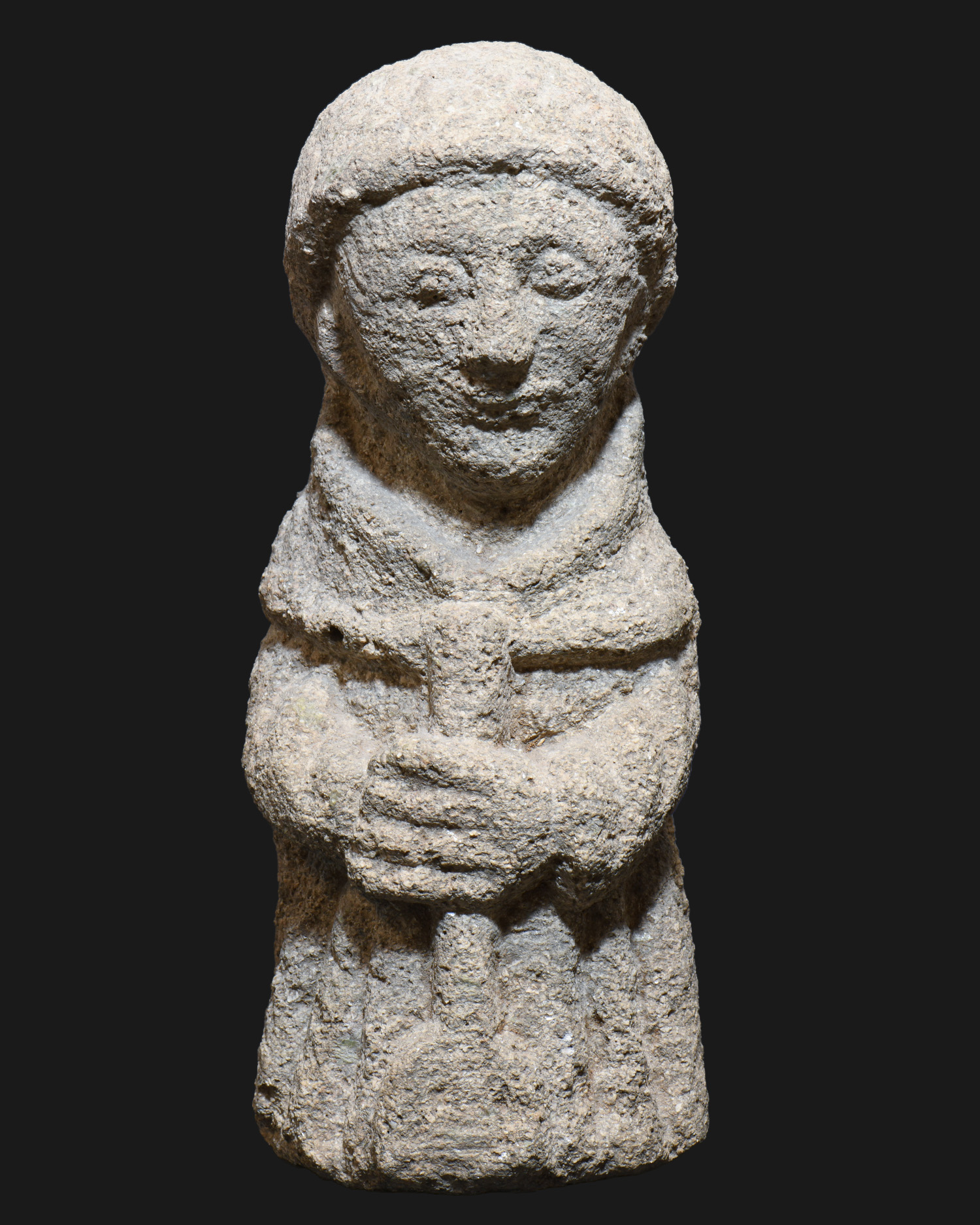
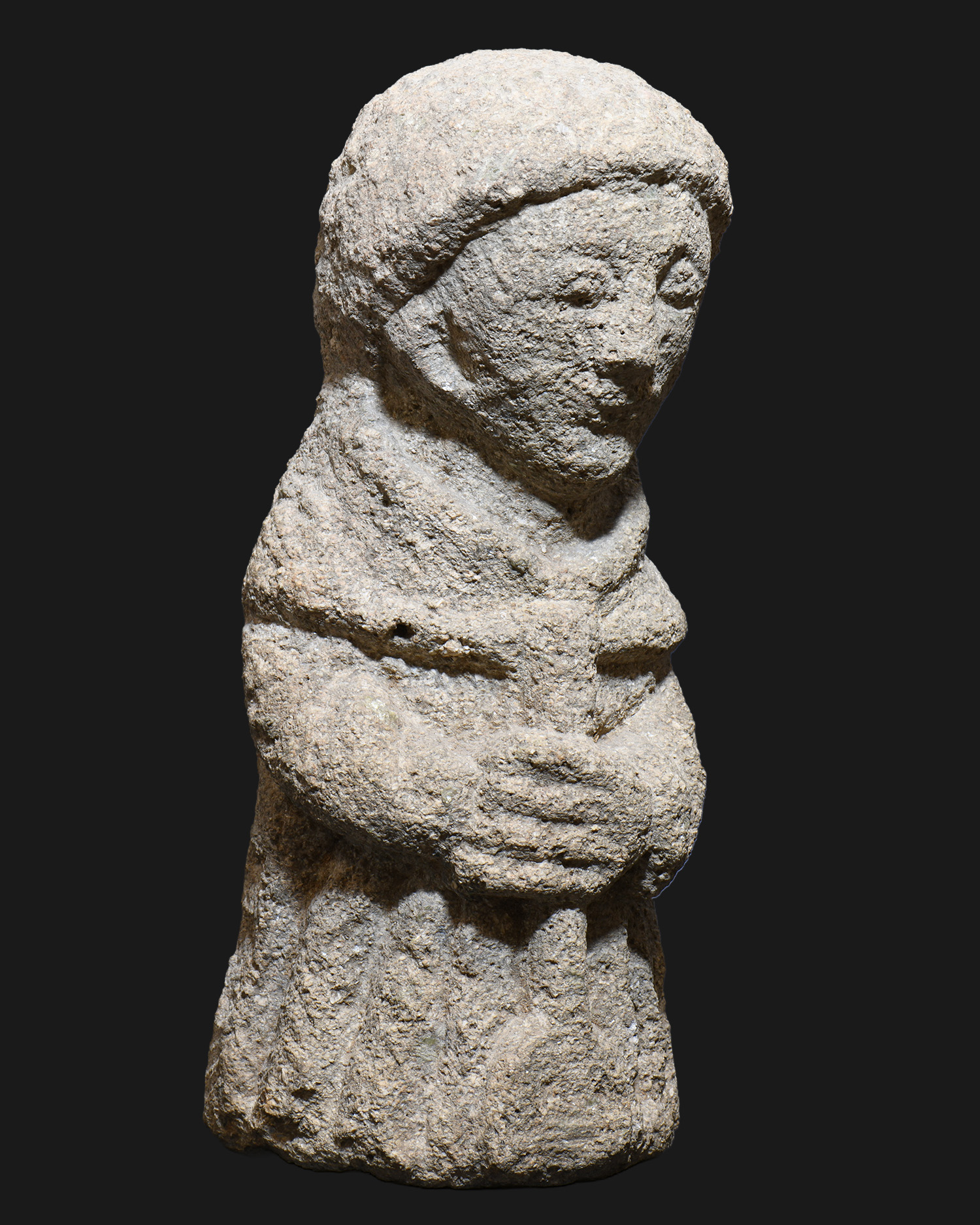
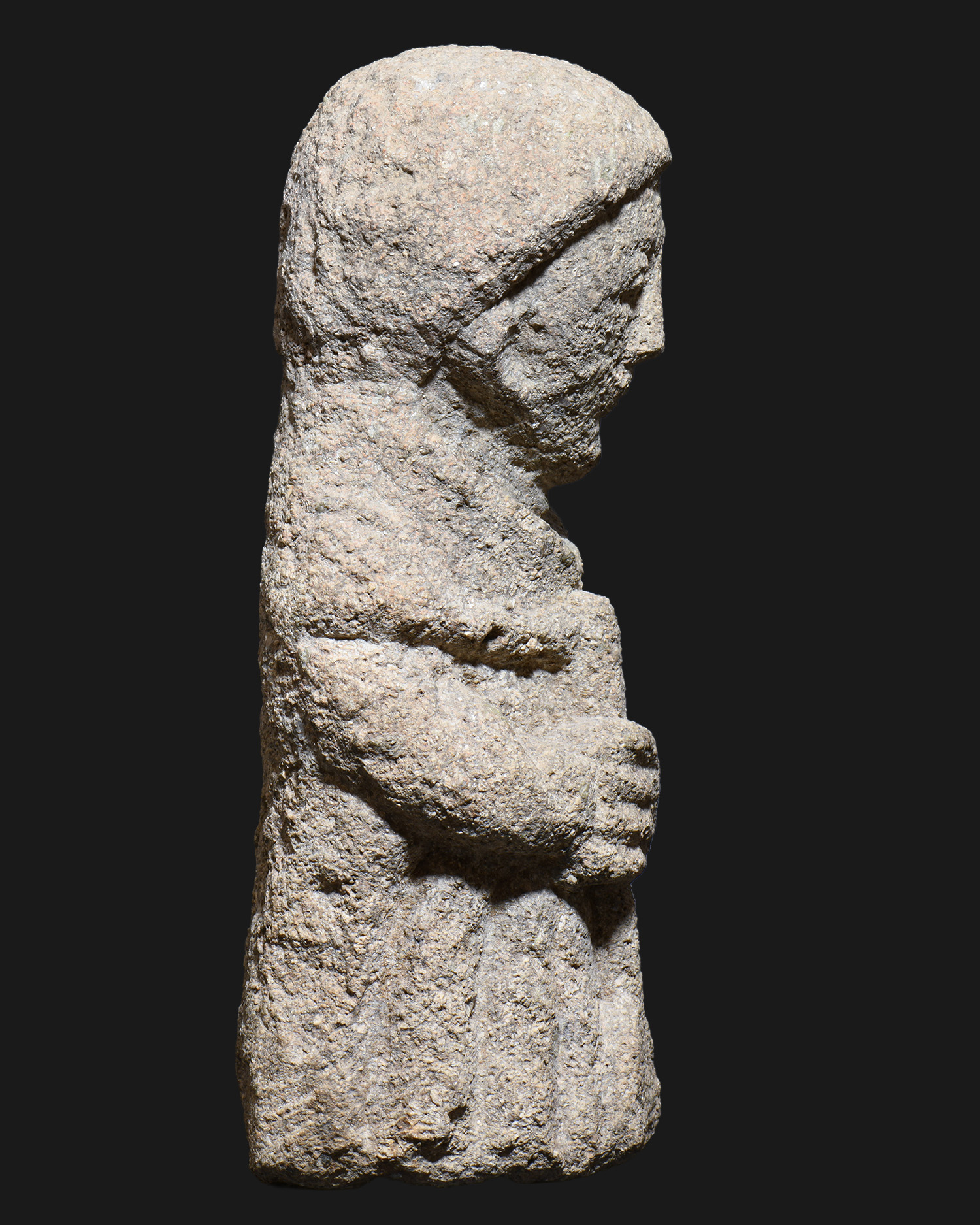
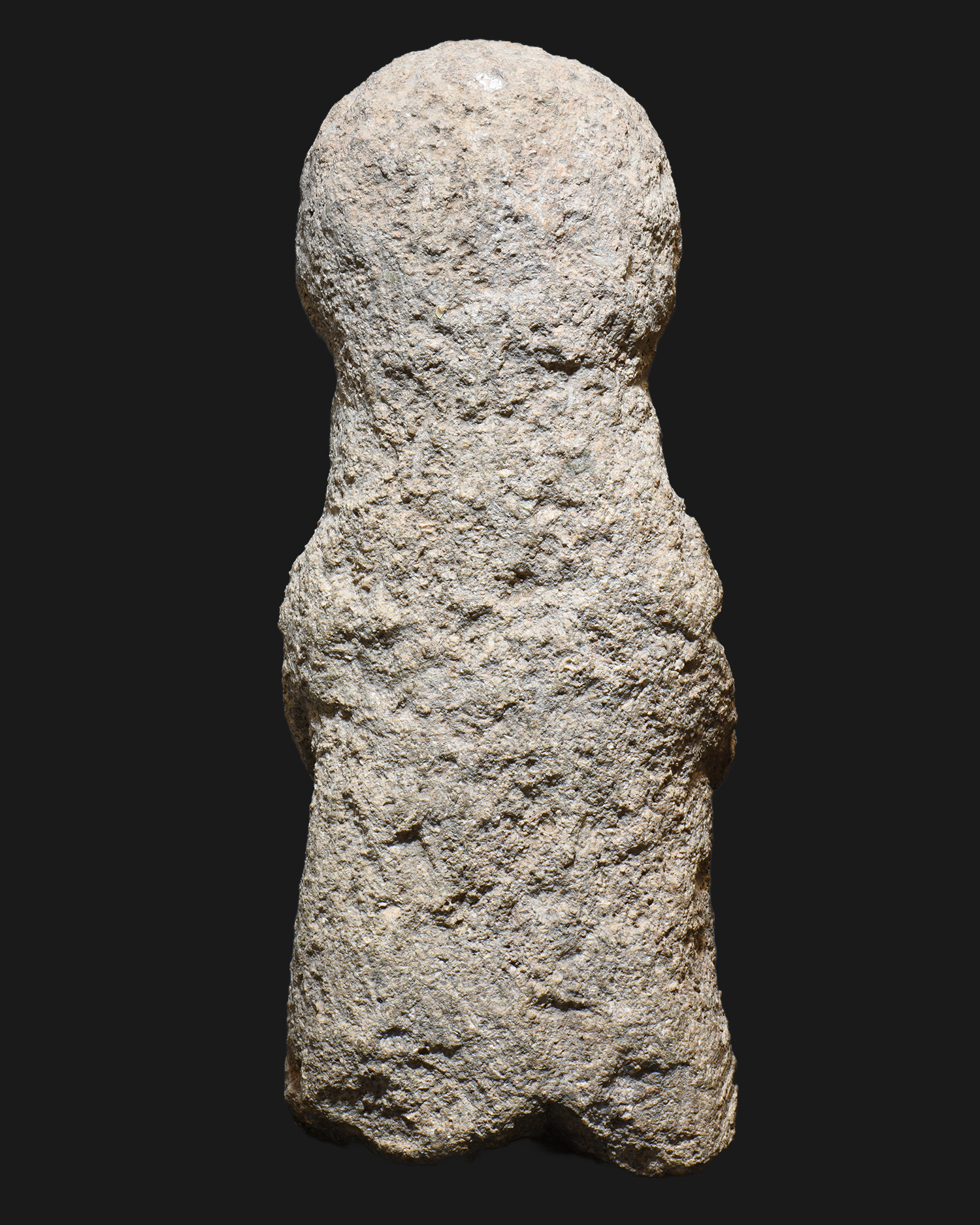

Saint Fiakier, granite, France (Brittany), 2nd half. XIX century.
1450,00 zł
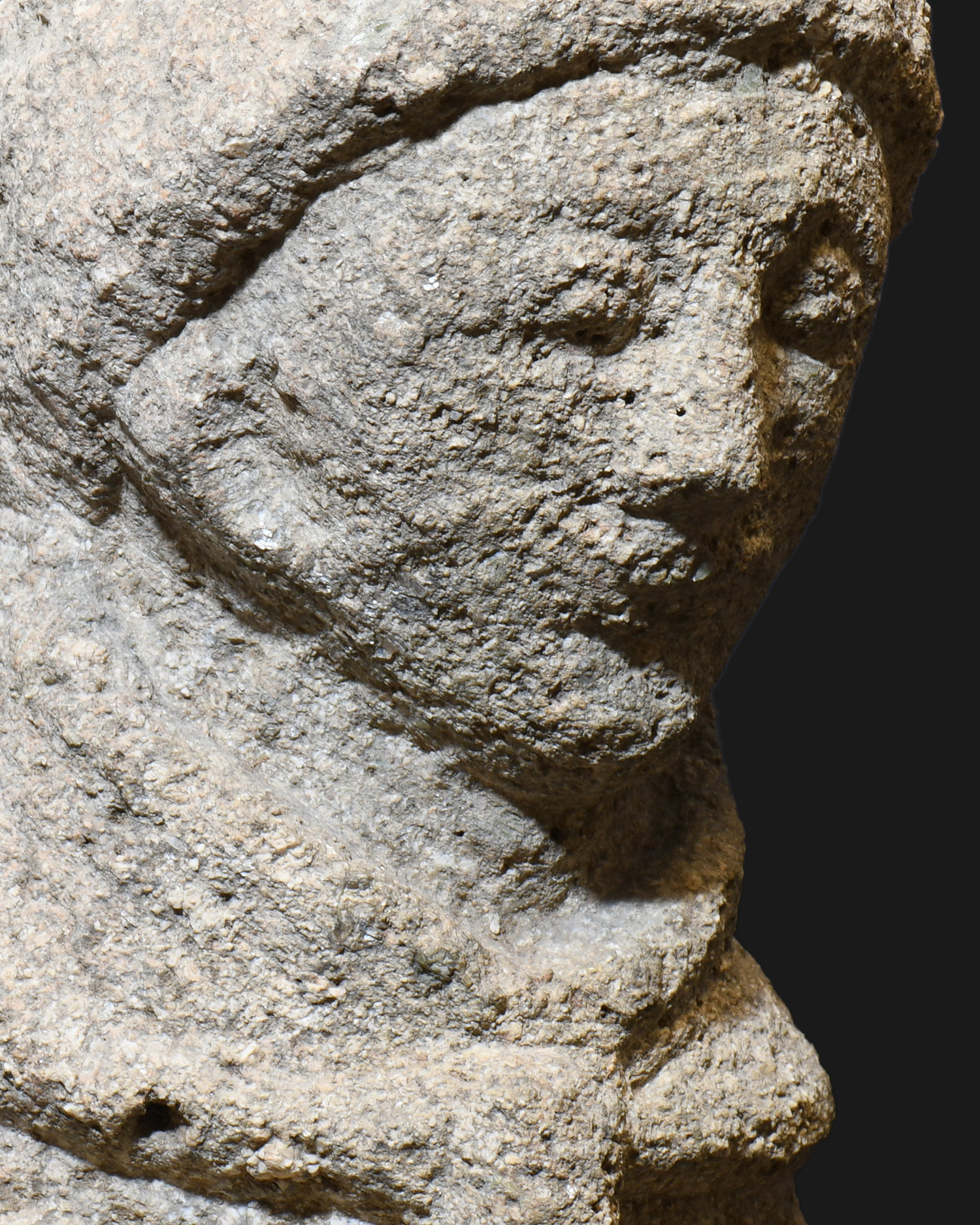
Folk sculpture depicting St. Fiacre (Saint Fiacre), patron saint of gardeners, herbalists and protector of hemorrhoid sufferers, whose ailment was even referred to as “St. Fiacre’s disease” in France for centuries. It is maintained in the traditional simplified Breton style. The figure is shown standing, clad in a habit with a clearly marked hood. The saint’s face with a gentle expression is characterized by primitivism of form – wide-set eyes and a delicately outlined smile are typical of folk workshops referring to Romanesque patterns.
The key attribute of the figure is a shovel (spade) held vertically in front of him, the handle of which is embraced by both hands of the saint. This alludes to the legend of the miraculous demarcation of the garden at the Brie monastery.
The sculpture is an excellent example of Breton stone craftsmanship. It combines a devotional and utilitarian function (guardian of the home garden), being an authentic testimony to rural piety and aesthetics in the most Celtic region of late 19th century France.
A racy example of French folk art (Art Populaire). The figurine impresses with its primitive, “archaic” form, which fits well in both garden spaces and modern, minimalist interiors.
Dimensions: ca. 30 cm (height) x 11.5 cm (width) x 11 (depth)
1 in stock
| Weight | 5,6 kg |
|---|---|
| Dimensions | 30 × 11,5 × 11 cm |
| Type |
Sculpture |
| Form |
Full figure sculpture |
| Materiał |
Granite |
| Kolorystyka |
Gray |
| Technika |
Carving |
| Czas powstania |
2nd half. XIX century. |
| Kraj pochodzenia |
France (Brittany) |
| Autor |
Unknown |
| State of preservation |
Very good, surface covered with natural patina of time with visible traces of long-term outdoor exposure (probably a garden sculpture or a niche in a wall). No structural loss. |
Related products
Brahma, marble, India, 19th (?) century.
Cabinet Reliquary with Relic of the True Cross and 26 Saints, wood, textiles, Central Europe, 18th century
An 18th-century Baroque cabinet reliquary, a freestanding wooden display case of trapezoidal form, containing a total of 27 relics. The side walls and top are chamfered, widening toward the front. The interior is lined with burgundy velvet, trimmed with decorative borders of gold bullion thread.
At the center, set slightly forward from the back, is a raised textile reliquary in the form of a monstrance, embroidered with gold thread and richly adorned with bullion, filigree, miniature beads, and multicolored glass imitating precious stones. On the base and shaft are placed six relics, identified by inscriptions painted in gold on dark blue banderoles.
Within the central repository is a reliquary capsule with a convex glass cover, containing two fragments of the True Cross, surrounded by a radiant glory.
Above the “monstrance” is an oval image with an indistinct representation, encircled by 20 additional relics interspersed with decorative elements of bullion, beads, gold thread embroidery, and colored glass. At the level of the nodus are two larger relics (Ex Ossibus) of Saint Vincent and Saint Fortunatus, uniquely labeled on white banderoles.
A distinction should be made between a reliquary and a reliquary cabinet: a reliquary is a vessel that directly contains relics, whereas a cabinet reliquary serves as a structure housing and presenting them. This object is therefore not a typical example, as—besides the central textile reliquary in the form of a monstrance containing fragments of the Cross on which Jesus Christ died—it also incorporates an additional 26 relics of various saints placed directly within the composition, without individual containers.
Their preservation is ensured either by a fine mesh covering or solely by labeled banderoles. The relic of the True Cross is the only one enclosed within a glazed, and undoubtedly sealed, capsule.
The interior of the case, measuring 37.3 × 26.5 × 10 cm, is lined with burgundy velvet, trimmed with gold bullion thread.
Head of an Angel (Putta), gilded linden wood, Poland, 1st half of the 18th century.
Holy Cross monstrance reliquary, gilded bronze, Central Europe, 18th century (ca. 1750)
Rococo reliquary in the form of a monstrance. In the glazed box (ostensorium) there is a cross made of rock crystal, in an openwork silver frame. Inside it are placed relics - small fragments (splinters) from the Holy Cross. On the back of the crystal cross, silk threads are visible, binding the relic to the setting, as well as a lacquer seal imprint.
Gloria (rays) - a richly decorated halo in the form of a radial shield, characteristic of a monstrance. On its perimeter, decorated with rocaillas, colored glasses of ruby and green are set, and the whole is crowned by a small cross with a central red eye.
Instead of a simple geometric form, the nodus is formed of twisted, sigmoidal volutes (shapes resembling the letters "C" and "S") that flow seamlessly from one to the other.
The foot is oval, multi-stepped, decorated with repoussed rocaillas. The reliquary represents high-class artistic craftsmanship; it is most likely preserved in "integral" condition.
Rama, marble, India, 19th century.
A sculpture depicting Rama, one of the most important deities of Hinduism, considered the seventh avatar of Vishnu. The object was hand-carved in white marble in India, probably in the 19th century.
The figure is depicted standing, facing forward. The face has a gentle expression with a soft smile and slightly closed eyes. The head is crowned with a decorative crown, and long necklaces are visible on the chest.
The figure is dressed in a draped robe with clearly marked folds. On its back is a quiver with arrows, characteristic of Rama's depictions.
The hands of the sculpture are not preserved, originally in one of them the figure held a bow - a characteristic element of representations of this deity. Further about these cavities do not write that they are consistent.
Rama is the hero of the epic Ramayana and in the Hindu tradition symbolizes righteousness and fidelity to the principle of dharma. His images occupy an important place in Indian sacred art, although full-figure marble sculptures of this scale are less common.
The object is preserved in good condition, with clear legibility of form and detail.
Reliquary with relic of the Holy Cross and four saints, gilded bronze, Central Europe, 18th century.
Baroque reliquary in the form of a monstrance, made of gilded bronze. Oval foot, multi-stepped, decorated with repoussed and engraved floral ornament. Smooth shaft with profiled nodus. Reservaculum surrounded by a gloria The gloria of the reliquary was formed of frayed, numerous rays, over which is superimposed a contrasting decorative wreath covered with rocaille and floral motifs. In the repository is placed an oval capsule made of silver sheet, glazed from the front. Glass at the edge decorated with octagonal faceting. On the back there is a wax seal on strings. The seal bears a coat of arms: in an ornamental cartouche a lion to the left, and below - separated by a beam - an opposite griffin to the left. The whole is crowned with a cardinal's hat (Galero): a hat with a wide brim and dangling strings with brads (fiocchi), which is a sign of cardinal dignity. Inside the capsule are 5 relics, described in ink on bandoliers - read more in the extended content below.