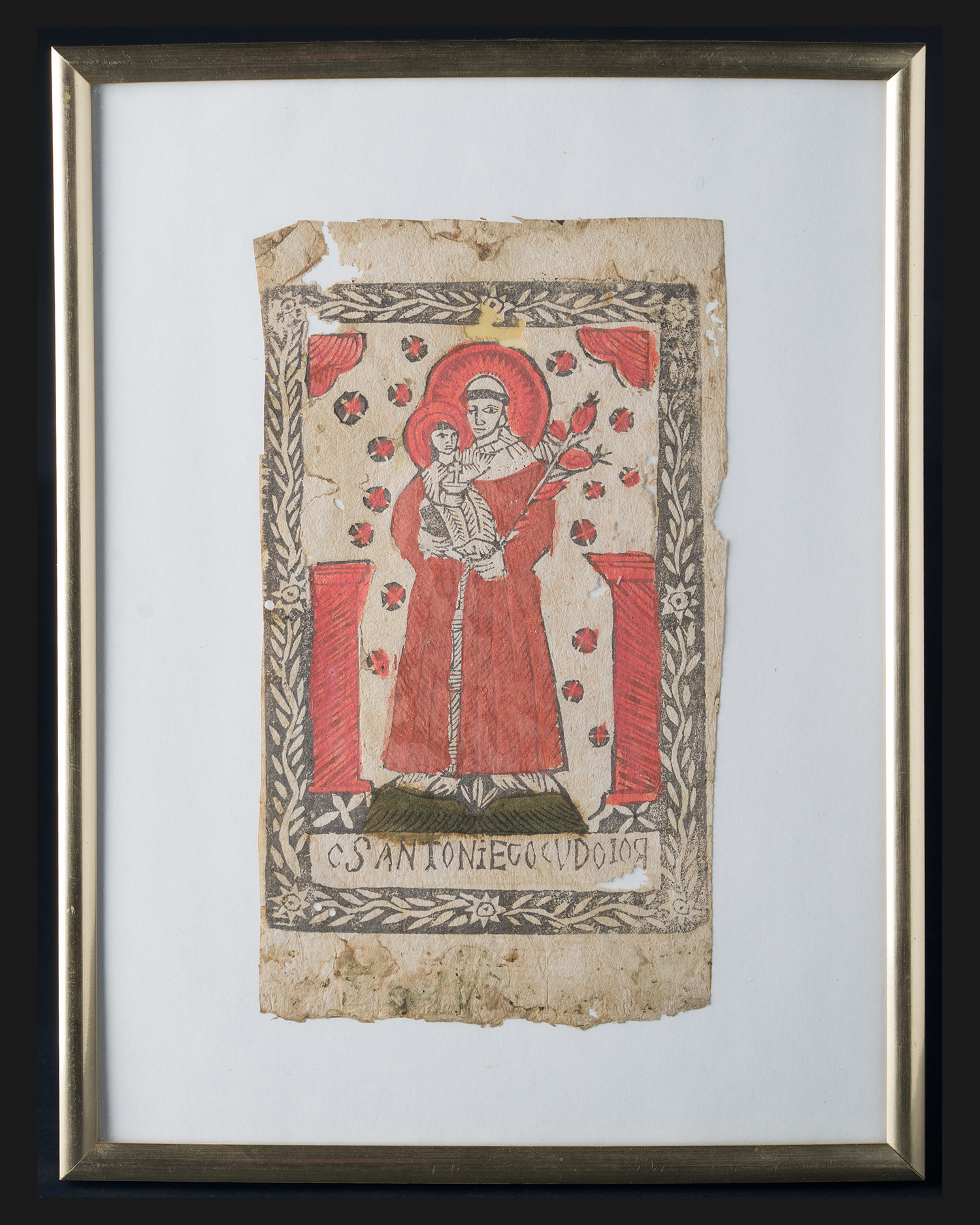
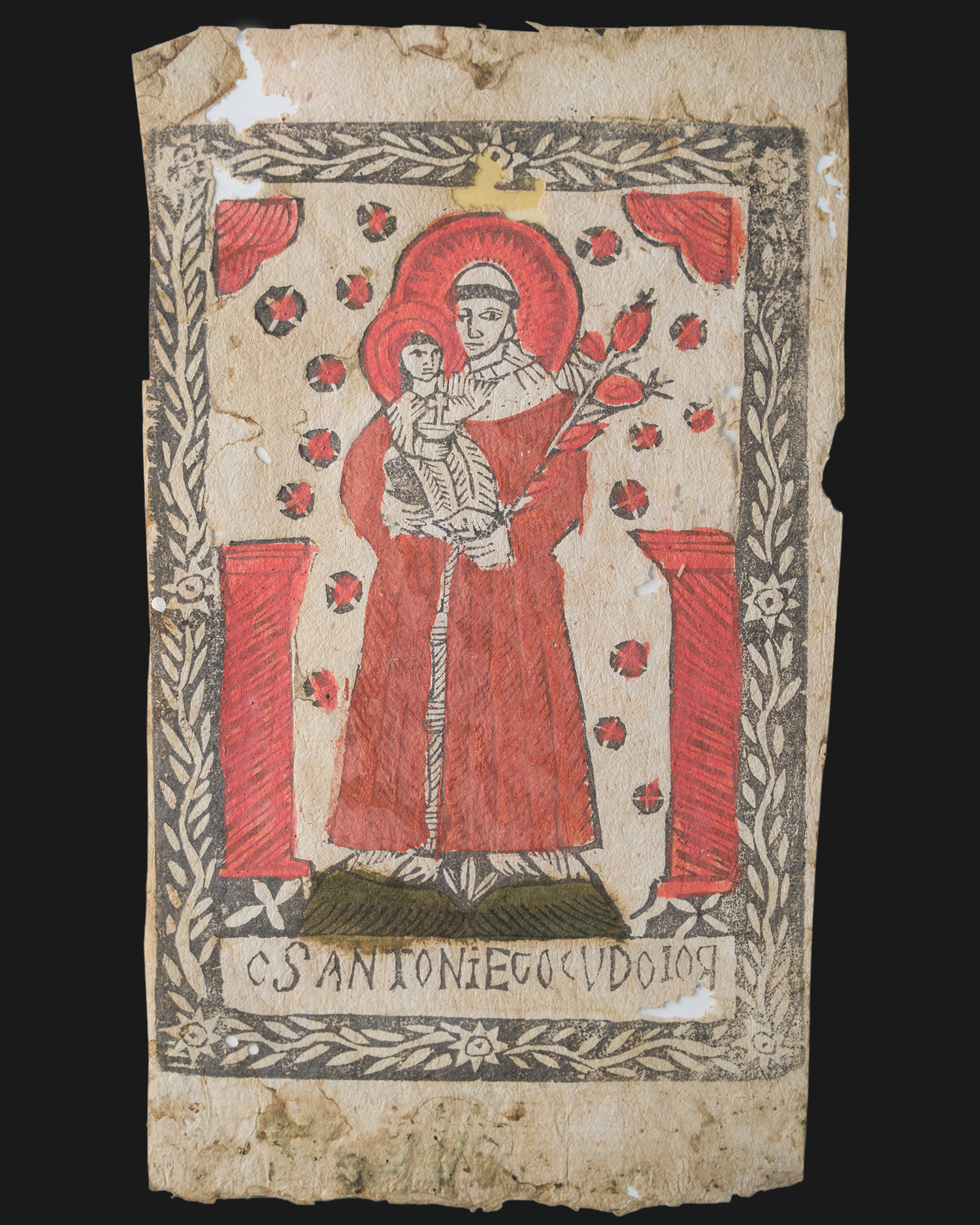
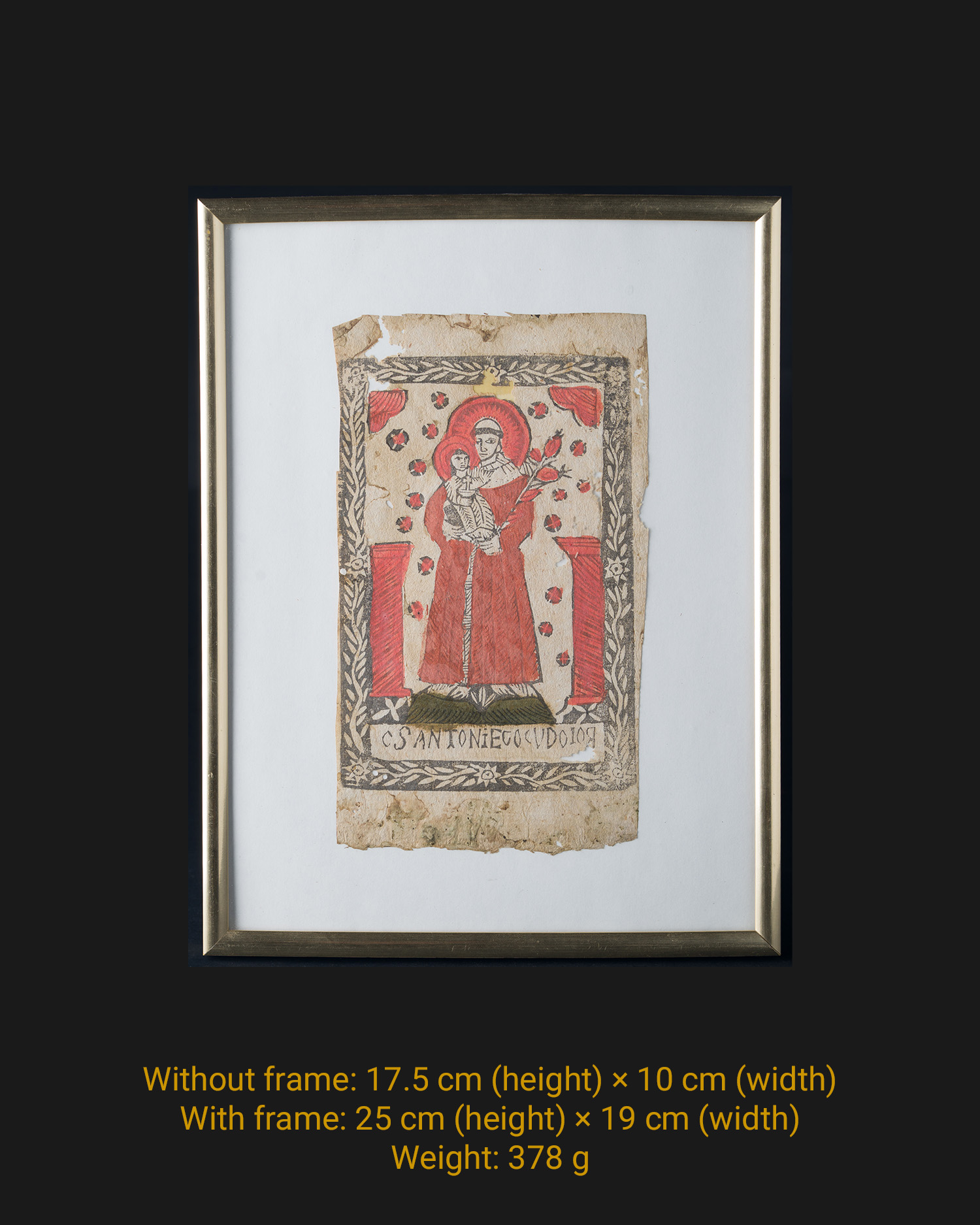
Saint Anthony with Child Jesus, woodcut on handmade paper, Poland, 18th/19th century.
2400,00 zł
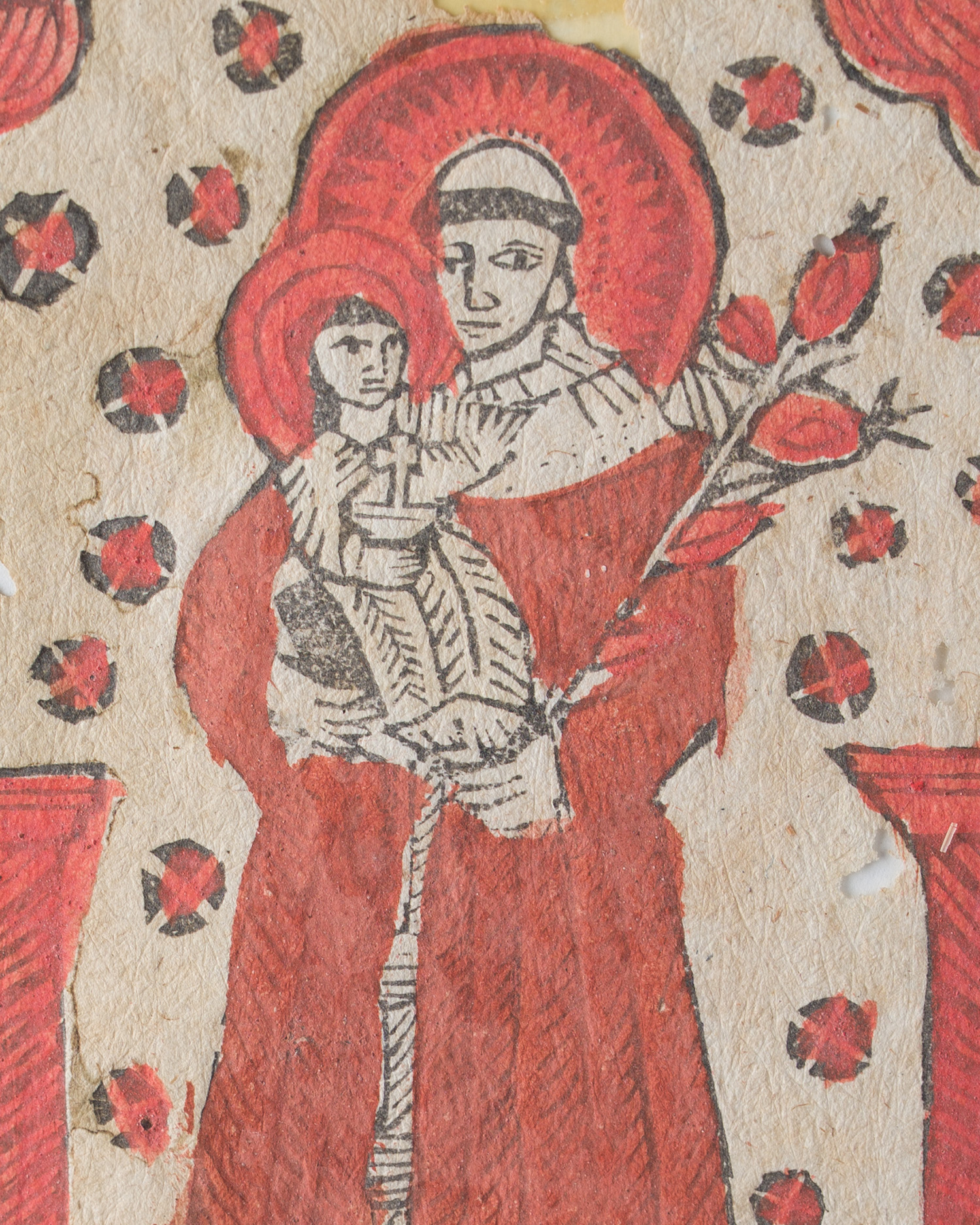
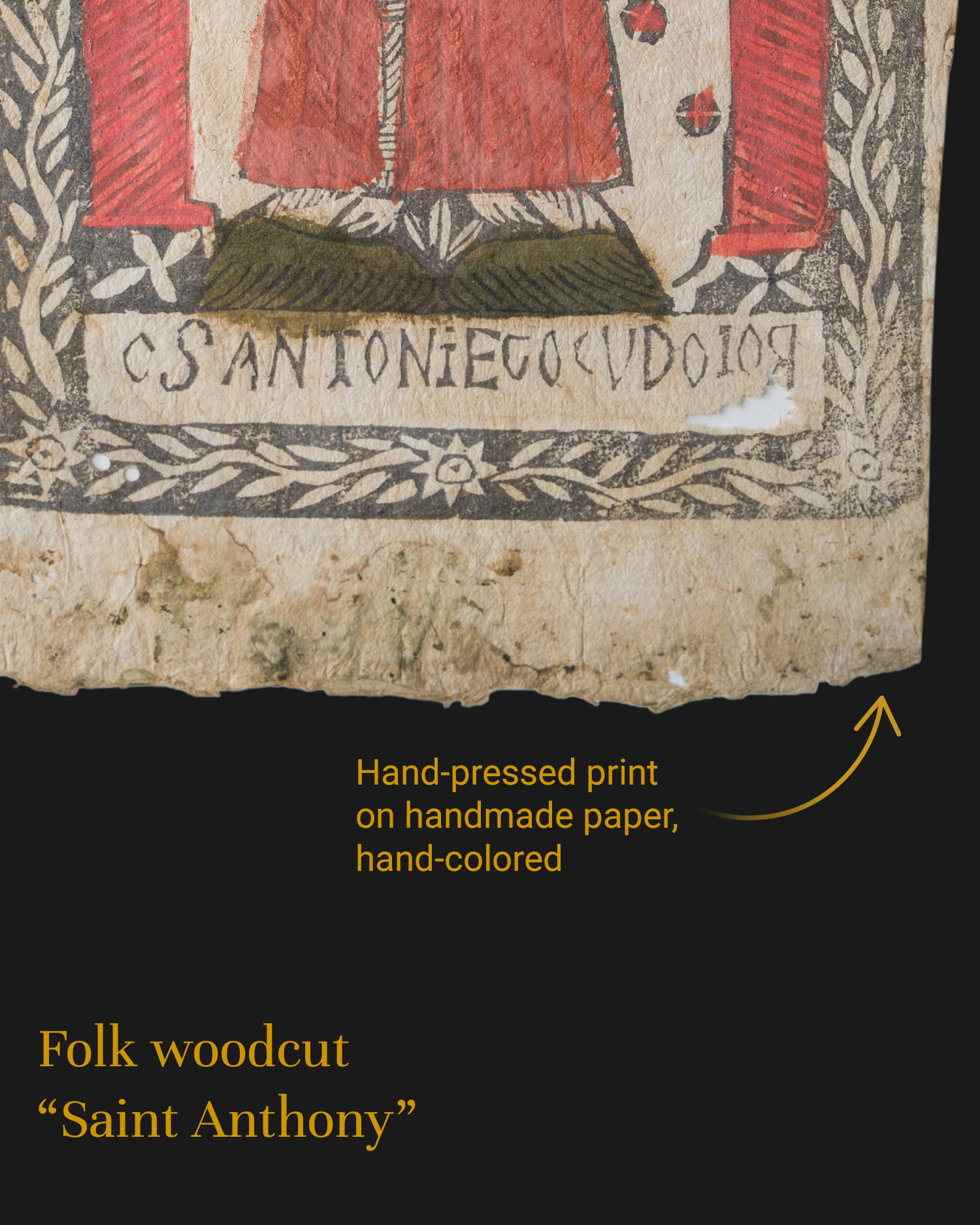
Original folk devotional woodcut from the late 18th or early 19th century, depicting St. Anthony of Padua with the Infant Jesus. The figure is framed frontally, wearing a red robe, holding the Child and flowers (lilies – symbol of purity). The shot is surrounded by a decorative leafy frame, with the inscription “OSANTONIEGOCUDOIOR” at the bottom. Framed.
1 in stock
Historical context
Polish folk woodcuts developed in parallel in several centers, of which the Plazovs on the Polish-Ruthenian borderland and the Carmelite workshop discovered after World War I are particularly often cited On the border of Samogitia and East Prussia. In 1921, a high-profile exhibition of old folk woodcuts was organized in Warsaw, a Zygmunt Lazarski published "Teka drzeworytów ludowych dawnych" (Teka of ancient folk woodcuts) (66 prints), which brought this branch of printmaking to the attention of the scholarly and collecting communities. These prints were distributed at indulgences and fairs -. itinerant offenders not only traded, but not infrequently reflected and colored the images themselves, using patrons or a brush "on the fly." Their technique was simple (hand-printing on damp paper, without a press), and the range of colors - bright and sparing, subordinated to the decorative and devotional function. Over time, woodcuts supplanted lithographs, chromolithographs and oleo-prints, but in the 19th century they still remained the "cheapest and closest" form of domestic devotional art. This context is brilliantly drawn by Jan St. Bystron's study, summarizing the state of research at the time (Witkiewicz, Sokolowski, Kieszkowski) and describing the practices of workshops, circulation and coloring of prints.
It is worth pointing out Mariampol (near Lezajsk) as a local point of indulgence circulation in southeastern Poland. It was in this pilgrimage-fair circle that small, practical sheet formats of Frontal monumentalized figure of the saint, with strong black outline, intense red in the parts of the robes and bordering with leafy motifs. Used handmade paper, and colors were applied with a stencil (patron) or brush by hand, which explains the differences in saturation and course of stains between different prints.
Symbolism
This depiction of St. Anthony of Padua with the infant Jesus is one of the clearest in Franciscan iconography. The lily in the saint's hand accentuates purity and fidelity, and the red of the robe and halo may allude to zealous preaching and merciful love (though it may also be due to the limited range of colors used by itinerant offenders). The frontal shot and decorative leafy bordure emphasize the picture's function as an indulgent souvenir - a home "altarpiece."
Collector's value
The presented original devotional woodcut in a small format has preserved the authentic polychrome, legible outline and inscription (with a minor loss). This is a representative example of "indulgence circulation prints" from southeastern Poland, valuable for both collectors of sacred and ethnographic art, as well as for museum institutions collecting a cross-section of 19th-century folk prints
Aesthetic qualities
The power of the image is born from the monumentalization of the figure in a modest format, from the clearly guided outline and vivid reds On the robe and the halo. Simple and flat development of the form, The typification of features and floral bordure give the composition a decorative quality inherent in folk art.
Application
The copies preserved in Mariampol circulations illustrate well the nature of regional distribution: they were created for quick distribution at shrines and indulgences, and their iconography, like that of St. Anthony with Child corresponded to the demand of domestic piety and the practice of hanging pictures above the bed or at the home altar. The framed woodcut will work well as a A unique decorative accent in rustic, vintage and artistic arrangements or as an object of private devotion (St. Anthony - patron saint of the poor, children, people looking for lost things).
| Weight | 0,378 kg |
|---|---|
| Dimensions | 10 × 17,5 cm |
| Type |
Devotional woodcut (folk graphics) |
| Form |
Framed picture to hang on the wall |
