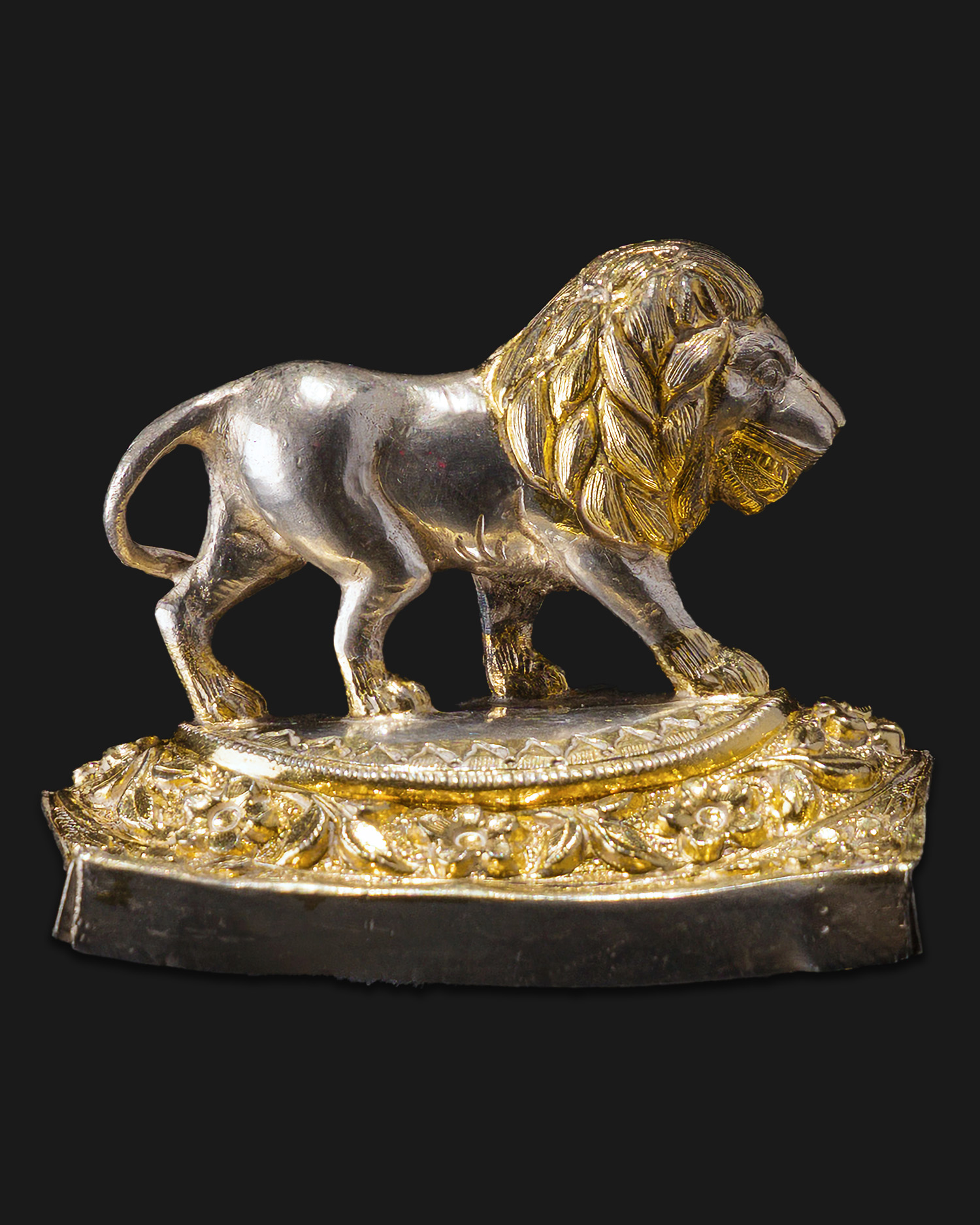
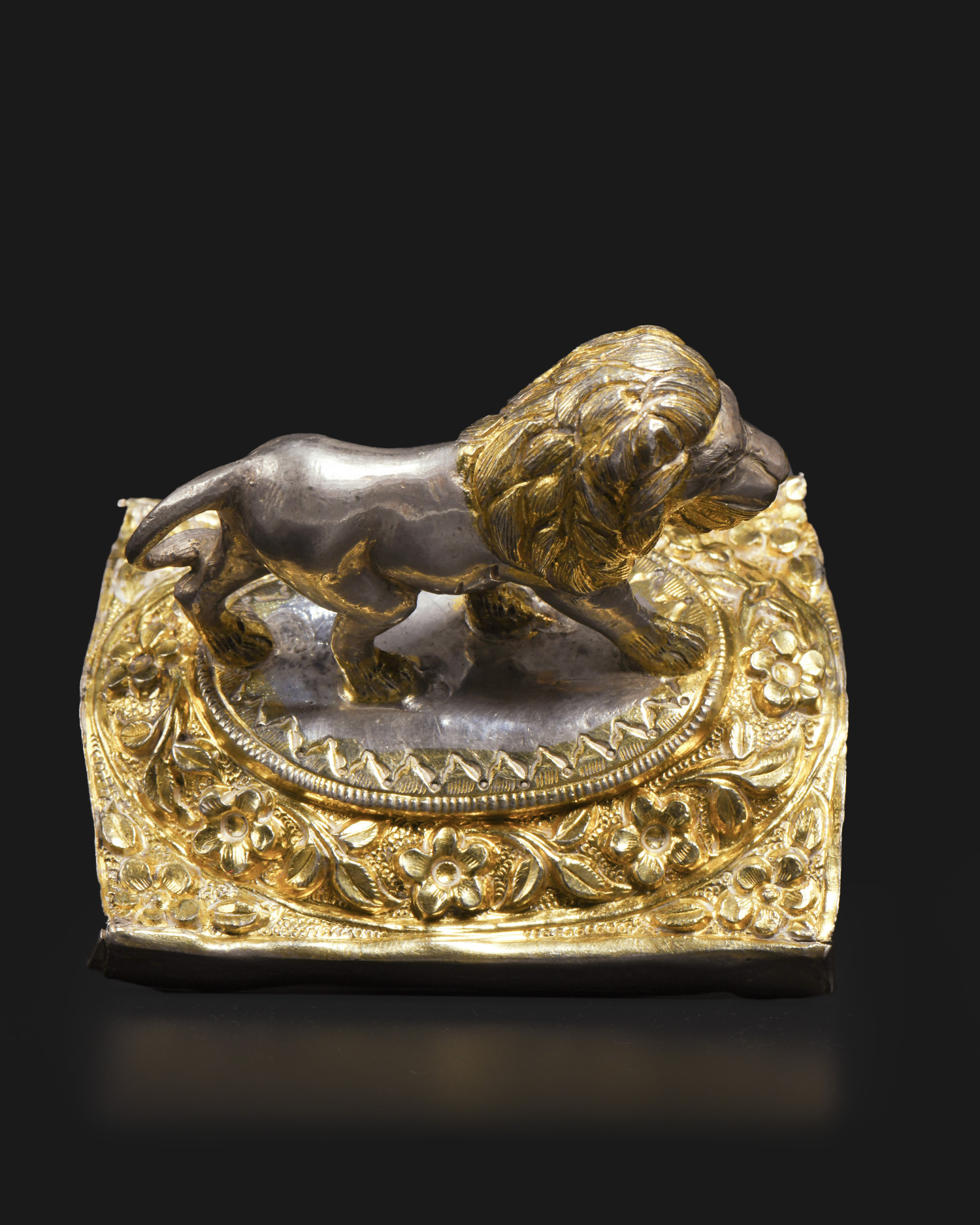
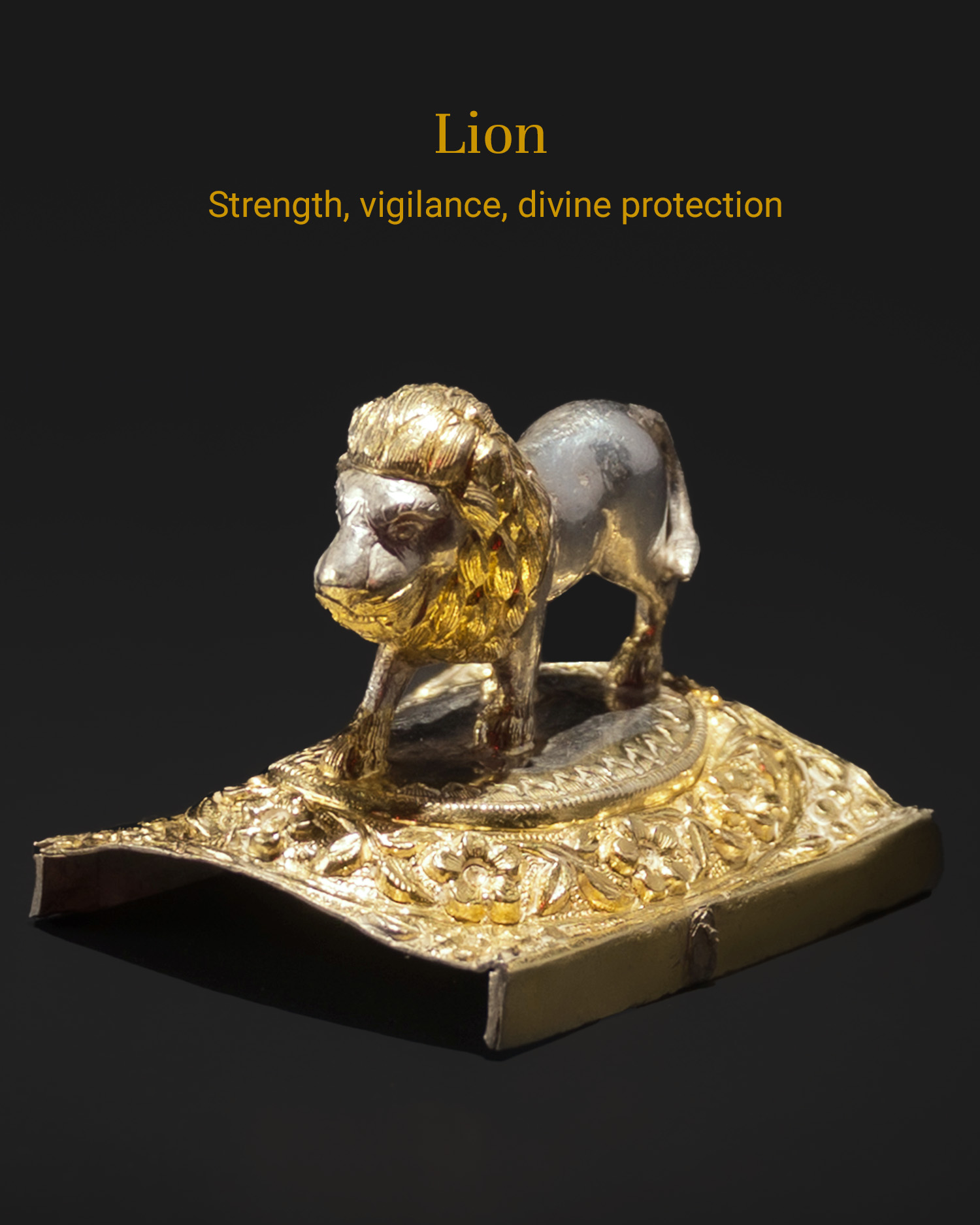
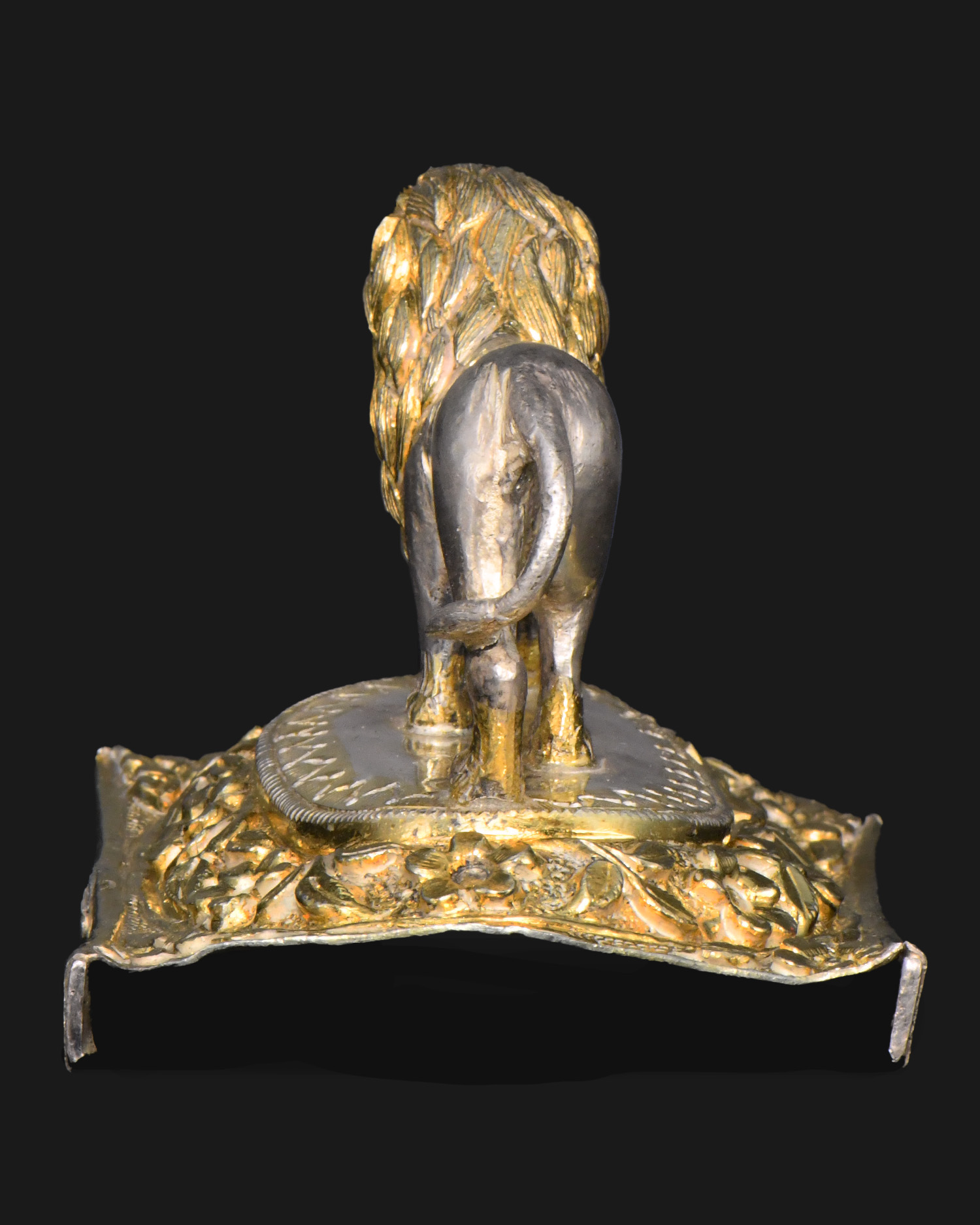
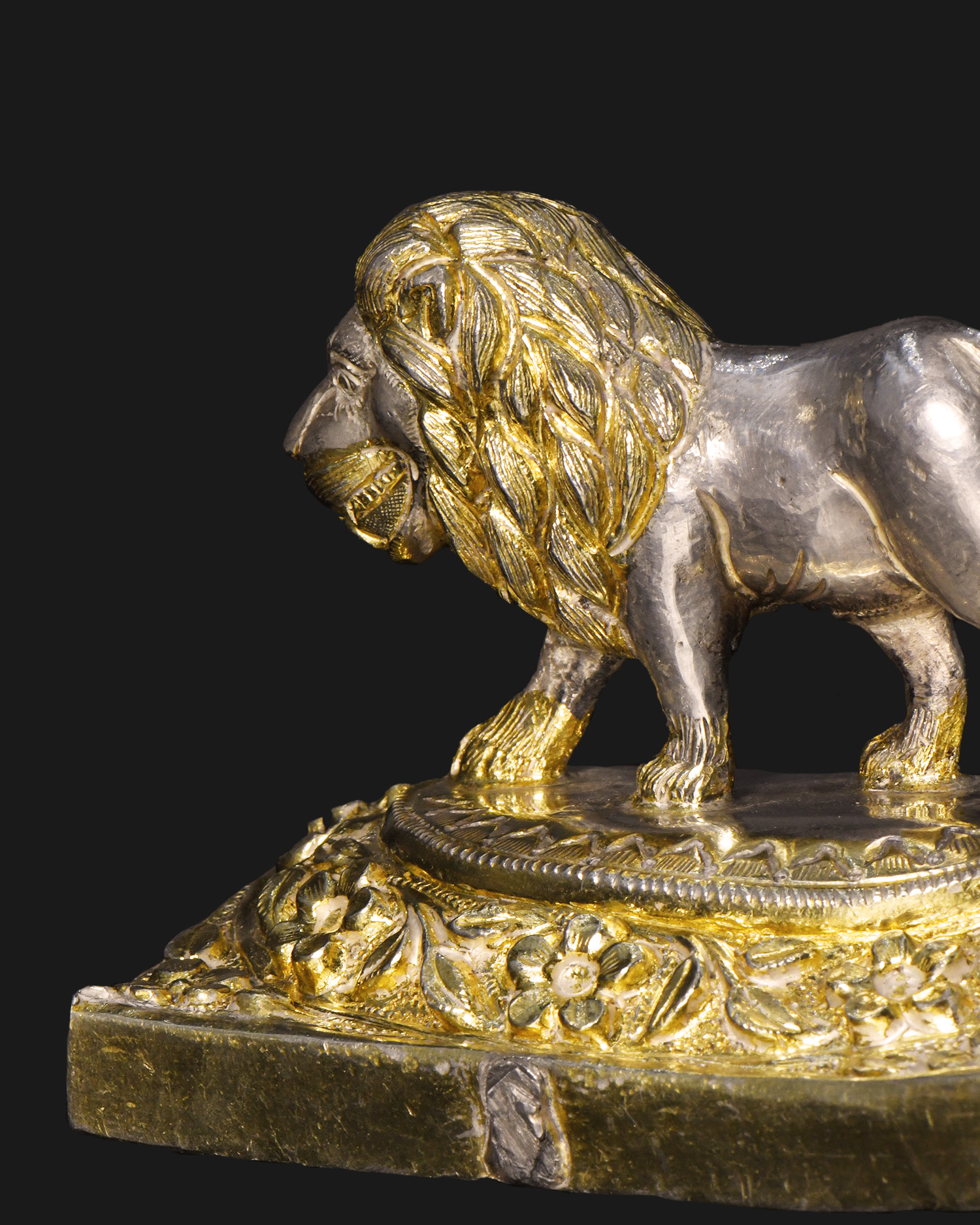
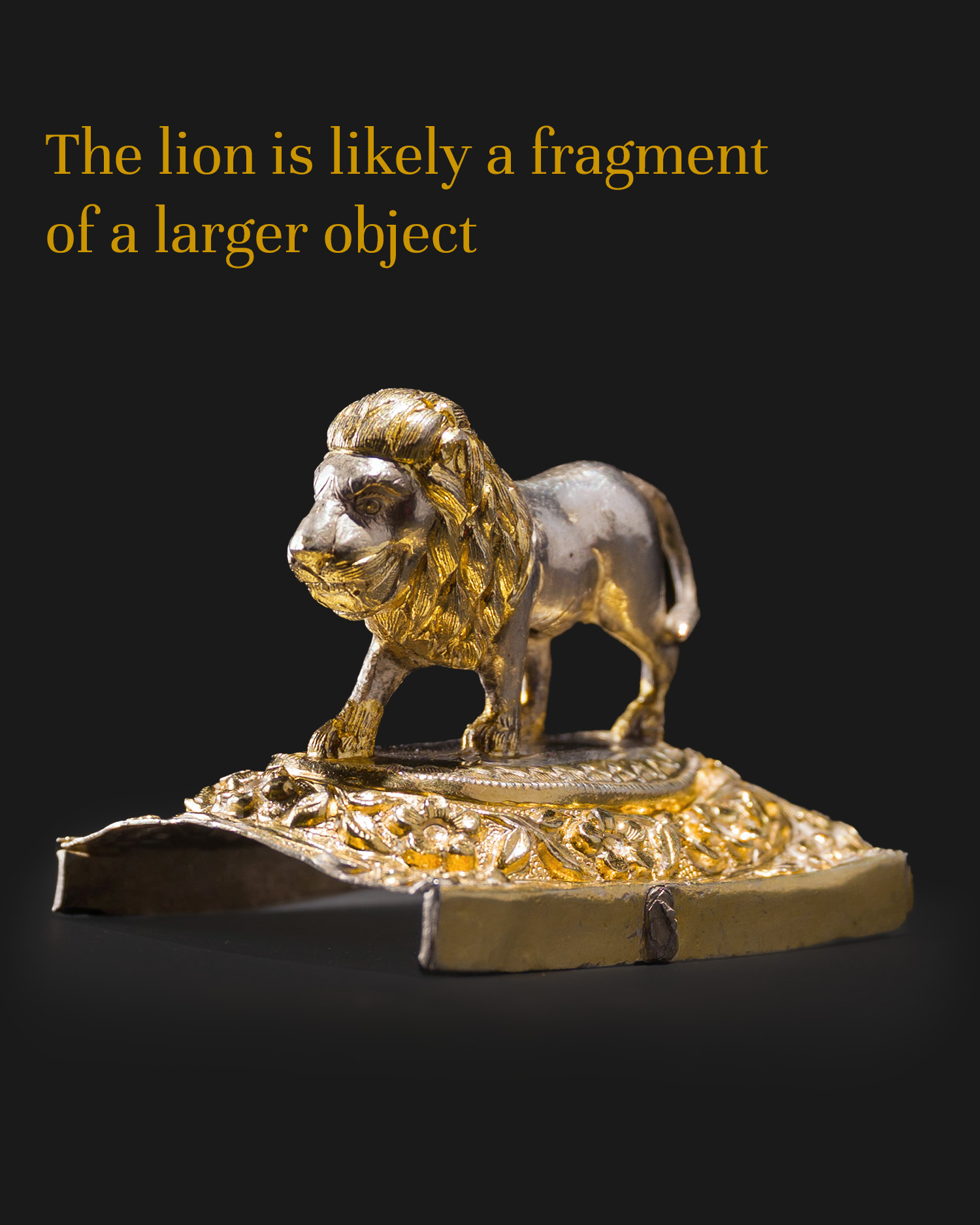
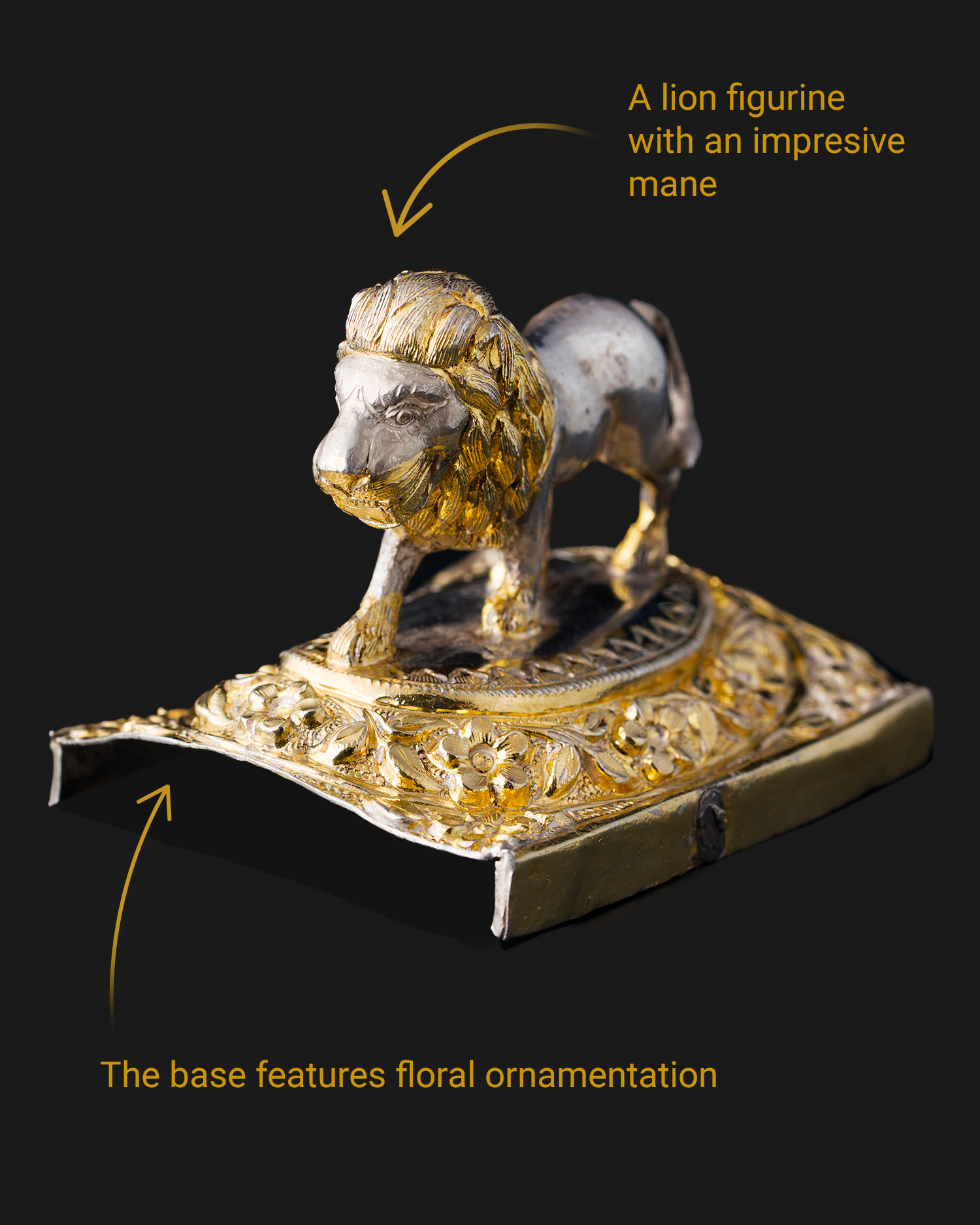
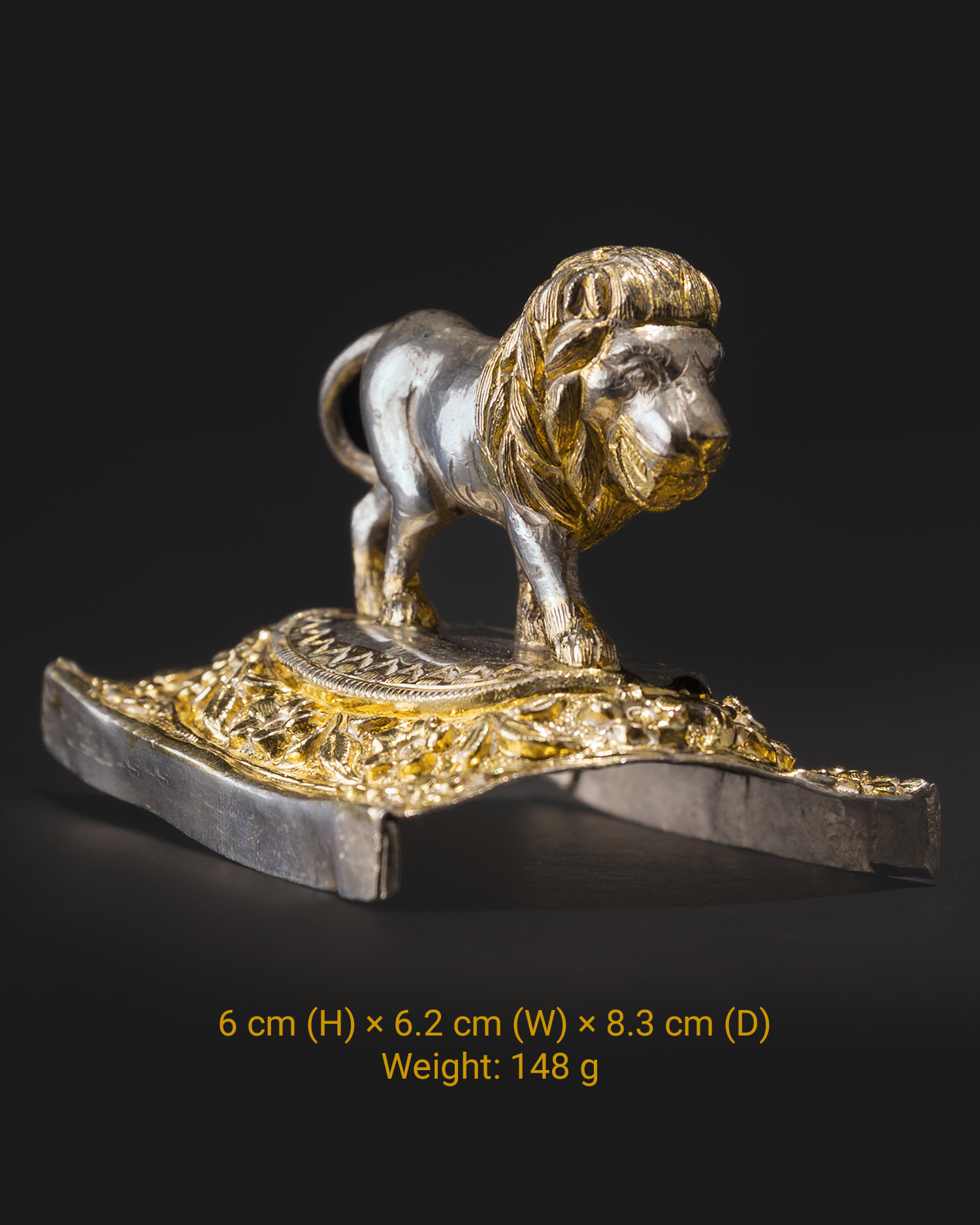
Stepping lion, gilt silver, Western Europe, 17th-18th century.
2250,00 zł
Small, realistically reproduced figurine of a lion with clear detail of the mouth and mane, made of silver, partly fire-gilded. Set on a slightly curved, florist-decorated pedestal. Visible traces of handwork – chiseling and engraving. Probably a fragment of a larger object – a reliquary, ceremonial casket or processional gate.
1 in stock
SKU:
700328
Category: Decorative arts
Additional information
| Weight | 0,145 kg |
|---|---|
| Dimensions | 6 × 6,2 × 8,3 cm |
| Type |
Decorative Baroque figurine |
| Form |
Lion with realistic details on a decorative base |
| Materiał |
Chiseled silver ,Fire gilding ,Thin sheet |
| Kolorystyka |
Gold ,Silver |
| Technika |
Hand chasing ,Riting the base ,Silver casting ,Surface gilding |
| Czas powstania |
17th-18th century |
| Era |
Baroque ,Rococo |
| Kraj pochodzenia |
Central Europe |
| Autor |
Unknown |
| State of preservation |
Very Good. Minimal rubbing of gilt and minor deformation of base |
Related products
“Apostle” spoon with St. Simon, silver, England, 18th century.
2100,00 zł
Spoon, so called "apostolic" with a handle topped with a full-figured figure of St. Simon Zelota holding a saw, which is his attribute. The head of the saint topped with a circular shield with a representation of a bird (probably a dove symbolizing the Holy Spirit). Item of liturgical or collectible nature.
“Apostle” spoon with St. Thomas, silver, England, 18th century.
2100,00 zł
Baroque votive plaque depicting a nobleman, repoussé silver, Poland, 17th–18th century.
1700,00 zł
Belt link, gilded silver, Poland, 17th century
470,00 zł
A gilded silver belt element in the form of a rectangular segment with open sides, creating an opening that allows a leather strap to pass through.
At the bottom there is a loop designed for hanging a decorative element. Links of this type likely formed a sequence of repeating belt segments; loops may have been present only on some of them and served to suspend decorative additions, such as small chains.
The decorative side is divided by a vertical double rib into two symmetrical fields. In each of them, three stylized flowers are arranged symmetrically. The background between them is concave, with a fine, granular texture, probably achieved by punching. The whole is surrounded by a narrow, smooth border.
Charles Julius Minter (1812 – 1892), Casket with lid in the form of a tombstone of King Stefan Batory, tin
1400,00 zł
Tin casket, so called "serviette", in the form of a tomb of King Stefan Batory. The body with convex sides, decorated with imitation fittings, supported on lion's feet. The lid depicts a model of the bas-relief from the tomb of Stefan Batory, located in St. Mary's Chapel in Wawel Castle. The king is shown in a semi-recumbent position with a scepter and apple, clad in armor and coronation cloak.
Casket designed by Wojciech Święcki and Kazimierz Stronczyński, made around 1857 in the Warsaw factory of artistic castings of Karol Minter.
Cup, silver, Poland (?), 17th-18th century
2500,00 zł
A cup made of forged silver, likely intended for drinking vodka or other spirits. The vessel has a squat form. The bowl with a semicircular bottom has straight walls, slightly flared upward. The rim is straight, slightly tilted outward and clearly separated from the wall section by a row of concave dots. The bowl has a five-part form – both the rim edge and the walls are divided into five convex segments, separated by vertical fluting. The vessel is set on a low, conical foot and fitted with a flat, S-curved handle. The surface of the bowl is decorated with engraved floral motifs and rocaille ornament.
Similar cups are characteristic of 18th-century Russian silverwork. As a rule, however, they are hallmarked. Our specimen bears no marks, although it undoubtedly came from a fine silversmith's workshop. It is possible that the cup described was made in the 17th century and not in Muscovy at all, but in the east of the Polish-Lithuanian Commonwealth. This would explain the absence of hallmarks, which is quite normal for Polish silver from that period. At the same time, it should be remembered that the origin of the popular Russian cups is unknown.
Ivan Khlebnikov, Kovsh with horse’s head, silver, enamel, gilt, Moscow, 1860-1918
10000,00 zł
A unique kovsh from the famous Moscow factory of Ivan Khlebnikov, made of silver and maintained in the aesthetics of the Novorussian style. The surface of the vessel is decorated with enamel cloisonné - cells formed from thin silver wires soldered to the body, forming partitions later filled with colored glaze, repeatedly fired and polished. The result is a smooth, glossy decoration with floral and geometric motifs in vivid colors. A striking accent is the naturalistically chiseled silver horse's head forming the vessel's handle. The interior retains traces of the original gilding. The kovsh bears the punches: the inscription ХЛѢБНИКОВЪ, which is the signature of Ivan Khlebnikov's company with an eagle (marking the Imperial Court's suppliers), and the oval Moscow probationary mark - the profile of a woman in a coquina with the Greek letter delta and the number 84 (partially rubbed off), indicating the sample of silver.
Table spoon, silver, Wrocław, early 18th century
4200,00 zł
Silver tablespoon with a richly decorated flat handle, ending with a characteristic profiled button in the Baroque style. On the top side, finely engraved floral ornaments - typical of Central European Baroque. On the underside of the scoop part, two punches: the city mark of Wroclaw (St. John's head in a circle) and the probationer's mark (the letter "H" in a heart). A proboscis in the place of joining the handle with the scoop - an element typical of Lower Silesian workshops of the period.
