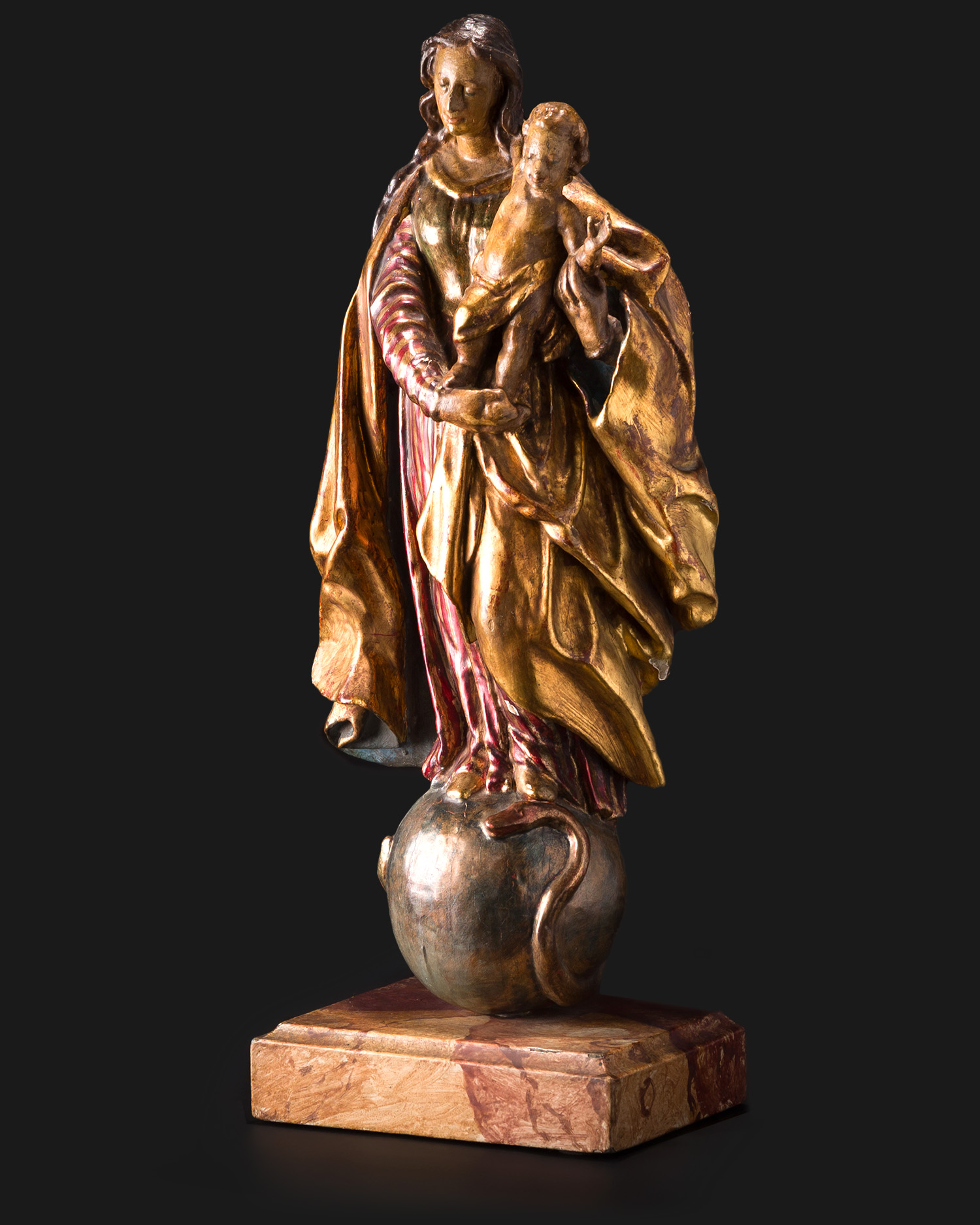
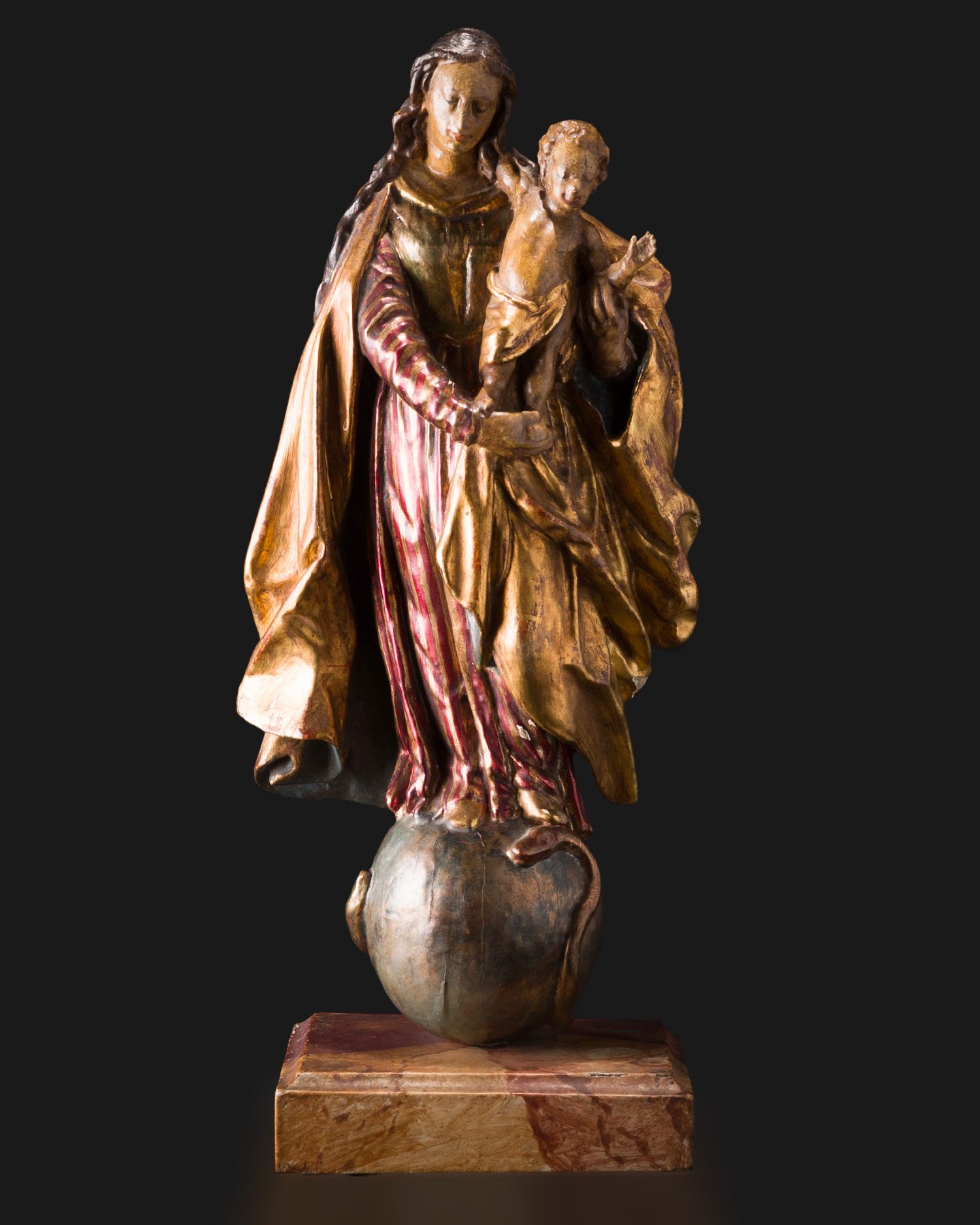
Madonna and Child, polychrome wood, gilded, Central Europe, 18th/19th century.
2750,00 zł
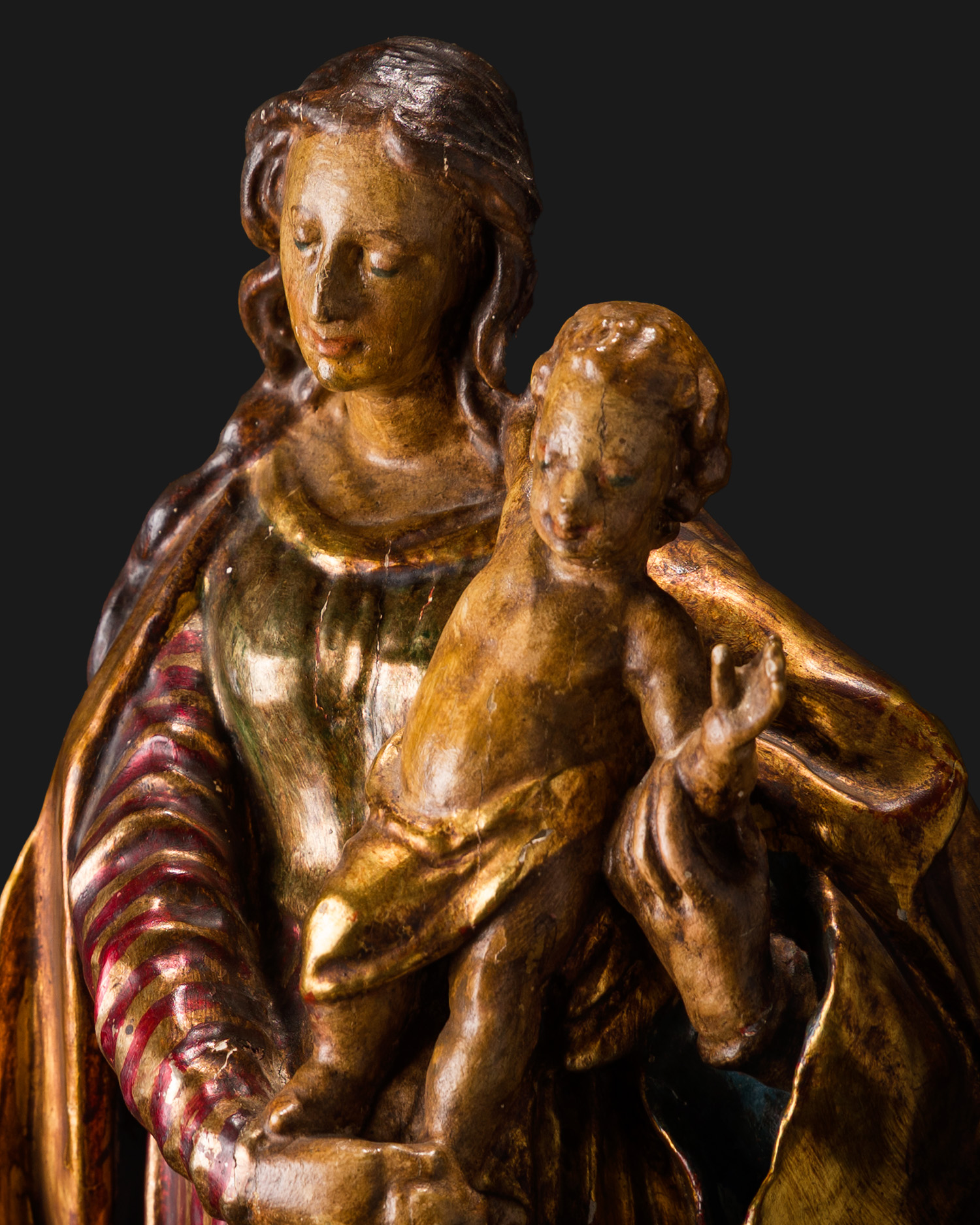
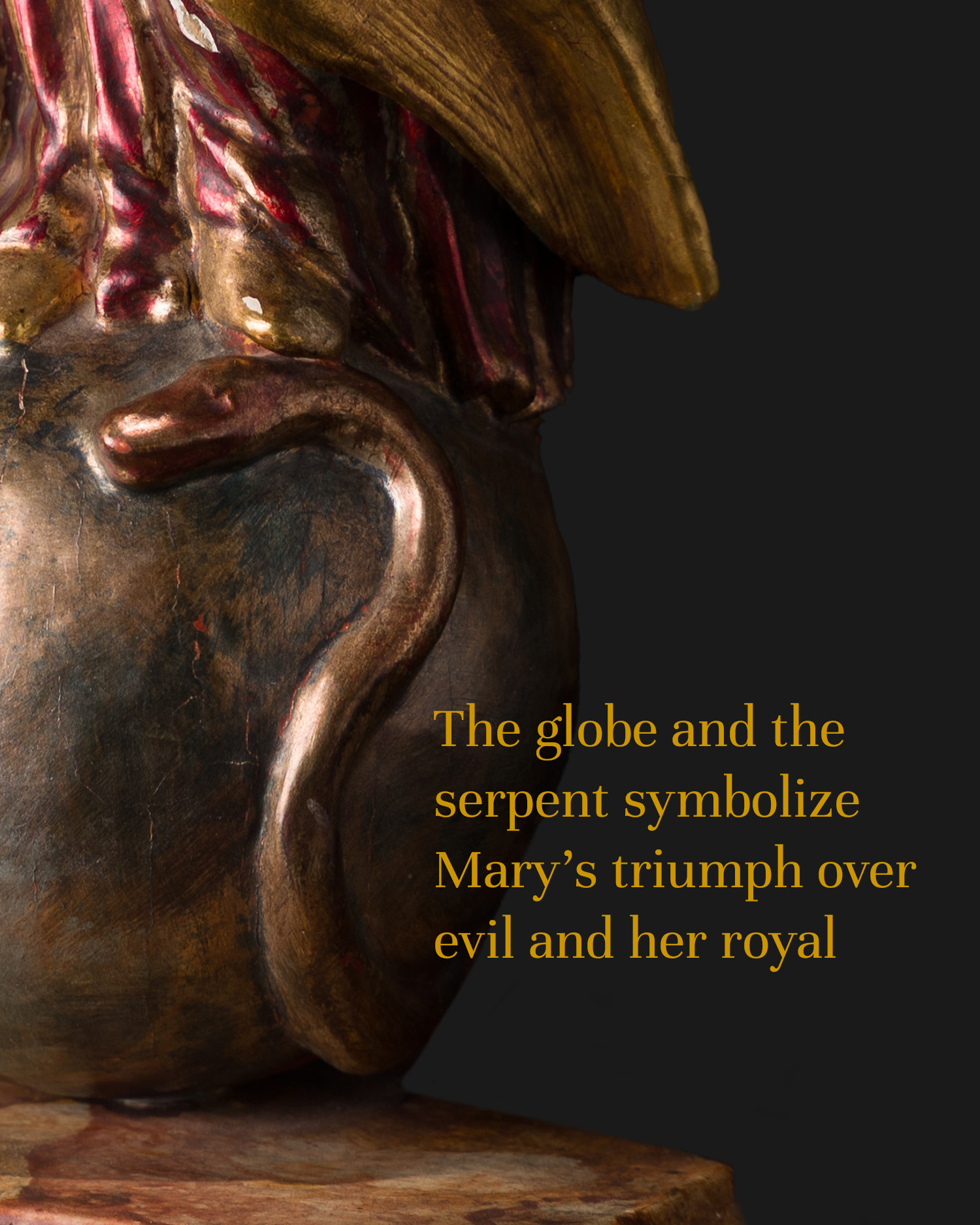
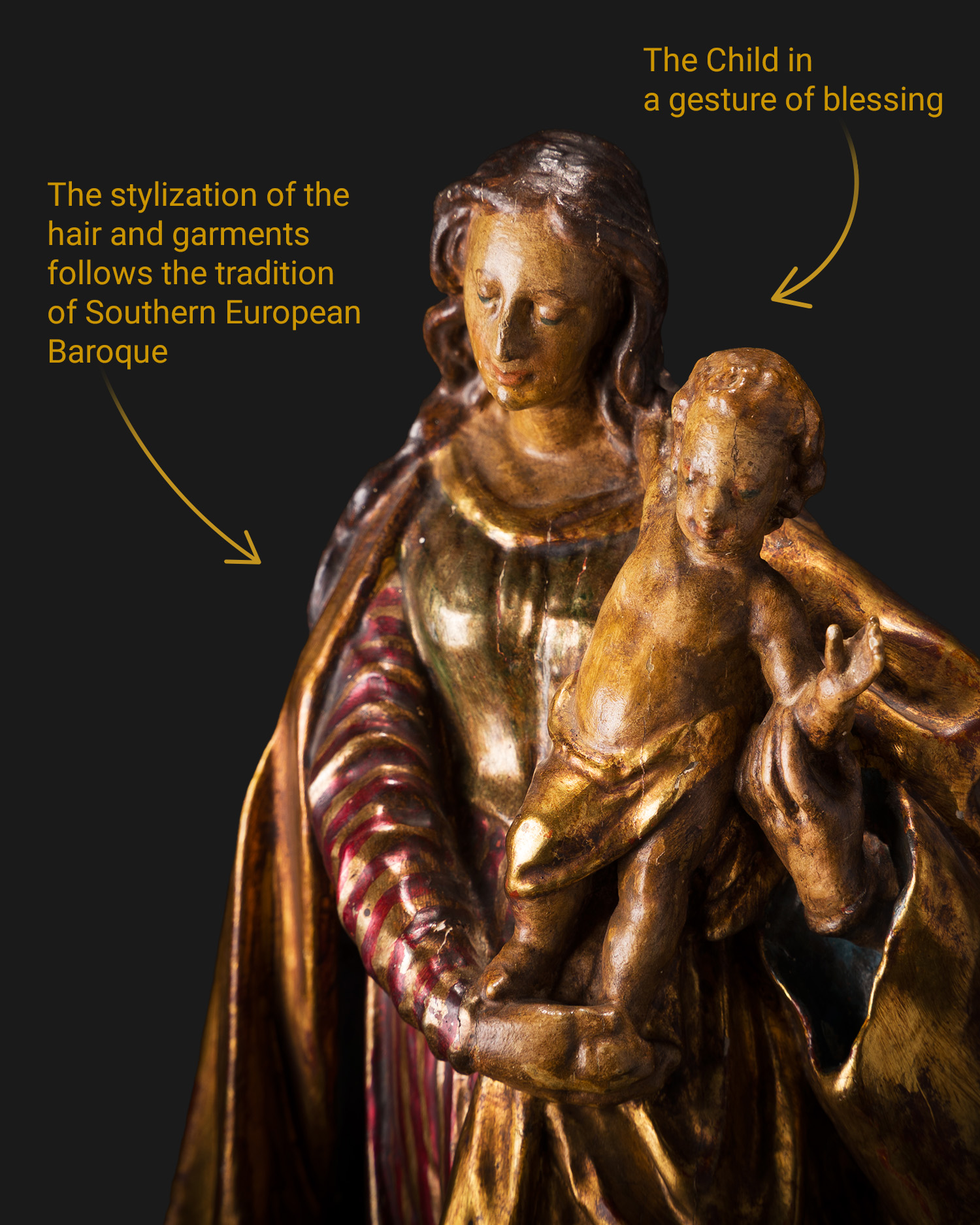
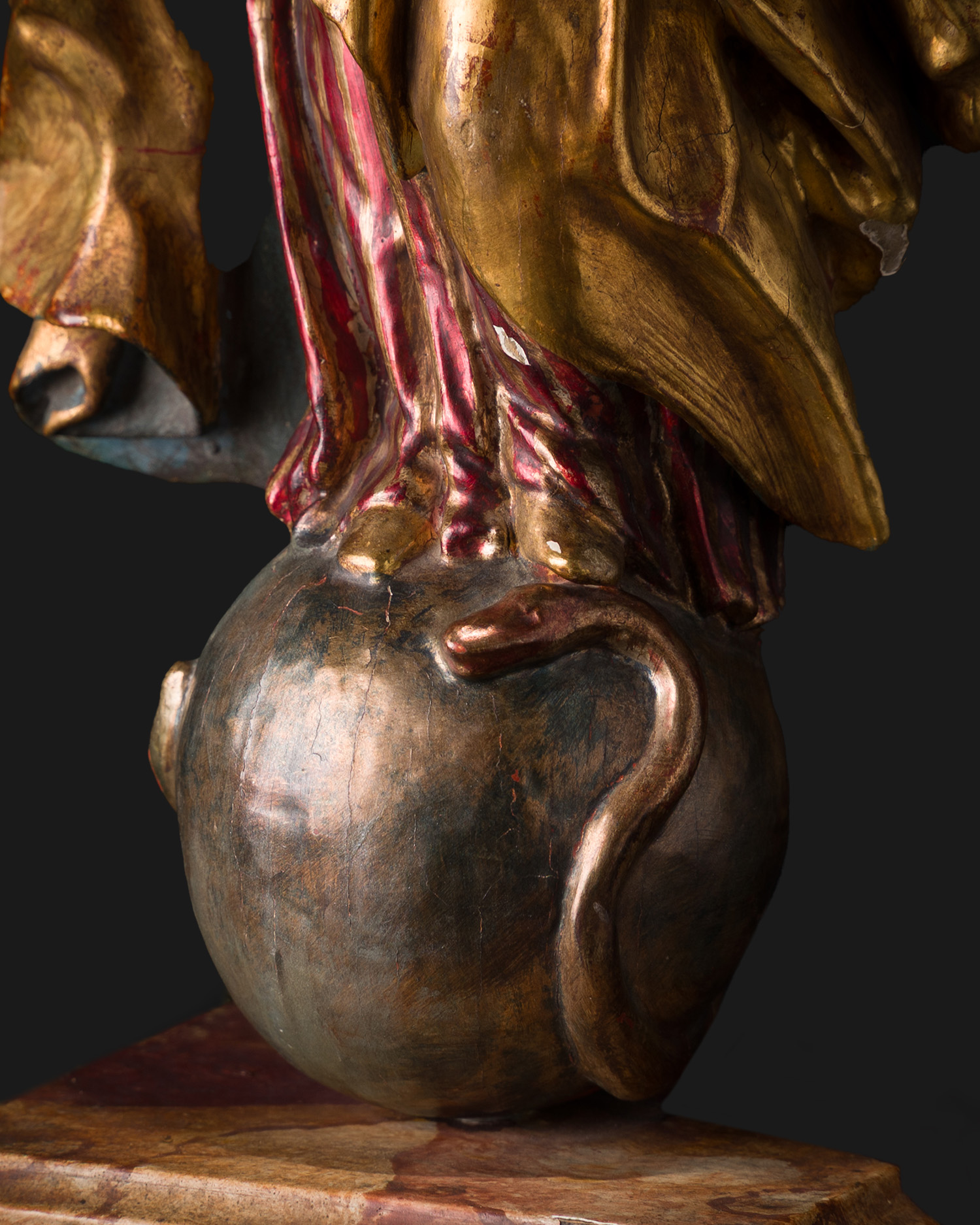
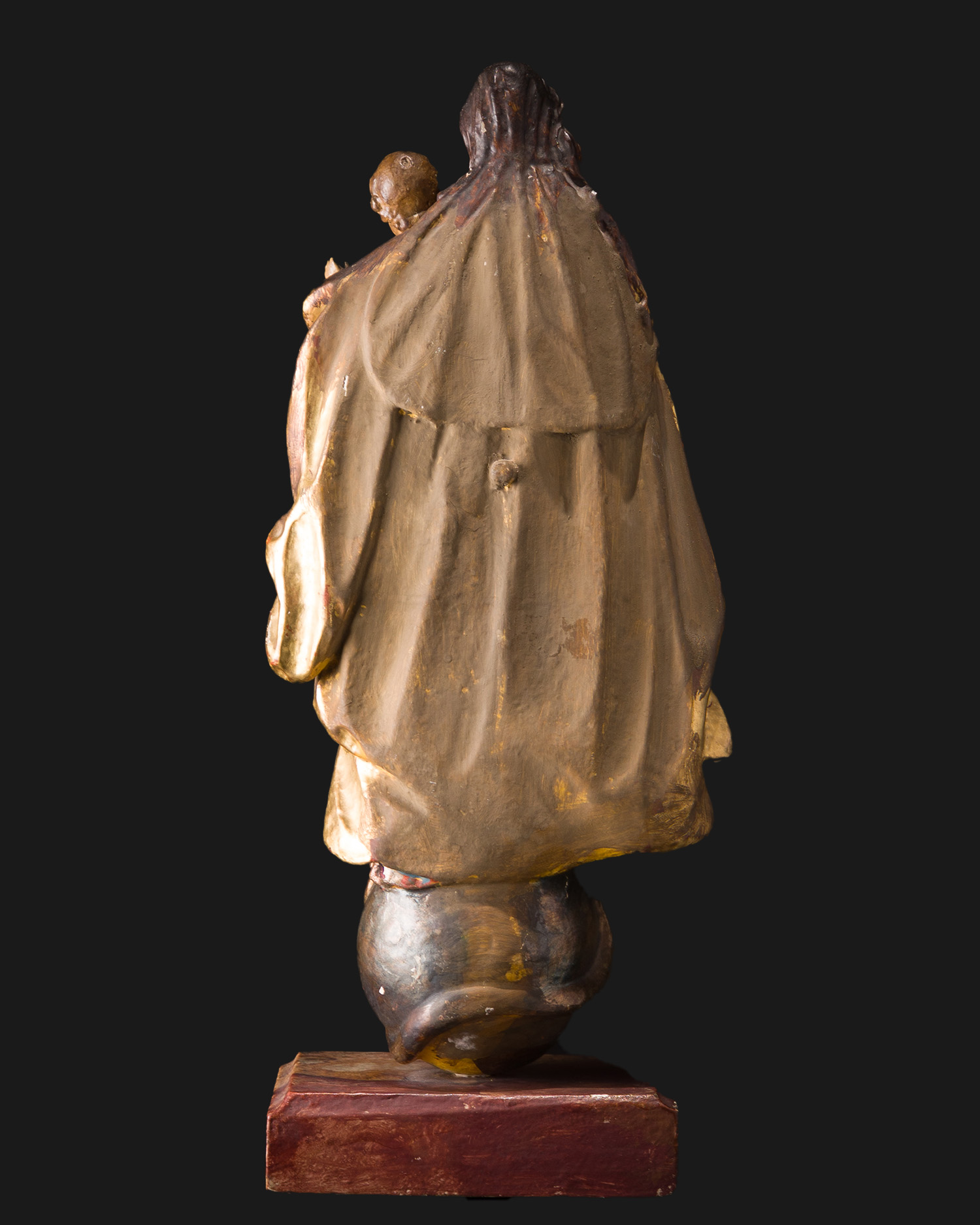
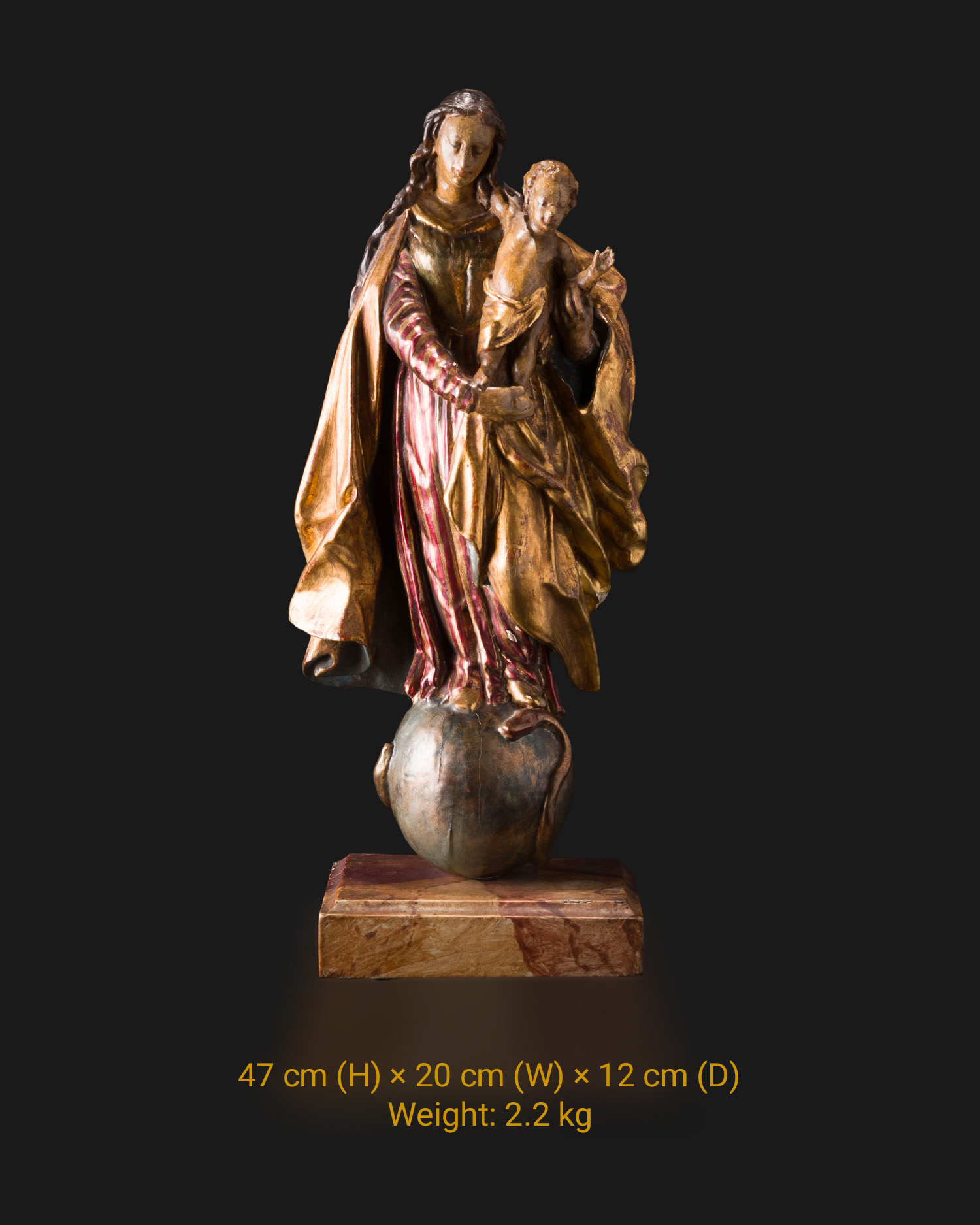
Polychrome and gilded wooden sculpture depicting the Immaculate Madonna with the Child Jesus. The figure stands on a globe entwined by a serpent – a classic motif symbolizing Mary’s victory over sin and evil. The Madonna, in a richly folded cloak covered with gilding, holds the Child on her left side. The sculpture is colorful, full of expression and dynamism.
1 in stock
Immaculate Madonna with Child.
The figure depicts the Immaculate Madonna trampling the serpent entwining the globe, constituting a classic motif of Baroque Catholic art, which symbolizes Mary's triumph over original sin. The Child Jesus in a gesture of blessing reinforces the spiritual message of this unique composition.
The serpent in this iconography symbolizes original sin and the corruption of the world after the fall of the first humans. Mary is depicted as New Eve – she who, through her obedience to God, participates in the work of humanity's salvation. The sculpture carries a deep spiritual charge, expressed through precise religious symbols.
This is an excellent and well-preserved example of Baroque religious sculpture with a Marian motif.
Historical context
Baroque sculptures of the Immaculate Mary with Child experienced a peak in popularity in the second half of the 18th century and early 19th century, especially in Southern European countries. They could be found in monasteries, churches, and private chapels of the faithful.
Sculptors from regions such as Tyrol, Styria, and Northern Italy often drew inspiration from Marian iconography from Loreto. Depictions of the Madonna on the globe with a serpent became a characteristic element of 18th-century European sacred art. Sculptors from Southern Germany, Styria, and Tyrol copied the characteristic stylization of the Madonna on the sphere, adapting it to local woodcarving traditions.
Collector's and Artistic Value
This sculpture combines the dynamism of Italian Baroque with details characteristic of the Austrian woodcarving school. The deep folds of the robes, the realistic facial expressions of the figures, and the contrast between dark green and gold create a composition with a strong visual impact.
Baroque sculpture depicting the Immaculate Madonna with Child in very good condition, with original gilding, is a true rarity in the sacred antiques market. Its Southern European origin and preserved style make it a unique work of Catholic art.
Application
Such a sculpture would be ideal as a home decor element, for a private chapel, or a space for prayer and reflection. It would also look excellent in a library, museum, or as a decoration in a classical or historical interior with sacred elements.
Mariology and Symbolism
The motif of the globe and the serpent directly refers to the Apocalypse of St. John and the biblical prophecy from the Book of Genesis, which speaks of a woman crushing the serpent's head. Over time, this figure was identified with Mary in Christian art, which found particularly strong expression in Baroque sculpture with a Marian theme.
Although the dogma of the Immaculate Conception was officially proclaimed in the mid-19th century, figures of the Madonna trampling the serpent already expressed deeply rooted popular piety and the spiritual need for the symbolic overcoming of evil. Such sacred wooden figures with the motif of Mary on the globe had immense aesthetic and religious significance.
Are You Looking for an Original Marian Sculpture from the Baroque Era?
this Authentic 18th-Century Figure of the Immaculate Madonna with Child is an Excellent Choice for Lovers of Sacred Art, Collectors, and those who Appreciate the Depth of Religious Symbolism. Add it to your Collection or Spiritual Space Today.
Are You Interested in more Works of Sacred Art?
| Weight | 2,2 kg |
|---|---|
| Dimensions | 47 × 20 × 12 cm |
| Type |
Sacred sculpture / Marian figure |
| Form |
Immaculate Madonna with Child on a globe with a serpent |
| Materiał |
Carved wood ,Polychrome wood |
| Kolorystyka |
Burgundy ,Earthy palette ,Gold |
| Technika |
Layered polychromy ,Wooden sculpture |
| Czas powstania |
18th/19th Century |
| Era |
Baroque ,Late Baroque |
| Kraj pochodzenia |
Southern Europe |
| Autor |
Unknown |
| State of preservation |
Very good for its age. |
You may also like…
Stepping lion, gilt silver, Western Europe, 17th-18th century.
Related products
Cabinet Reliquary with Relic of the True Cross and 26 Saints, wood, textiles, Central Europe, 18th century
An 18th-century Baroque cabinet reliquary, a freestanding wooden display case of trapezoidal form, containing a total of 27 relics. The side walls and top are chamfered, widening toward the front. The interior is lined with burgundy velvet, trimmed with decorative borders of gold bullion thread.
At the center, set slightly forward from the back, is a raised textile reliquary in the form of a monstrance, embroidered with gold thread and richly adorned with bullion, filigree, miniature beads, and multicolored glass imitating precious stones. On the base and shaft are placed six relics, identified by inscriptions painted in gold on dark blue banderoles.
Within the central repository is a reliquary capsule with a convex glass cover, containing two fragments of the True Cross, surrounded by a radiant glory.
Above the “monstrance” is an oval image with an indistinct representation, encircled by 20 additional relics interspersed with decorative elements of bullion, beads, gold thread embroidery, and colored glass. At the level of the nodus are two larger relics (Ex Ossibus) of Saint Vincent and Saint Fortunatus, uniquely labeled on white banderoles.
A distinction should be made between a reliquary and a reliquary cabinet: a reliquary is a vessel that directly contains relics, whereas a cabinet reliquary serves as a structure housing and presenting them. This object is therefore not a typical example, as—besides the central textile reliquary in the form of a monstrance containing fragments of the Cross on which Jesus Christ died—it also incorporates an additional 26 relics of various saints placed directly within the composition, without individual containers.
Their preservation is ensured either by a fine mesh covering or solely by labeled banderoles. The relic of the True Cross is the only one enclosed within a glazed, and undoubtedly sealed, capsule.
The interior of the case, measuring 37.3 × 26.5 × 10 cm, is lined with burgundy velvet, trimmed with gold bullion thread.
Christ Salvator Mundi, polychrome wood, Poland, 19th century.
Fragment of an antiphonary page with illuminated initial, parchment, Europe, 15th century
Gallo-Roman sculpture of the head of Eros (?), marble, 1st-3rd century A.D.
Icon of Our Lady of the Dawn Gate, brass, enamel on metal, Poland, 19th century.
Irish (Celtic) cross, stone sculpture, Ireland, 19th century.
Saint John the Evangelist, late Gothic wooden sculpture, ca. 1500
The work may have been part of a winged altarpiece (retabulum), most likely in the Crucifixion group.
