


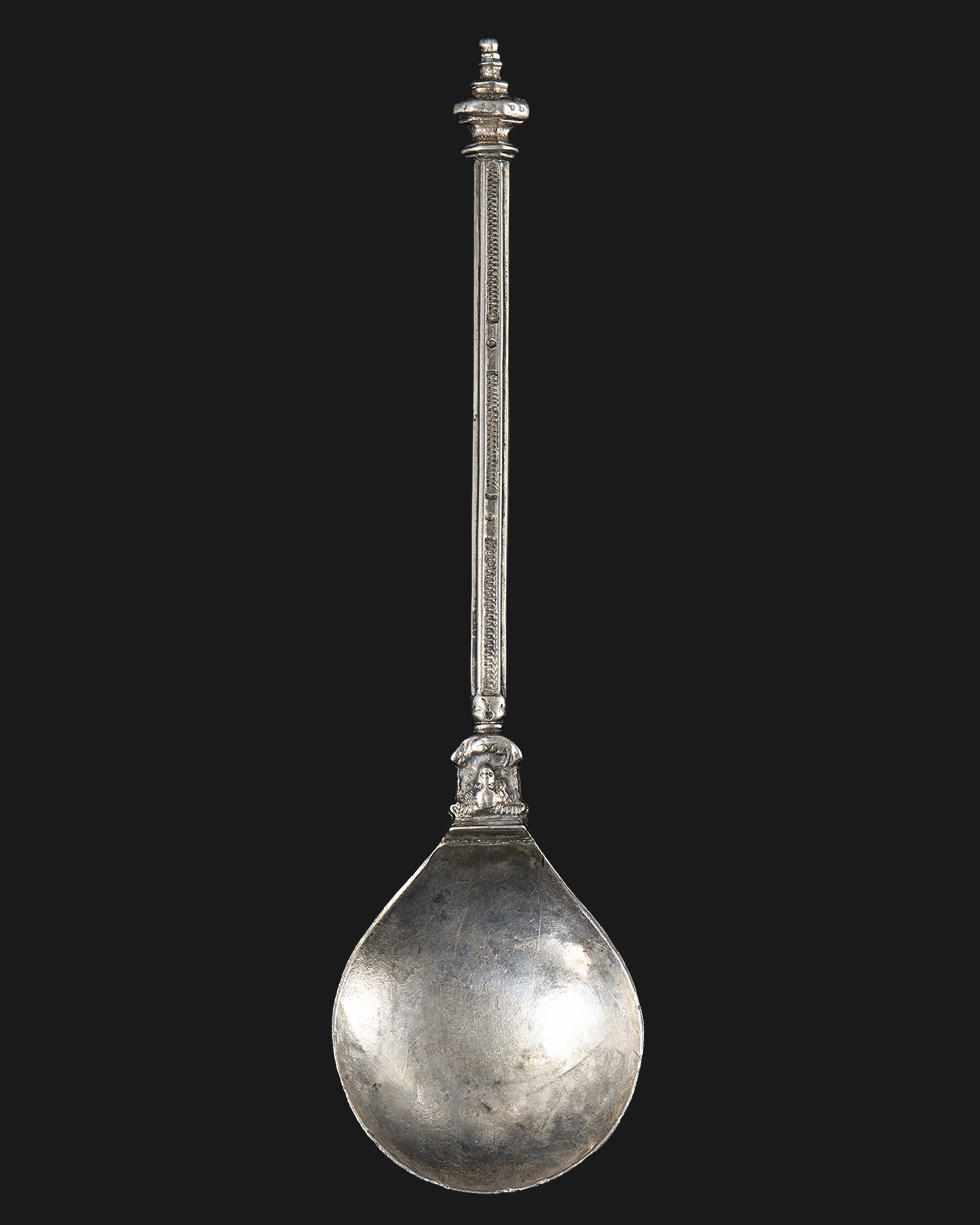
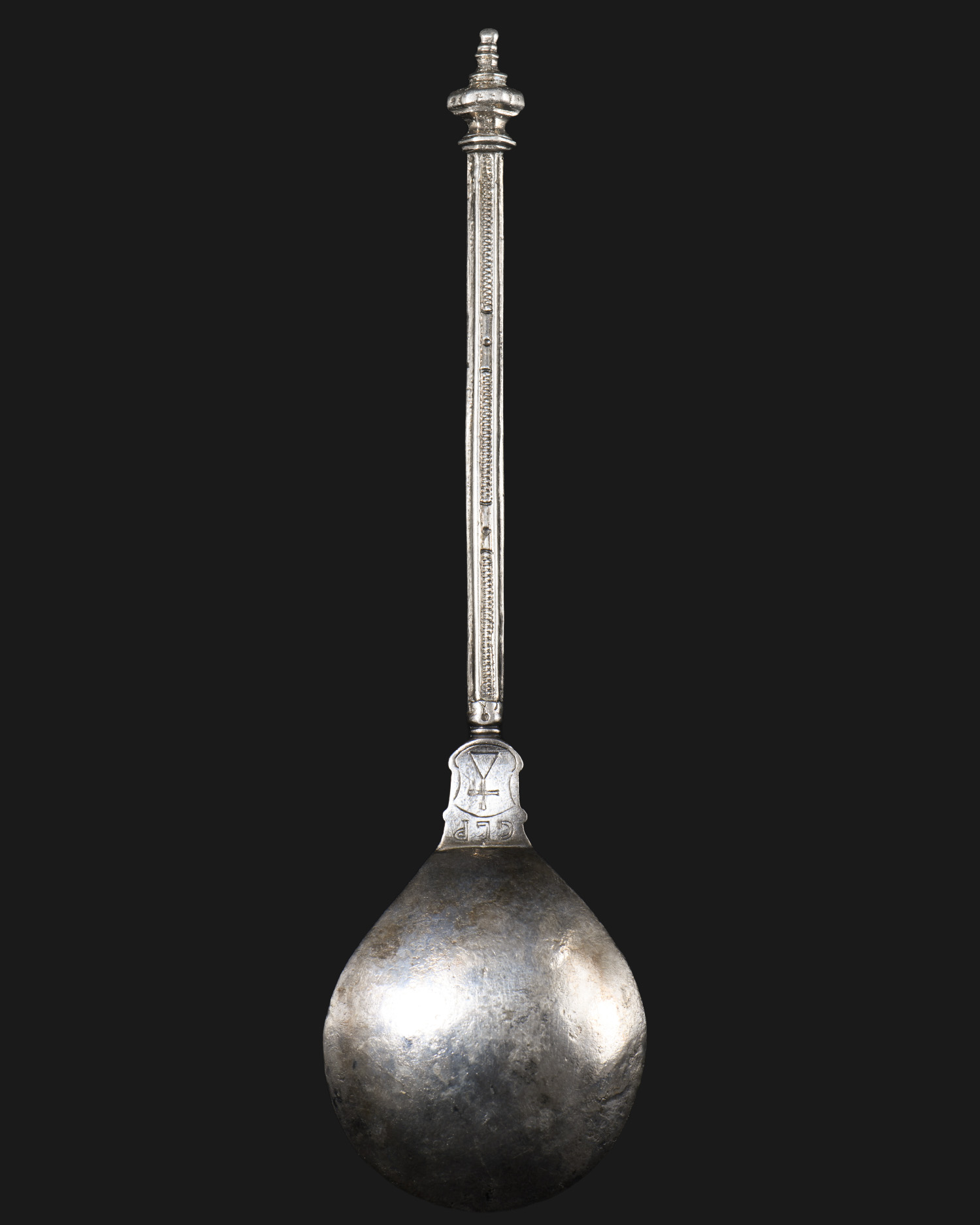
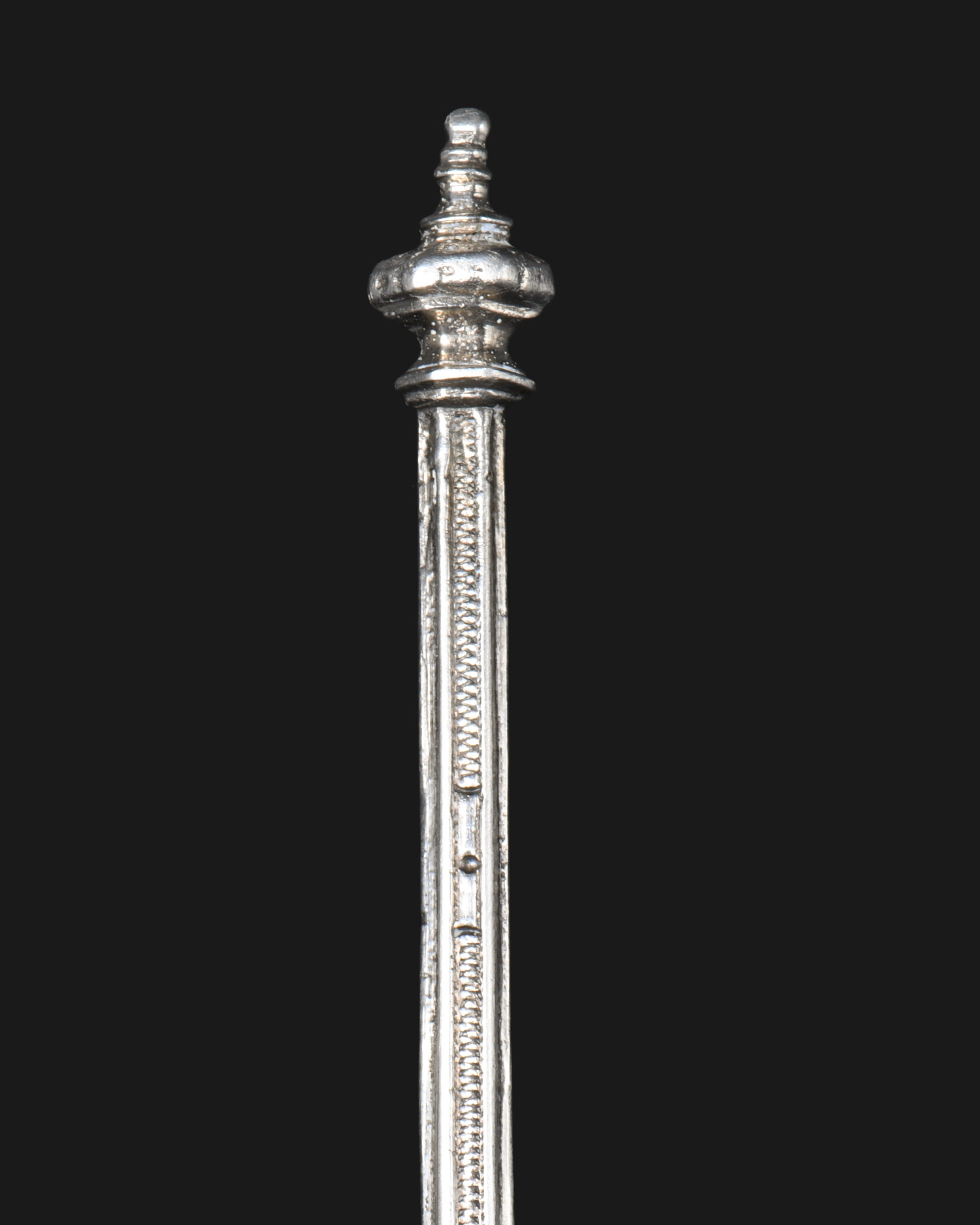
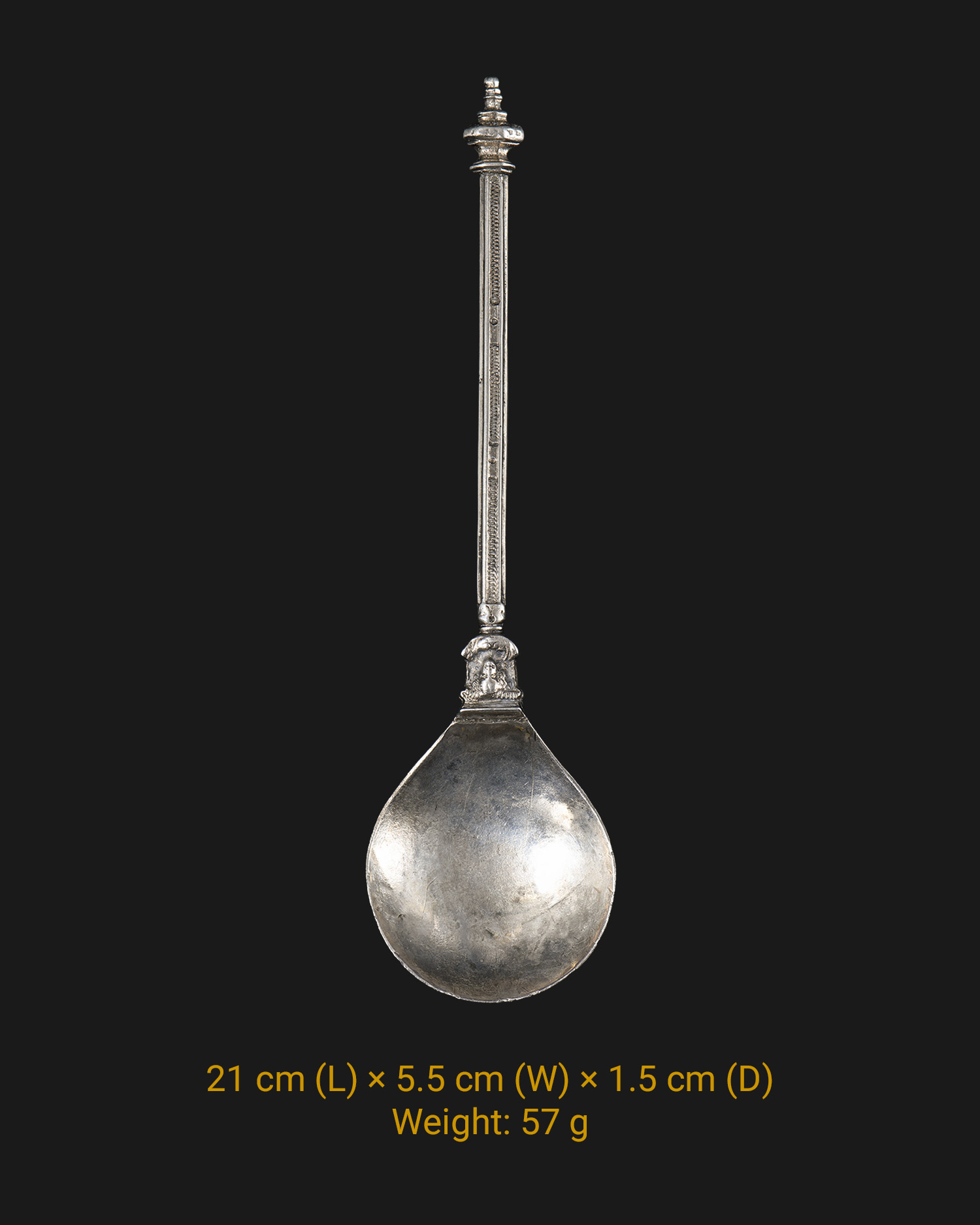

Spoon, silver, Poland, c. mid-17th century
5400,00 zł
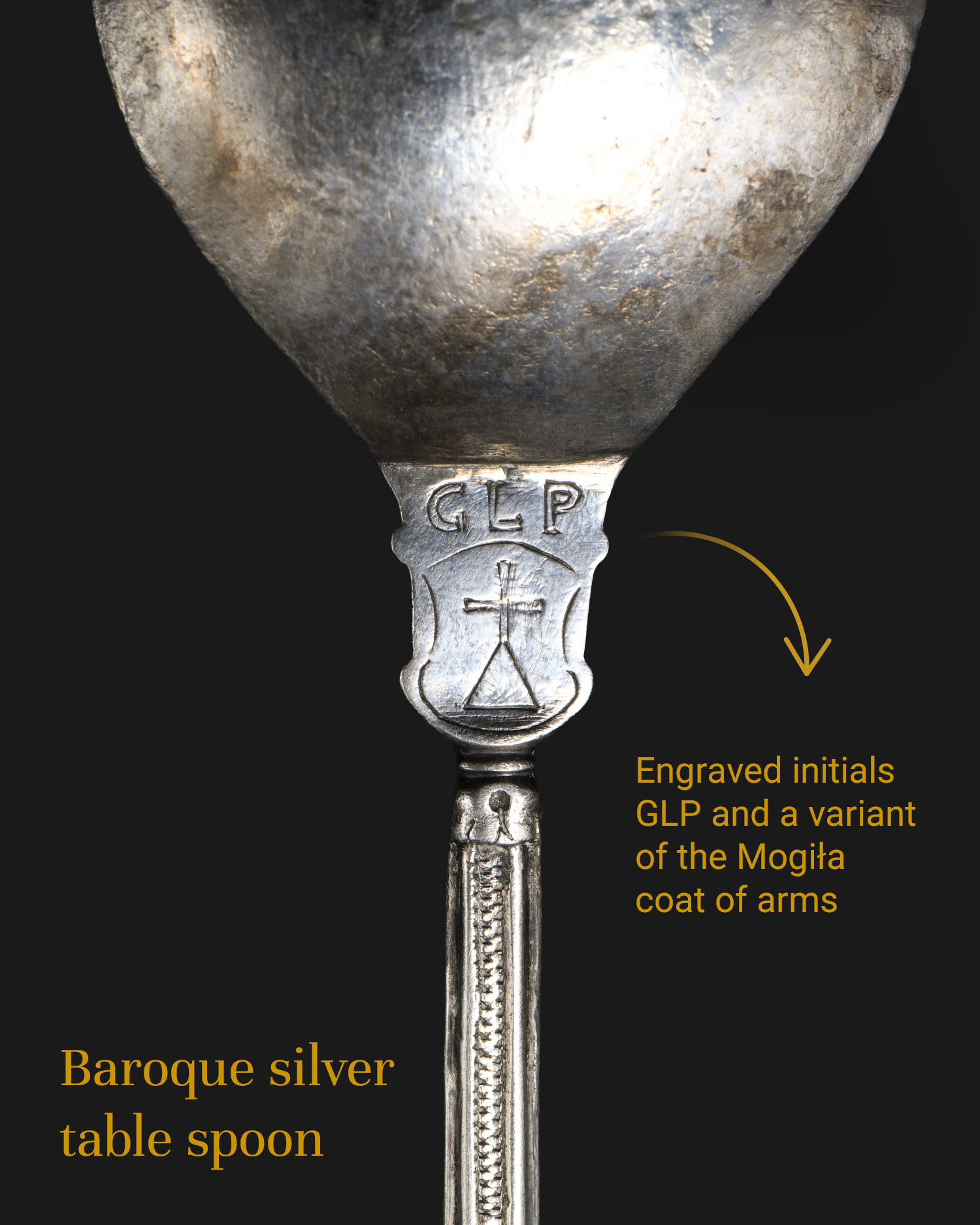
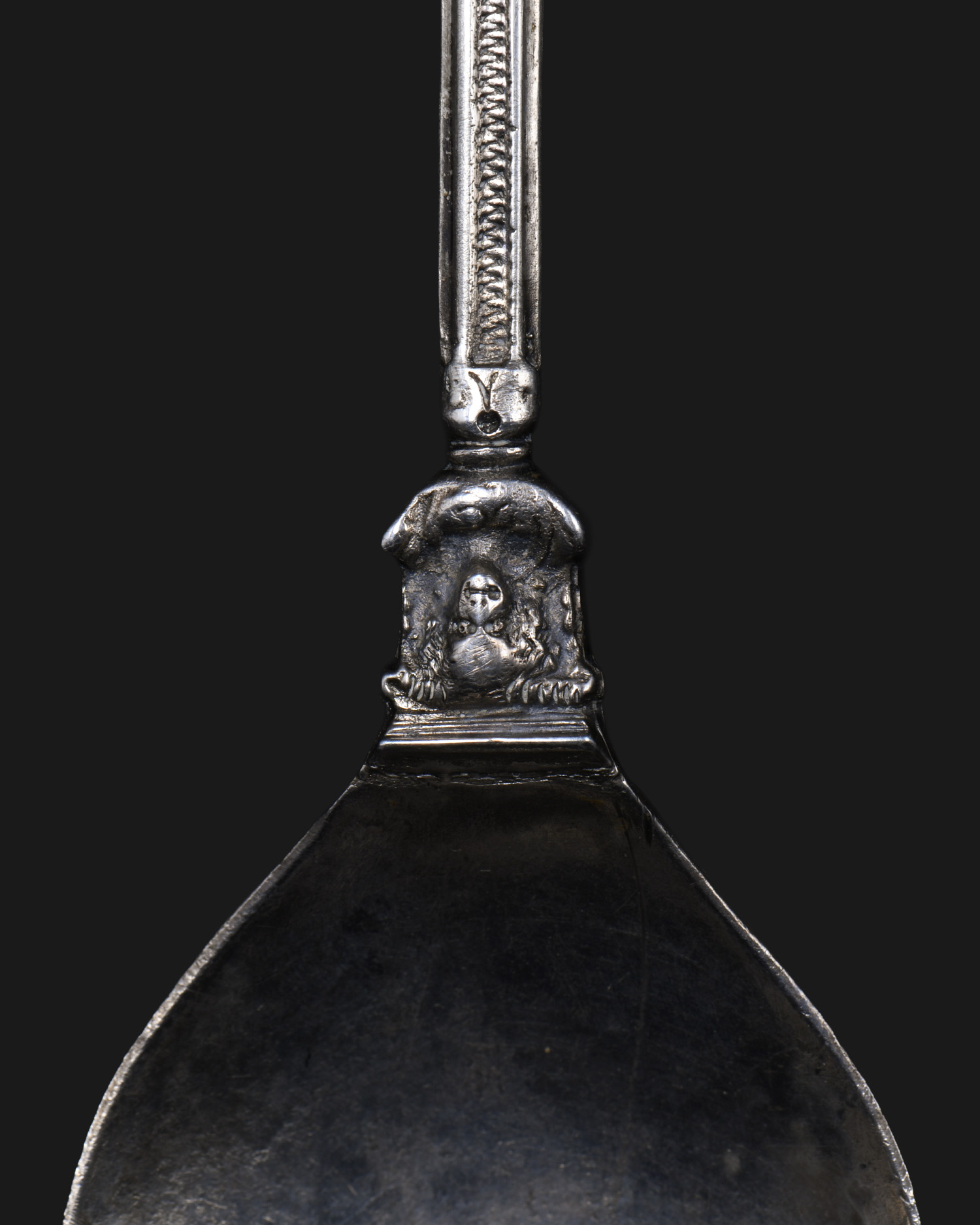
A Baroque tablespoon, c. mid-17th century. Features a smooth, ovoid bowl. The bar-shaped handle is hexagonal in cross-section, profiled, and terminates in a finial. Both upper and lower sides are adorned with an engraved serpentine motif, divided into three zones. The handle’s junction with the bowl forms a cartouche, embellished with a sculptural mascaron. The underside of the cartouche bears engraved initials ‘GLP’ and a variant of the Mogiła coat of arms.
1 in stock
Related products
Belt link, gilded silver, Poland, 17th century
A gilded silver belt element in the form of a rectangular segment with open sides, creating an opening that allows a leather strap to pass through.
At the bottom there is a loop designed for hanging a decorative element. Links of this type likely formed a sequence of repeating belt segments; loops may have been present only on some of them and served to suspend decorative additions, such as small chains.
The decorative side is divided by a vertical double rib into two symmetrical fields. In each of them, three stylized flowers are arranged symmetrically. The background between them is concave, with a fine, granular texture, probably achieved by punching. The whole is surrounded by a narrow, smooth border.
Charles Julius Minter (1812 – 1892), Casket with lid in the form of a tombstone of King Stefan Batory, tin
Tin casket, so called "serviette", in the form of a tomb of King Stefan Batory. The body with convex sides, decorated with imitation fittings, supported on lion's feet. The lid depicts a model of the bas-relief from the tomb of Stefan Batory, located in St. Mary's Chapel in Wawel Castle. The king is shown in a semi-recumbent position with a scepter and apple, clad in armor and coronation cloak.
Casket designed by Wojciech Święcki and Kazimierz Stronczyński, made around 1857 in the Warsaw factory of artistic castings of Karol Minter.
Coin Necklace, Silver, Rock Crystal, Bronze, Poland, 17th Century
This necklace is crafted from multi-faceted, cut rock crystal beads of varying sizes and clarity, alongside Russian silver kopecks. These small coins are known as 'teardrops' or 'wire kopecks' due to their distinctive shape. Some coins were left flat, with specially made holes allowing them to be strung onto a cord.
The central accent of the composition is an ancient, three-edged Scythian bronze arrowhead, dated to approximately the 7th–6th century BC. In the 17th century, it was set in silver and fitted with a loop for suspension. Its presence indicates that certain finds were perceived as extraordinary objects endowed with special significance, regardless of any lack of knowledge about their origin and function. Undoubtedly, the creator of the necklace had no knowledge of ancient Scythians or their weaponry.
An immense rarity on the collector's market! A great treat for enthusiasts of the culture and traditions of the former Polish-Lithuanian Commonwealth!
Cup, silver, Poland (?), 17th-18th century
A cup made of forged silver, likely intended for drinking vodka or other spirits. The vessel has a squat form. The bowl with a semicircular bottom has straight walls, slightly flared upward. The rim is straight, slightly tilted outward and clearly separated from the wall section by a row of concave dots. The bowl has a five-part form – both the rim edge and the walls are divided into five convex segments, separated by vertical fluting. The vessel is set on a low, conical foot and fitted with a flat, S-curved handle. The surface of the bowl is decorated with engraved floral motifs and rocaille ornament.
Similar cups are characteristic of 18th-century Russian silverwork. As a rule, however, they are hallmarked. Our specimen bears no marks, although it undoubtedly came from a fine silversmith's workshop. It is possible that the cup described was made in the 17th century and not in Muscovy at all, but in the east of the Polish-Lithuanian Commonwealth. This would explain the absence of hallmarks, which is quite normal for Polish silver from that period. At the same time, it should be remembered that the origin of the popular Russian cups is unknown.
Przeworsk belt buckle, gilt silver, Poland, 17th century.
The buckle was part of the fastener of the Przeworsk belt, which was part of the representative attire of the Polish nobility. It was made in the 17th century, when Przeworsk belts were gaining popularity. It was forged from silver, and traces of old gilding remain in places.
The central part of the bracket is filled with a figural scene: a standing female figure between columns, with two seated women on either side. Above them are visible swans with their necks facing the central figure. Around the scene, a geometric pattern is engraved on the diagonal sides of the buckle, forming a decorative border. Rivet heads are visible at the edges. On the side there is a cast openwork application, the so-called "tongue".
Przeworsk belt buckle, silver, Poland, 17th century.
The buckle is a part of the fastener of the Przeworsk belt, was made of silver and dates back to the 17th century. Przeworsk belts were part of the representative attire of the Polish nobility, so the buckles were decorated with striking scenes and rich ornamentation. This is a larger, massive piece, rather intended for a man. The central part of the buckle is filled with a figural scene showing a man holding a scepter or torch, depicted between two standing griffins. The spaces between the figures are filled with single swirls and flowers typical of Baroque design. An engraved geometric pattern is placed on the slanted sides of the buckle. At the edges of the scene the heads of the fastening rivets are visible, and on the side of the buckle there is a cast openwork application, the so-called "tongue".
Table spoon, silver, Wrocław, early 18th century
Silver tablespoon with a richly decorated flat handle, ending with a characteristic profiled button in the Baroque style. On the top side, finely engraved floral ornaments - typical of Central European Baroque. On the underside of the scoop part, two punches: the city mark of Wroclaw (St. John's head in a circle) and the probationer's mark (the letter "H" in a heart). A proboscis in the place of joining the handle with the scoop - an element typical of Lower Silesian workshops of the period.