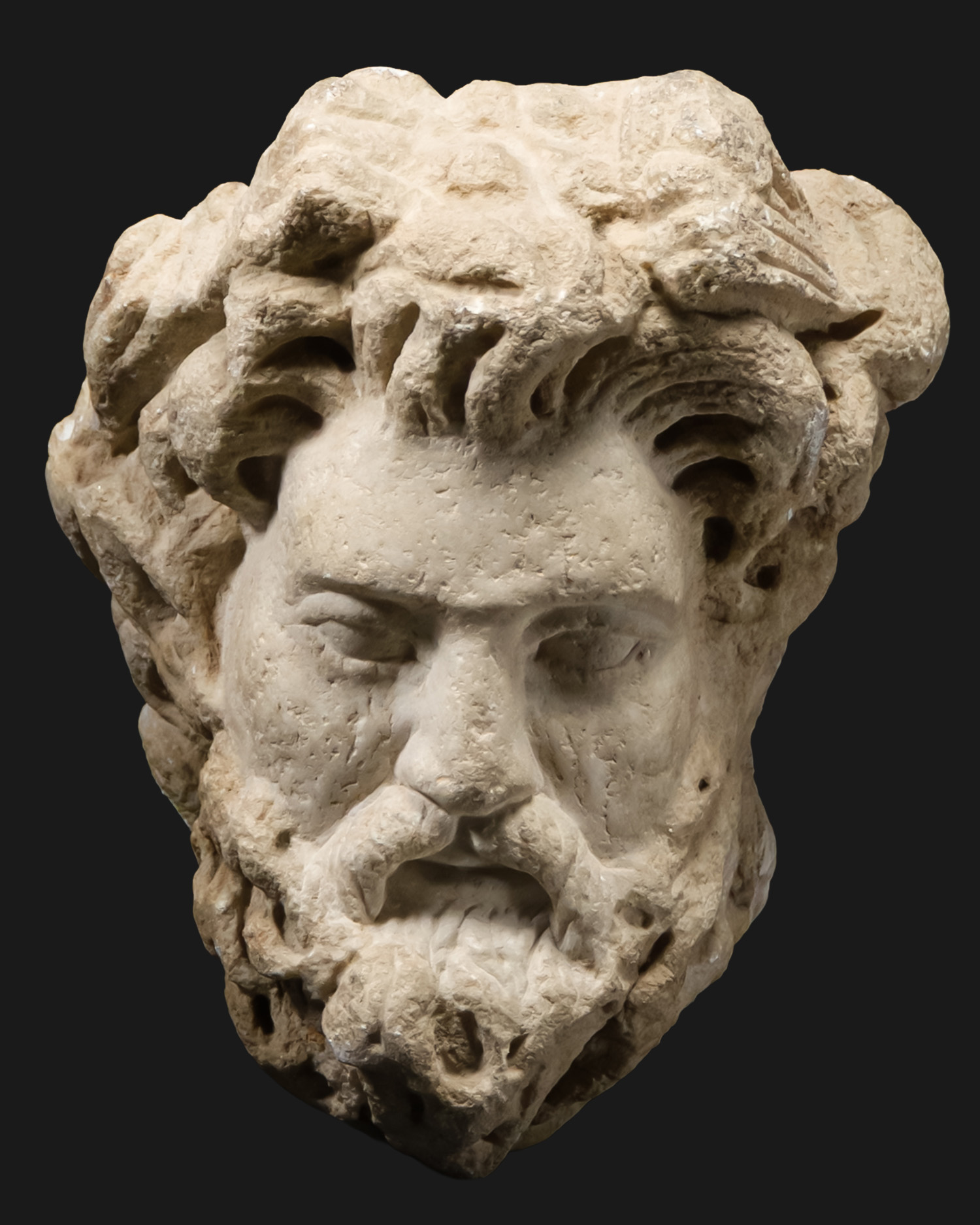
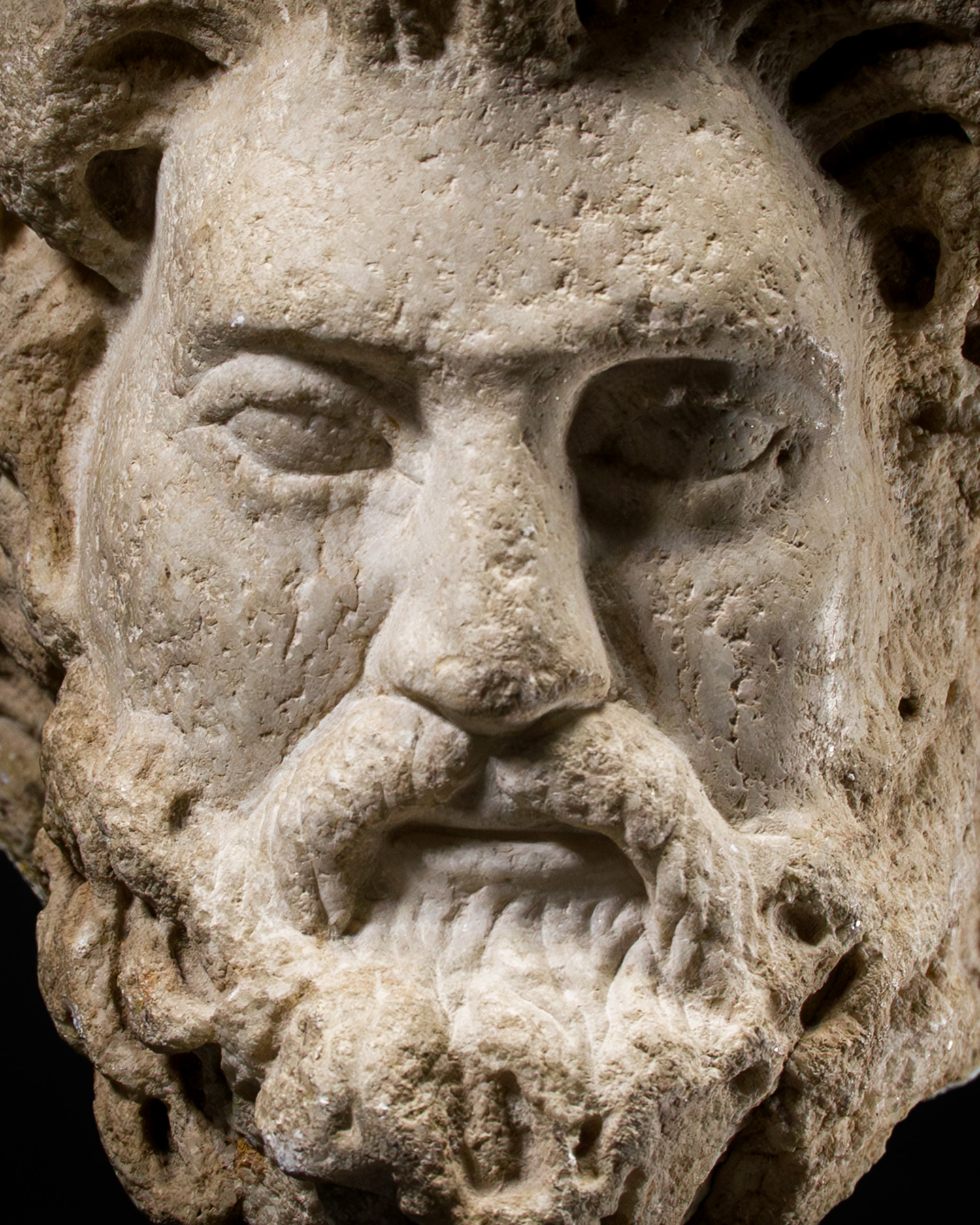
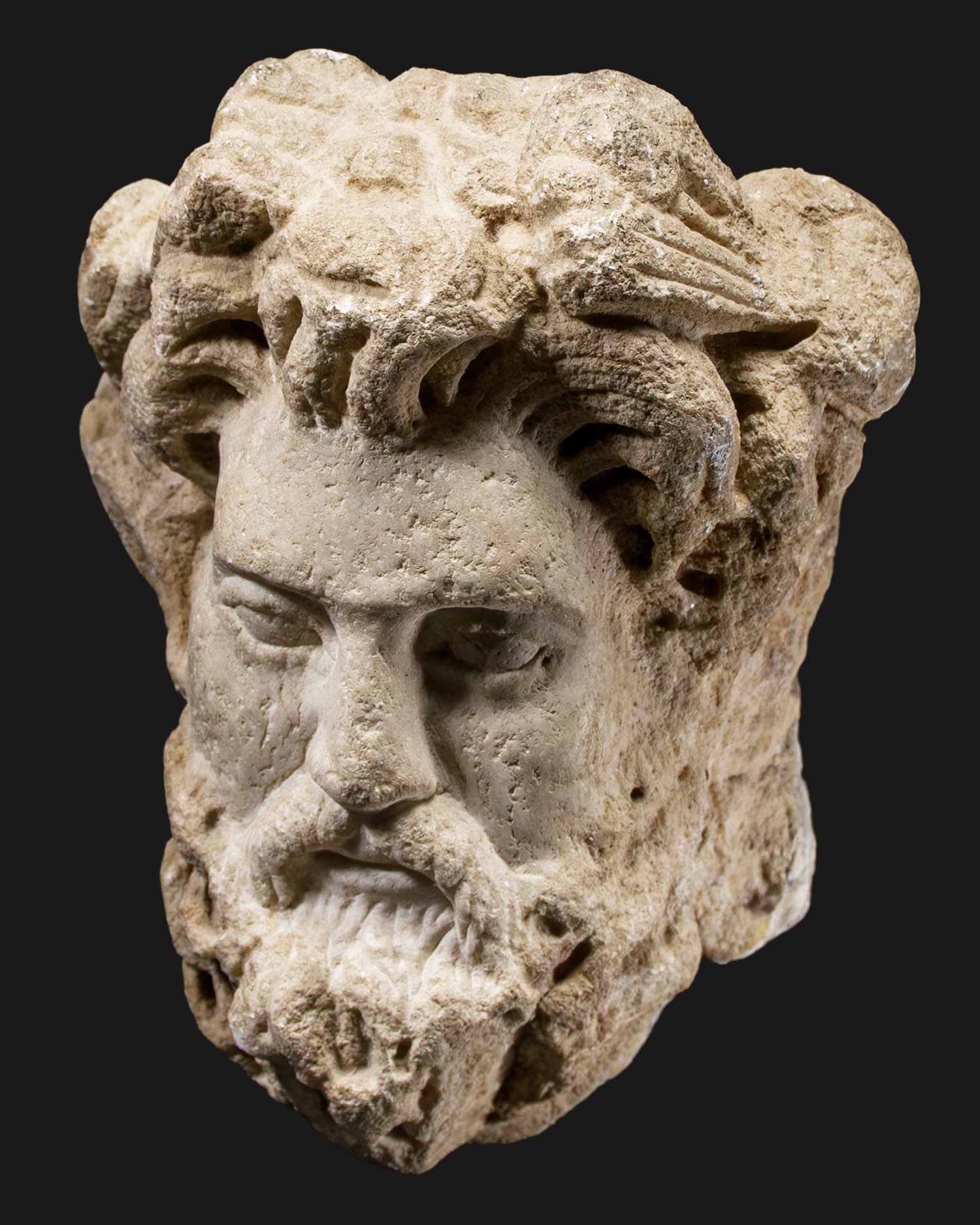
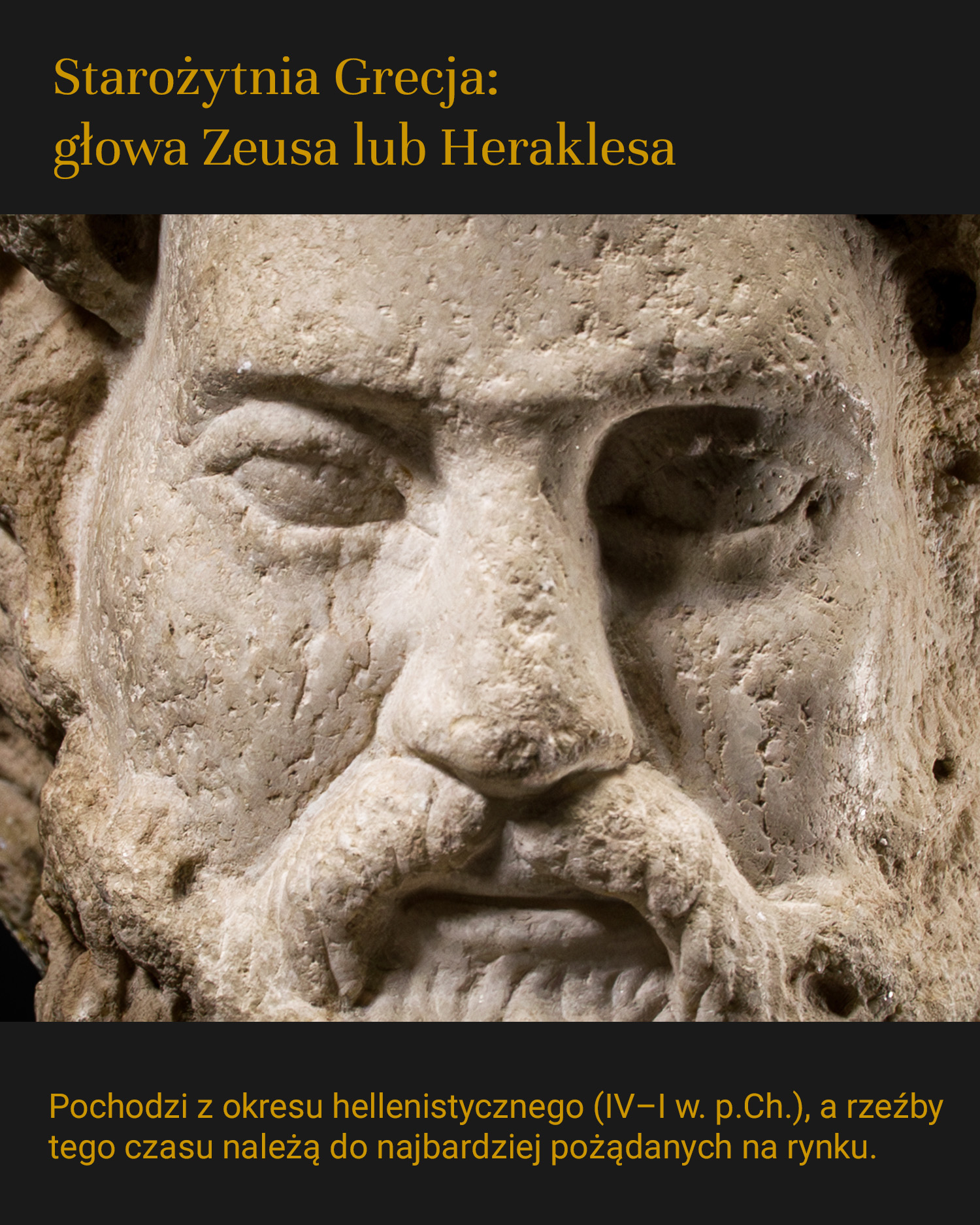
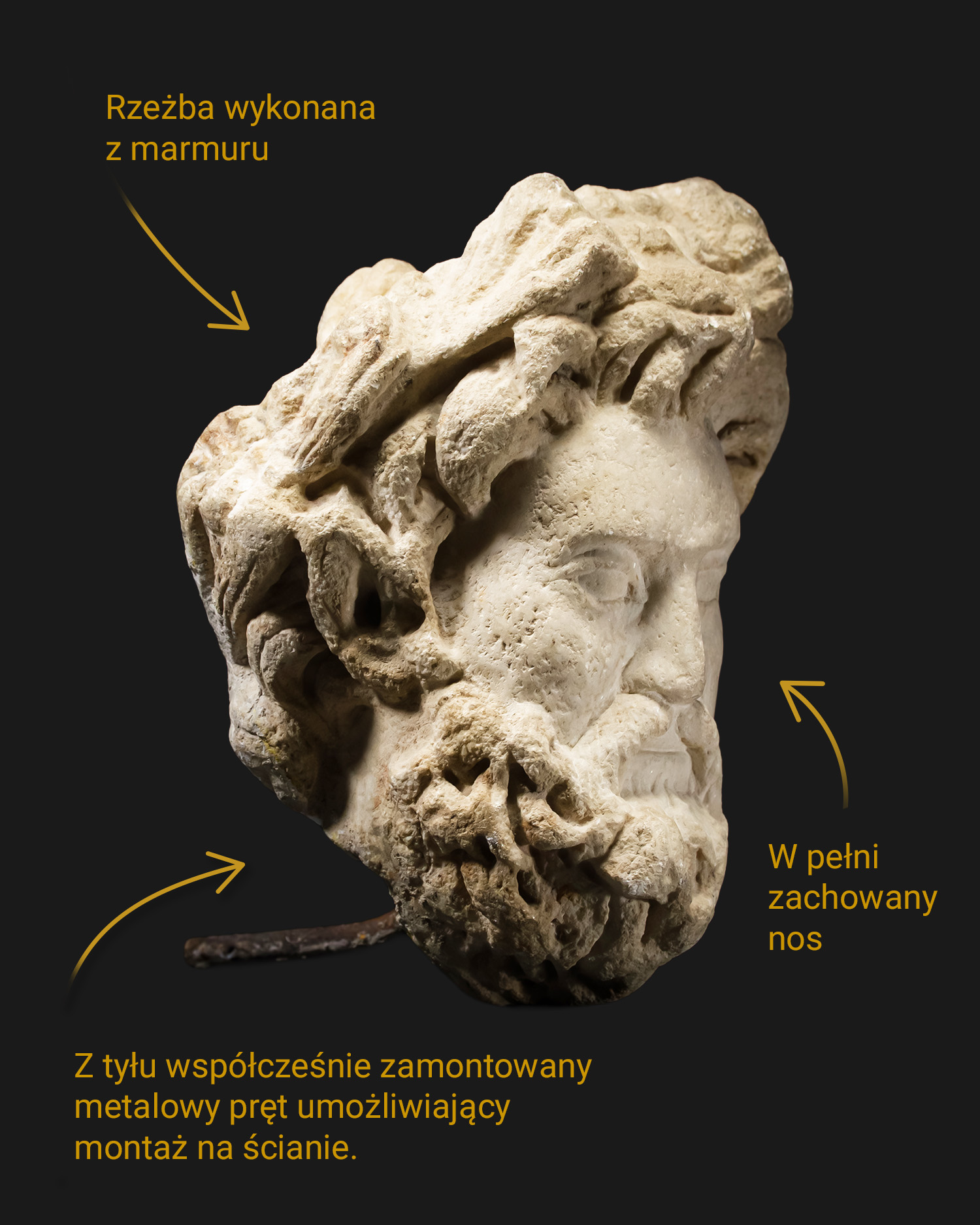
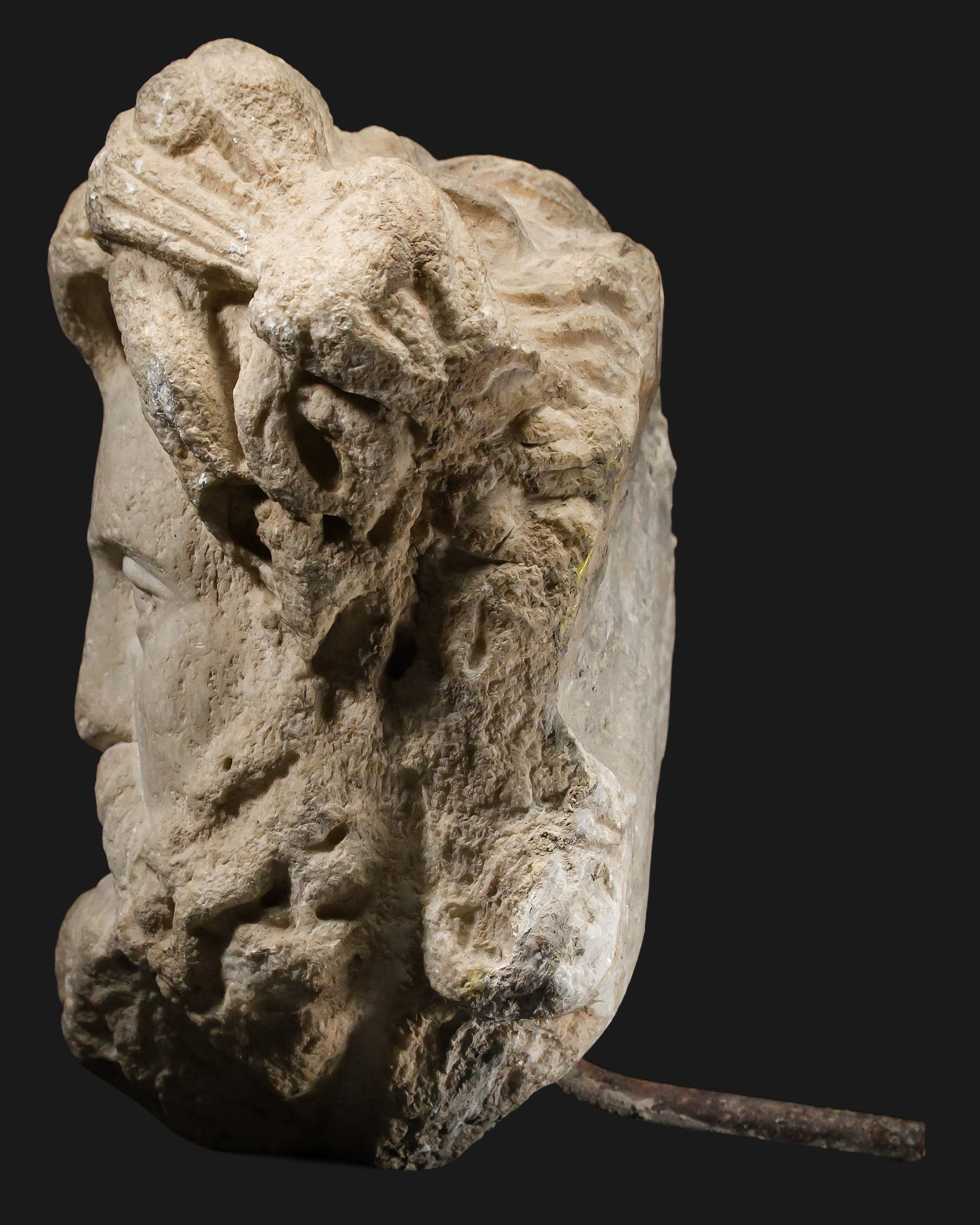
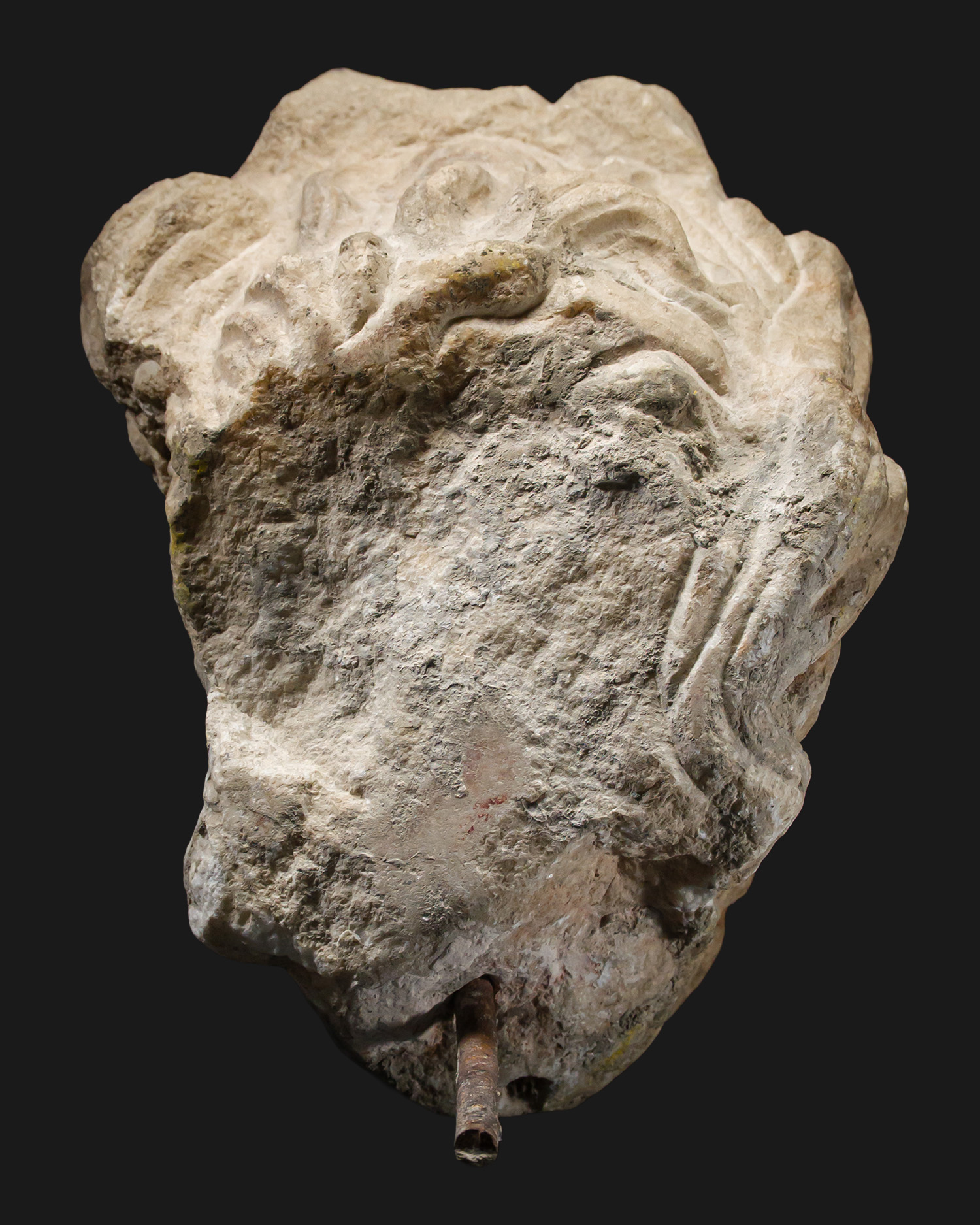
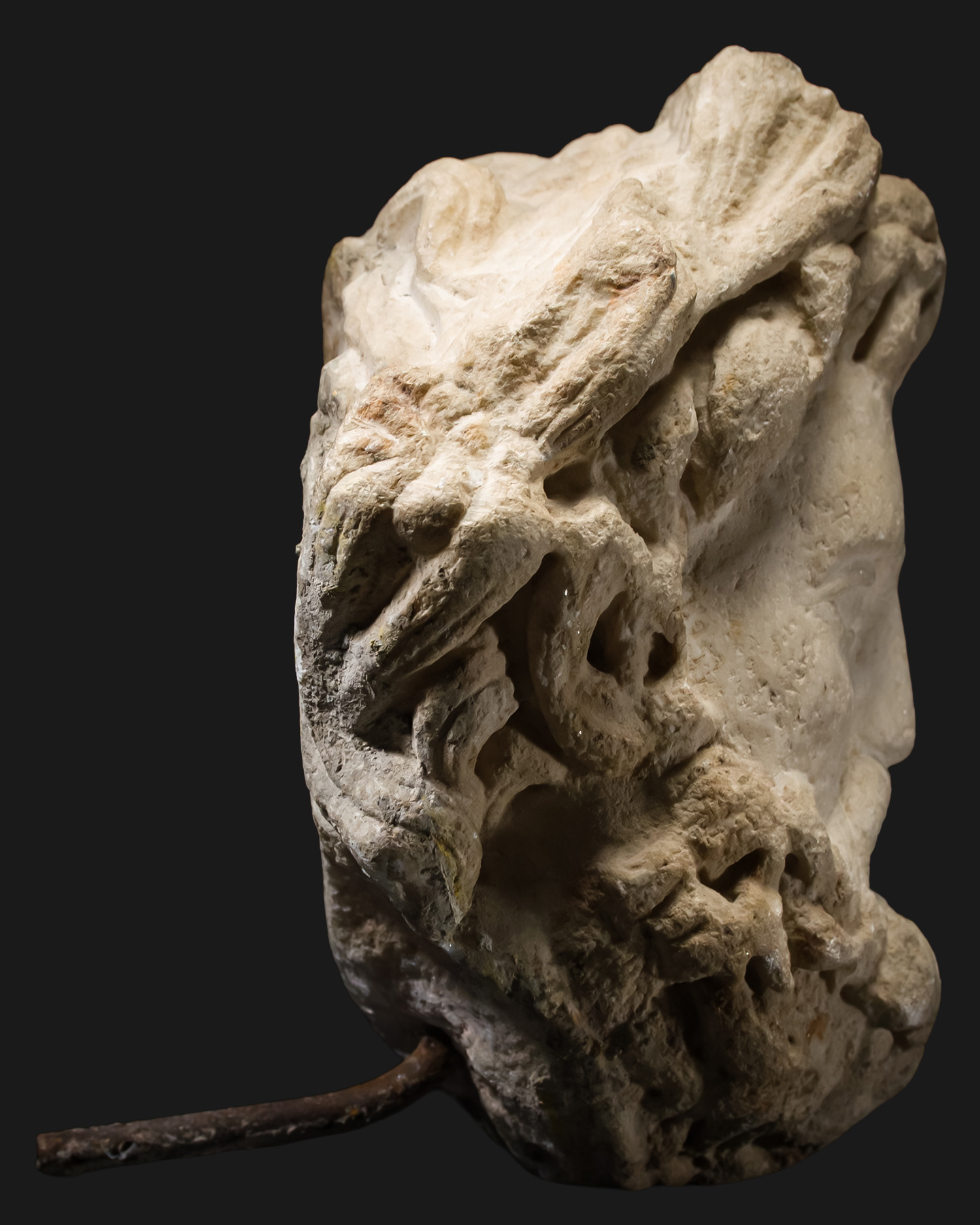
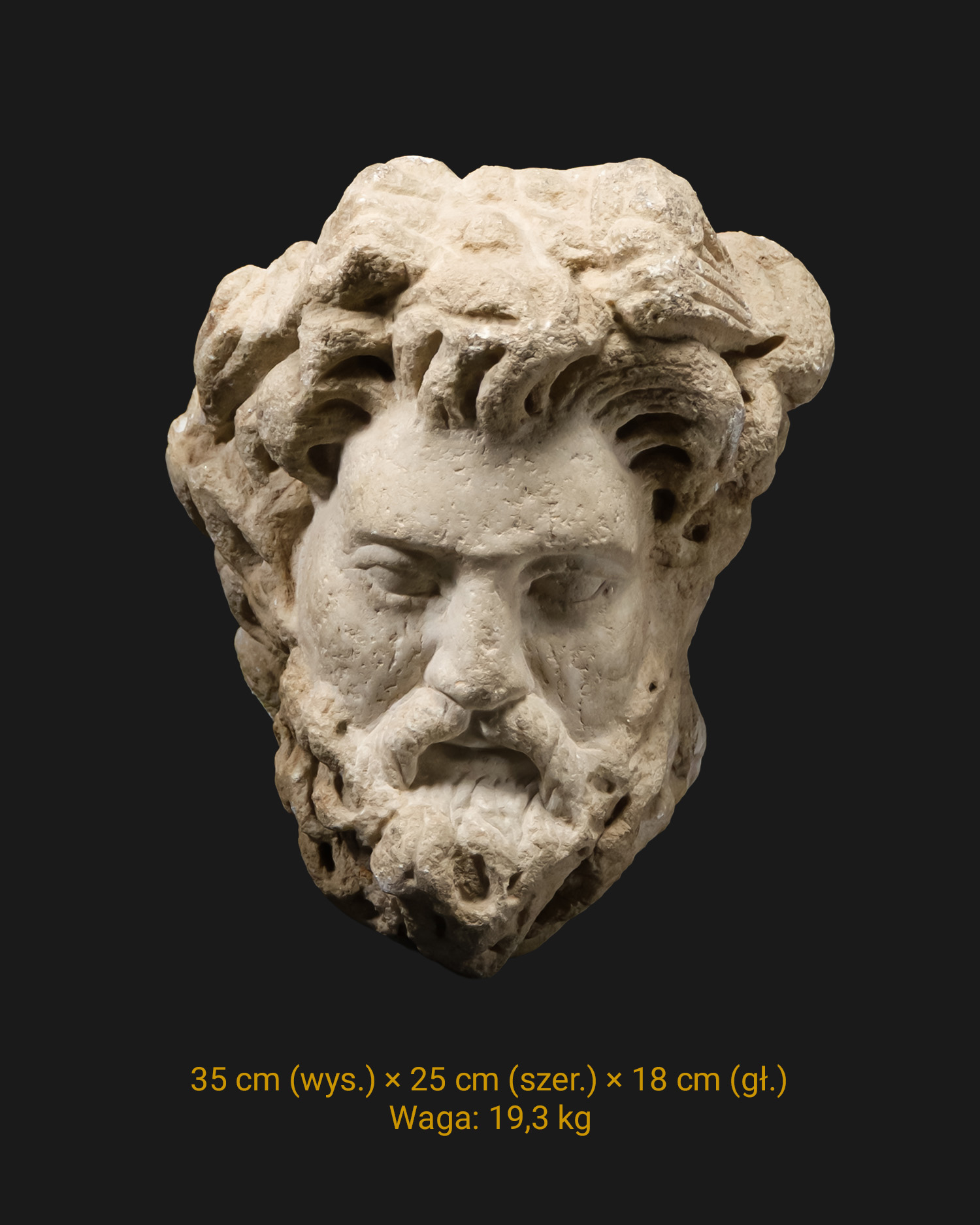
Sculpture of a god’s head (Zeus or Hercules), marble, Mediterranean basin, Hellenistic period
25000,00 zł
Monumental sculpture depicting the head of a bearded god, probably Zeus. The hair and beard form wavy, loose curls; a long mustache descends on the sides and frames the closed mouth. The face has a serious, focused expression, with a slightly flattened nose and furrowed brows. The eyes are carefully modeled, with a distinct upper eyelid, without marked pupils. The sculpture is made of white marble. The piece dates from the Hellenistic period in Greece, circa 300–200 BC.
Sprzedane
SKU:
700176
Categories: Sculpture, Ancient Greece, Antiquities
Additional information
| Weight | 19,3 kg |
|---|---|
| Dimensions | 35 × 25 × 18 cm |
| Type |
Sculpture |
| Form |
Head of a man |
| Materiał |
Marble |
| Kolorystyka |
Sandy ,White ,White-Gray |
| Technika |
Carving |
| Czas powstania |
Hellenistic period |
| Era |
Antiquity |
| State of preservation |
Very good |
Related products
Balmamarium, terracotta, Ancient Rome, ca. 1st-2nd century A.D.
430,00 zł
Authentic Roman balsamarium (unguentarium) from the 1st-2nd century BC, made of clay using a potter's wheel. The vessel, which had a distinctive form - with a cracked belly, slender neck and wide, orifice-shaped spout, was used to store liquid fragrances and toilet scents. It was often part of the equipment of the deceased. Formerly it was believed that balsamaria were used to collect the tears of mourners during funeral ceremonies - hence the misnomer lacrimatorium (from lacrima - tear).
Brahma, marble, India, 19th (?) century.
500,00 zł
A marble sculpture depicting Brahma, the Hindu creator god and personification of cosmic wisdom, belonging to the Trimurti trinity alongside Vishnu and Shiva. The object was hand-carved in gray marble and represents a simplified iconographic form in which Brahma is shown with three faces, instead of the traditional four .
The figure is depicted seated, with a sphere held in his hand, interpreted as a symbol of the earth or the entire cosmos, and refer to the act of creation and the order of the world.
Due to the limited worship of Brahma in India and the small number of temples dedicated to him, sculptural representations of this deity are rare, making the object particularly interesting. The sculpture is in very good condition.
Cartoon with a representation of a usekh necklace, Egypt, 1st millennium BC.
3300,00 zł
Cartonage (canvas covered with gypsum and polychrome) with a depiction of a wide necklace called a "usekh" collar, ancient Egypt, 1st millennium B.C. The collar has a semicircular form and is composed of several zones of ornament separated by narrow yellow bands. The different zones are filled with diverse decorative motifs: a row of circular ornaments filled with dots, imitating glass or faience beads, stylized "pendants," strips with alternating triangular segments, and rows of spindle-shaped ornaments. At the top, in the center, is a rectangular field with a representation of Horus, shown in profile in a seated position, facing right, inside a stylized temple. The sides of the collar show depictions of a red disk above the head of a falcon or hawk - most likely a depiction of the head of the god Ra with a solar disk.
It is impossible to say conclusively whether the offered collar covered the coffin or directly the mummy of the deceased, as both possibilities are possible. Without specialized research, its dating should be placed in a wide range covering the 1st millennium B.C. However, it is worth noting that similar decorative motifs appear on a cartonage collar from the collection of The Michael C. Carlos Museum in Atlanta, dated to 1069-750 B.C. (object no. 2018.010.254).
Christ Salvator Mundi, polychrome wood, Poland, 19th century.
2200,00 zł
Wooden sculpture depicting Christ as Salvator Mundi (Savior of the World), made in Poland in the 19th century. An example of folk Baroque sculpture, combining a religious theme with a simple, legible form. The full-plastic, frontal figure shows a young Jesus in a gesture of blessing, with a globe in his left hand.
The figure is dressed in a white tunic and blue coat with yellow piping. Remnants of the original polychrome and natural traces of use are visible. The simplified modeling, linear folds and expressive face indicate a folk workshop from southern Poland, representing the late Baroque tradition of devotional sculpture.
Head of an angel (?), sandstone, France, ca. 1300
3600,00 zł
The Gothic full-figure sculpture depicting a head, most likely an angel, was created in the circle of Parisian sculpture around 1300. The face with a calm expression and idealized features, surrounded by curls supported by a band, fits the type of depictions characteristic of French sculpture of the time of Philippe the Beautiful (1285-1314). The style, which spread in the 14th century, is sometimes referred to as "court style." Sculpture with traces of polychromy, damage and traces of surface erosion. Made of sandstone, it was originally most likely part of a full-figure representation. It most likely had a sacred function.
Oinochoe, terracotta, Ancient Greece, 4th century BC.
1500,00 zł
A ceramic vessel, turned on a wheel, used in antiquity as a basic pitcher at Greek feasts (symposion). Oinochoe presents a variant typical of the Greater Greece region with a three-leaf spout, whose innovative form facilitated precise portioning of liquid without spilling.
Dark gray/dark brown matte surface with visible mineral deposits and earth deposits. The state of preservation is very good, the handle and spout are complete, which increases the collector and research value. This is a rare utilitarian piece, representing a tangible piece of ancient Italian culture.
Saint John the Evangelist, late Gothic wooden sculpture, ca. 1500
6400,00 zł
Full-plastic sculpture depicting St. John the Evangelist , made of wood, dated around 1500. The figure is shown in counterpoint, with a slightly bowed head and entwined hands holding a book - an attribute of the Evangelist. The sculpture is preserved in its original polychrome, with a visible structure of pigment layers and natural cracking of the wood.
The work may have been part of a winged altarpiece (retabulum), most likely in the Crucifixion group.
Samuel Lipszyc (1880 – 1943), Naked ballerina, patinated bronze, ca. 1920
5000,00 zł
Sculpture by Samuel Lipszyc in the Art Déco style depicting a nude ballerina in a dynamic pose, balancing on one foot. The sculpture is made of green patinated bronze, set on a marble pedestal with decorative contrasting veining. The dancer's dynamic silhouette and streamlined lines are characteristic of the modernist aesthetic of the 1920s. The figure exudes lightness, grace and modern elegance, capturing the spirit of the Art Déco era. The work is signed "Lipchytz" on the left foot.
