

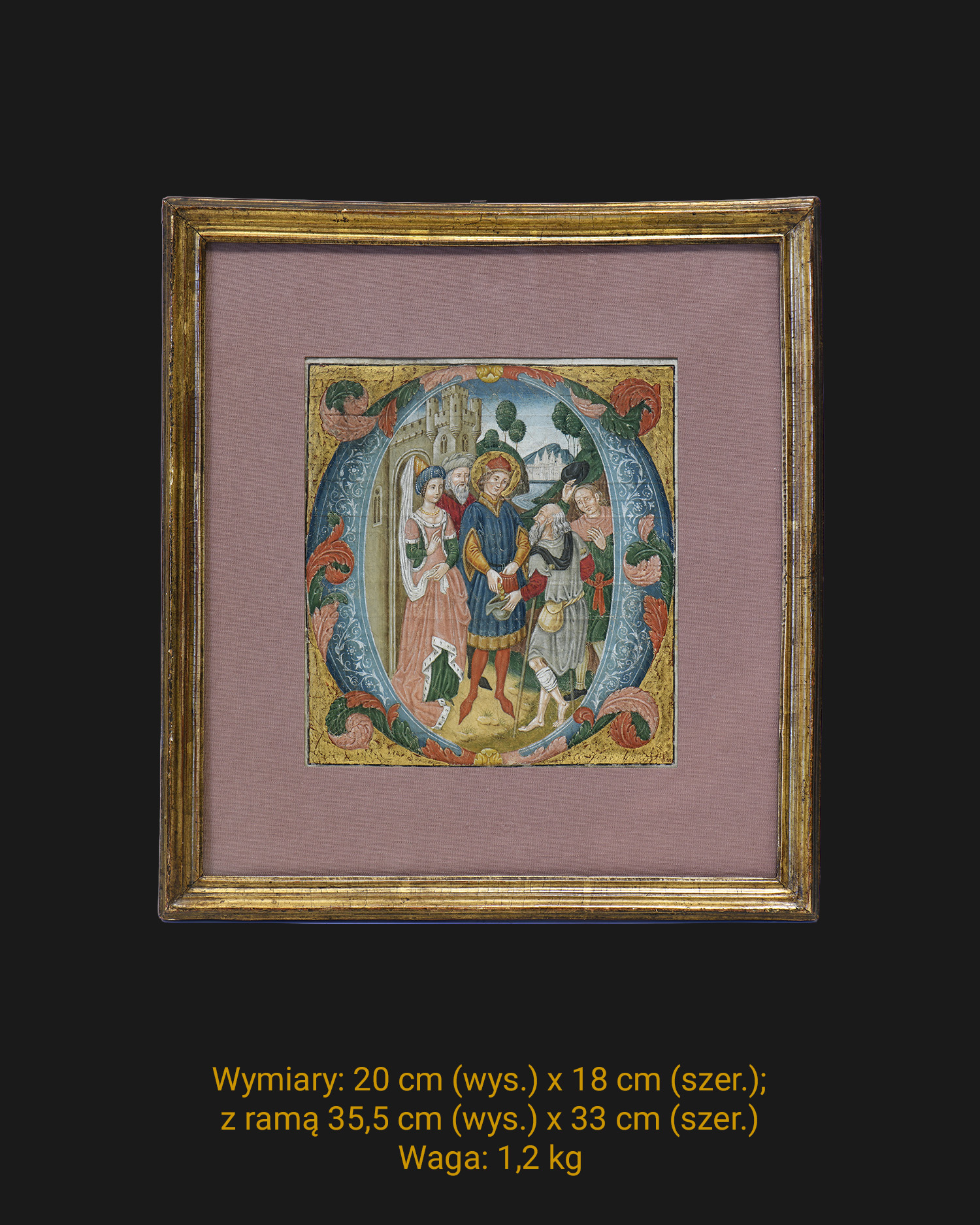

Fragment of an antiphonary page with illuminated initial, parchment, Europe, 15th century
4100,00 zł
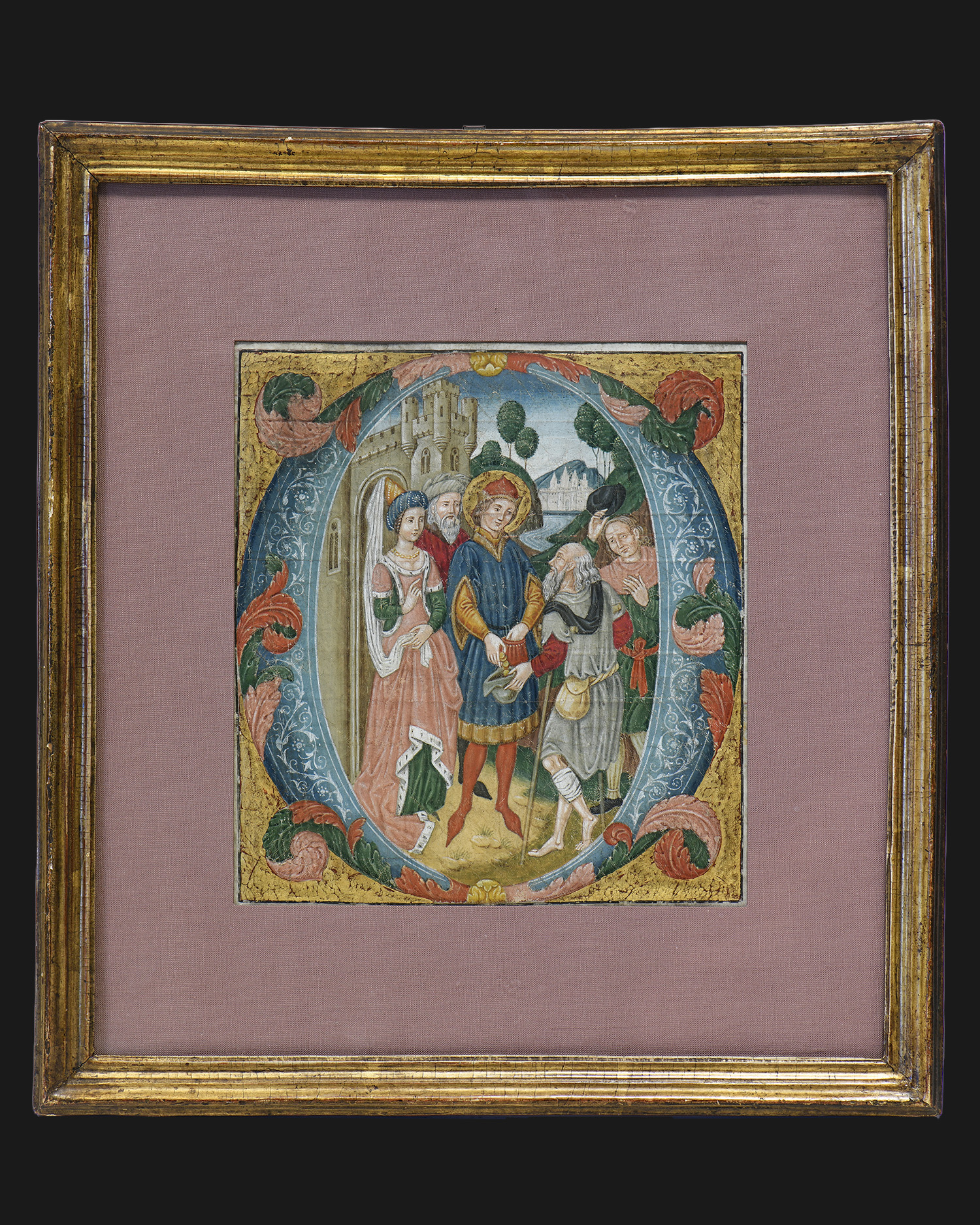
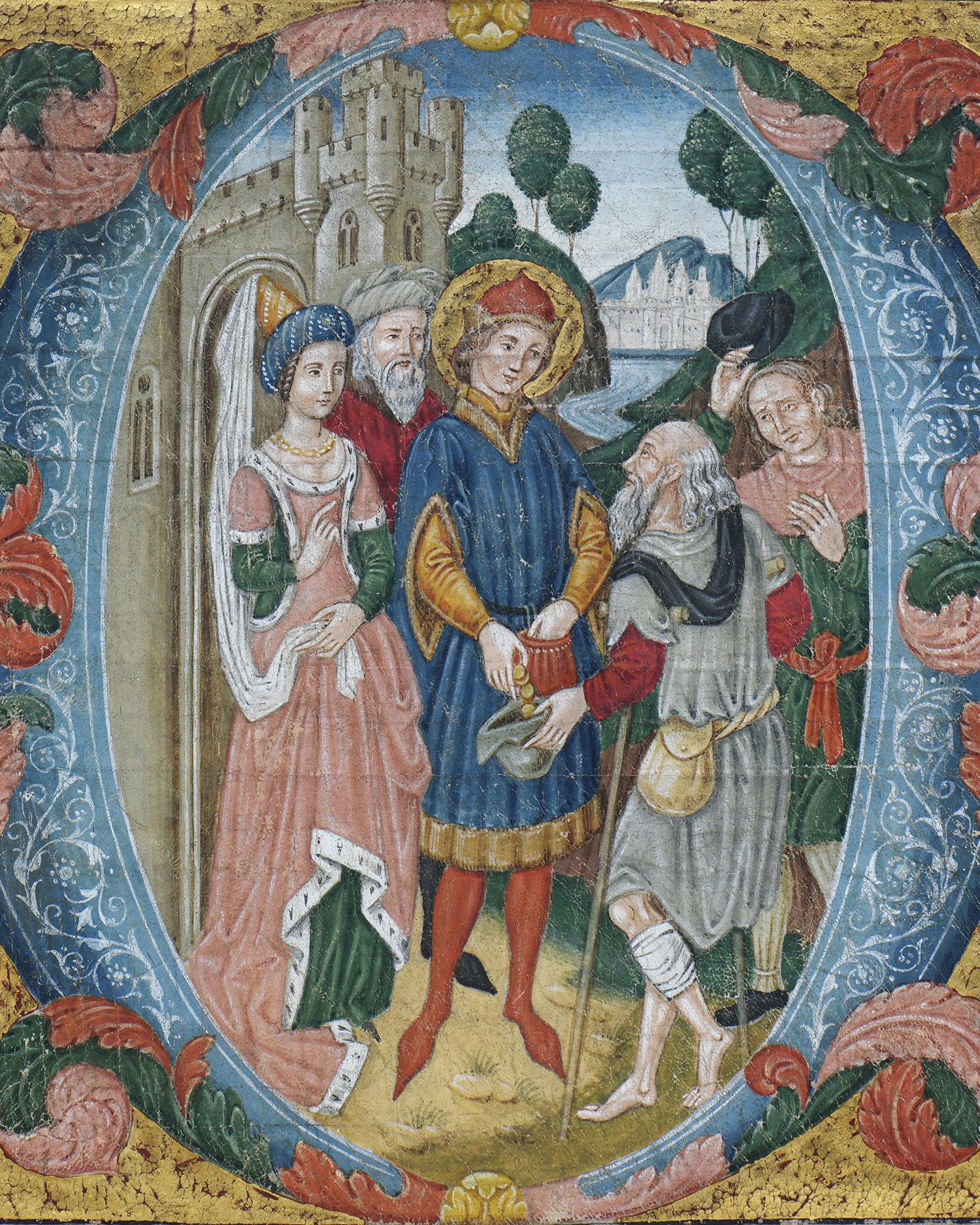
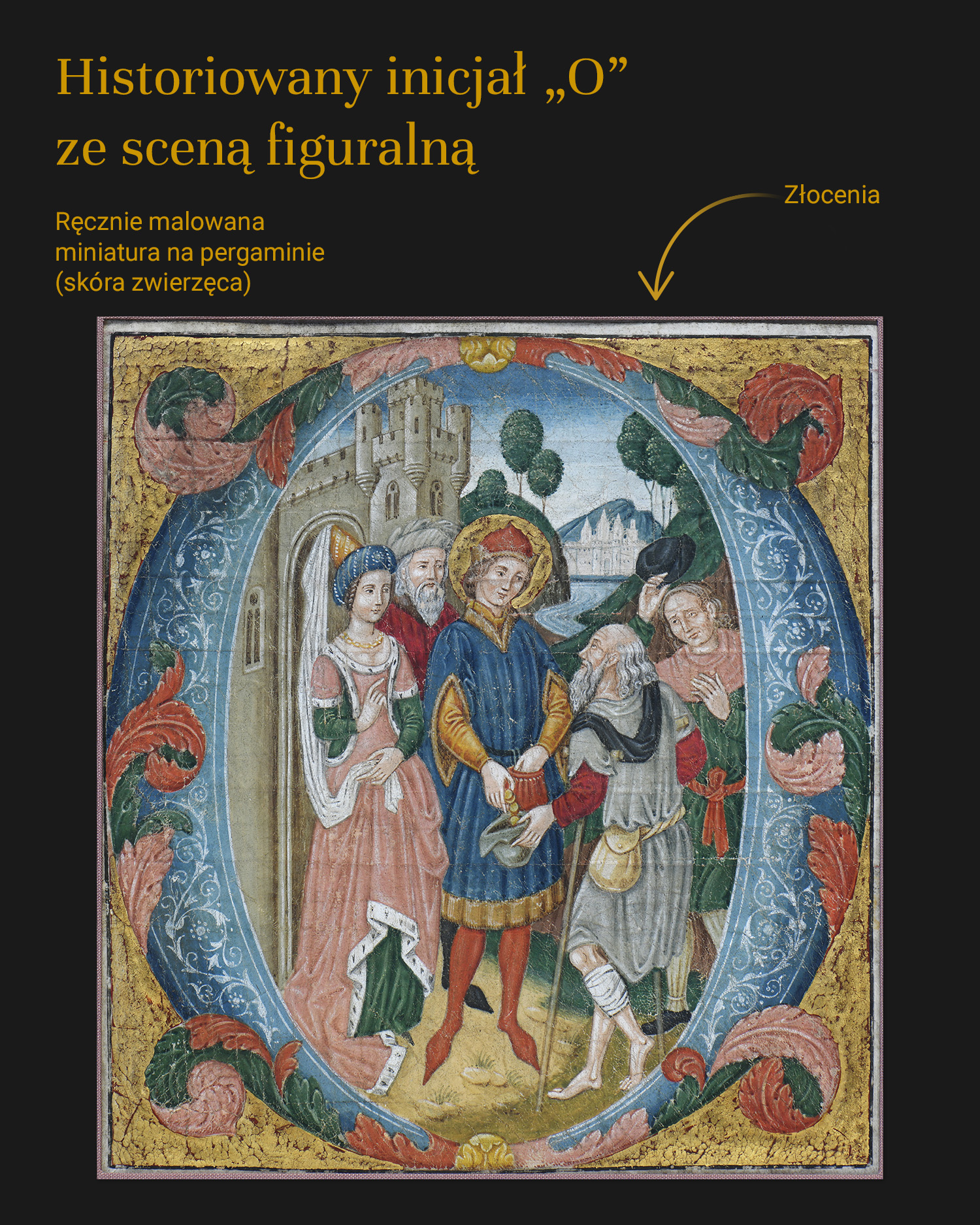
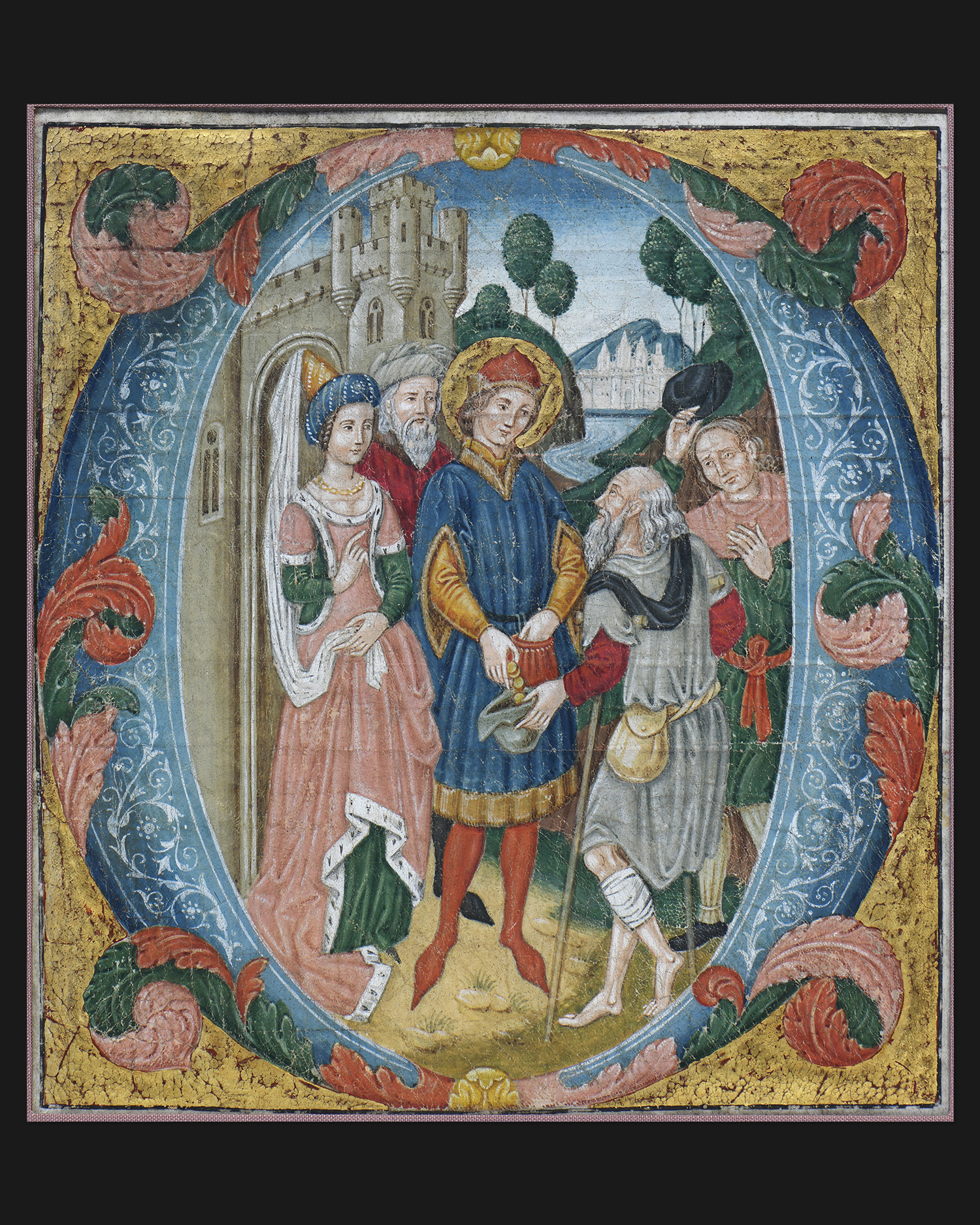
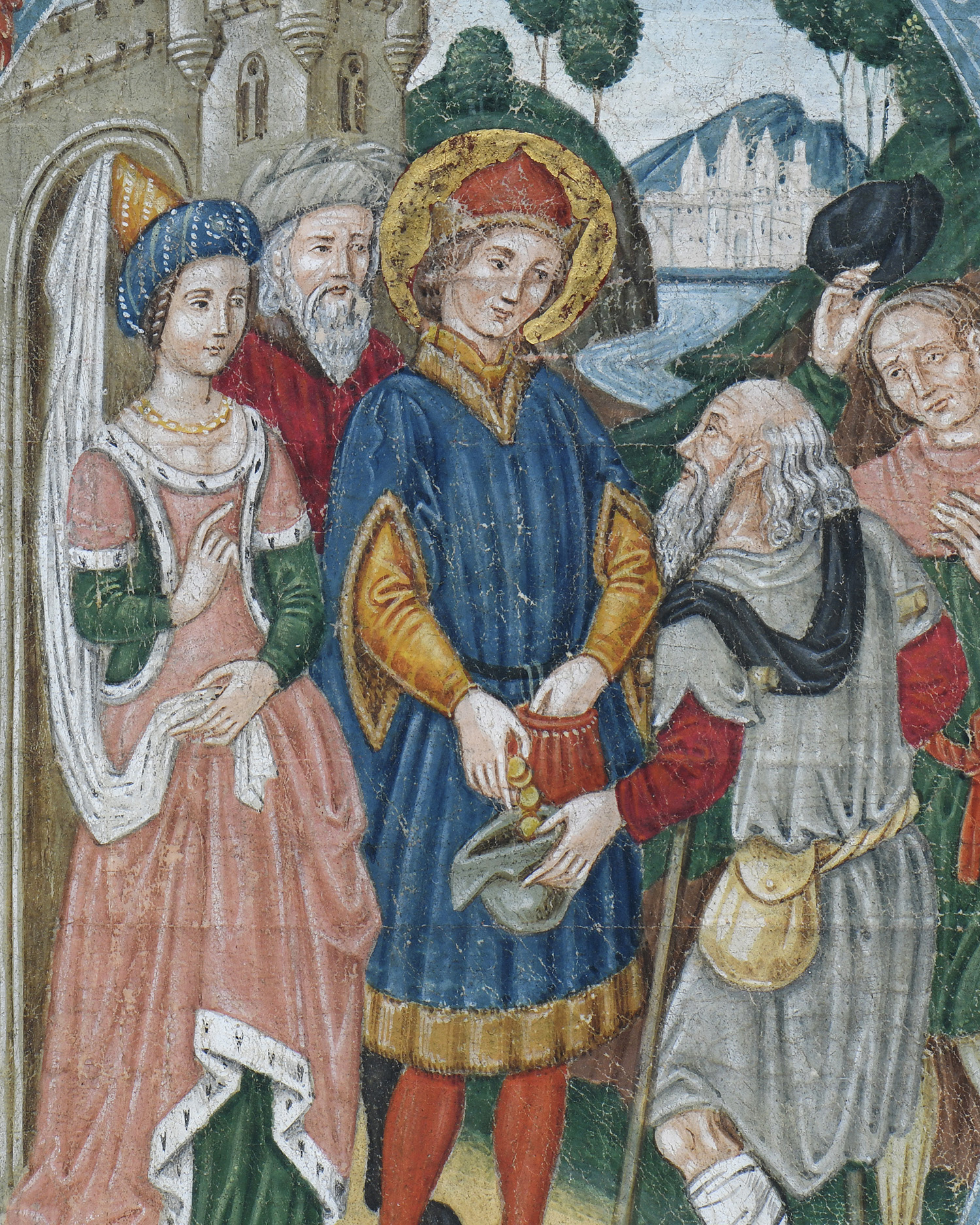
The fragment of the page visible within the frame is entirely occupied by a historiated initial “O”. The figural scene within depicts a haloed youth dressed in secular attire giving alms to an old beggar supported by crutches. He is accompanied by a young woman and an older man, with urban architecture visible in the background.
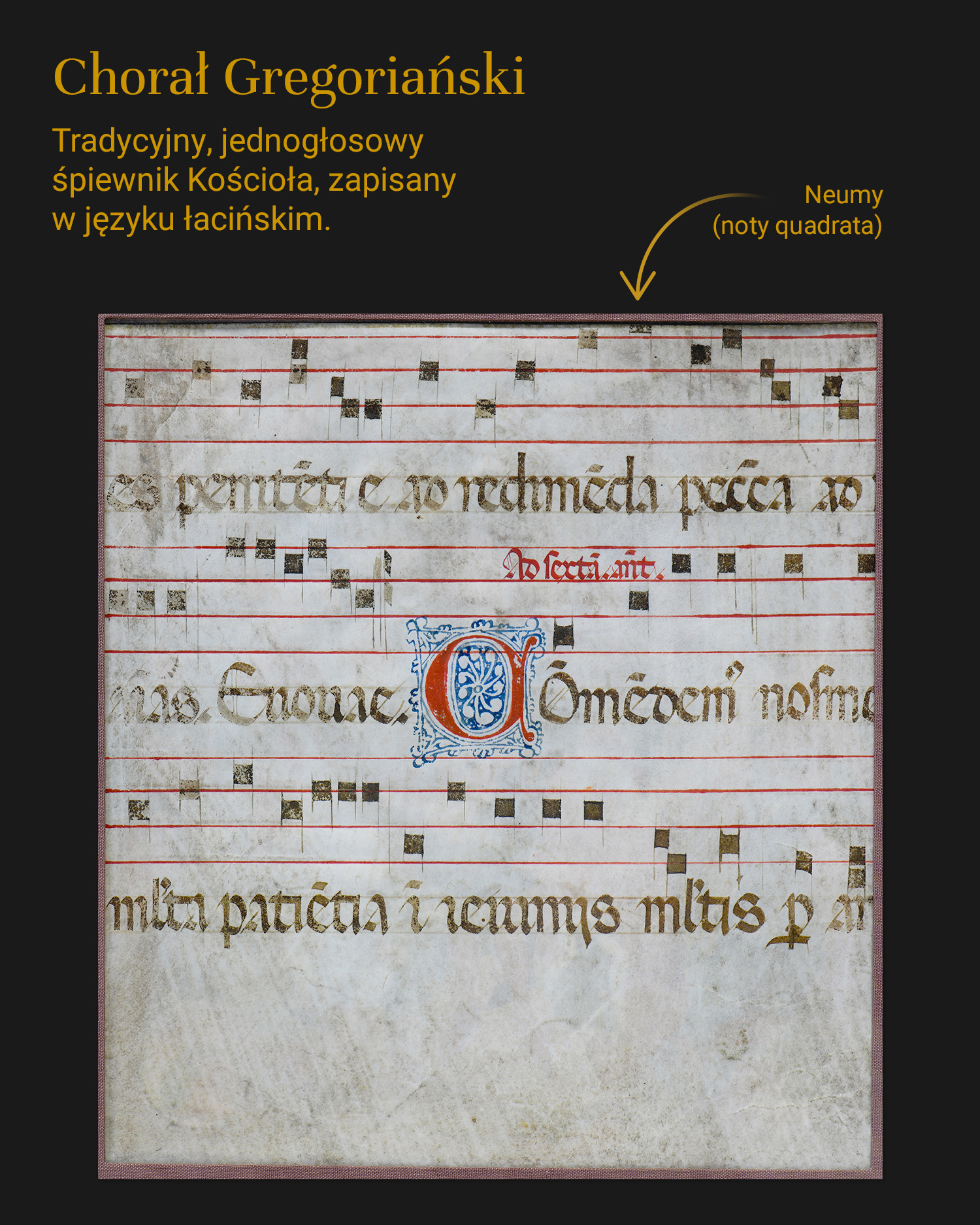
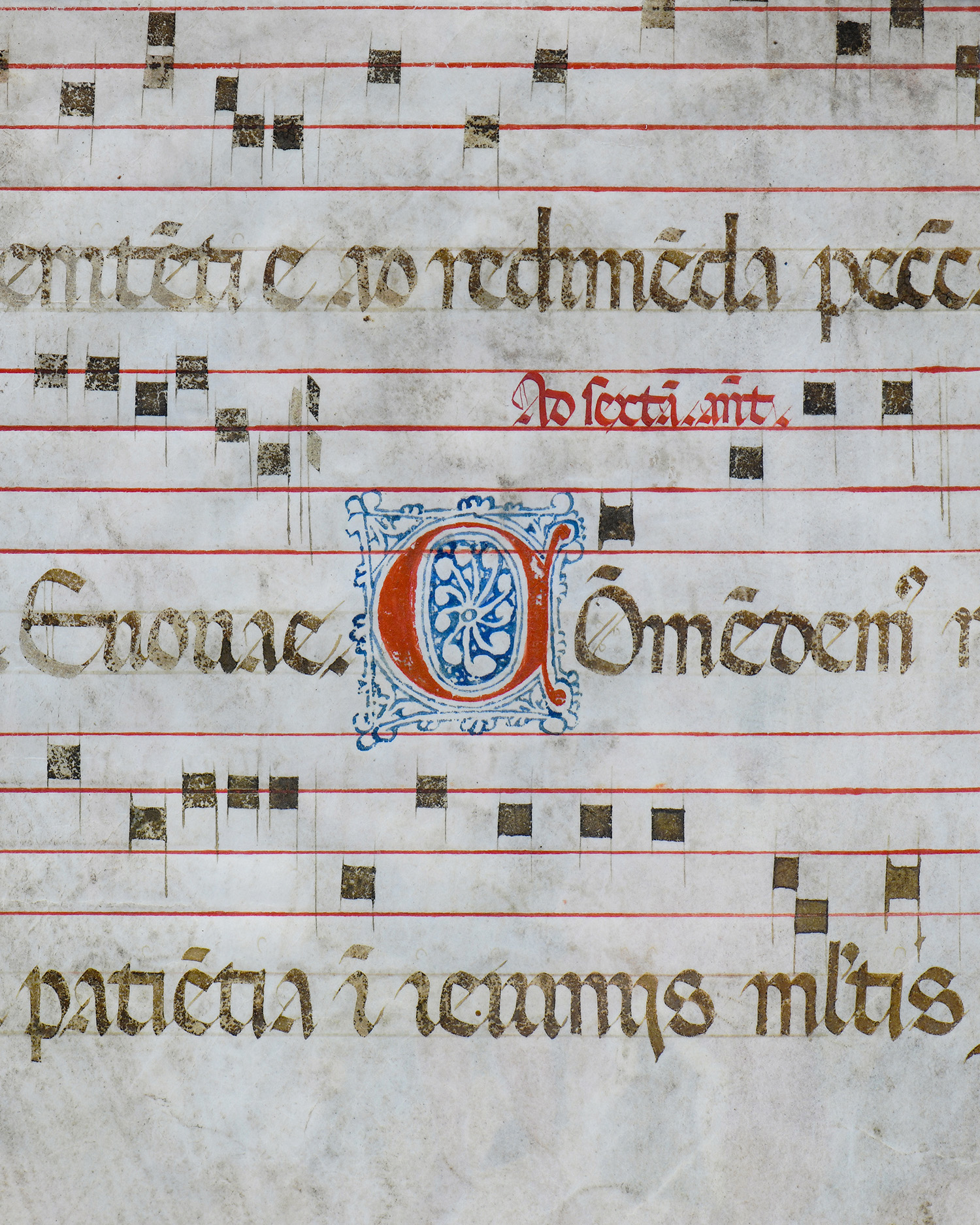
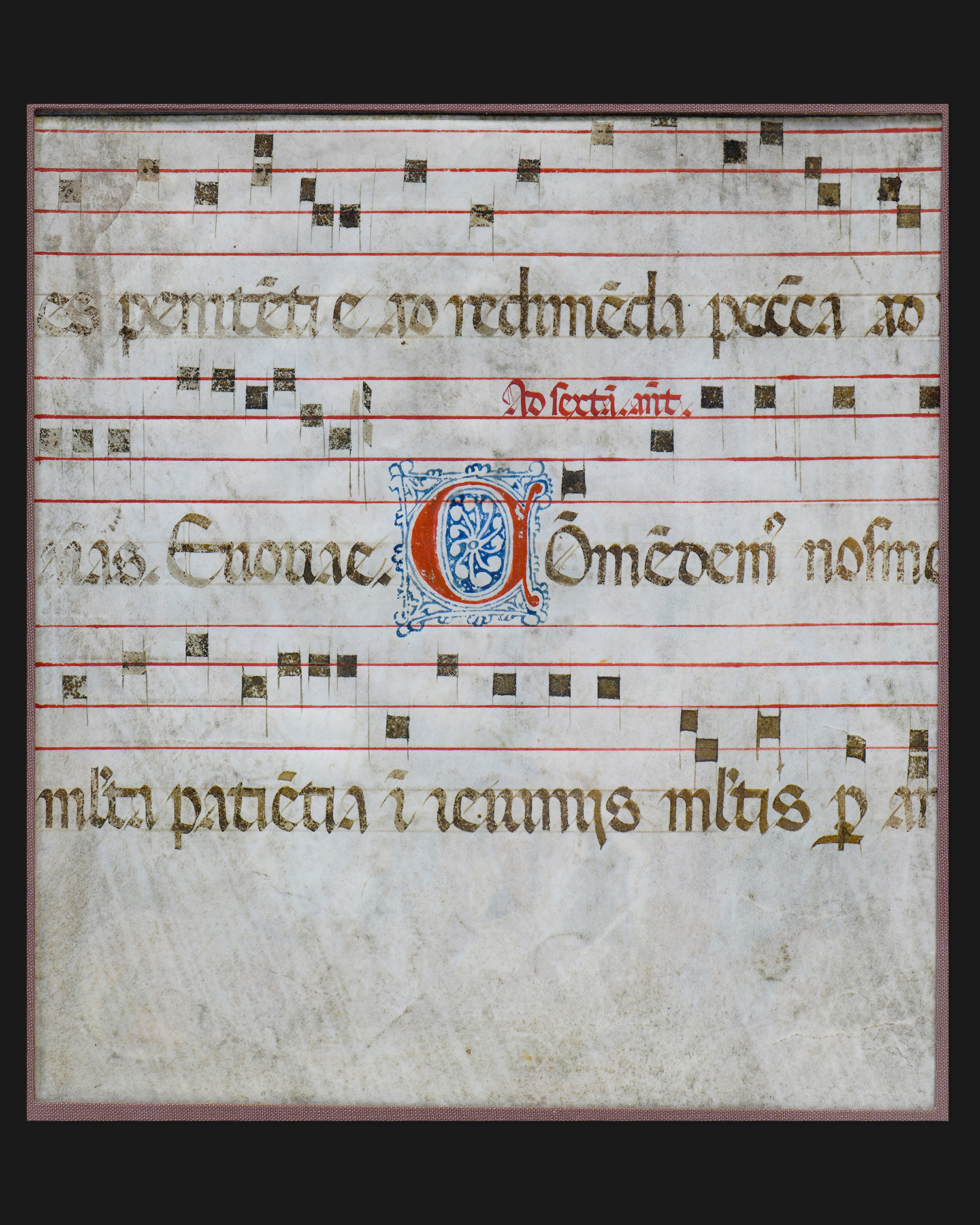
The reverse side features a fragment of Latin liturgical text written in Gothic minuscule and musical notation using square neumes (predecessors of notes used in medieval Europe) on a four-line staff, characteristic of Gregorian chant. The presence of the formula “Euouae” (a notation of vowels from the phrase saeculorum Amen), typical of psalm endings in antiphonal arrangement, allows identification of the notation as a fragment of an antiphon. The page also features a decorative initial “O” beginning a new antiphon.
The page is framed in a 19th-century gilded frame with a gently curved upper edge.
An object of extraordinary aesthetic and collectible value. A great rarity on the market!
Sprzedane
| Weight | 1,2 kg |
|---|---|
| Dimensions | 20 × 18 cm |
| Type |
Page from an antiphonary |
| Form |
Framed liturgical manuscript page |
| Kolorystyka |
Blue ,Gold ,Gray ,Green ,Red |
| Technika |
Gilding ,Tempera on parchment |
| Czas powstania |
15th century |
| Era |
The Middle Ages |
| Kraj pochodzenia |
Europe |
| State of preservation |
Very good; only microcracks in the paint layer typical of age |
Related products
Egbert van Heemskerck the Younger (1676–1744), Tavern Scene, oil on canvas, England, after ca. 1695
Giacomo Francesco Cipper – “il Todeschini”, Young man eating from a wooden bowl, oil on canvas, Italy, 1st third of the 18th century
Gillis van Tilborgh (ca. 1625 – ca. 1678) – workshop or circle, Interior of an inn with backgammon players, oil on duplicated canvas, Netherlands, ca. 1650-1670
Govert Camphuysen (1623/1624-1672) – attributed, Landscape with cattle grazing in front of a hut, oil on board
In front of the village thatched hut, sheep, a cow and a goat are grazing. Next to it, a villager is sleeping under a tree. To the left of the composition, a second scene is visible: a man leading a bull over a small bridge over a stream. In the background is a landscape with trees and gentle hills, and the sky occupies a large part of the painting, building the mood of the whole scene. What draws attention is the exquisite way in which the animals are depicted. This was a specialty of Camphuysen, whose work was inspired by the style of Paulus Potter. Warm, earthy colors dominate - browns, ochres, dim greens and broken yellows. The light is soft, diffused, as if in the early morning or towards evening. The sky has shades of gray, beige and soft pink, suggesting changing weather or impending dusk. The contrast between the bright sky on the left and the darker, more saturated part with the cottage on the right gives the image depth and balance.
Hendrik van Steenwijk II (ca. 1580 – 1649) – circle, Interior of a Gothic church, oil on board, Flemish school, 17th century.
The painting depicts the interior of a Gothic church, executed in the Flemish school of the 17th century, in the circle of Hendrick van Steenwijk i.e. one of the pioneers of perspective painting. The composition, built on an axis leading towards the main altar, shows a monumental interior with pillars, cross-ribbed vaults and side chapels. Figures of the faithful and clergy are visible in the space, introduced to emphasize the scale of the architecture and the mood of concentration.
The painting was made with oil technique on board, in typical Flemish school style. The frame is original, wooden, veneered, with preserved gilt edge.
The composition refers to the solutions used by Hendrick van Steenwijk the Elder and Younger, as well as Pieter Neefs and Bartholomeus van Bassen, developing the genre of architectural painting in Antwerp and Delft.
John Baptist Lambrechts (1680 – after 1731), Genre scene in an inn, oil on board, ca. mid-18th century.
John Baptist Lambrechts (1680 – after 1731), Genre scene in an inn, oil on board, ca. mid-18th century.