

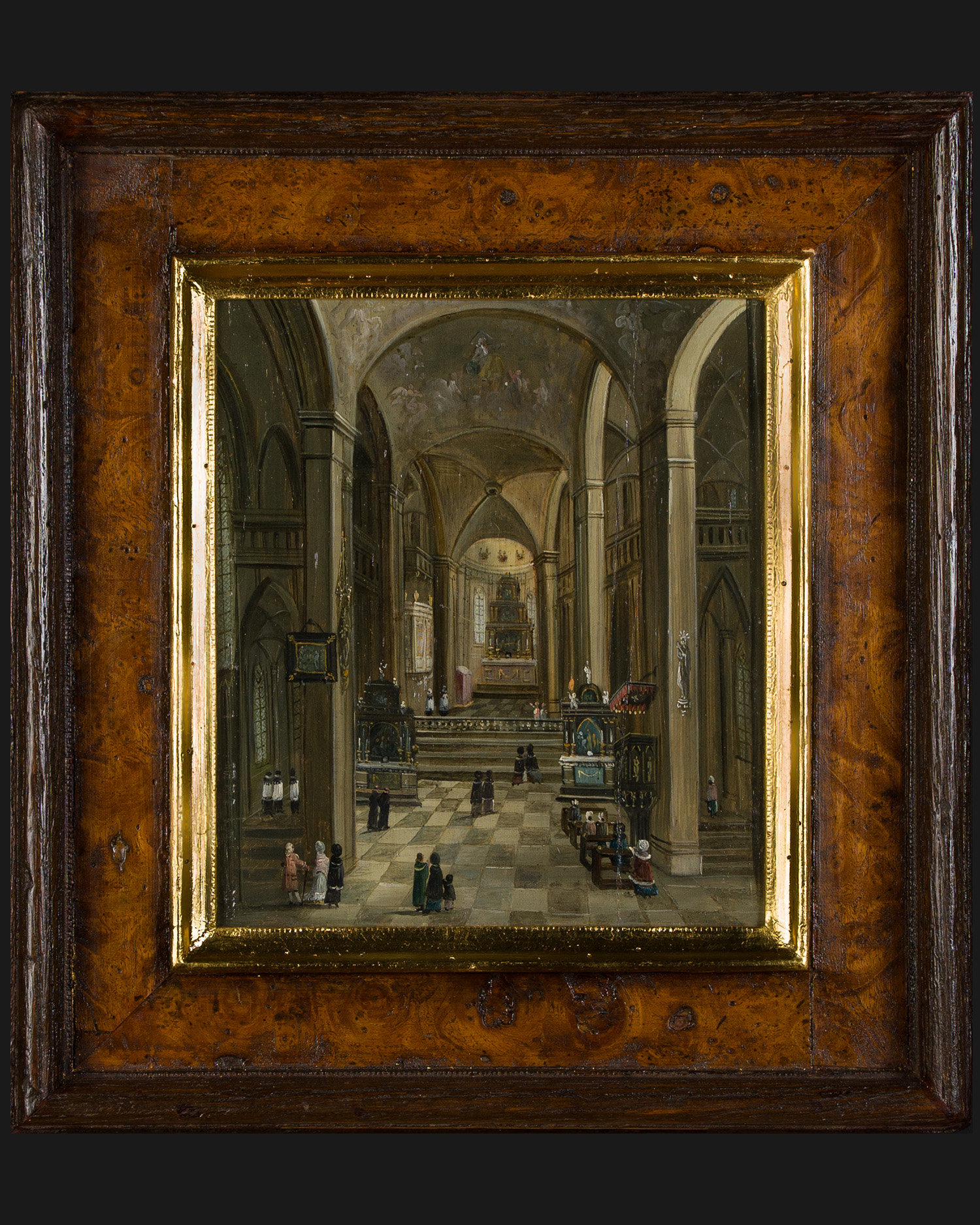
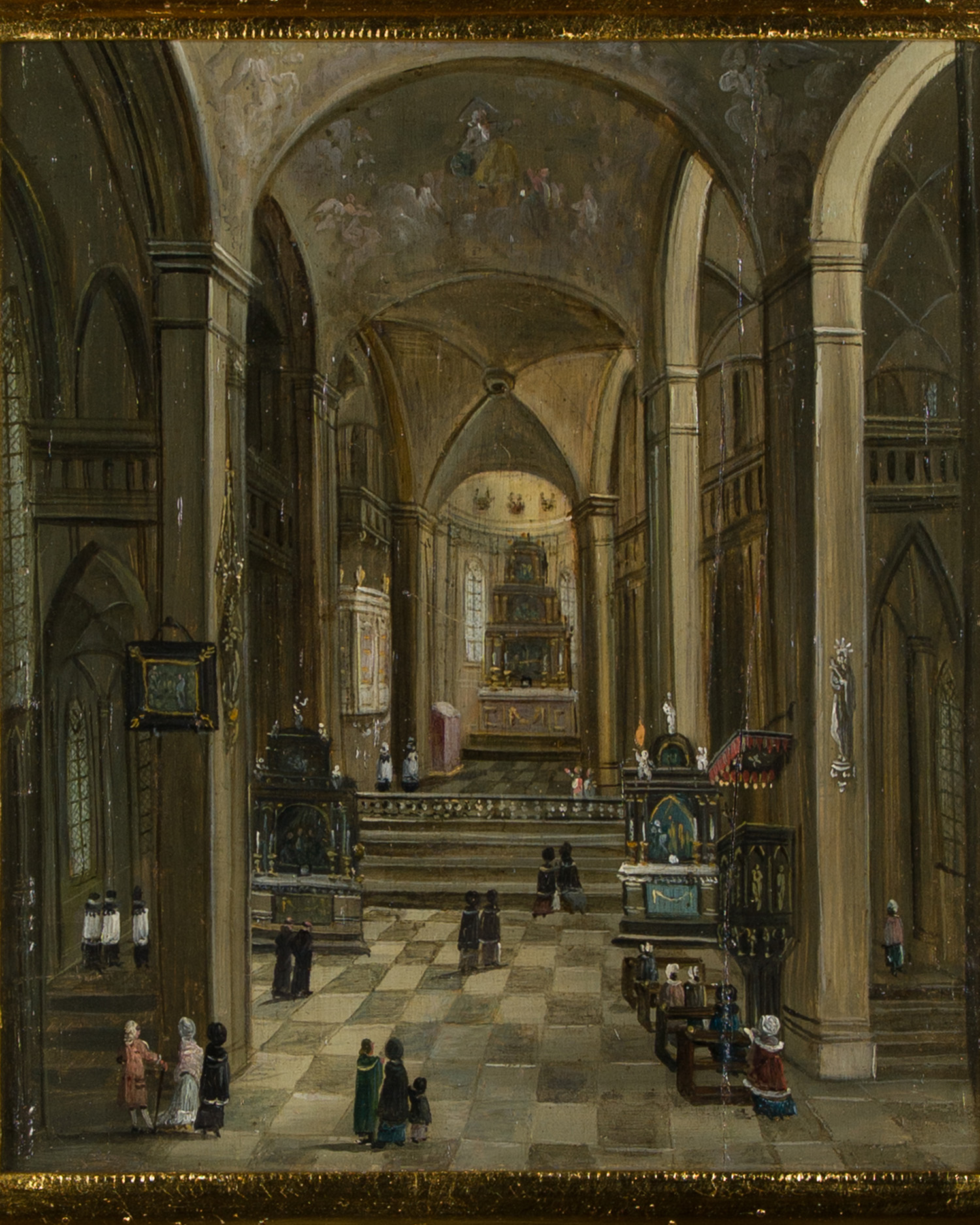
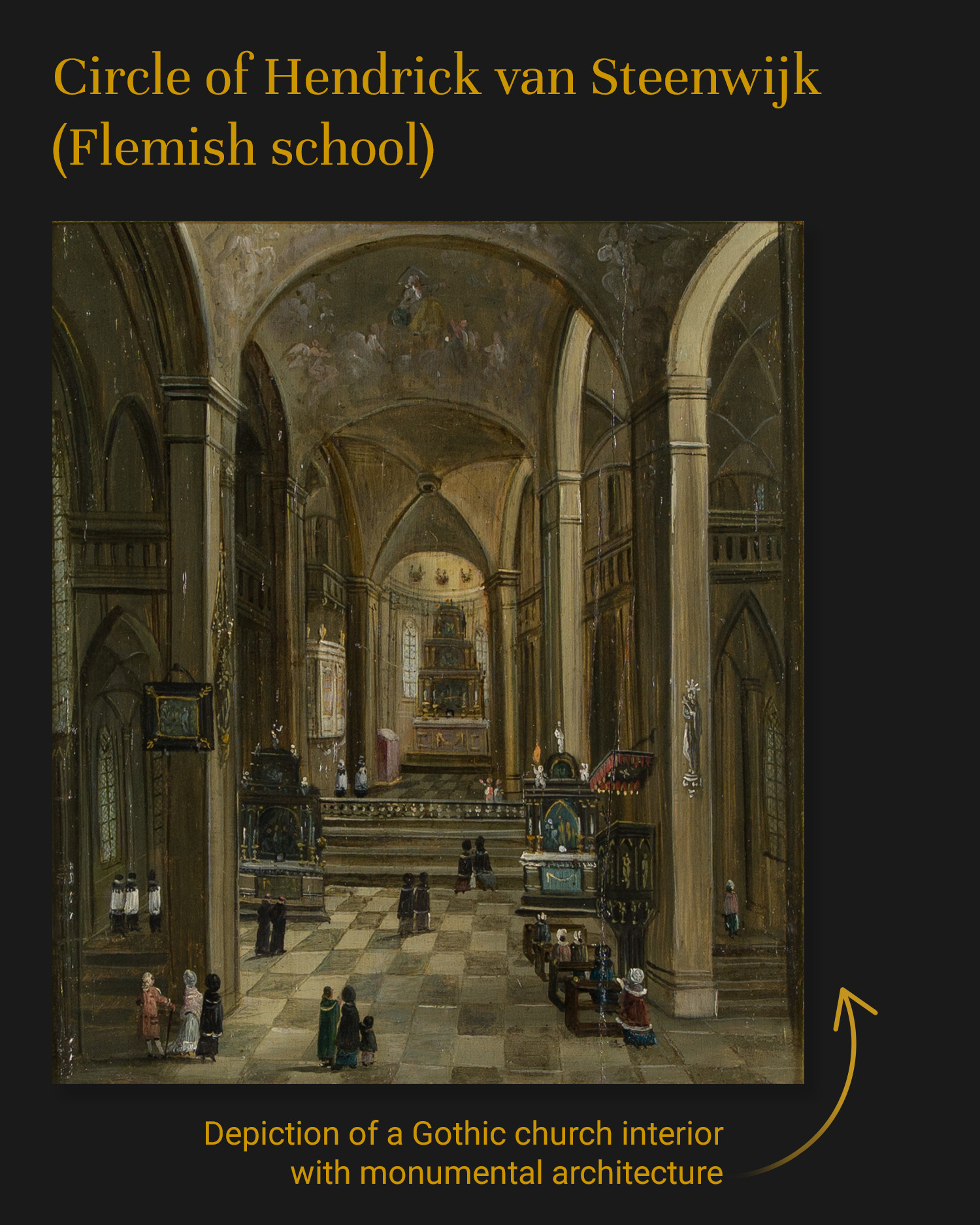
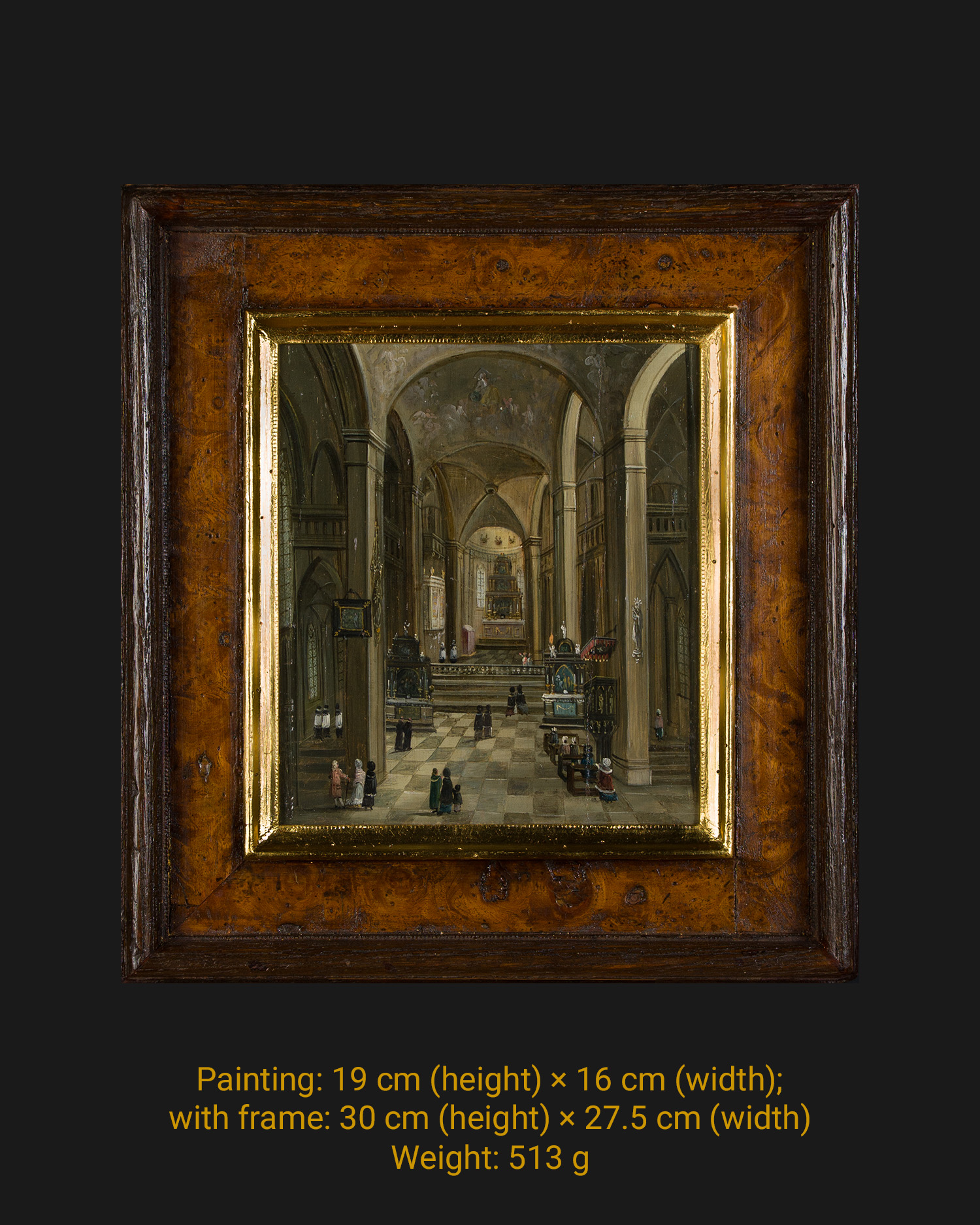

Hendrik van Steenwijk II (ca. 1580 – 1649) – circle, Interior of a Gothic church, oil on board, Flemish school, 17th century.
2800,00 zł
The painting depicts the interior of a Gothic church, executed in the Flemish school of the 17th century, in the circle of Hendrick van Steenwijk i.e. one of the pioneers of perspective painting. The composition, built on an axis leading towards the main altar, shows a monumental interior with pillars, cross-ribbed vaults and side chapels. Figures of the faithful and clergy are visible in the space, introduced to emphasize the scale of the architecture and the mood of concentration.
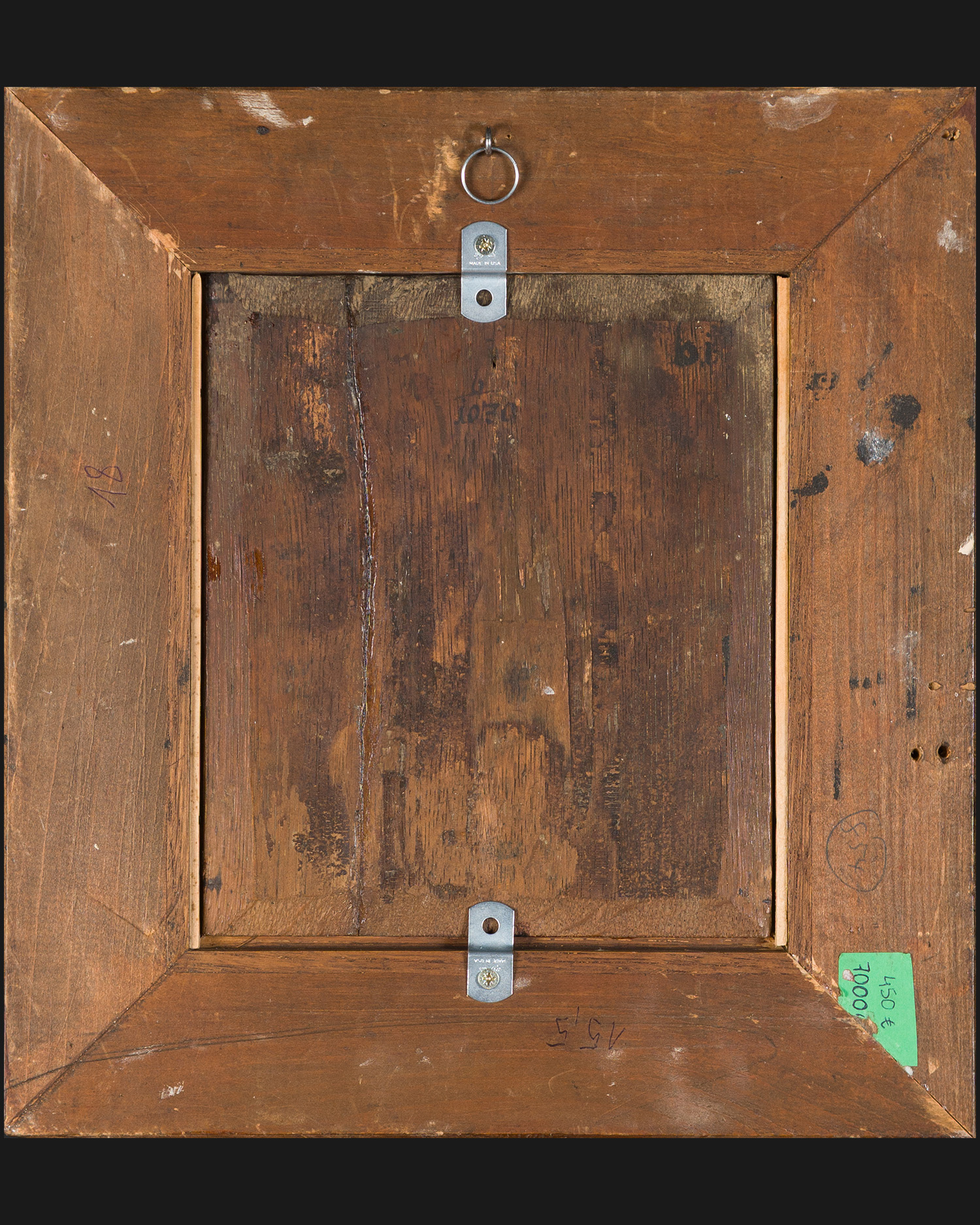
The painting was made with oil technique on board, in typical Flemish school style. The frame is original, wooden, veneered, with preserved gilt edge.
The composition refers to the solutions used by Hendrick van Steenwijk the Elder and Younger, as well as Pieter Neefs and Bartholomeus van Bassen, developing the genre of architectural painting in Antwerp and Delft.
Sprzedane
| Weight | 0,513 kg |
|---|---|
| Dimensions | 16 × 19 cm |
| Form |
Scene inside a Gothic church |
| Kolorystyka |
Earthy palette |
| Materiał |
Board ,Oil paints |
| Technika |
Oil on the board |
| Era |
Baroque |
| Kraj pochodzenia |
Flanders |
| Czas powstania |
17th century |
| State of preservation |
Very good; board stable, minor losses of paint layer, frame with minor traces of use |
Related products
Battle of Mohacz, oil on canvas, Krakow, 1886
Egbert van Heemskerck the Younger (1676–1744), Tavern Scene, oil on canvas, England, after ca. 1695
Fragment of an antiphonary page with illuminated initial, parchment, Europe, 15th century
German-Italian Master, Image from the Cross, oil on board, Western Europe, 16th century.
John Baptist Lambrechts (1680 – after 1731), Genre scene in an inn, oil on board, ca. mid-18th century.
Pieter Neefs II (1620 – 1675/1685), Night Mass in a Gothic Church, oil on board, Flanders, 17th century.
The painting depicts the interior of a Gothic church, by Pieter Neefs the Younger (1620–after 1675), a Flemish painter specializing in 17th-century sacred interiors. The composition based on a precise linear perspective leads the eye towards the main altar, around which the faithful and clergy participating in the liturgy are gathered.
The painting was made in oil technique on board, without a visible signature. The upper part of the composition has been cropped, resulting in the loss of the original format and probably also the author's signature.
The work represents the mature style of Pieter Neefs the Younger - precise rendering of space, controlled light and realistic depiction of architecture, characteristic of the Antwerp school. Paintings of almost identical composition appear in several well-known collections and collections - including the Szépművészeti Múzeum (Museum of Fine Arts) in Budapest and a Sotheby's auction (2021).
It is worth mentioning that works from this series are also sometimes attributed to Pieter Neefs the Elder (c. 1578-1656), confirming the strong stylistic affinity between the works of father and son.
Bibliography / links:
- Peeter Neefs I - Invaluable
- Pieter Neefs II - Art Salon
- Pieter Neefs I - Museum of Fine Arts Budapest (Wikimedia Commons)
- Pieter Neefs II - Sotheby's Auction 2021
Stanisław Chlebowski (1835-1884), Genre Scene – Dance, watercolor on paper, Istanbul (?), 1874
A small watercolor by Stanisław Chlebowski (artist's signature in the lower left corner: "St. Chlebowski 1874 ), depicting an intimate, dynamic and graceful genre scene of Oriental character. It reflects the artist's fascination with the culture of the Middle East and the Caucasus, which he explored during his many years of work as court painter to the Sultan in Istanbul.
With frame 50 x 42, visible area: 31.5 x 23.5 cm