


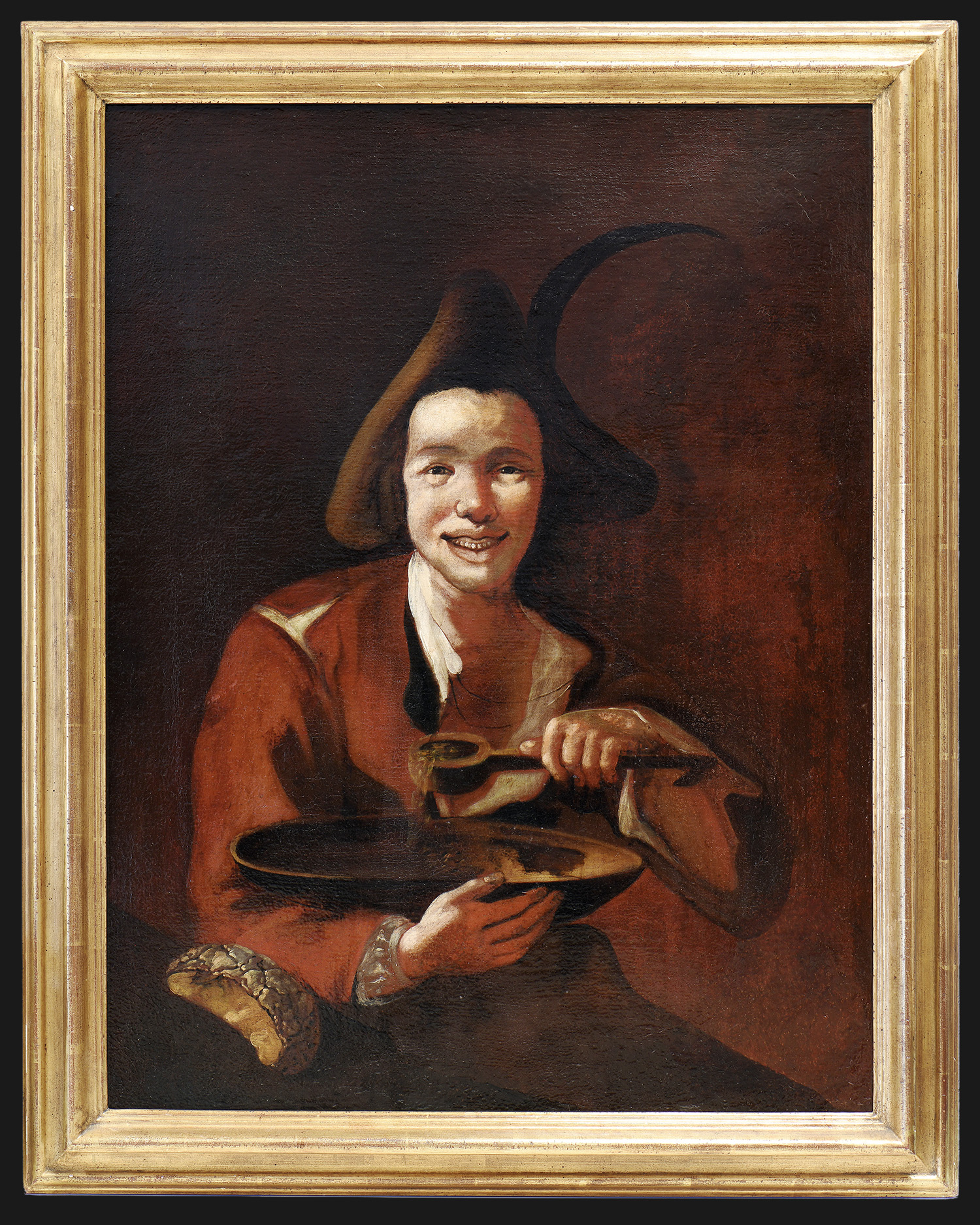
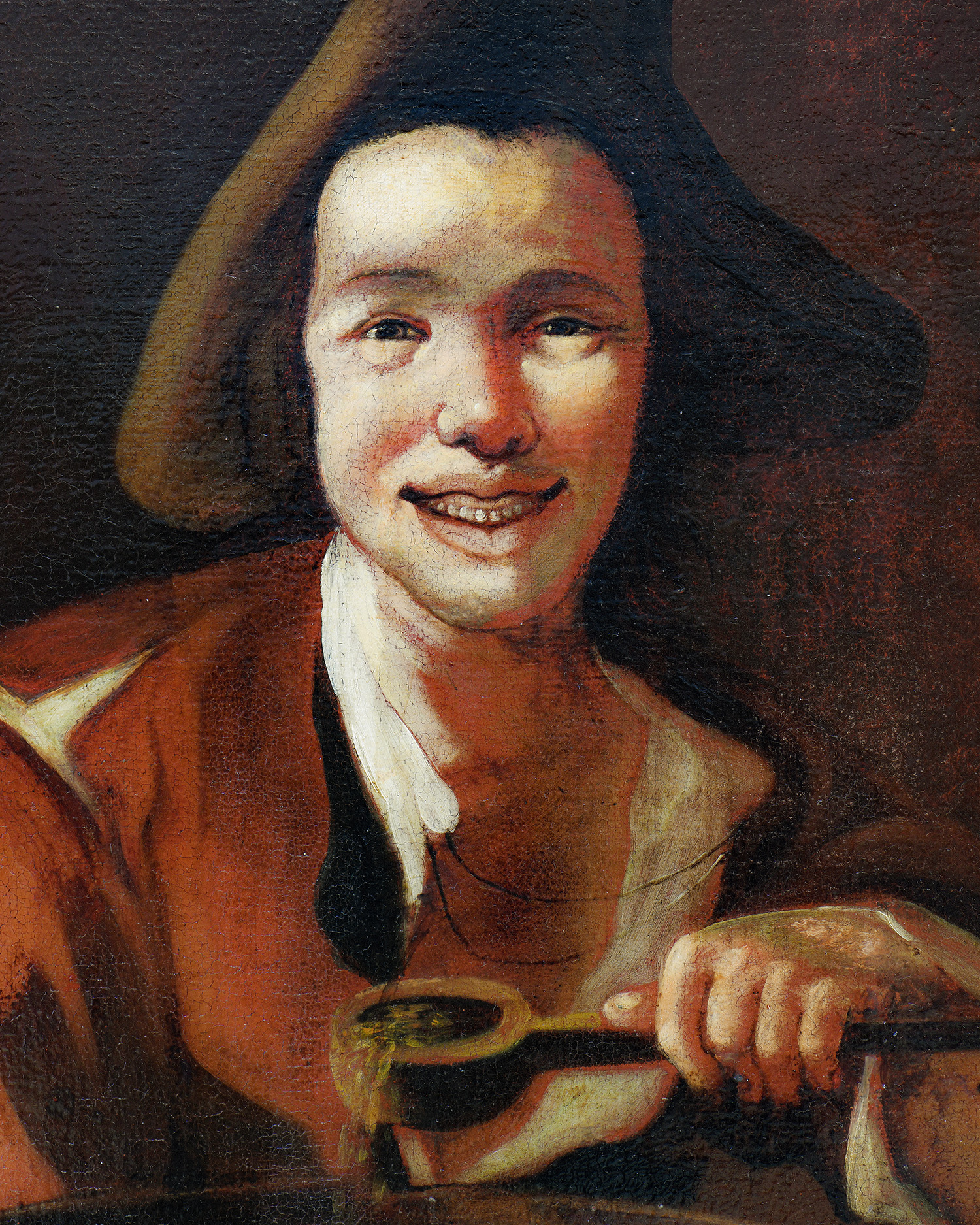
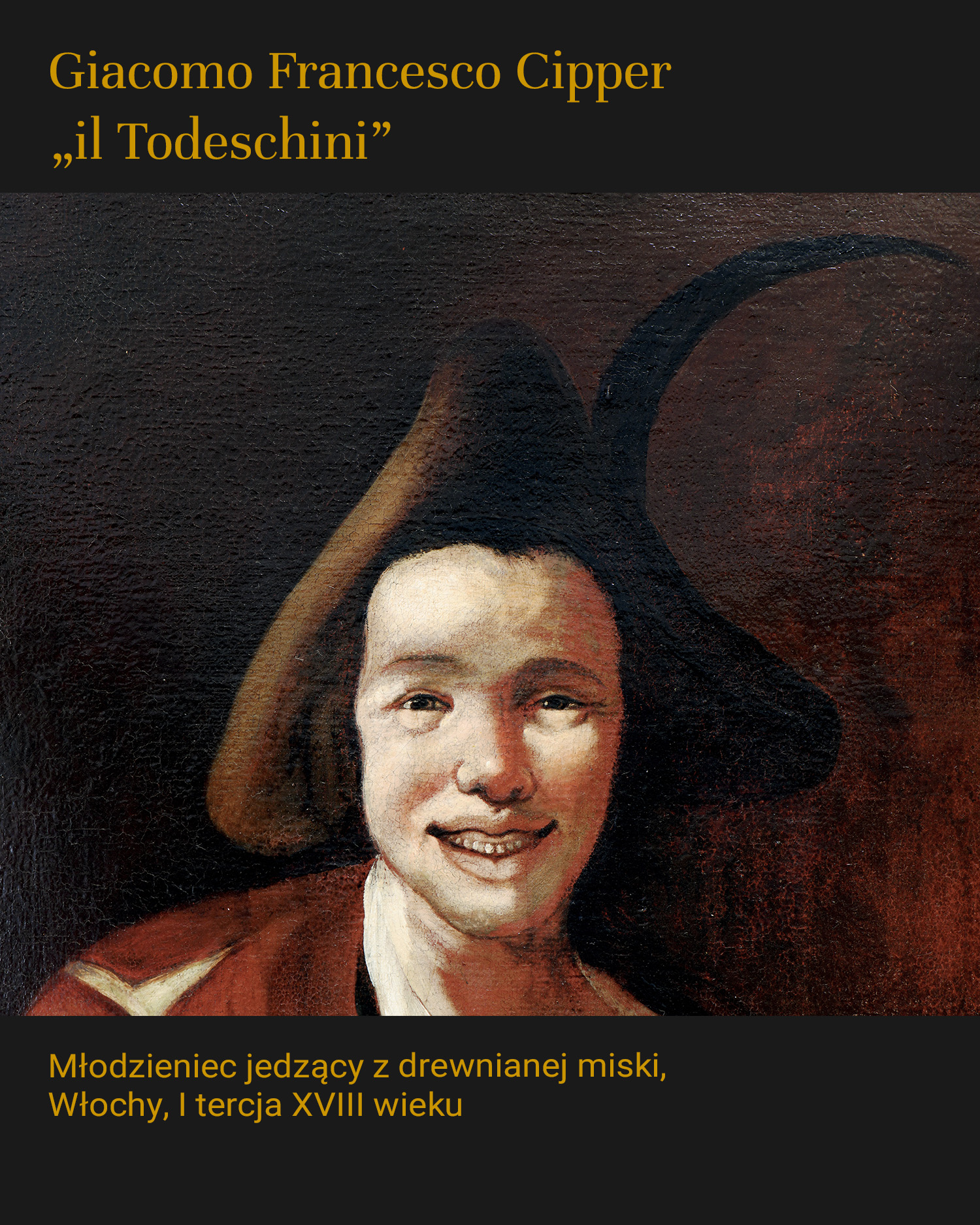
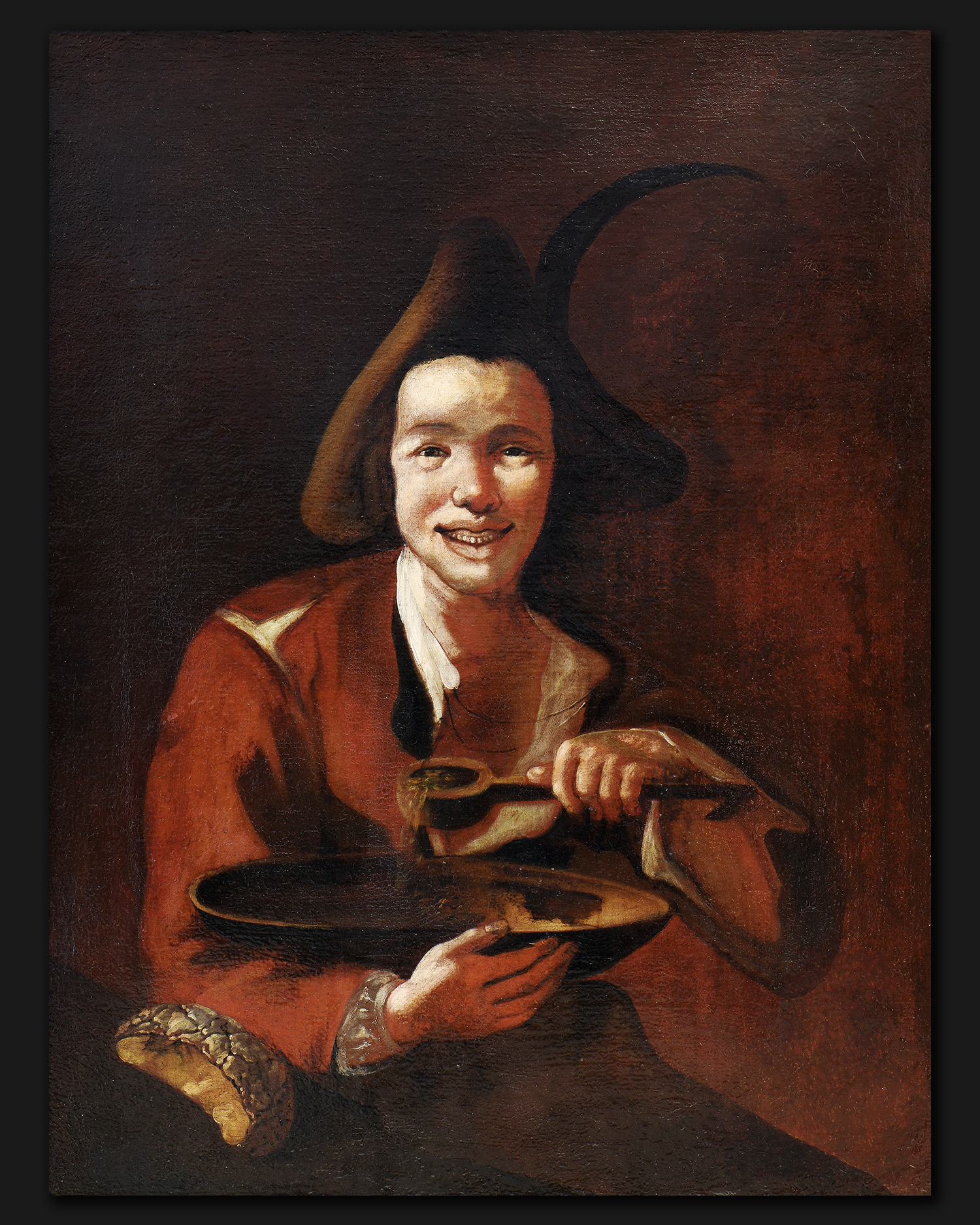
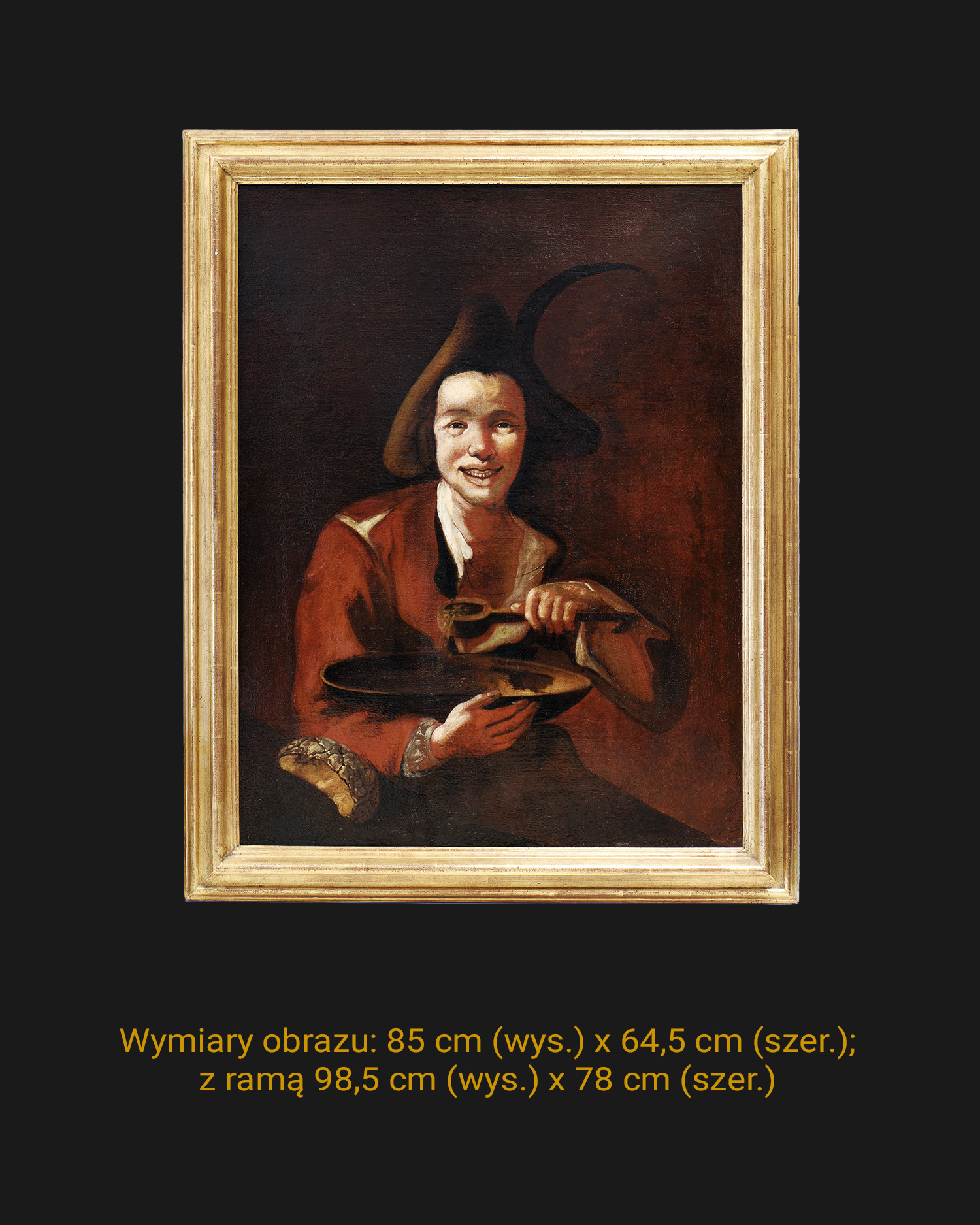

Giacomo Francesco Cipper – “il Todeschini”, Young man eating from a wooden bowl, oil on canvas, Italy, 1st third of the 18th century
7000,00 zł
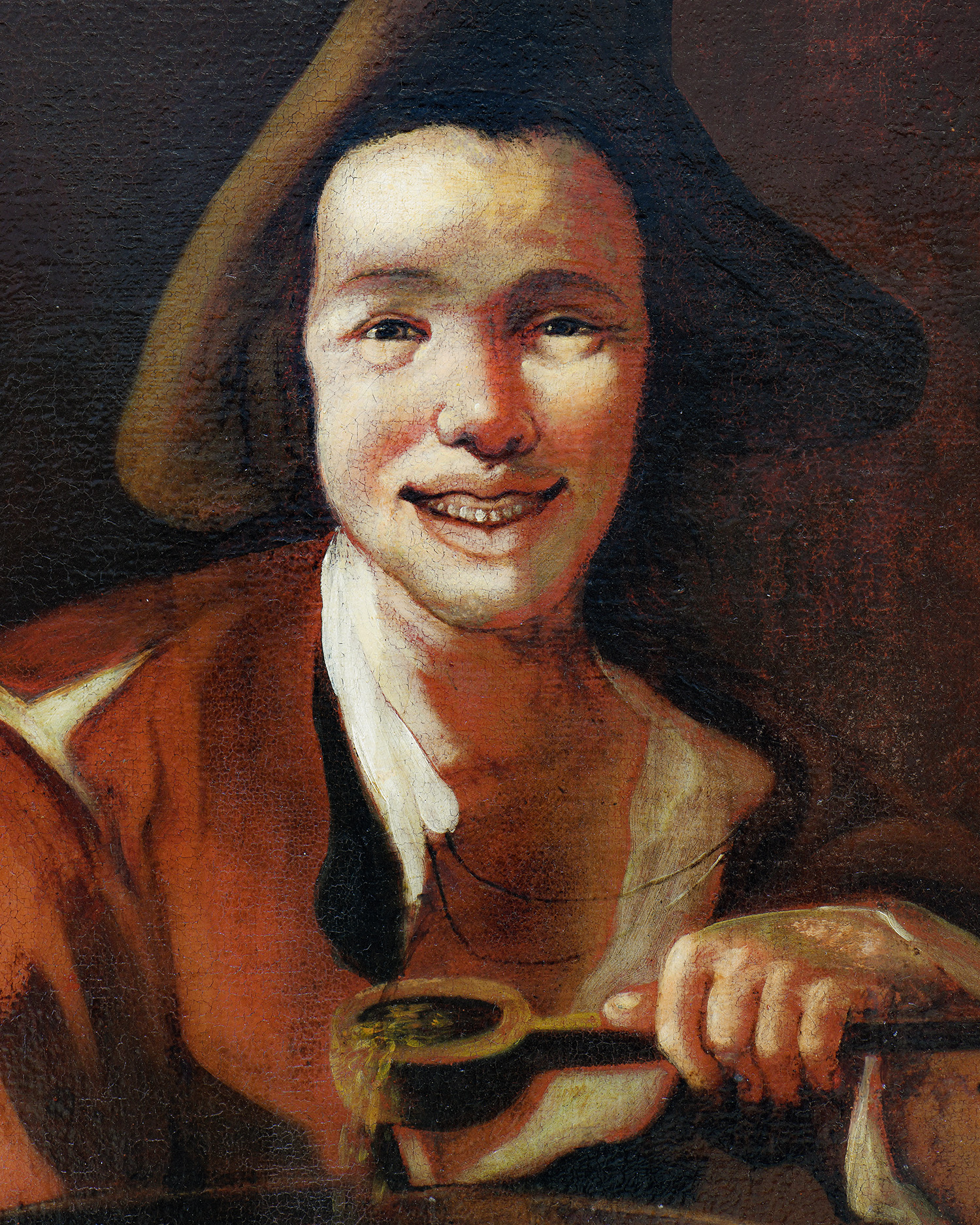
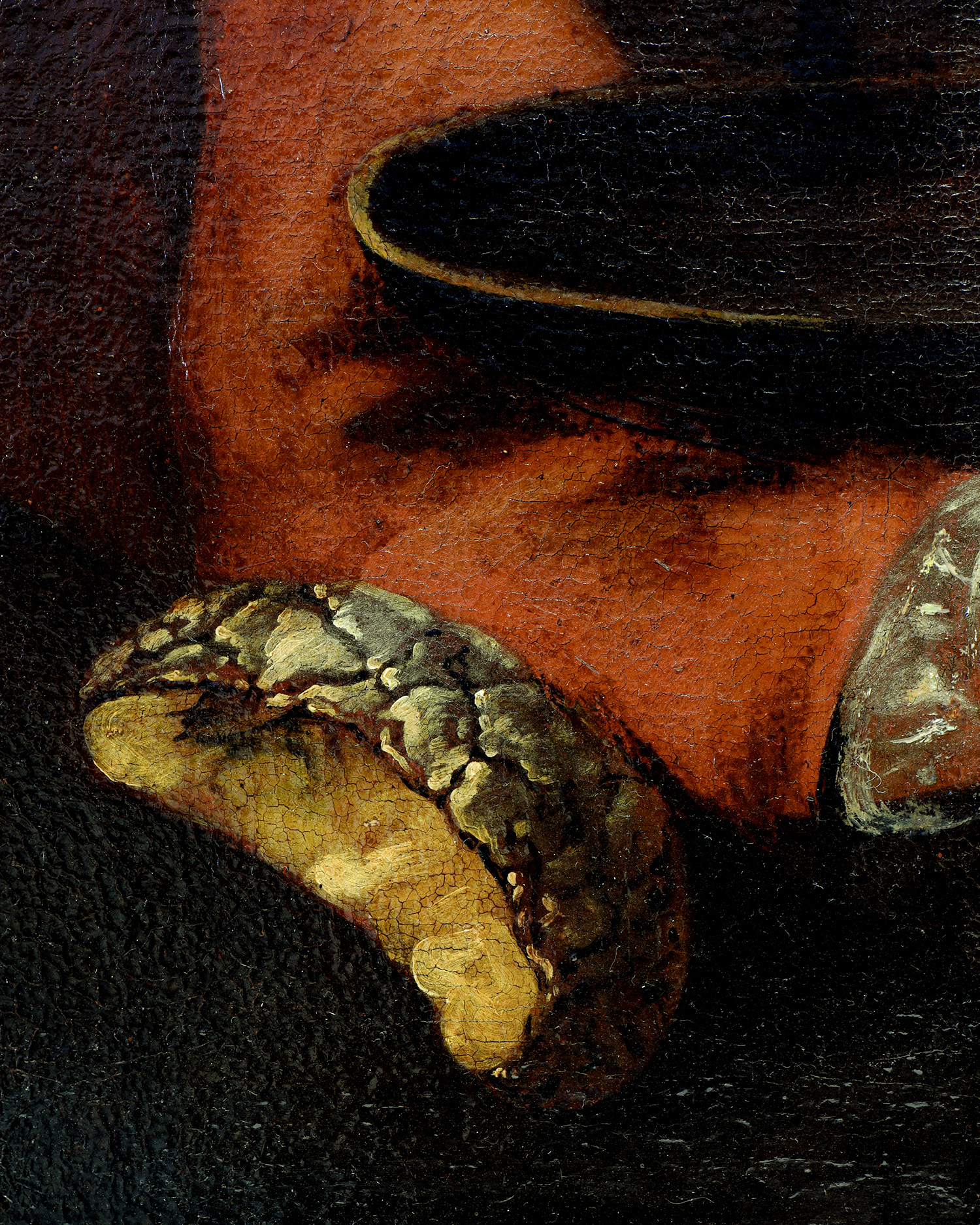
The portrait shows a young man hailing from the plebeian strata, framed in half pose, sitting against a neutral dark background. The boy is facing frontally, his cheerful expression emphasized by a wide smile revealing his teeth. In his right hand he holds a large wooden bowl, while in his left hand he holds a spoon with which he scoops up the food. The young man is dressed in a white shirt and a simple chestnut cubicle, as well as a tricorn, which is a distinctive triangular hat, decorated with a feather. In the lower left corner of the painting, a section of the table is visible, on which lies an unleavened loaf of bread.
The color palette is maintained in tones of warm browns, reds and ochres, with clear chiaroscuro contrasts that artfully model the face and hands and bring out the figure from the dark background.
1 in stock
| Dimensions | 85 × 64,5 cm |
|---|---|
| Type |
Image |
| Form |
Portrait of a boy eating from a bowl |
| Kolorystyka |
Black ,Brown ,Flesh ,White |
| Technika |
Oil on canvas |
| Czas powstania |
First third of the 18th century |
| Era |
Baroque |
| Kraj pochodzenia |
Italy |
| Autor |
Giacomo Francesco Cipper "Il Todeschini" (1664 – 1736) |
| State of preservation |
Very good, after conservation, minor repainting |
Related products
Battle of Mohacz, oil on canvas, Krakow, 1886
Circle of Jan Wijnants, Landscape with Hunters and Travelers by a Lake, oil on panel, Netherlands, 17th century.
Egbert van Heemskerck I (1634 – 1704) – attributed, Scene with Soldiers in a Tavern, oil on canvas, Netherlands, second half of the 17th century.
Egbert van Heemskerck I (1634 Haarlem – 1704 London) – attributed, Scene with Soldiers in a Tavern, oil on canvas, relined on panel, framed.
The painting, created in the second half of the 17th century, depicts an intimate yet expressive genre scene with a satirical-political undertone, set within the austere interior of a 17th-century Dutch tavern. The composition centers on a group of five men intently analyzing a document in the form of a large book spread out on a barrel, which serves as a table.
One of the men wears a distinctive metal soldier's helmet (a cabasset or morion type), while another clearly has a rapier attached to his side. The presence of these props indicates that the protagonists of this scene are not ordinary peasants, but rather soldiers, veterans, or members of a local civic militia (the so-called schutterij). The document they are studying thus gains a military-political context; it could be news from the front (a broadsheet), a mobilization order, a royal decree, or a letter of safe conduct, which they are suspiciously verifying.
The artist masterfully employs caricatured facial features, exposing human flaws and creating an ironic narrative about "armchair strategists" or "weekend soldiers," haphazardly dressed and armed. Egbert van Heemskerck delighted in showcasing this contrast for comedic effect. For the painter, such individuals were a brilliant satirical subject – here is a group of common craftsmen or villagers attempting to impersonate great military strategists. One has donned an old helmet, another has strapped on an oversized weapon, yet their attire and physiognomy betray that they are far from a regular army. Each character represents a different emotional state – from deep concentration and suspicion to violent gesticulation (the figure in the light shirt on the left). The composition relies on contrasting, localized chiaroscuro. Light effectively glides across the texture of the paper, drawing hands and grimaces of the characters from the darkness, and reflecting off the metallic surface of the helmet, showcasing the painter's technical skill.
The reverse side bears traces of old paper ownership or auction labels, which once protected the wood from oxidation but have since crumbled. The condition of the support indicates that the relining process onto period wood was carried out a very long time ago (likely at the turn of the 18th and 19th centuries).
Dimensions: 31 cm (width) x 21 cm (height)
German-Italian Master, Image from the Cross, oil on board, Western Europe, 16th century.
Nathan Gutman (1914 Warsaw – 1990 Paris), Female Nude, oil on cardboard, Paris (?)
Portrait of Franciszka Krasinska, oil on canvas, Poland, ca. 1760