


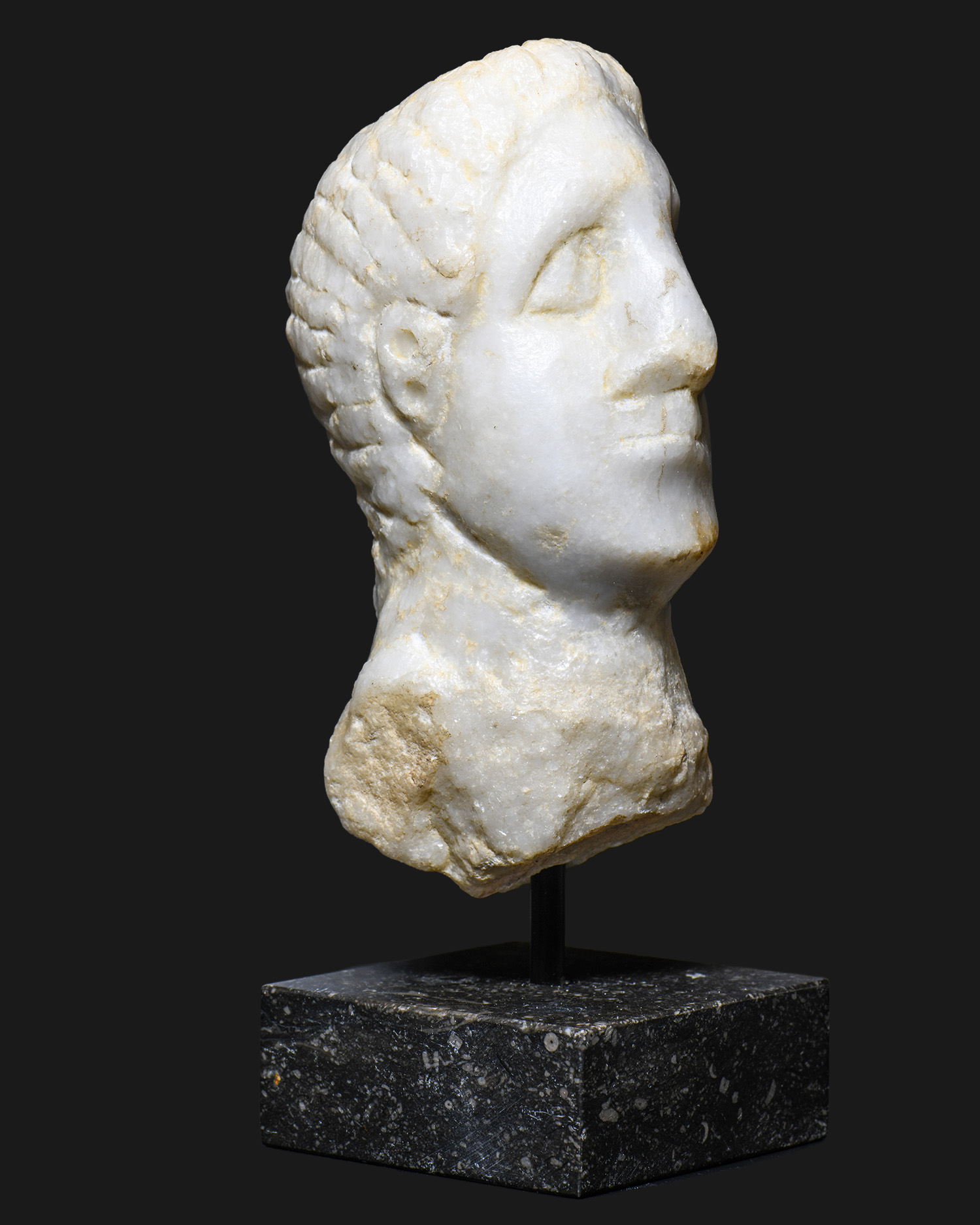
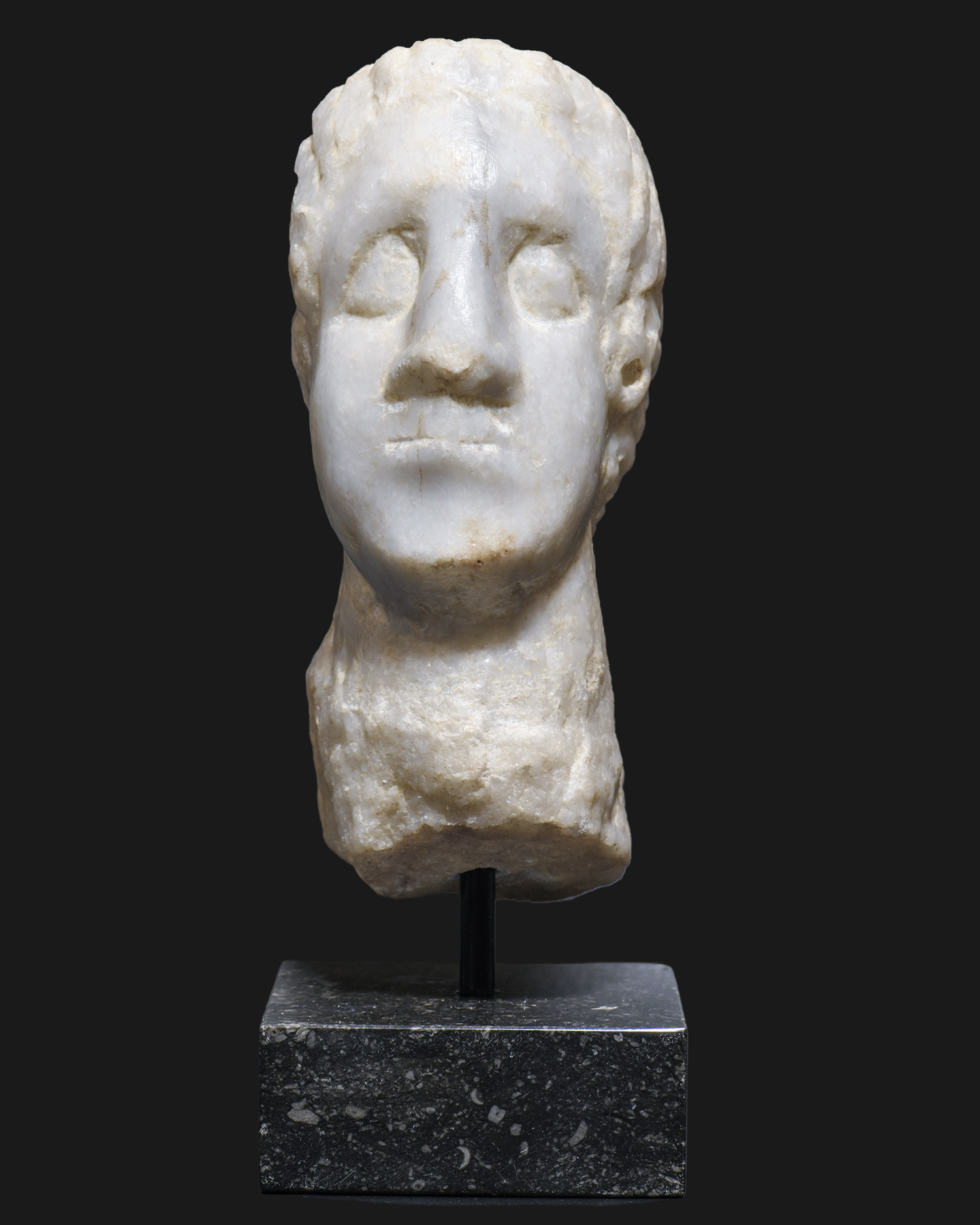
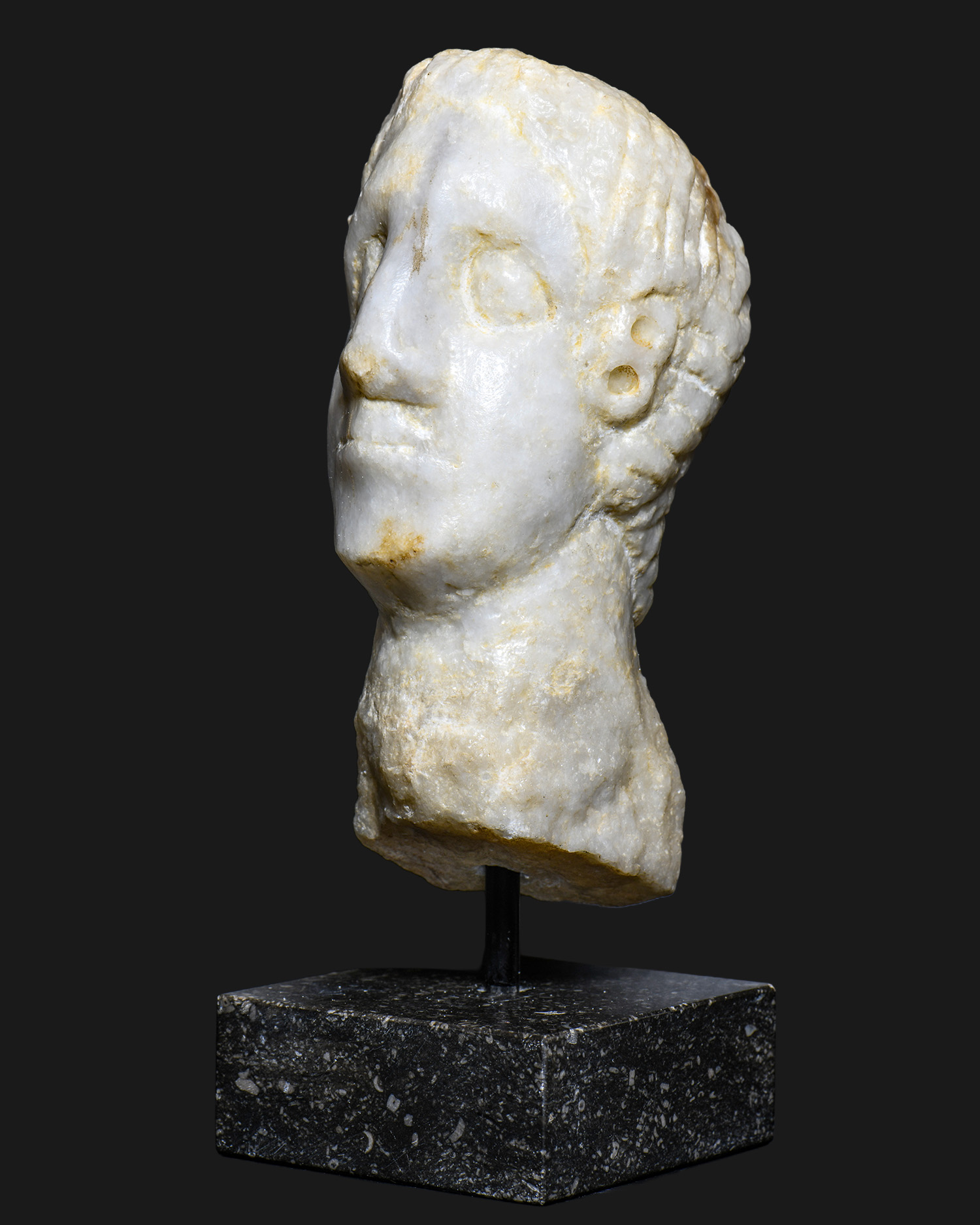
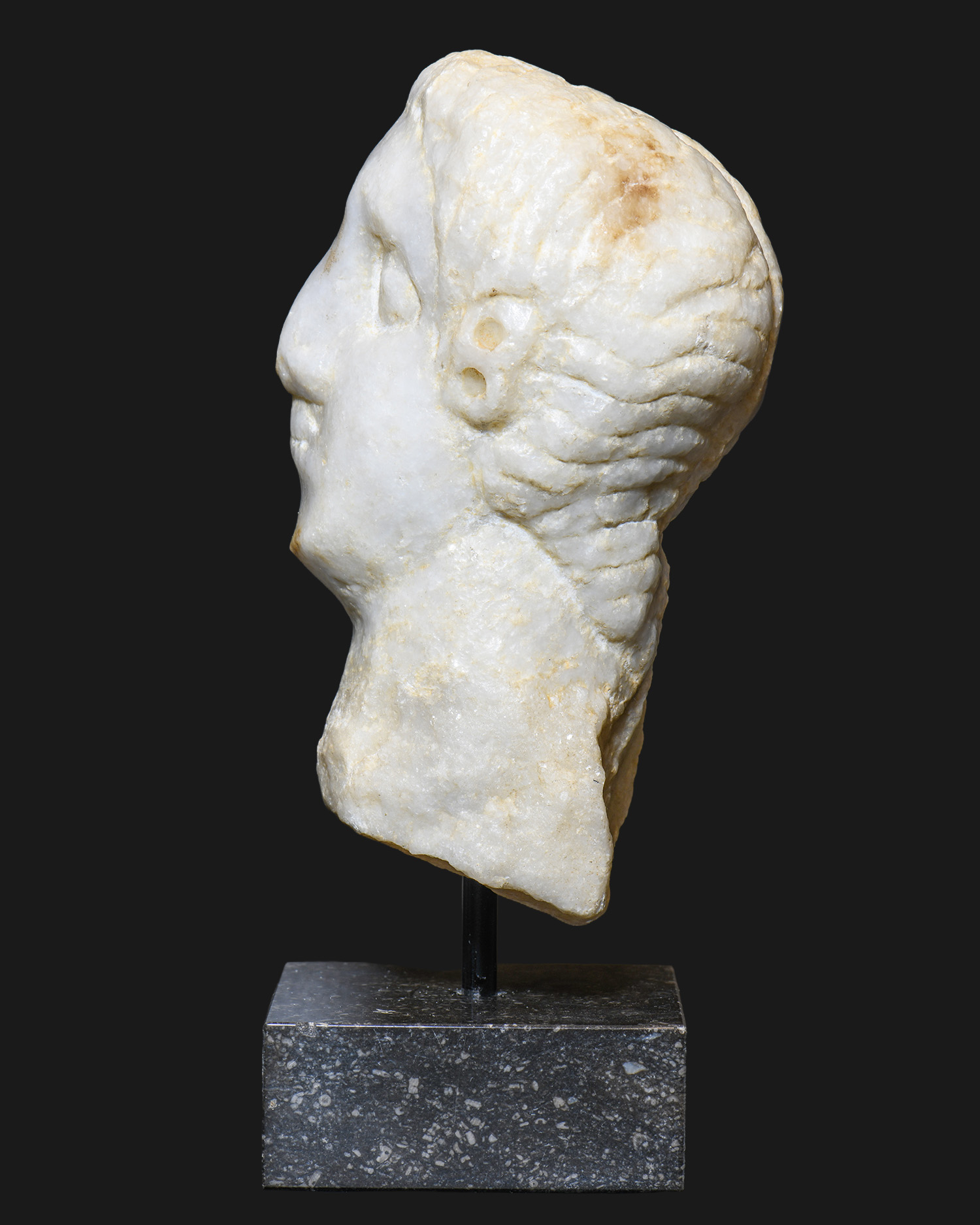
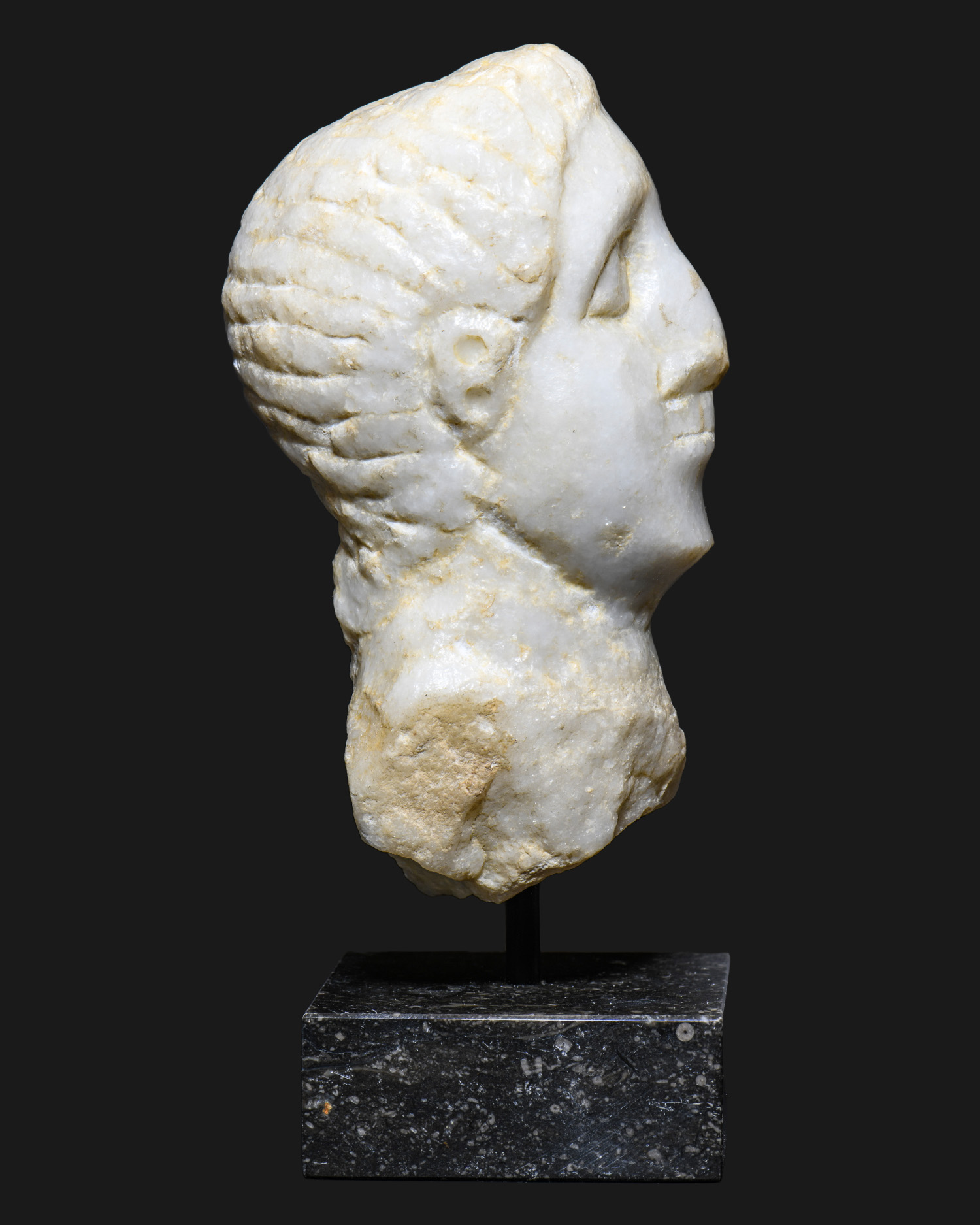
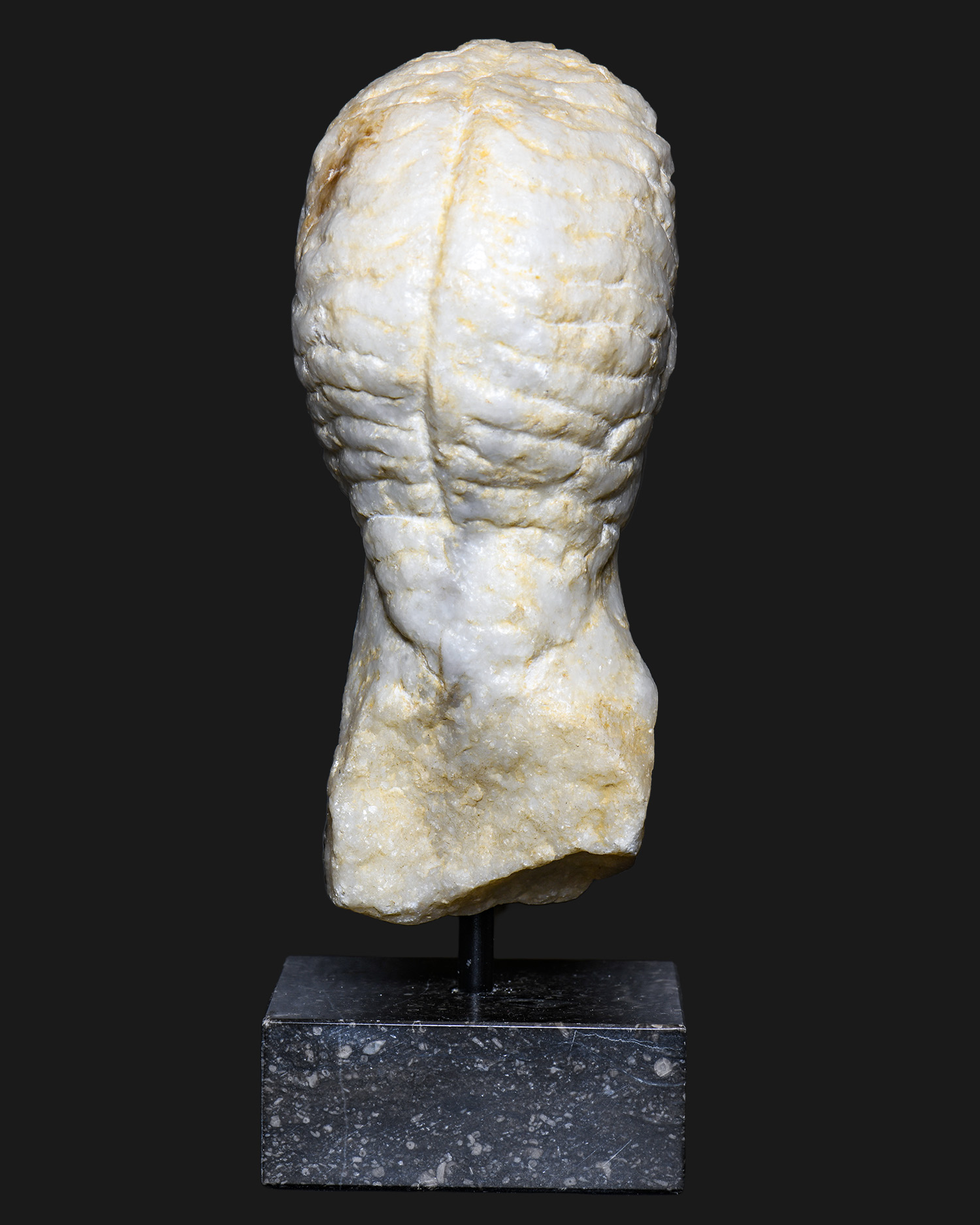
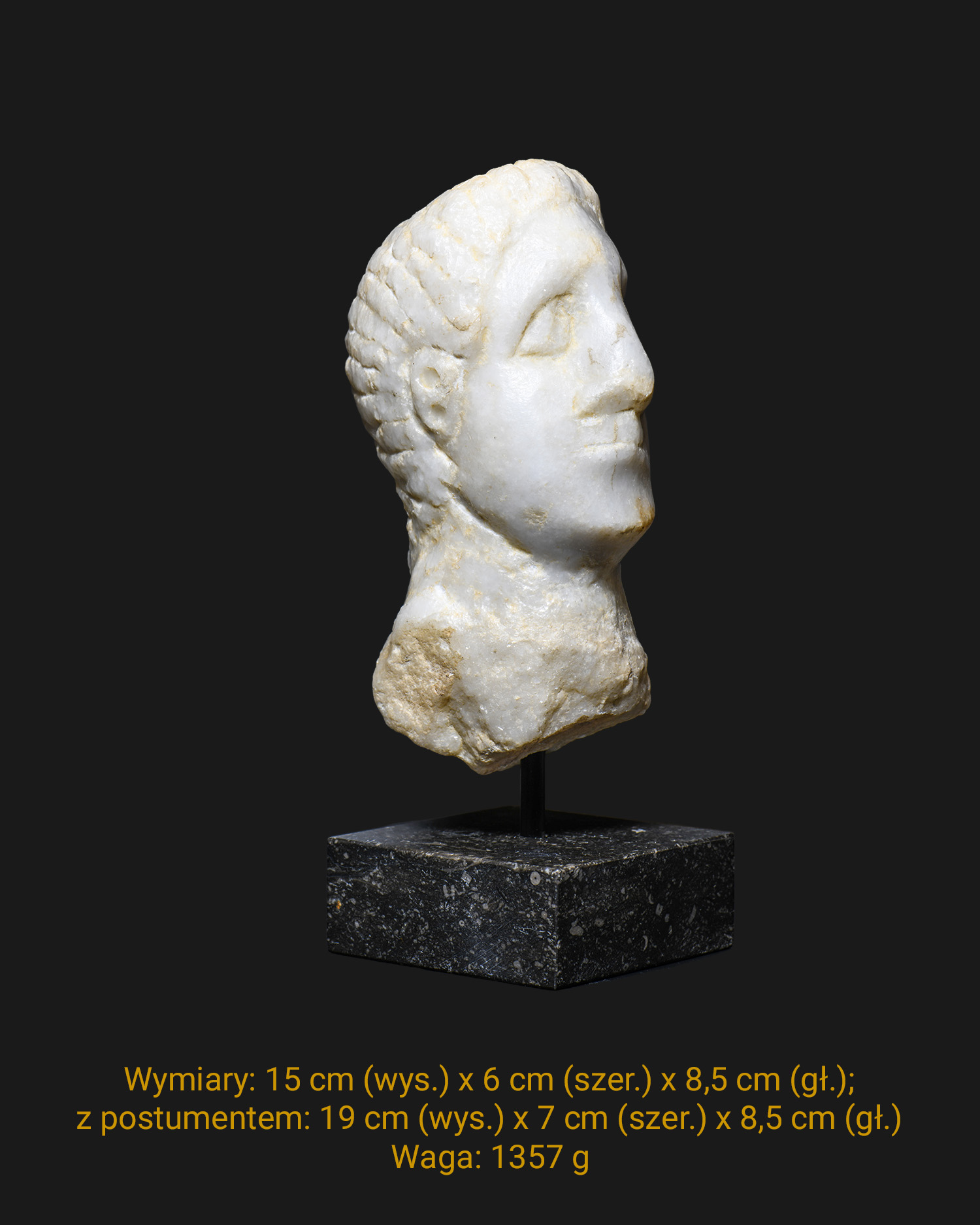

Gallo-Roman male portrait head, marble, Roman Empire, Province of Gaul (area of modern France), 1st-3rd century after Chr.
2800,00 zł
A unique example of provincial stone sculpture from the heyday of the Roman Empire. Executed in white marble, the head depicts an individualized male portrait, a textbook example of the fusion of official Roman realism with local Gallic artistic expression. The face is characterized by a crude, geometric synthesis of form. A long, straight nose connects directly to a well-defined, severe eyebrow arch (the so-called Greco-Roman profile), giving the whole a monumental expression. The large, almond-shaped, convex eyes have no cut eyelids or pupils, which firmly places the object in post-Celtic sculptural traditions and the local votive art. The sculpture directly alludes to austere, hieratic representations of deities and heroes from the Celtic tradition.
The object is set on a contemporary metal arbor and pedestal of gray veined marble.
Dimensions: 15 cm (height) x 6 cm (width) x 8.5 cm (depth); with pedestal: 19 cm (height) x 7 cm (width) x 8.5 cm (depth)
Weight: 1357 g
1 in stock
| Weight | 1,357 kg |
|---|---|
| Dimensions | 15 × 6 × 8,5 cm |
| Type |
Sculpture |
| Form |
Head of a man |
| Materiał |
White crystal marble |
| Kolorystyka |
Dark grey ,White |
| Technika |
Carving with chisel and carving auger (trepan) |
| Czas powstania |
1st-3rd century after Chr. |
| Era |
Antiquity |
| Kraj pochodzenia |
Roman Empire, Province of Gaul (territory of modern France) |
| Autor |
Unknown |
| State of preservation |
Fragmentary (destruct of a full sculpture or votive bust). Condition of the face and profile very good – facial features, the line of the nose and the composition of the hairstyle fully legible. The entire surface shows deep natural erosion of the stone, minor structural chipping and pronounced mineral soil discoloration (yellowish-red earthen patina), evidence of centuries of deposition in the ground. |
Related products
Balmamarium, terracotta, Ancient Rome, ca. 1st-2nd century A.D.
Balmamarium, terracotta, Ancient Rome, ca. 1st-2nd century A.D.
Capital with Figural Decoration, Sandstone, France, 12th-14th Century
Christ Crucified, wood, Spain (Pyrenees?), 12th-13th century.
The sculpture impresses with the pronounced rigidity of the body, typical of early Roman depictions. The calm yet poignant expression of Christ's face is emphasized by huge, forward-facing eyes set in deep eye sockets.
His gaze, however, is slightly lowered, emphasized by a prominent nose and large, spreading ears that frame his face. His hair falls symmetrically on his shoulders; a peculiar hairstyle draws attention - the hair, separated by a parting on top of the head, is arranged in rollers covered with densely diagonal cuts. Very similarly arranged hair, resembling braids, has the famous statue of Christ of Mig Aran, located in the church of Sant Miquèu de Vielha (Val d'Aran valley). The beard and mustache end in artificial, volute curls.
Kantharos, terracotta, Ancient Greece (Magna Graecia – Apulia or Campania), 3rd century BC
A South Italian kantharos, a wine-drinking vessel, classified in Hellenistic pottery typology as a variant with vertical loop handles and stamped decoration on the base. The object dates from the Hellenistic period, specifically the 3rd century BC. The vessel was crafted using a potter's wheel from rich, sorted clay in one of the workshops of Magna Graecia, located in Apulia or Campania.
Rim diameter: 8.5 cm
Width with handles: 13.5 cm Height: 8.8 cm Foot diameter (base): 5.3 cm Weight: 190 g
St. Augustine reliquary with Ex Ossibus relic, polychrome wood, gilded, Italy, 18th century.
Terra sigillata vessel, Dragendorff 18/31 type, terracotta, Roman Empire, circa 190-240 AD.
This Roman terra sigillata vessel (bowl) represents the Dragendorff 18/31 form, a smooth, undecorated transitional variant between a flat plate and a deep bowl. The artifact dates from the turn of the 2nd and 3rd centuries AD (the time of Septimius Severus or Caracalla) and was produced in the thriving provincial Roman pottery center in Trier, within the Roman province of Gallia Belgica. The vessel features universal, medium table dimensions: a maximum rim diameter of 19.2 centimeters, an overall height of 4.5 centimeters, and a stabilizing footring diameter of 10.2 centimeters. These proportions reflect an ancient geometric module based on a strict two-to-one relationship between the rim width and the base, which was standard in serial workshop production of that period.
The bowl was crafted from very well-sorted ferruginous clay, which, after firing, achieved a uniform, bright red color. The surface of the vessel is covered with a slip exhibiting a characteristic silky sheen. Natural traces of ancient use are visible on its structure, manifesting as fine scratches within the interior and superficial abrasions on the rim and the underside of the footring, resulting from repeated placement of the vessel on hard surfaces. The vessel's profile is formed by straight, conically flaring side walls that gently curve into a deepened base in the lower section. The central part of the interior features a regular, conical elevation, known as an omphalos, which is further encircled by a distinct ring incised into the clay before firing.
Rim diameter (maximum): 19.2 cm Overall height: 4.5 cm Footring diameter (base): 10.2 cm Weight: 417 g