


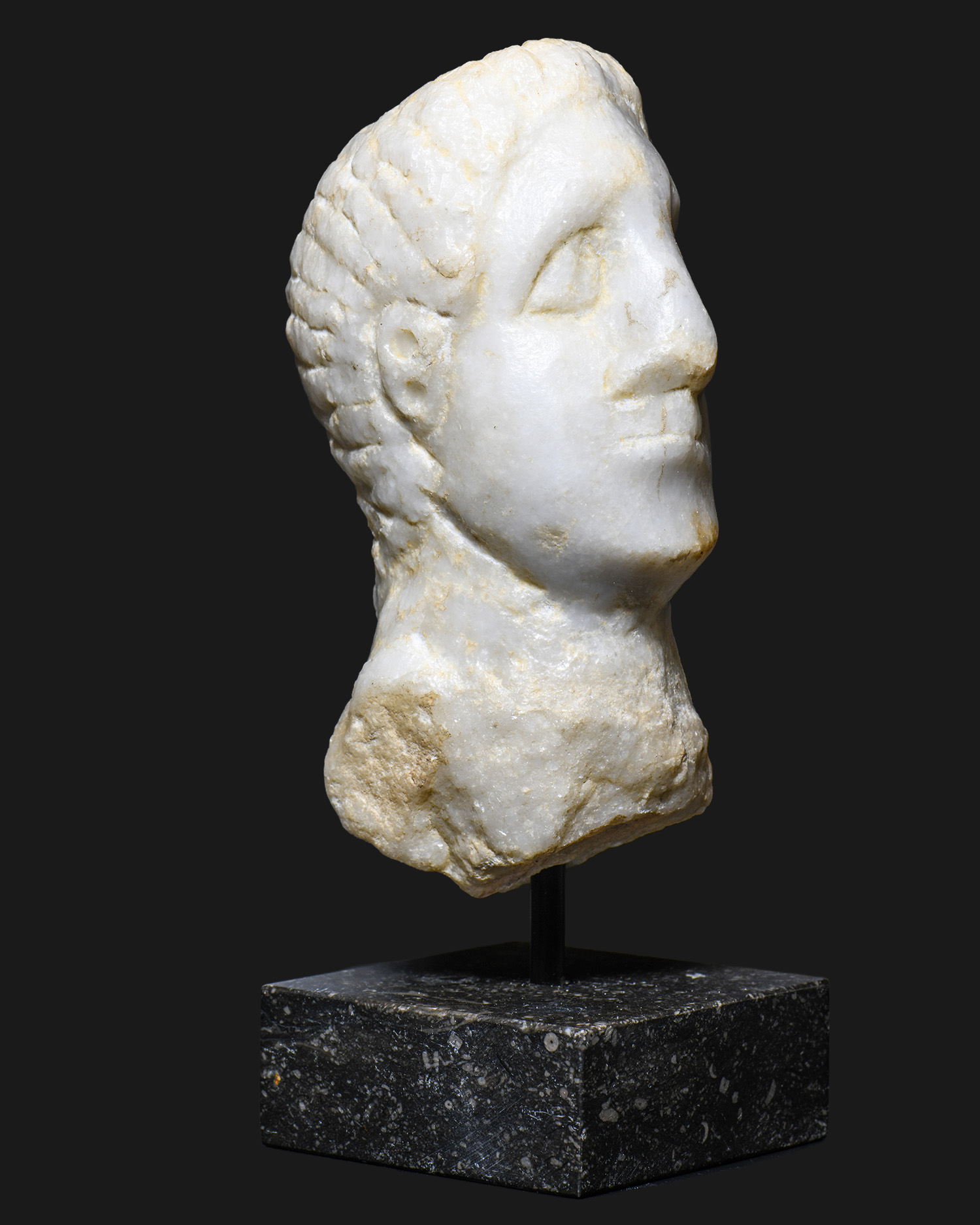
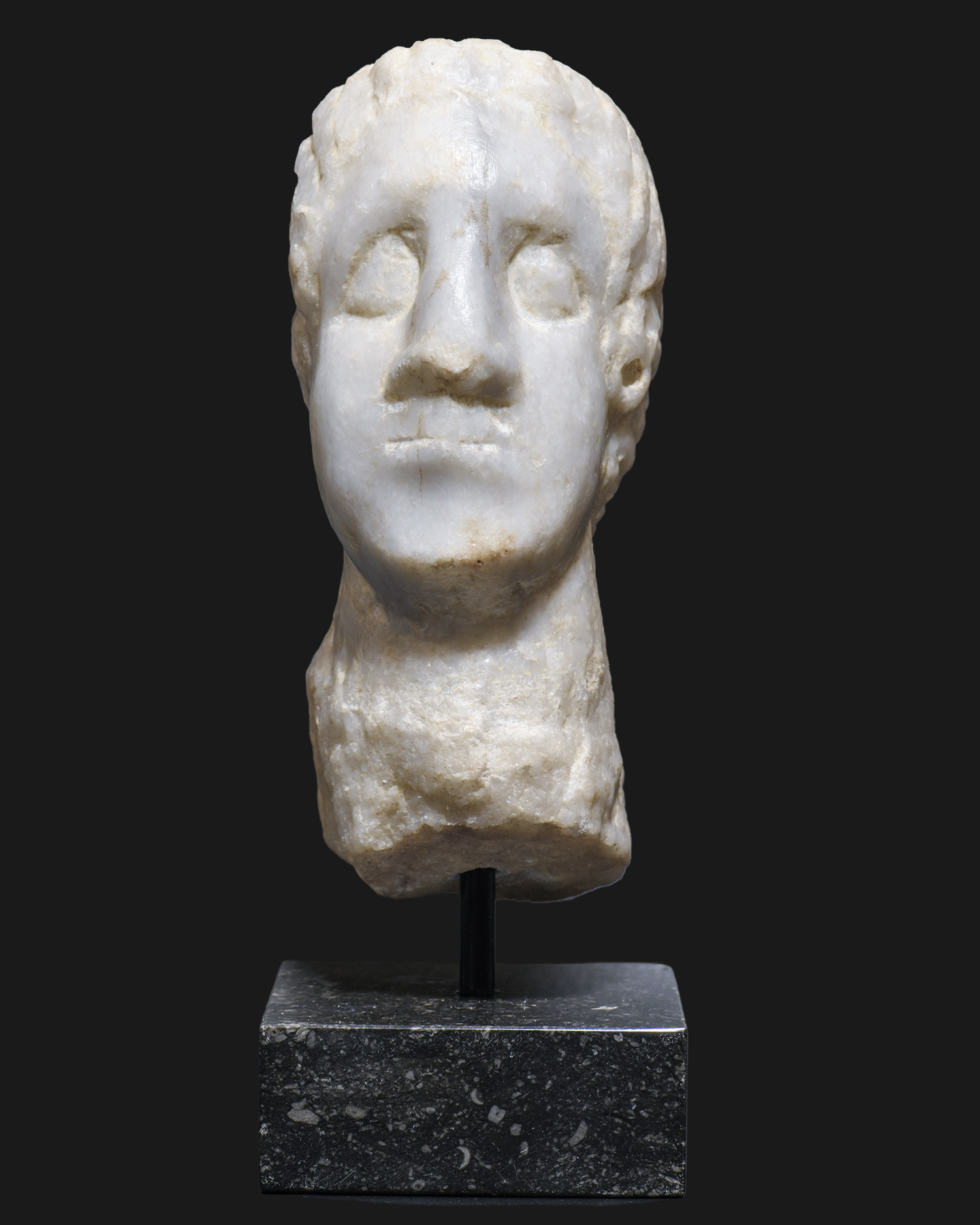
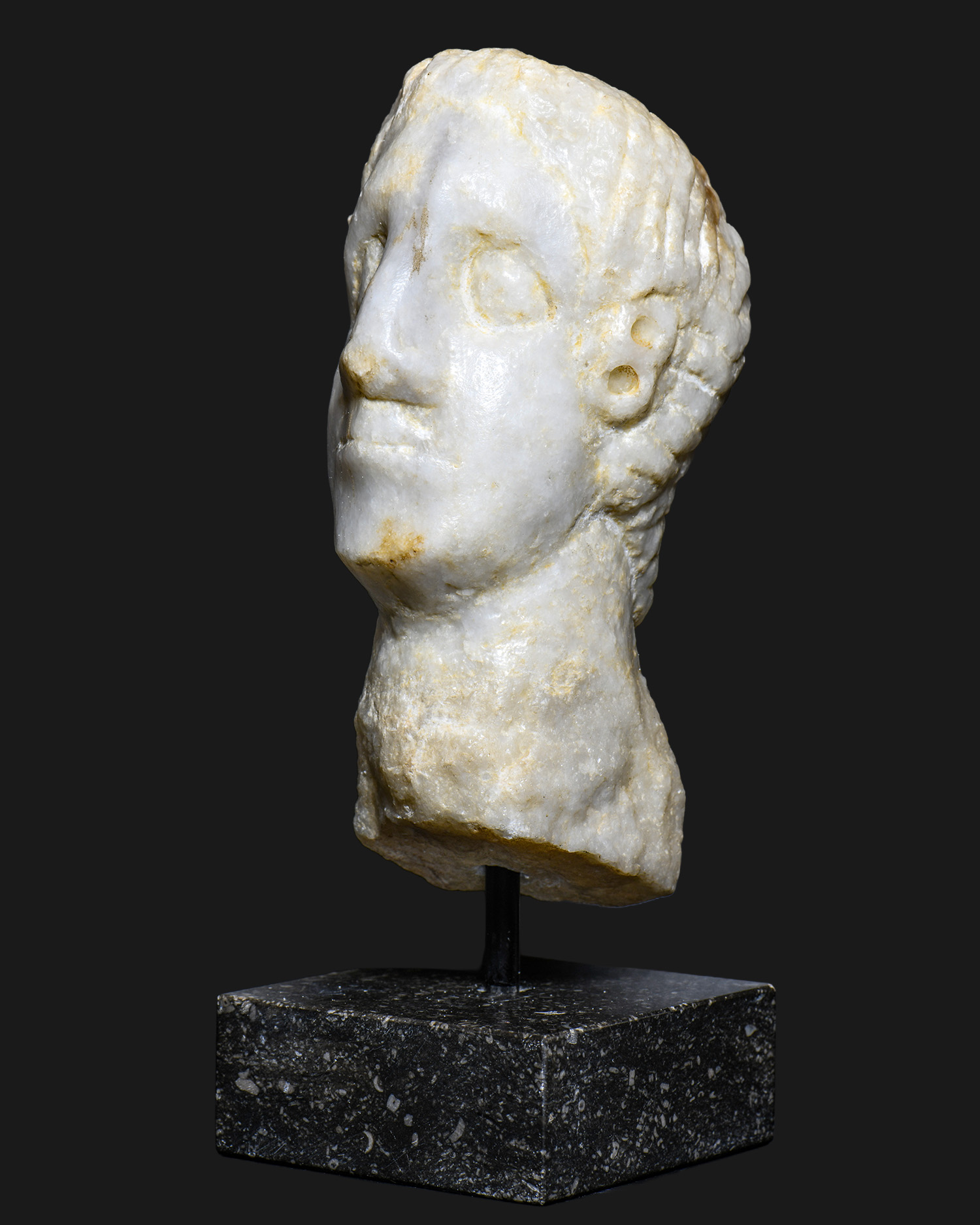
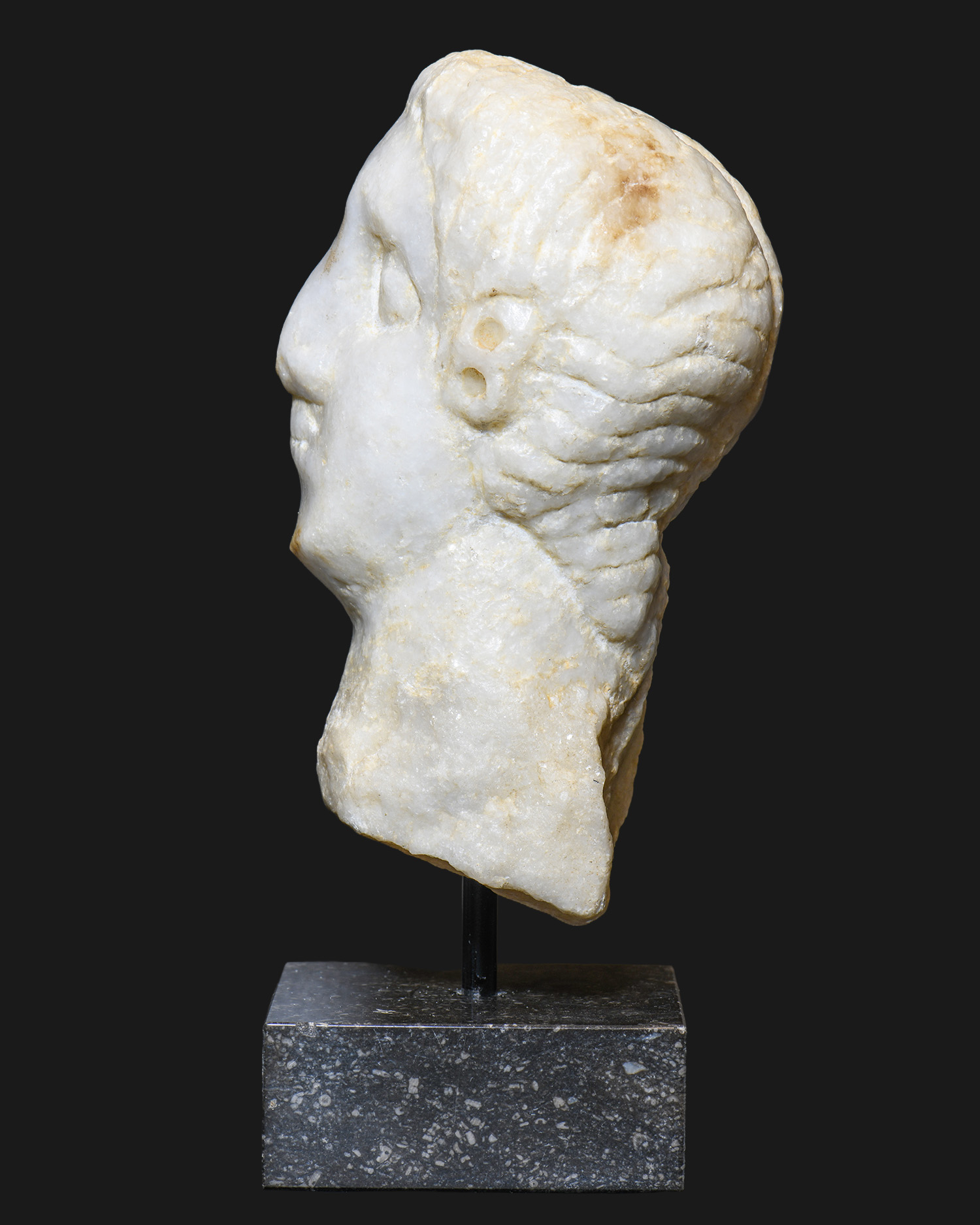
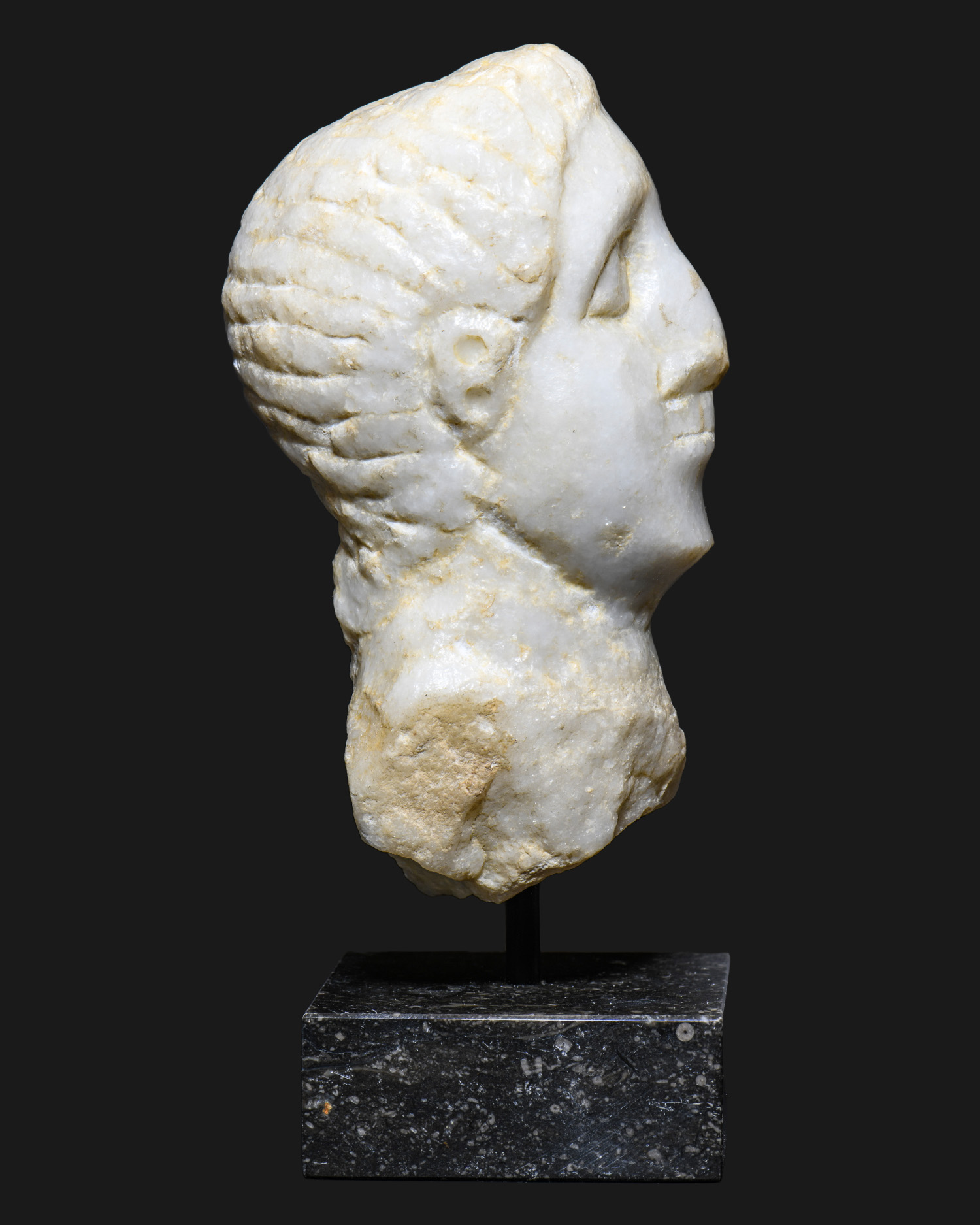
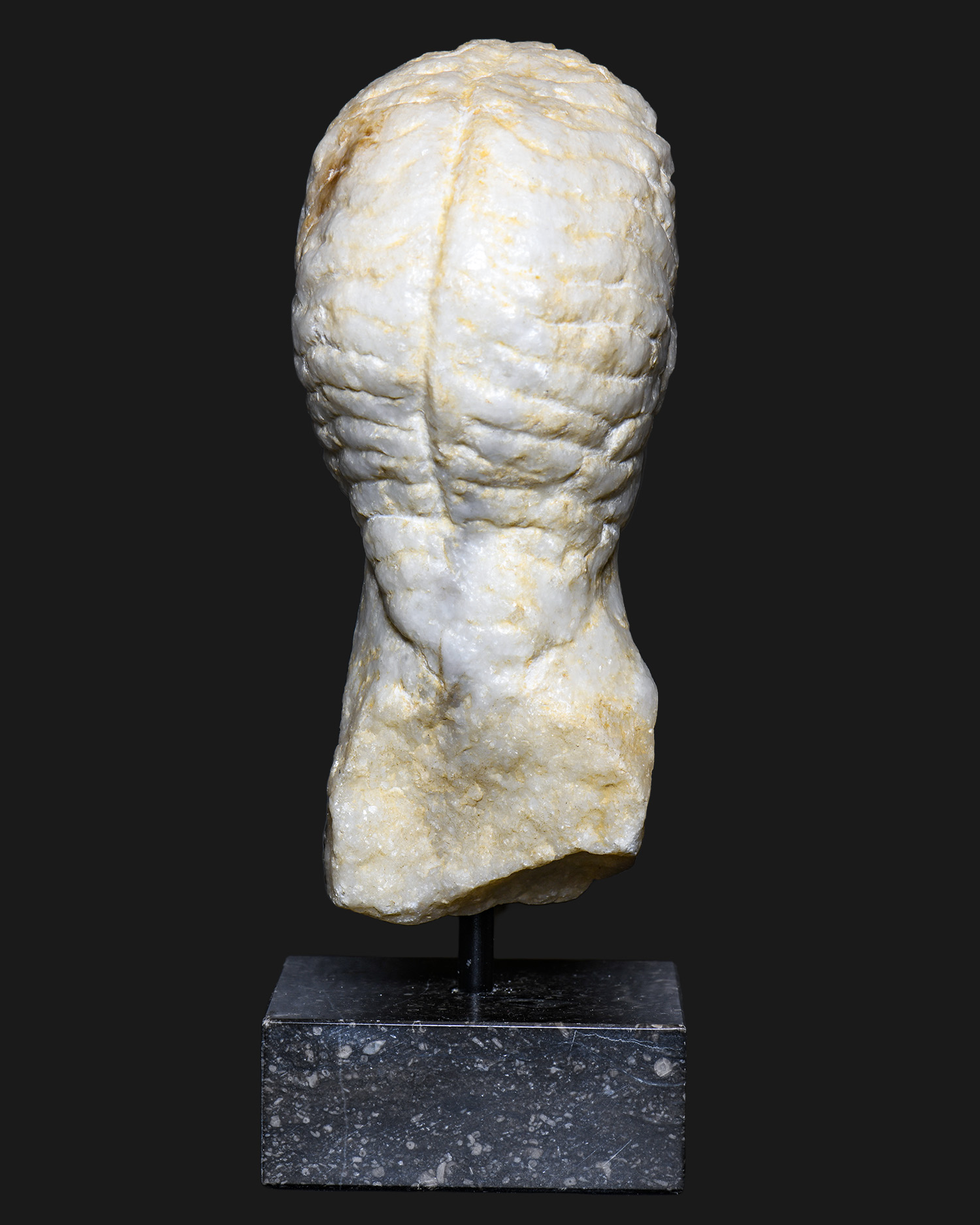
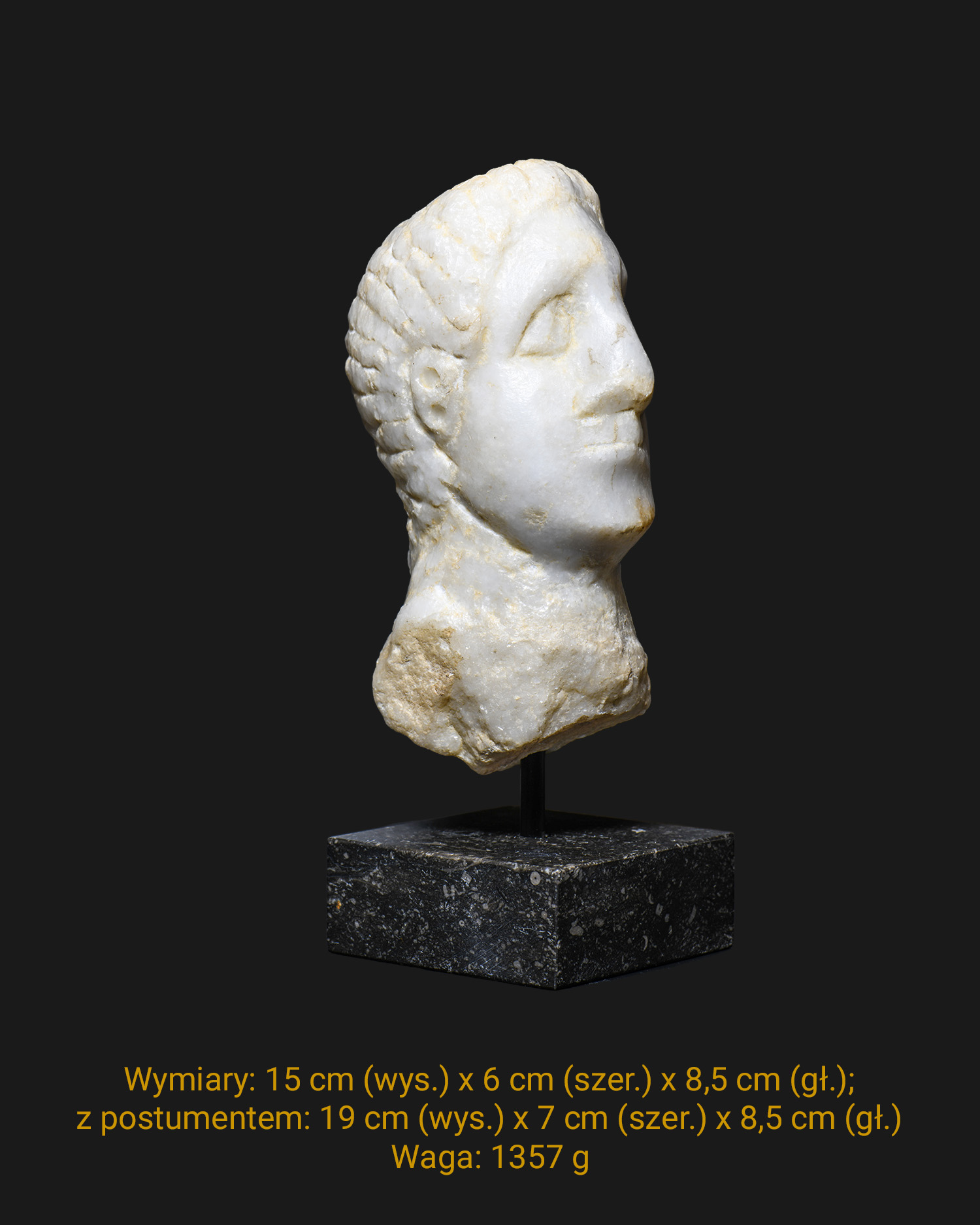

Gallo-Roman male portrait head, marble, Roman Empire, Province of Gaul (area of modern France), 1st-3rd century after Chr.
2800,00 zł
A unique example of provincial stone sculpture from the heyday of the Roman Empire. Executed in white marble, the head depicts an individualized male portrait, a textbook example of the fusion of official Roman realism with local Gallic artistic expression. The face is characterized by a crude, geometric synthesis of form. A long, straight nose connects directly to a well-defined, severe eyebrow arch (the so-called Greco-Roman profile), giving the whole a monumental expression. The large, almond-shaped, convex eyes have no cut eyelids or pupils, which firmly places the object in post-Celtic sculptural traditions and the local votive art. The sculpture directly alludes to austere, hieratic representations of deities and heroes from the Celtic tradition.
The object is set on a contemporary metal arbor and pedestal of gray veined marble.
Dimensions: 15 cm (height) x 6 cm (width) x 8.5 cm (depth); with pedestal: 19 cm (height) x 7 cm (width) x 8.5 cm (depth)
Weight: 1357 g
1 in stock
| Weight | 1,357 kg |
|---|---|
| Dimensions | 15 × 6 × 8,5 cm |
| Type |
Sculpture |
| Form |
Head of a man |
| Materiał |
White crystal marble |
| Kolorystyka |
Dark grey ,White |
| Technika |
Carving with chisel and carving auger (trepan) |
| Czas powstania |
1st-3rd century after Chr. |
| Era |
Antiquity |
| Kraj pochodzenia |
Roman Empire, Province of Gaul (territory of modern France) |
| Autor |
Unknown |
| State of preservation |
Fragmentary (destruct of a full sculpture or votive bust). Condition of the face and profile very good – facial features, the line of the nose and the composition of the hairstyle fully legible. The entire surface shows deep natural erosion of the stone, minor structural chipping and pronounced mineral soil discoloration (yellowish-red earthen patina), evidence of centuries of deposition in the ground. |
Related products
Balmamarium, terracotta, Ancient Rome, ca. 1st-2nd century A.D.
Capital with Figural Decoration, Sandstone, France, 12th-14th Century
Lekanis with lid, terracotta, Ancient Greece (probably Beotia), 5th century BC.
Rama, marble, India, 19th century.
A sculpture depicting Rama, one of the most important deities of Hinduism, considered the seventh avatar of Vishnu. The object was hand-carved in white marble in India, probably in the 19th century.
The figure is depicted standing, facing forward. The face has a gentle expression with a soft smile and slightly closed eyes. The head is crowned with a decorative crown, and long necklaces are visible on the chest.
The figure is dressed in a draped robe with clearly marked folds. On its back is a quiver with arrows, characteristic of Rama's depictions.
The hands of the sculpture are not preserved, originally in one of them the figure held a bow - a characteristic element of representations of this deity. Further about these cavities do not write that they are consistent.
Rama is the hero of the epic Ramayana and in the Hindu tradition symbolizes righteousness and fidelity to the principle of dharma. His images occupy an important place in Indian sacred art, although full-figure marble sculptures of this scale are less common.
The object is preserved in good condition, with clear legibility of form and detail.
Saucepan (patella) of Eggers type 137, tinned bronze, Roman Empire, c. 50-120 AD
This Roman culinary and banqueting vessel represents the form of a patella (deep saucepan), classified in archaeological typology as Eggers type 137. The object dates from the early Roman Empire, specifically the second half of the 1st century or the beginning of the 2nd century AD (a timeframe of approximately 50–120 AD), corresponding to the chronological horizon from Emperor Nero's reign to the Flavian dynasty and Emperor Trajan. The saucepan was cast from tinned bronze in a provincial Roman workshop, located in Gaul or Germania Inferior, modeled after products from Campanian manufacturers in the Capua region. The tin coating on the inner walls of the vessel was intended to protect prepared food from direct contact with copper and the formation of toxic compounds. The vessel's net weight is 1060 grams. The object consists of a hemispherical bowl, 8.2 centimeters in height and 18 centimeters in rim diameter, connected to a flat handle with a trapezoidal finial, resulting in a total length of 30.2 centimeters.
Sculpture of a god’s head (Zeus or Hercules), marble, Mediterranean basin, Hellenistic period
Shekel (Judas silver), Tyre, 139 local era = 13/14 after Chr.