

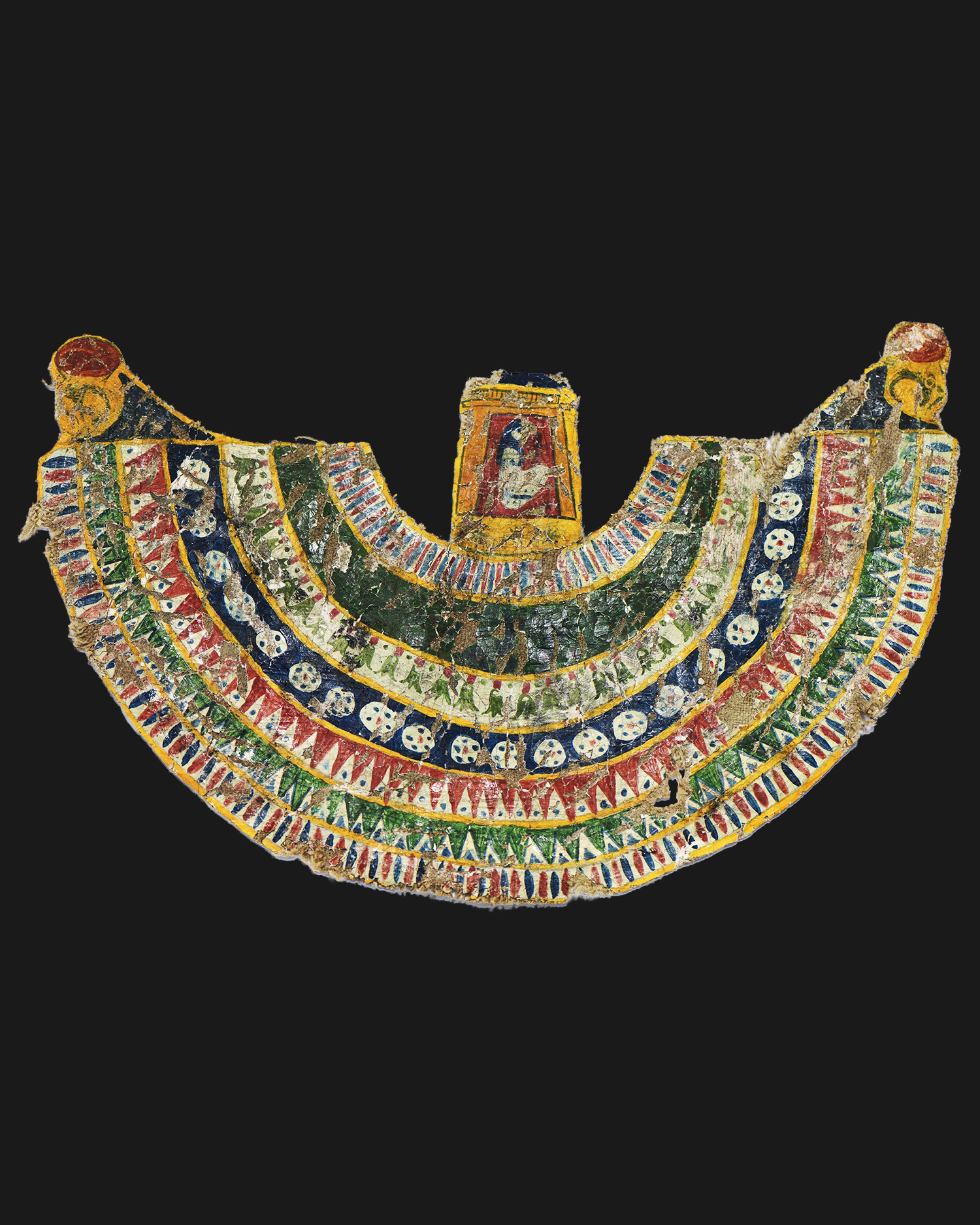
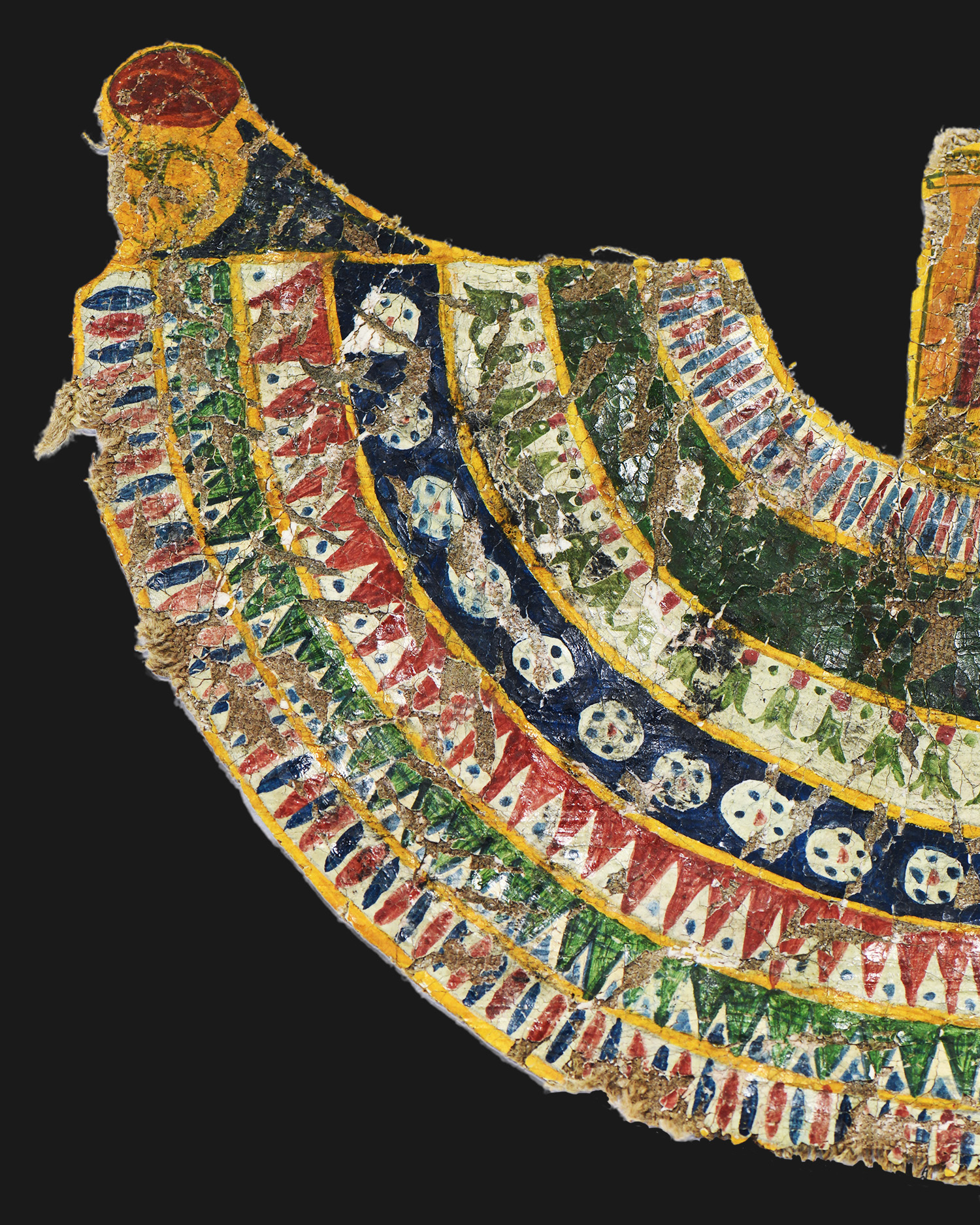
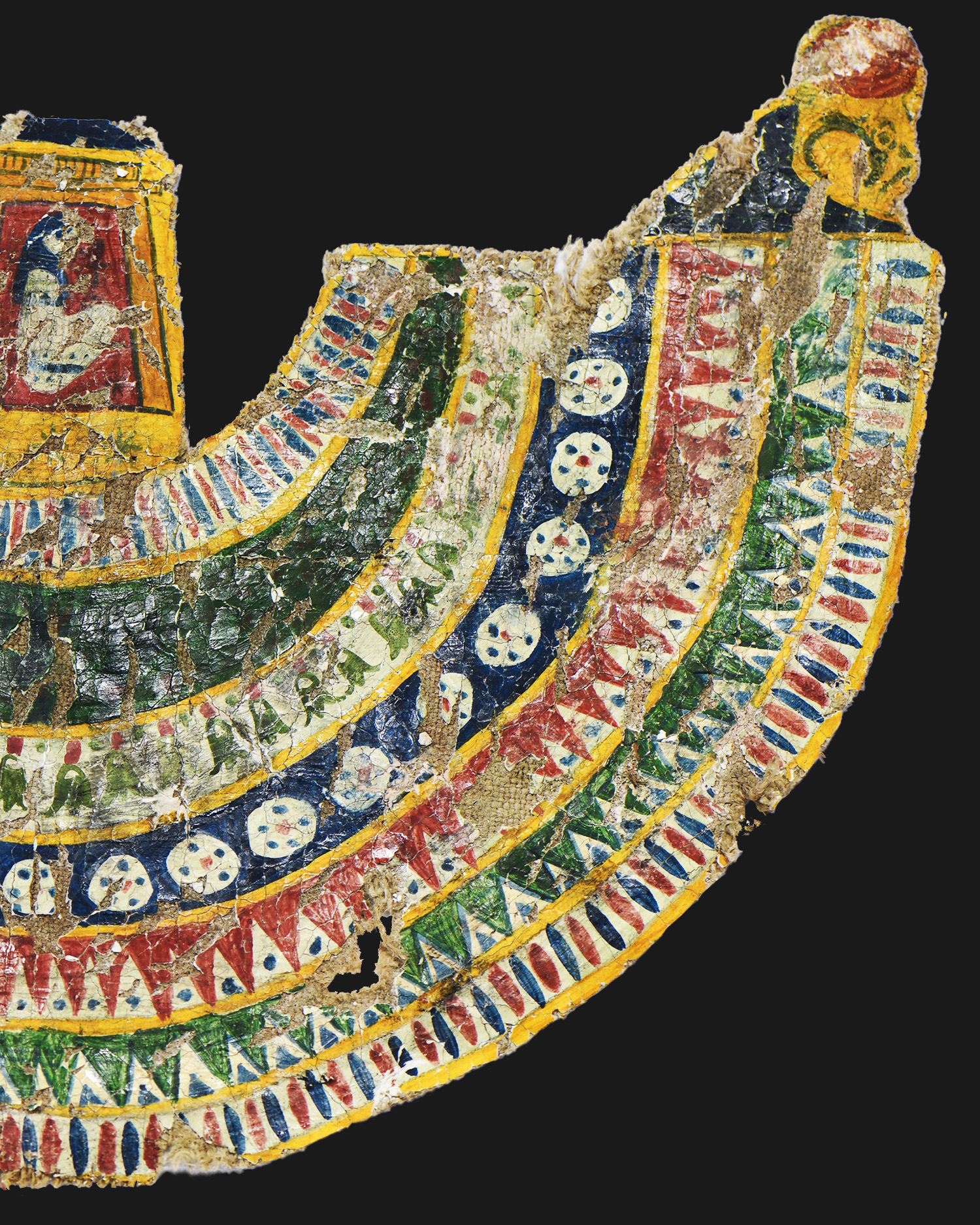
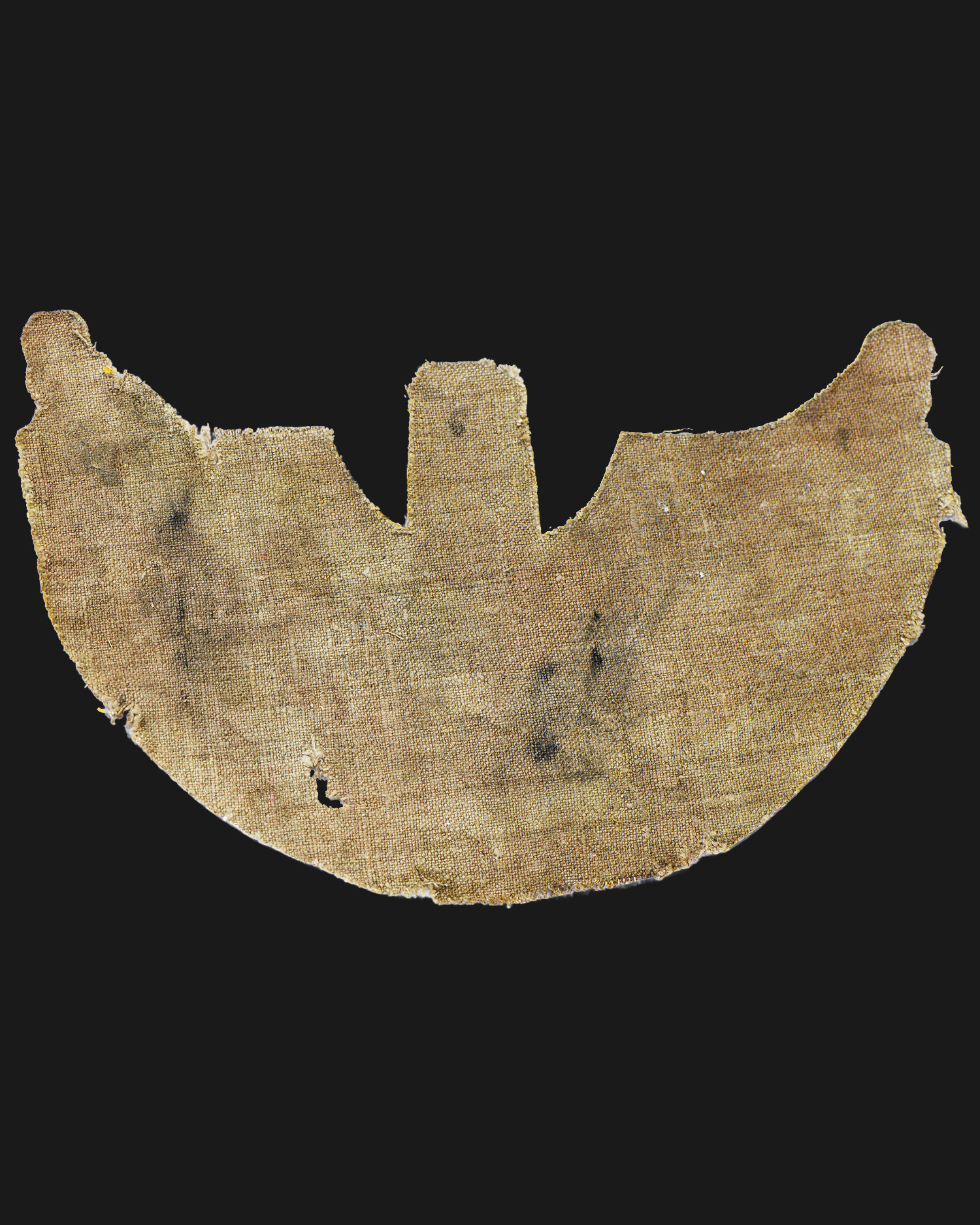
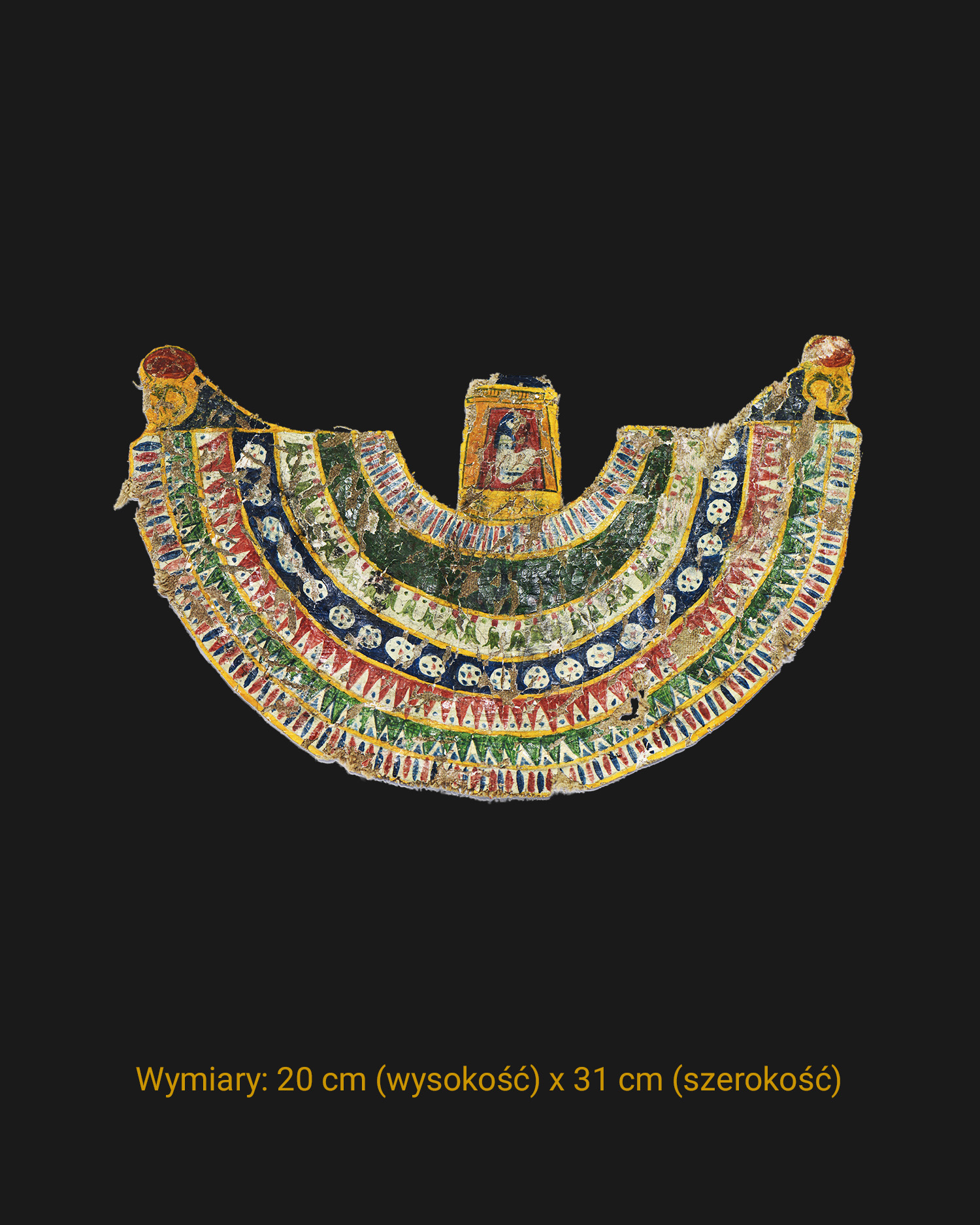

Cartoon with a representation of a usekh necklace, Egypt, 1st millennium BC.
3300,00 zł
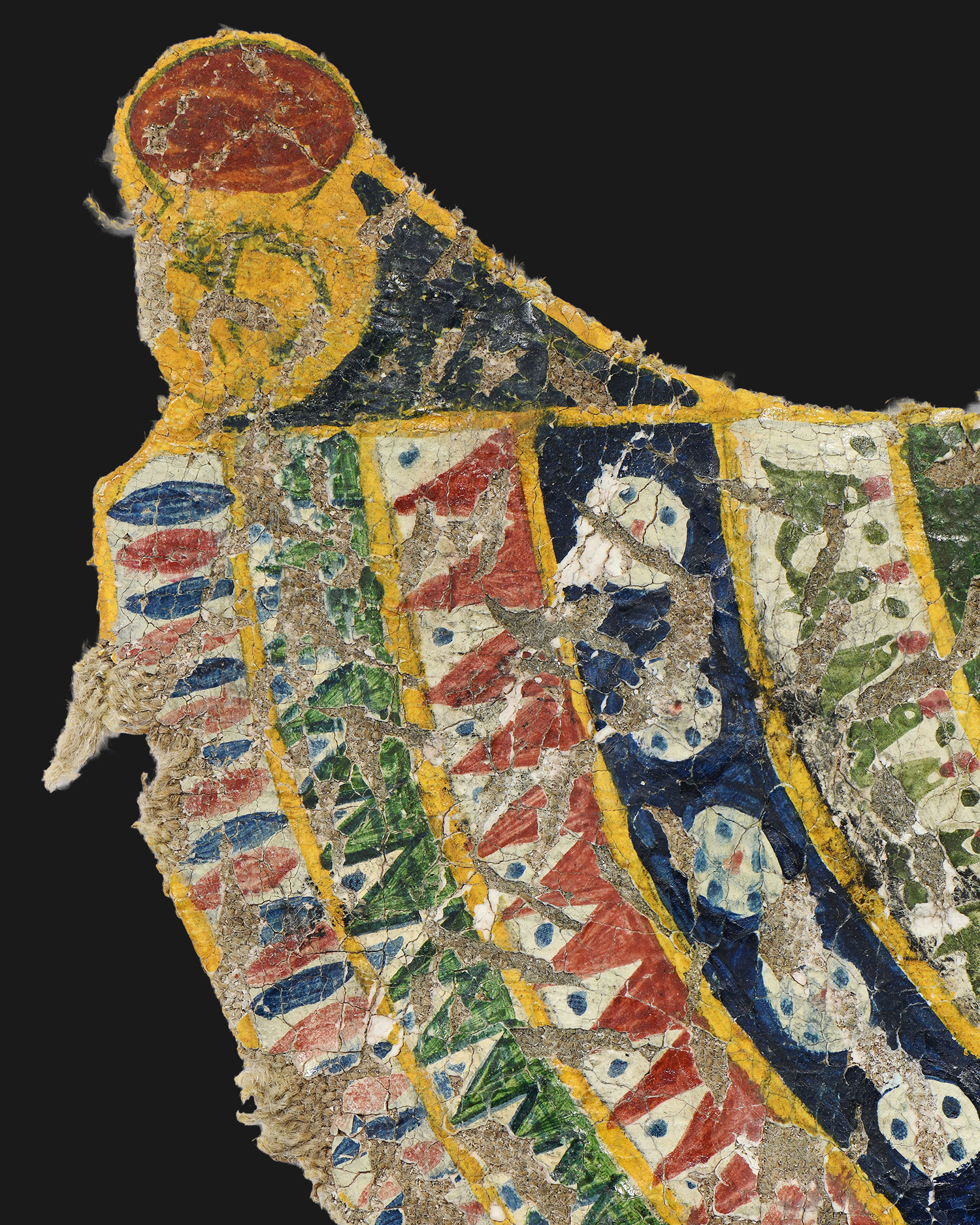
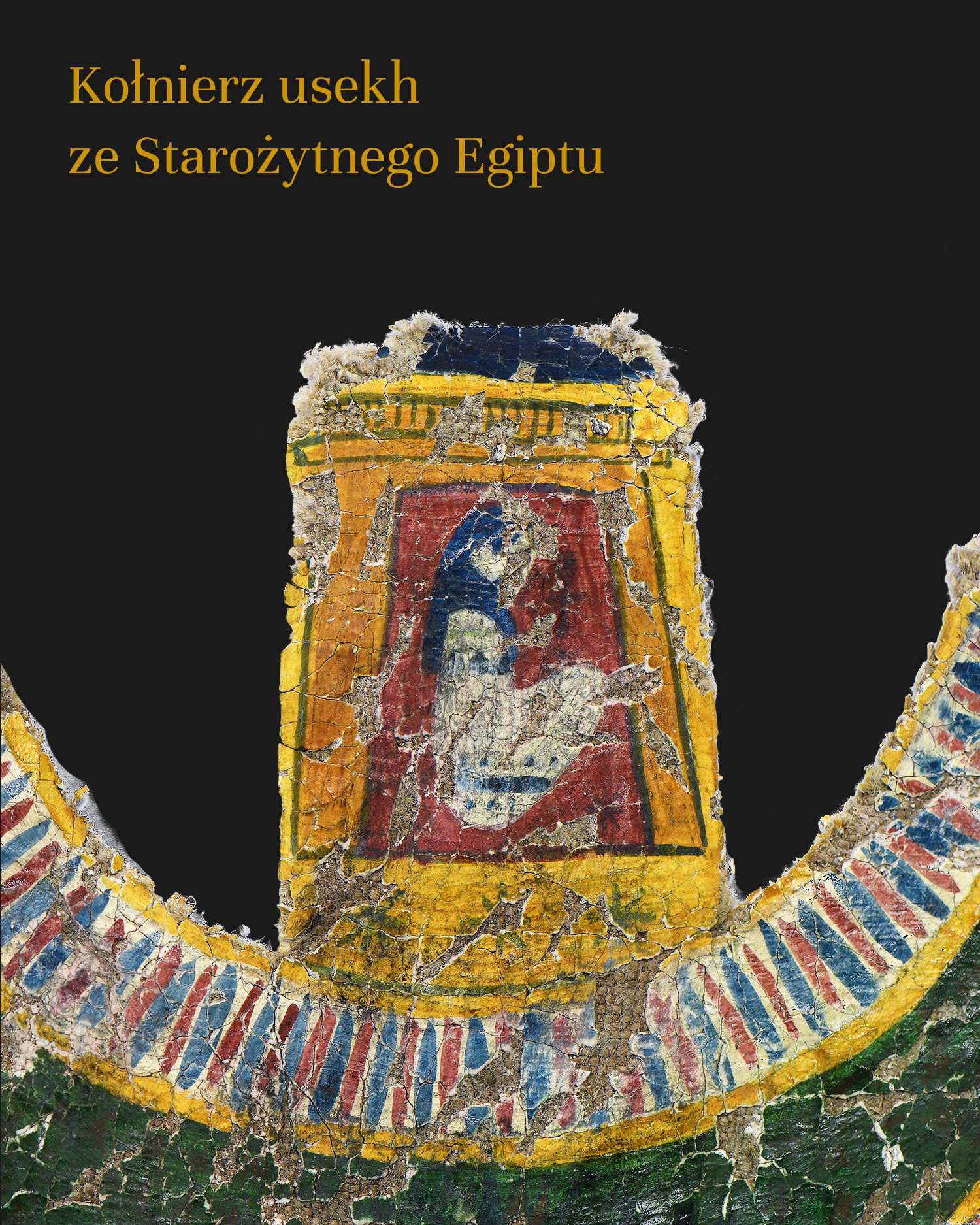
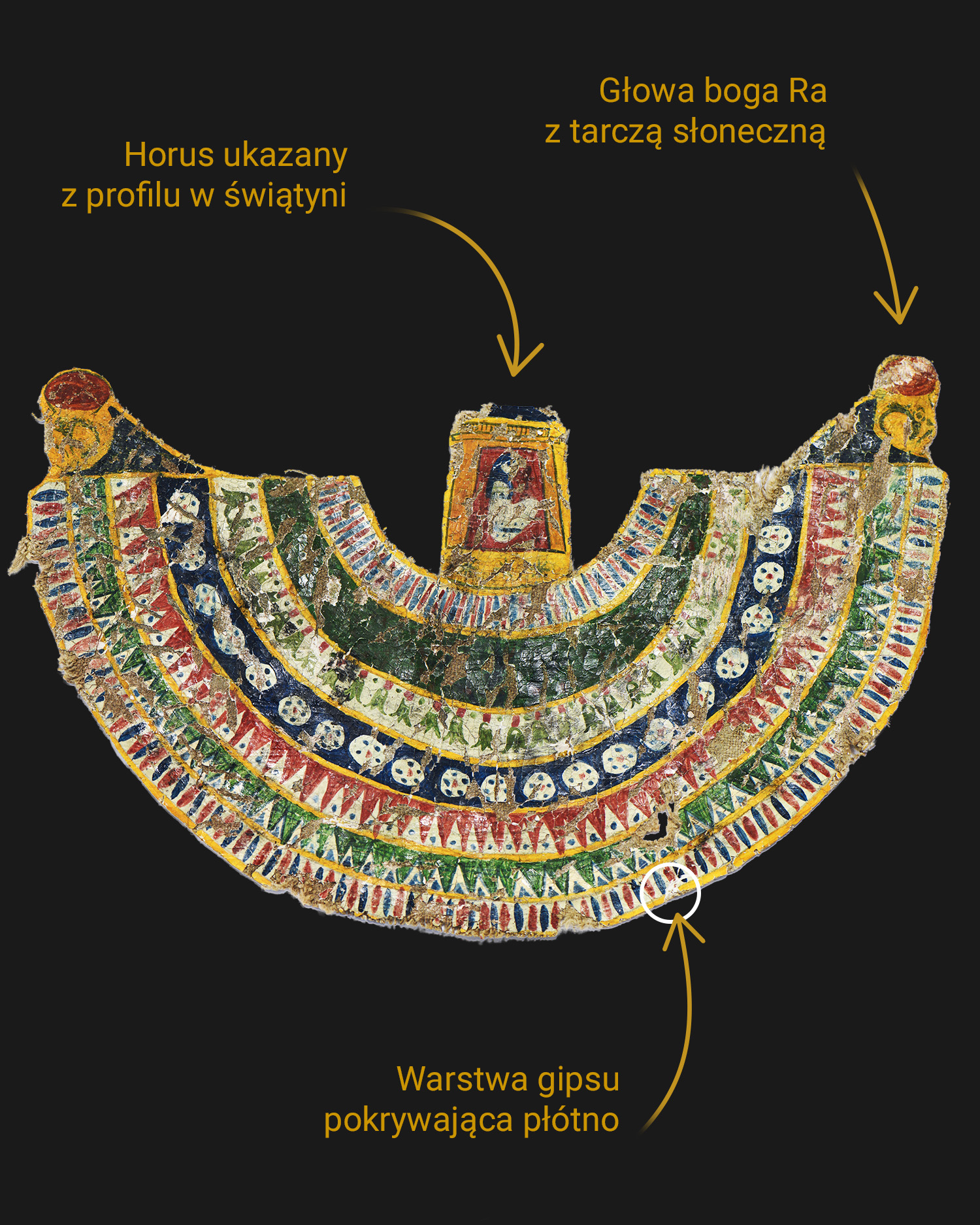
Cartonage (canvas covered with gypsum and polychrome) with a depiction of a wide necklace called a “usekh” collar, ancient Egypt, 1st millennium B.C. The collar has a semicircular form and is composed of several zones of ornament separated by narrow yellow bands. The different zones are filled with diverse decorative motifs: a row of circular ornaments filled with dots, imitating glass or faience beads, stylized “pendants,” strips with alternating triangular segments, and rows of spindle-shaped ornaments. At the top, in the center, is a rectangular field with a representation of Horus, shown in profile in a seated position, facing right, inside a stylized temple. The sides of the collar show depictions of a red disk above the head of a falcon or hawk – most likely a depiction of the head of the god Ra with a solar disk.
It is impossible to say conclusively whether the offered collar covered the coffin or directly the mummy of the deceased, as both possibilities are possible. Without specialized research, its dating should be placed in a wide range covering the 1st millennium B.C. However, it is worth noting that similar decorative motifs appear on a cartonage collar from the collection of The Michael C. Carlos Museum in Atlanta, dated to 1069-750 B.C. (object no. 2018.010.254).
Sprzedane
| Dimensions | 20 × 31 cm |
|---|---|
| Type |
Fragment of funerary decoration |
| Form |
Cartoon with representation of usekh necklace |
| Kolorystyka |
Blue ,Green ,Red ,White ,Yellow |
| Technika |
Cartonage |
| Czas powstania |
1st millennium BC. |
| Era |
Antiquity |
| Kraj pochodzenia |
Ancient Egypt |
| State of preservation |
Losses of fabric and paint layer, surface cracks |
Related products
Balsamarium / Scatozza 49 Type Toilet Flask, glass, Roman Empire, 1st/2nd century AD.
A complete, ancient Roman unguentarium (balsamarium), this piece is a classic example of a luxurious toilet vessel with rare and highly specialized morphology. In the rigorous archaeological classification of glass from the Vesuvius region, this vessel represents the Scatozza 49 form (the Italian equivalent of the De Tommaso 14 type). In Clasina Isings' classic, pan-European classification, this object is positioned as an early transitional variant of the Isings 82 form (displaying evolutionary characteristics between Isings 28 and 65 types), making it exceptionally interesting from the perspective of Roman glass craftsmanship development. The artifact dates from the early Imperial period and exhibits workshop characteristics typical of manufactories operating in Italy and the western provinces of the empire during the second half of the 1st and early 2nd century AD (Flavian period).
Height: 14.2 cm Rim diameter: 4.8 cm Maximum body diameter: 7.8 cm Weight: 54.0 g (wall thickness approx. 1 mm)Dragendorff 15/17 type terra sigillata dish, terracotta, Roman Empire, c. 70-120 AD.
This Roman terra sigillata table dish (patera) represents the Dragendorff 15/17 form (a variant featuring plastic decoration and a prominent rim). It was crafted between approximately 70–120 AD, during the Early Imperial period, specifically under the Flavian dynasty and Emperor Trajan. The dish was produced in renowned, highly specialized ceramic workshops in Pisa, recognized as part of the advanced Tardo-Italic (Padanian) production circle.
Rim diameter (maximum): 24.5 cm Total height: 6.3 cm Foot diameter (base): 11.5 cm Weight: 808 g
Gallo-Roman male portrait head, marble, Roman Empire, Province of Gaul (area of modern France), 1st-3rd century after Chr.
Kantharos, terracotta, Ancient Greece (Magna Graecia – Apulia or Campania), 3rd century BC
A South Italian kantharos, a wine-drinking vessel, classified in Hellenistic pottery typology as a variant with vertical loop handles and stamped decoration on the base. The object dates from the Hellenistic period, specifically the 3rd century BC. The vessel was crafted using a potter's wheel from rich, sorted clay in one of the workshops of Magna Graecia, located in Apulia or Campania.
Rim diameter: 8.5 cm
Width with handles: 13.5 cm Height: 8.8 cm Foot diameter (base): 5.3 cm Weight: 190 g
Oinochoe, terracotta, Ancient Greece, 4th century BC.
Saucepan (patella) of Eggers type 137, tinned bronze, Roman Empire, c. 50-120 AD
This Roman culinary and banqueting vessel represents the form of a patella (deep saucepan), classified in archaeological typology as Eggers type 137. The object dates from the early Roman Empire, specifically the second half of the 1st century or the beginning of the 2nd century AD (a timeframe of approximately 50–120 AD), corresponding to the chronological horizon from Emperor Nero's reign to the Flavian dynasty and Emperor Trajan. The saucepan was cast from tinned bronze in a provincial Roman workshop, located in Gaul or Germania Inferior, modeled after products from Campanian manufacturers in the Capua region. The tin coating on the inner walls of the vessel was intended to protect prepared food from direct contact with copper and the formation of toxic compounds. The vessel's net weight is 1060 grams. The object consists of a hemispherical bowl, 8.2 centimeters in height and 18 centimeters in rim diameter, connected to a flat handle with a trapezoidal finial, resulting in a total length of 30.2 centimeters.