


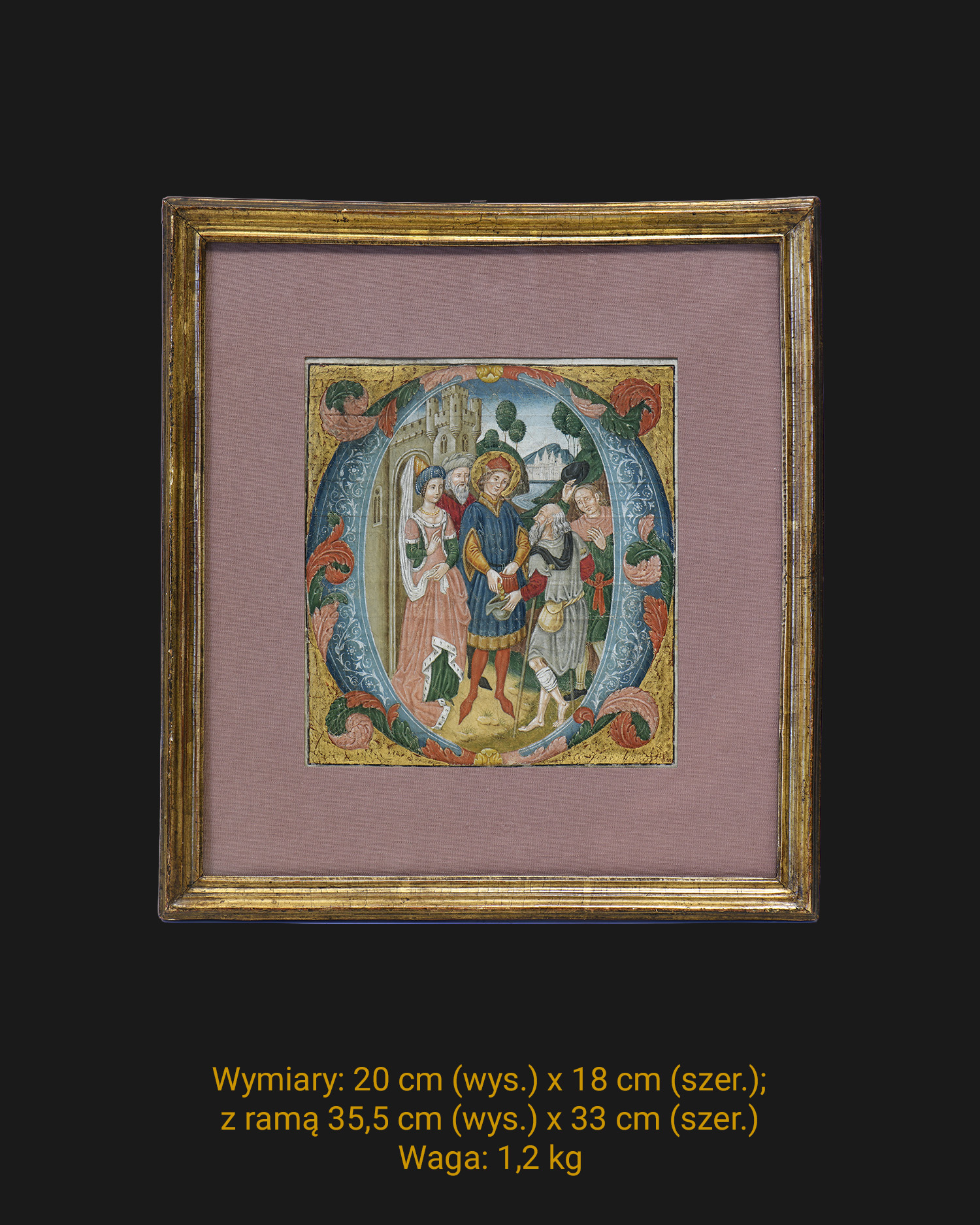

Fragment of an antiphonary page with illuminated initial, parchment, Europe, 15th century
4100,00 zł
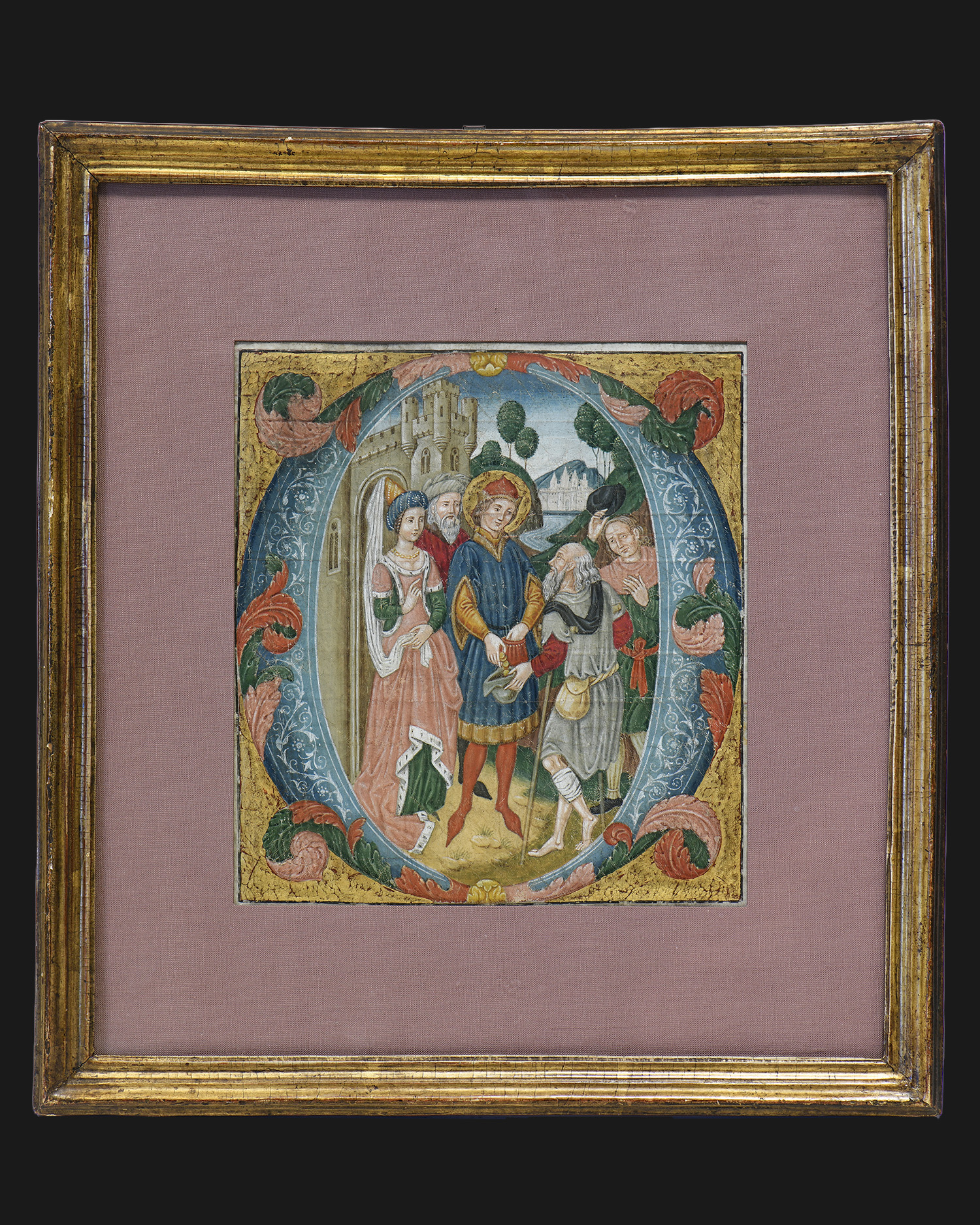
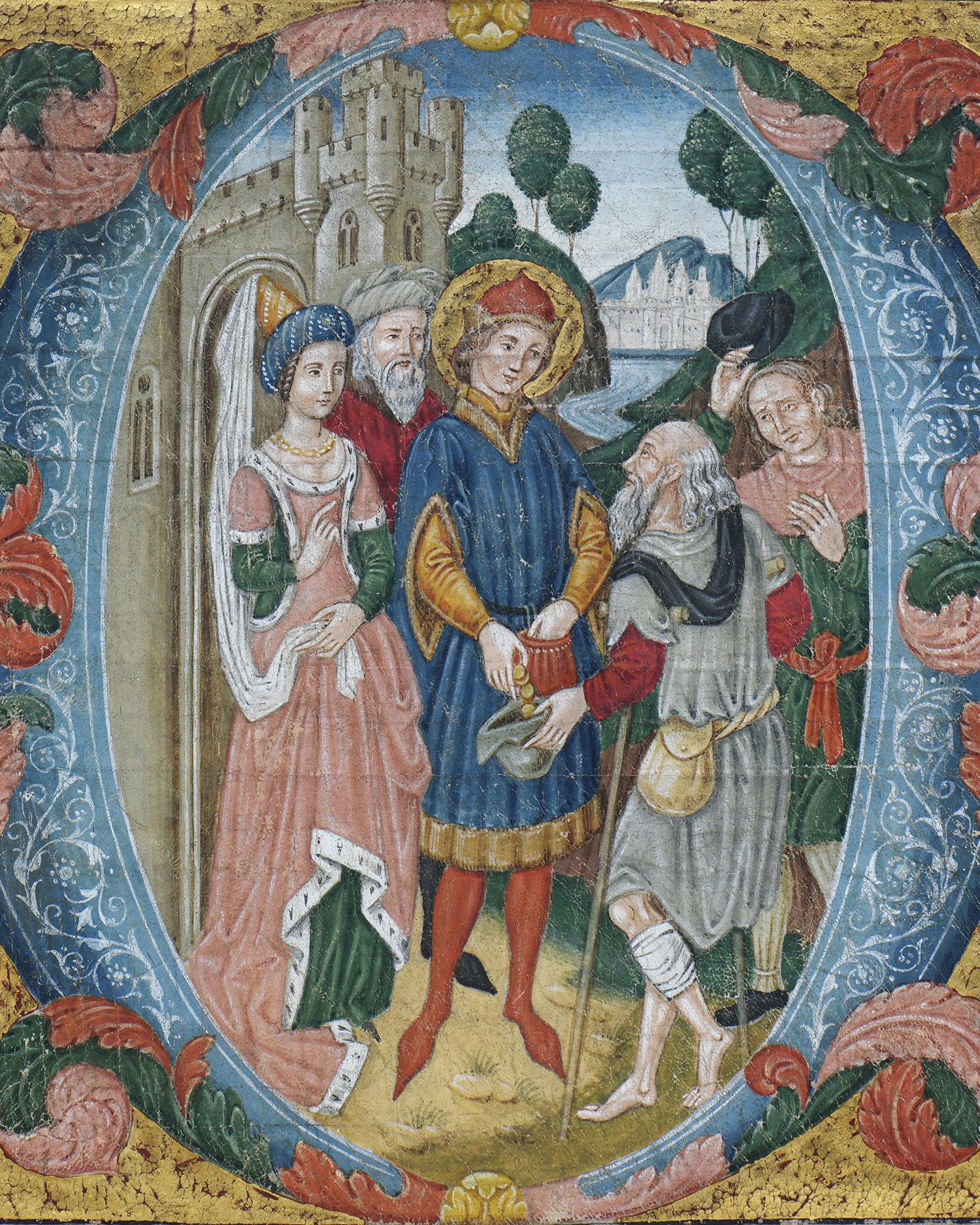
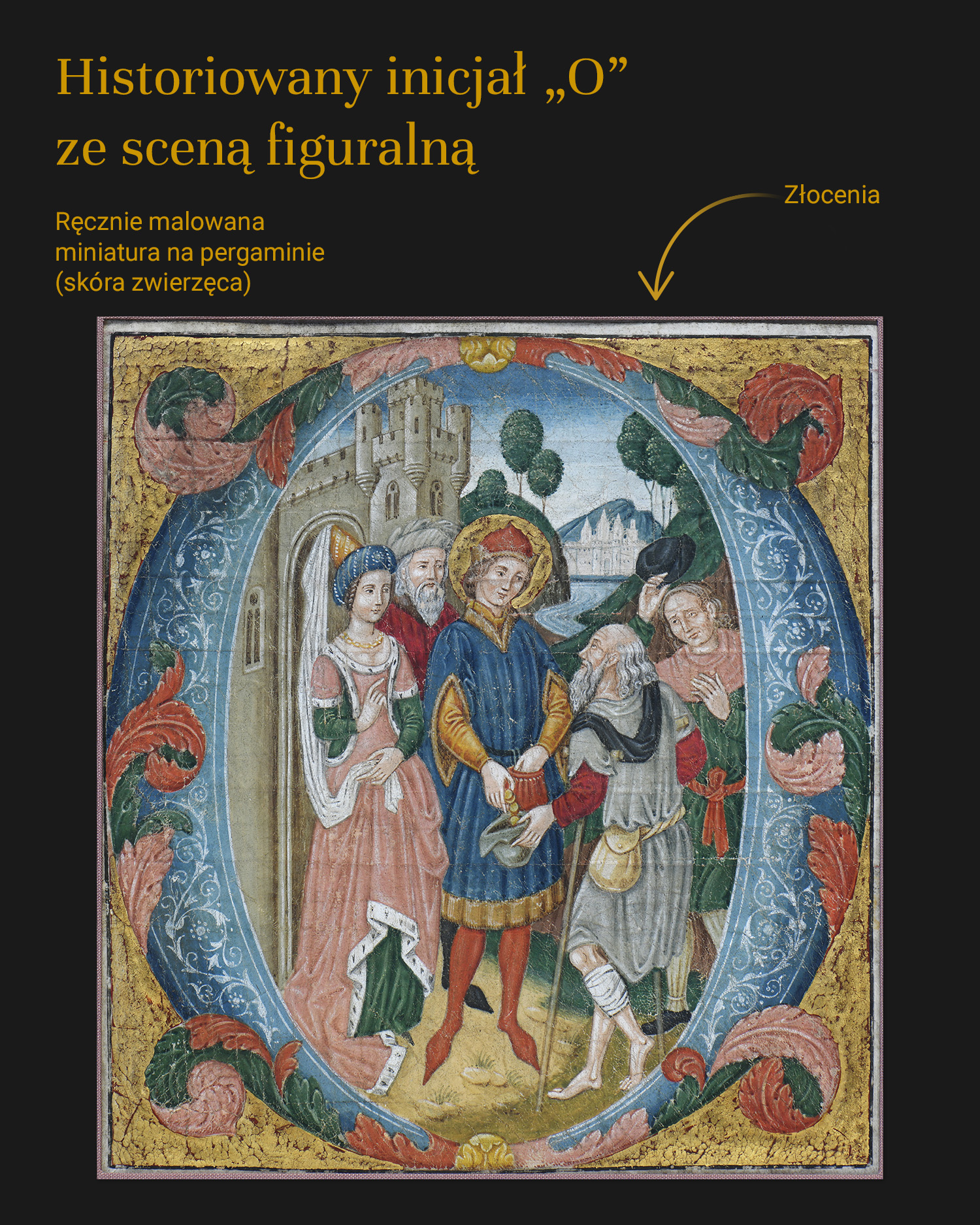
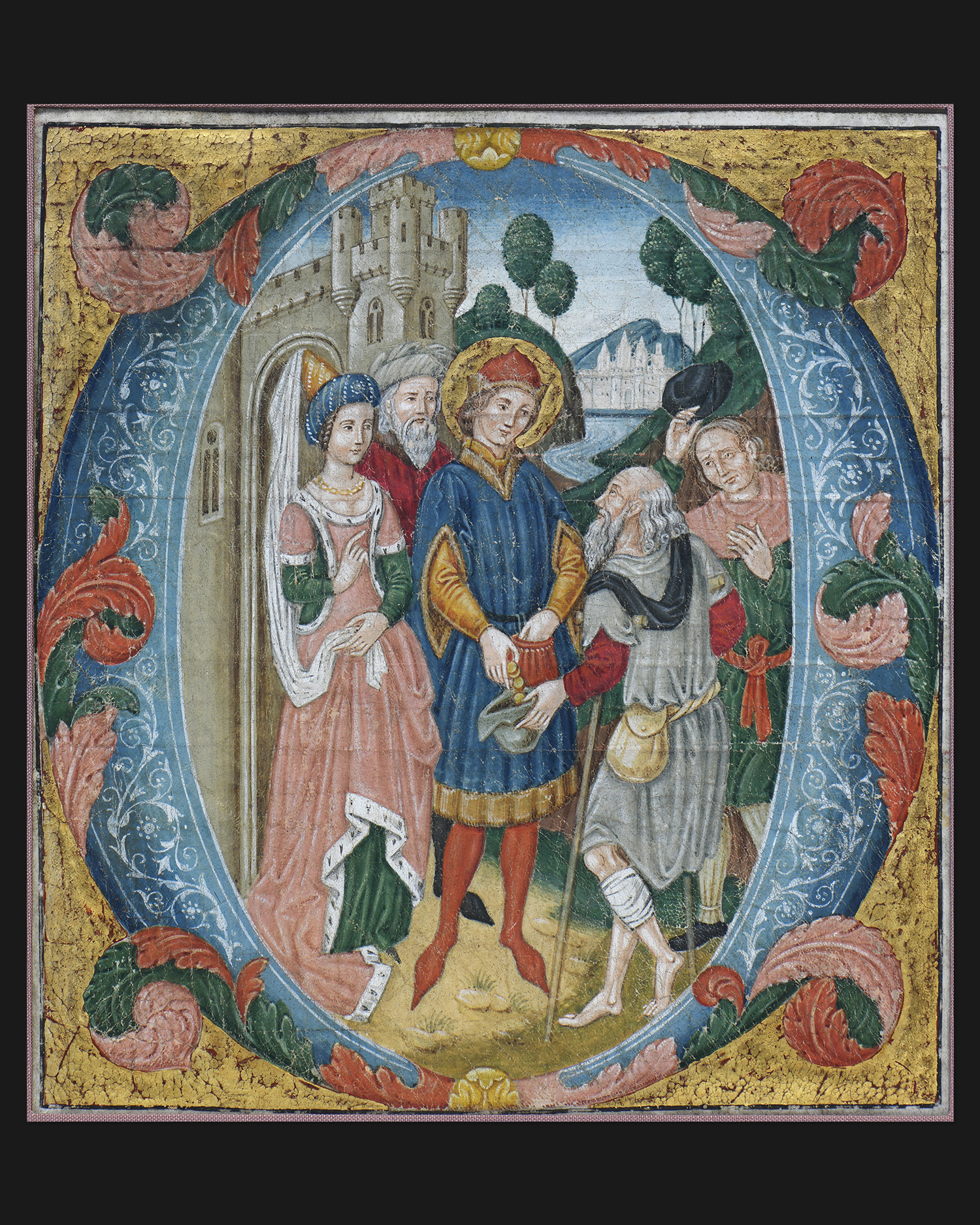
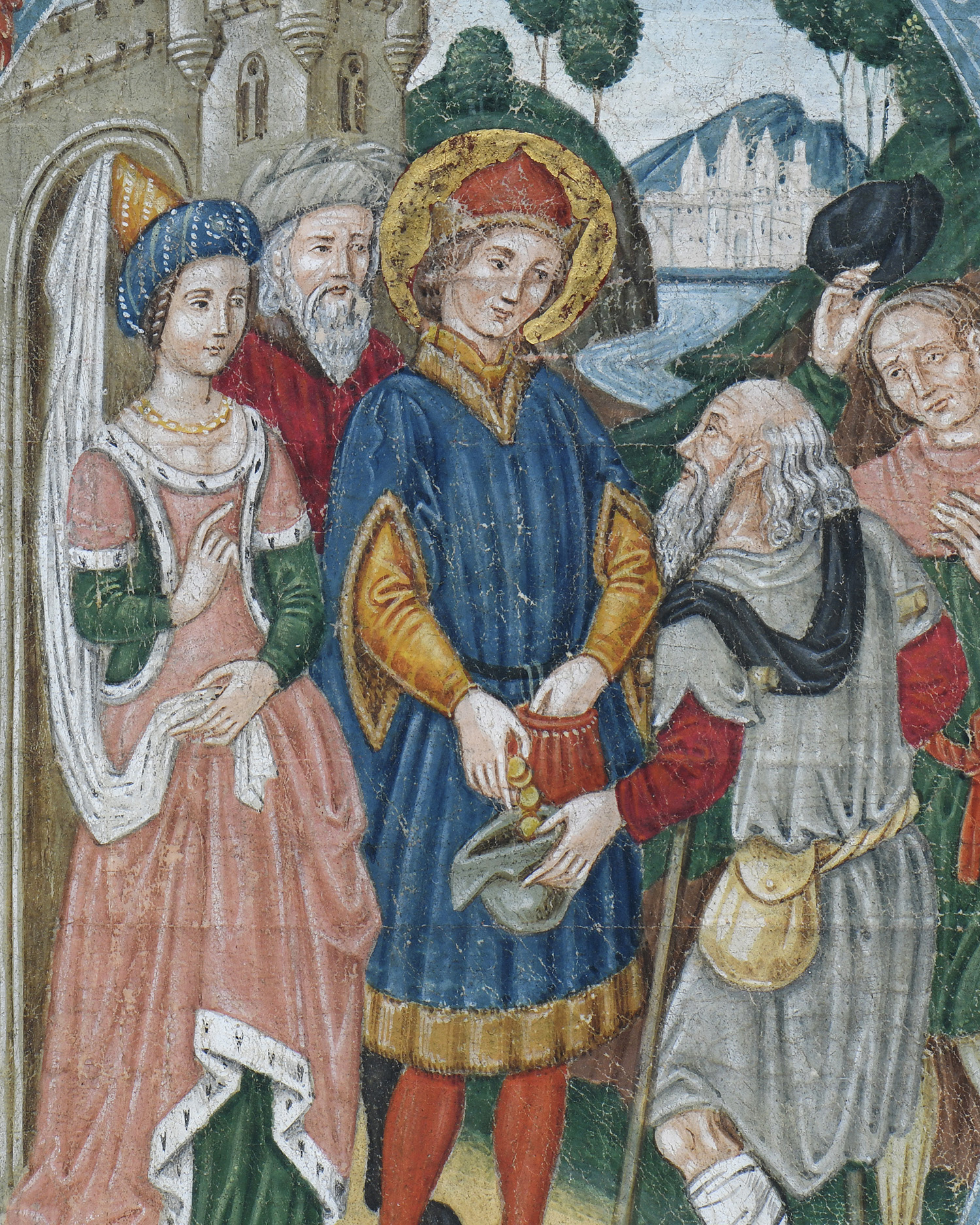
The fragment of the page visible within the frame is entirely occupied by a historiated initial “O”. The figural scene within depicts a haloed youth dressed in secular attire giving alms to an old beggar supported by crutches. He is accompanied by a young woman and an older man, with urban architecture visible in the background.
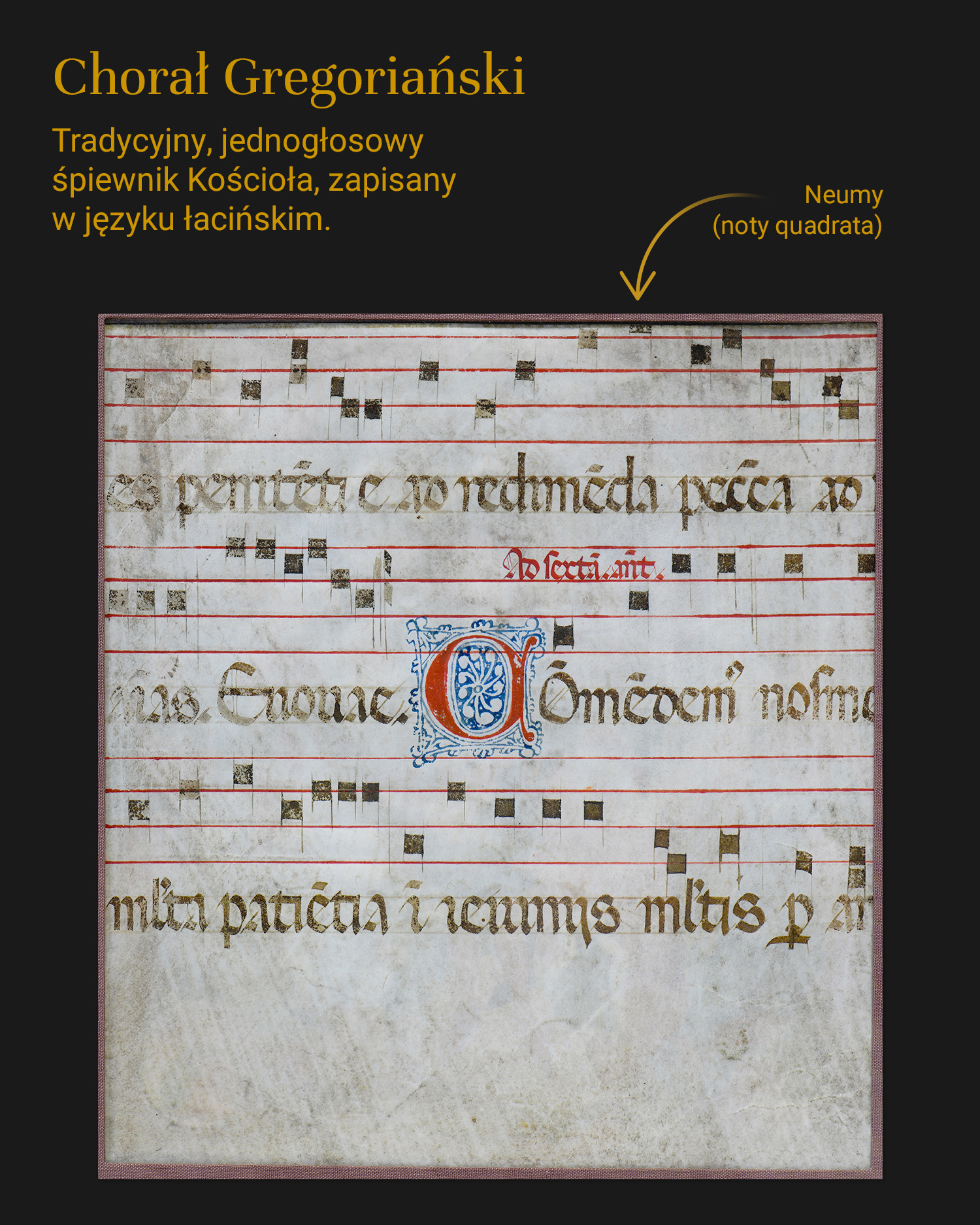
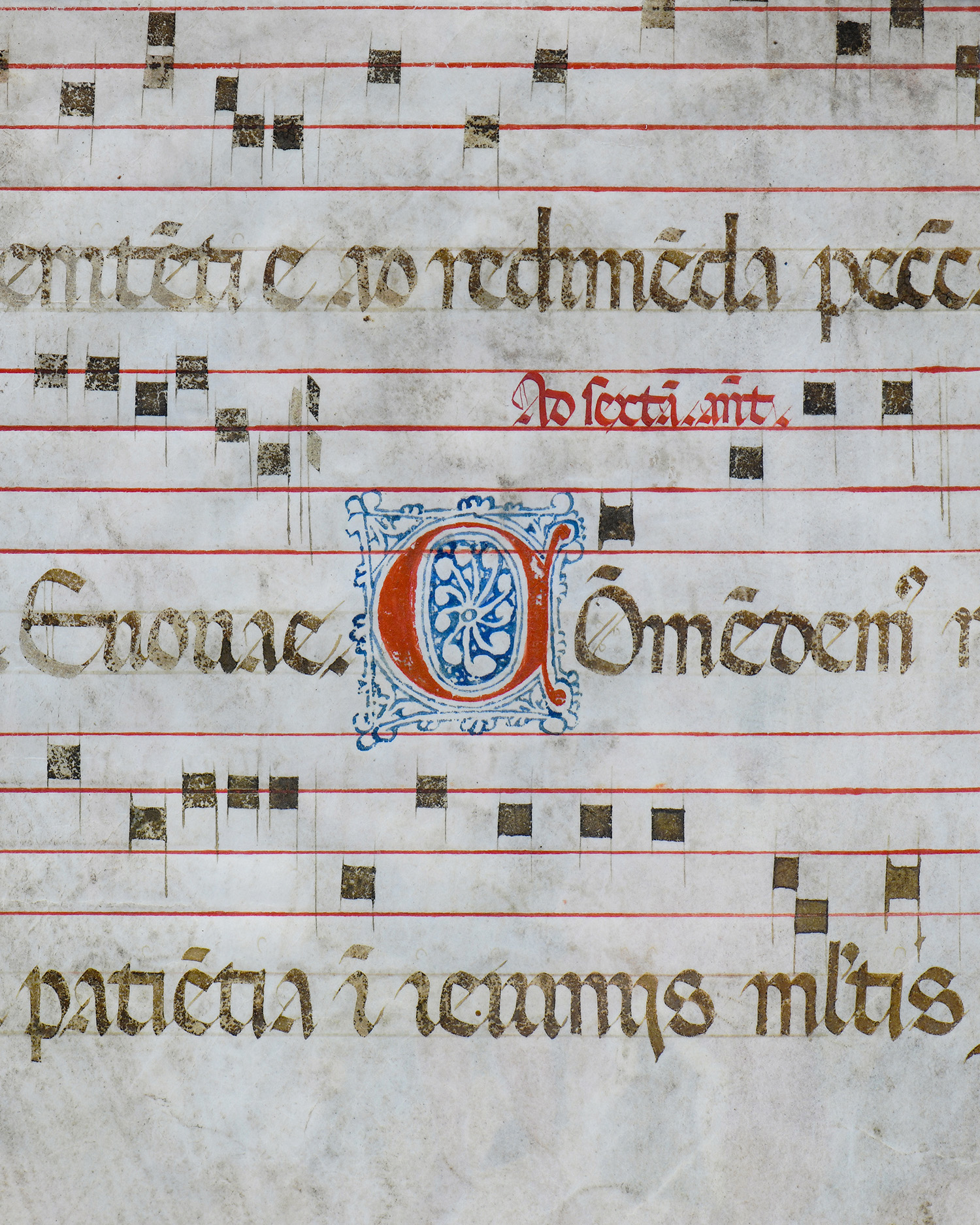
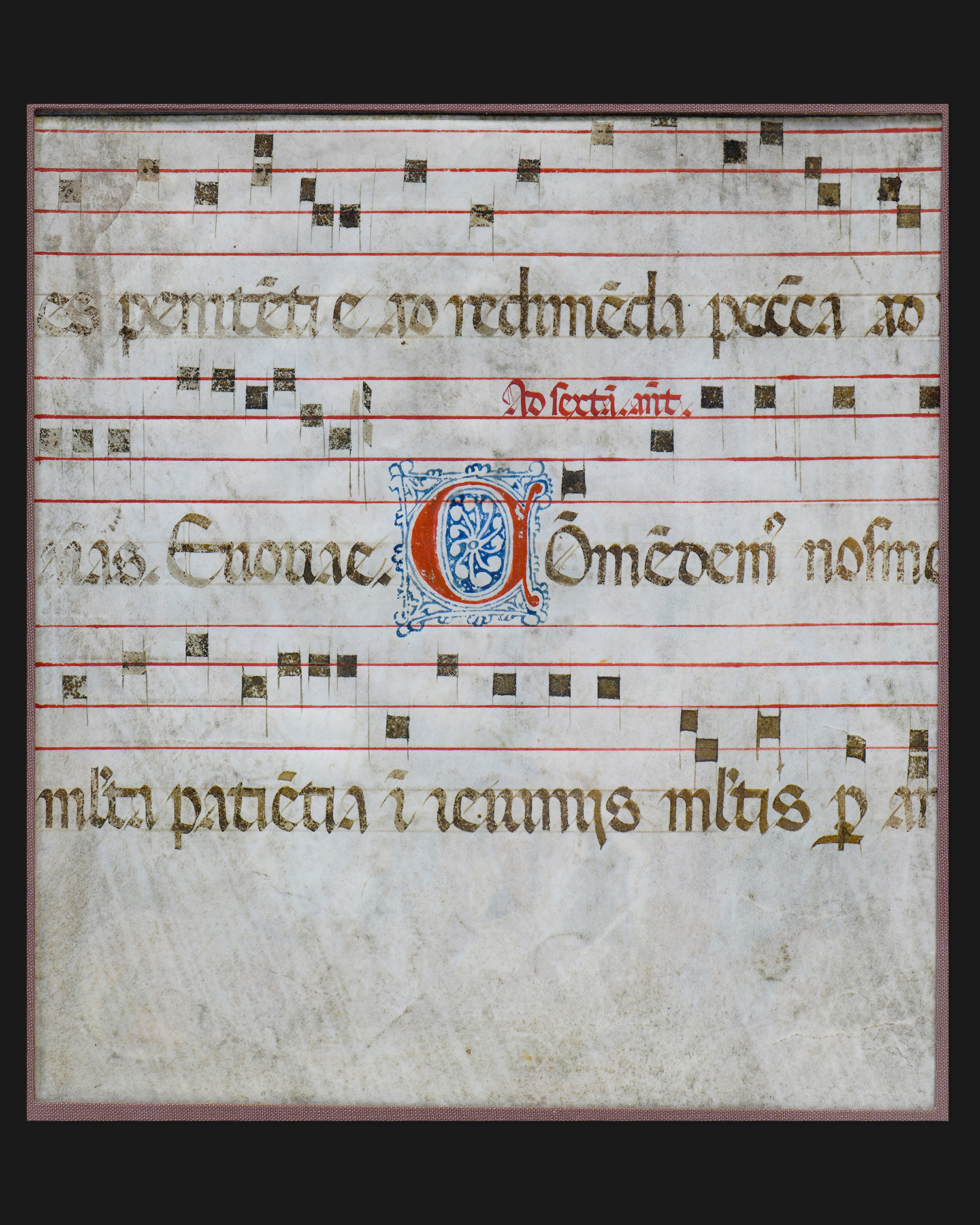
The reverse side features a fragment of Latin liturgical text written in Gothic minuscule and musical notation using square neumes (predecessors of notes used in medieval Europe) on a four-line staff, characteristic of Gregorian chant. The presence of the formula “Euouae” (a notation of vowels from the phrase saeculorum Amen), typical of psalm endings in antiphonal arrangement, allows identification of the notation as a fragment of an antiphon. The page also features a decorative initial “O” beginning a new antiphon.
The page is framed in a 19th-century gilded frame with a gently curved upper edge.
An object of extraordinary aesthetic and collectible value. A great rarity on the market!
Sprzedane
| Weight | 1,2 kg |
|---|---|
| Dimensions | 20 × 18 cm |
| Type |
Page from an antiphonary |
| Form |
Framed liturgical manuscript page |
| Kolorystyka |
Blue ,Gold ,Gray ,Green ,Red |
| Technika |
Gilding ,Tempera on parchment |
| Czas powstania |
15th century |
| Era |
The Middle Ages |
| Kraj pochodzenia |
Europe |
| State of preservation |
Very good; only microcracks in the paint layer typical of age |
Related products
Chapel with Our Lady of Czestochowa and Eagle, Poland, 19th century.
Christ Crucified, wood, Spain (Pyrenees?), 12th-13th century.
The sculpture impresses with the pronounced rigidity of the body, typical of early Roman depictions. The calm yet poignant expression of Christ's face is emphasized by huge, forward-facing eyes set in deep eye sockets.
His gaze, however, is slightly lowered, emphasized by a prominent nose and large, spreading ears that frame his face. His hair falls symmetrically on his shoulders; a peculiar hairstyle draws attention - the hair, separated by a parting on top of the head, is arranged in rollers covered with densely diagonal cuts. Very similarly arranged hair, resembling braids, has the famous statue of Christ of Mig Aran, located in the church of Sant Miquèu de Vielha (Val d'Aran valley). The beard and mustache end in artificial, volute curls.
Christ Salvator Mundi, polychrome wood, Poland, 19th century.
Dutch School, Ships in a Storm, oil on canvas, Netherlands (?), 2nd half of the 18th century.
Hendrik van Steenwijk II (ca. 1580 – 1649) – circle, Interior of a Gothic church, oil on board, Flemish school, 17th century.
The painting depicts the interior of a Gothic church, executed in the Flemish school of the 17th century, in the circle of Hendrick van Steenwijk i.e. one of the pioneers of perspective painting. The composition, built on an axis leading towards the main altar, shows a monumental interior with pillars, cross-ribbed vaults and side chapels. Figures of the faithful and clergy are visible in the space, introduced to emphasize the scale of the architecture and the mood of concentration.
The painting was made with oil technique on board, in typical Flemish school style. The frame is original, wooden, veneered, with preserved gilt edge.
The composition refers to the solutions used by Hendrick van Steenwijk the Elder and Younger, as well as Pieter Neefs and Bartholomeus van Bassen, developing the genre of architectural painting in Antwerp and Delft.
John Baptist Lambrechts (1680 – after 1731), Genre scene in an inn, oil on board, ca. mid-18th century.
John Baptist Lambrechts (1680 – after 1731), Genre scene in an inn, oil on board, ca. mid-18th century.
Pieter Neefs II (1620 – 1675/1685), Night Mass in a Gothic Church, oil on board, Flanders, 17th century.
The painting depicts the interior of a Gothic church, by Pieter Neefs the Younger (1620–after 1675), a Flemish painter specializing in 17th-century sacred interiors. The composition based on a precise linear perspective leads the eye towards the main altar, around which the faithful and clergy participating in the liturgy are gathered.
The painting was made in oil technique on board, without a visible signature. The upper part of the composition has been cropped, resulting in the loss of the original format and probably also the author's signature.
The work represents the mature style of Pieter Neefs the Younger - precise rendering of space, controlled light and realistic depiction of architecture, characteristic of the Antwerp school. Paintings of almost identical composition appear in several well-known collections and collections - including the Szépművészeti Múzeum (Museum of Fine Arts) in Budapest and a Sotheby's auction (2021).
It is worth mentioning that works from this series are also sometimes attributed to Pieter Neefs the Elder (c. 1578-1656), confirming the strong stylistic affinity between the works of father and son.
Bibliography / links:
- Peeter Neefs I - Invaluable
- Pieter Neefs II - Art Salon
- Pieter Neefs I - Museum of Fine Arts Budapest (Wikimedia Commons)
- Pieter Neefs II - Sotheby's Auction 2021