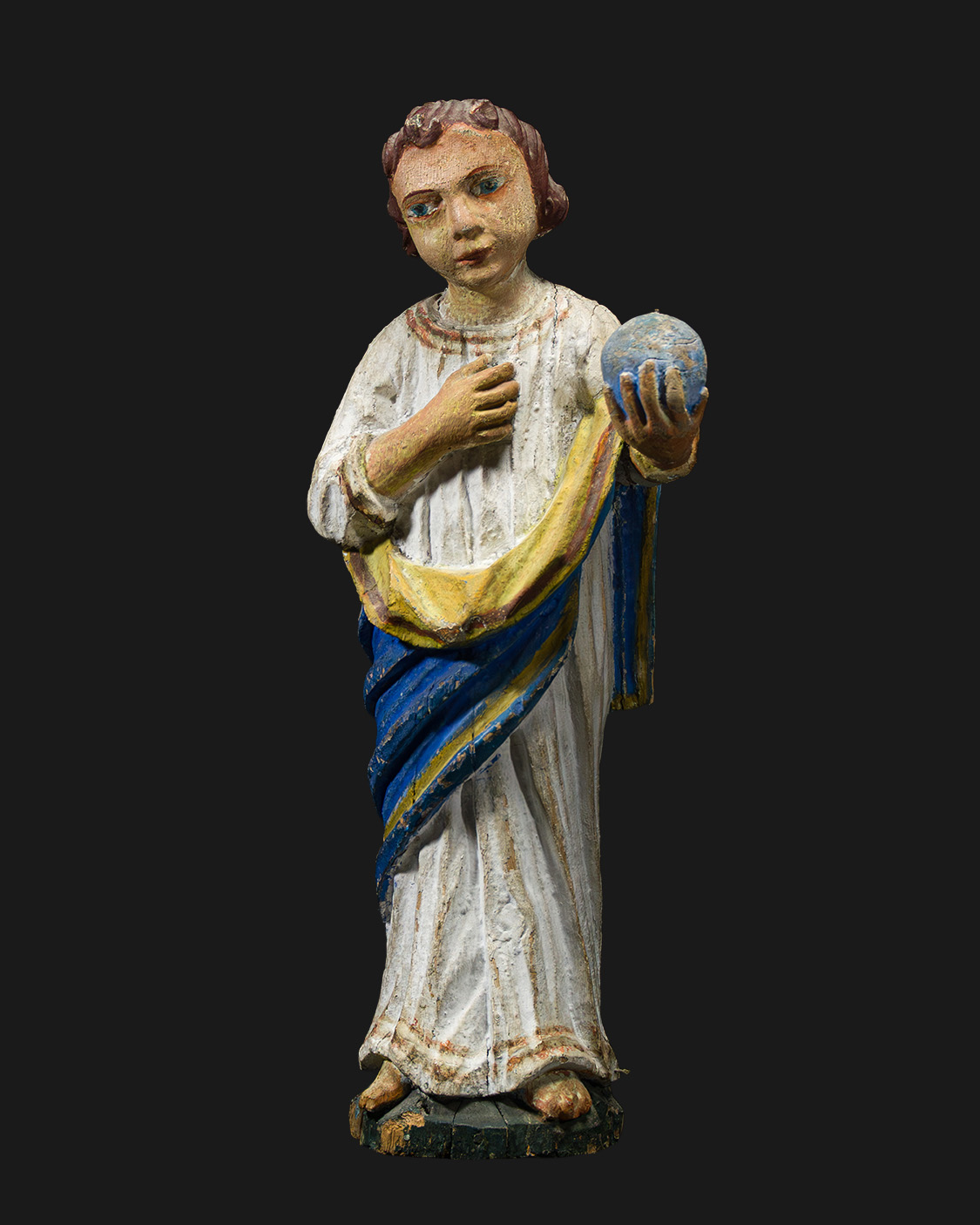
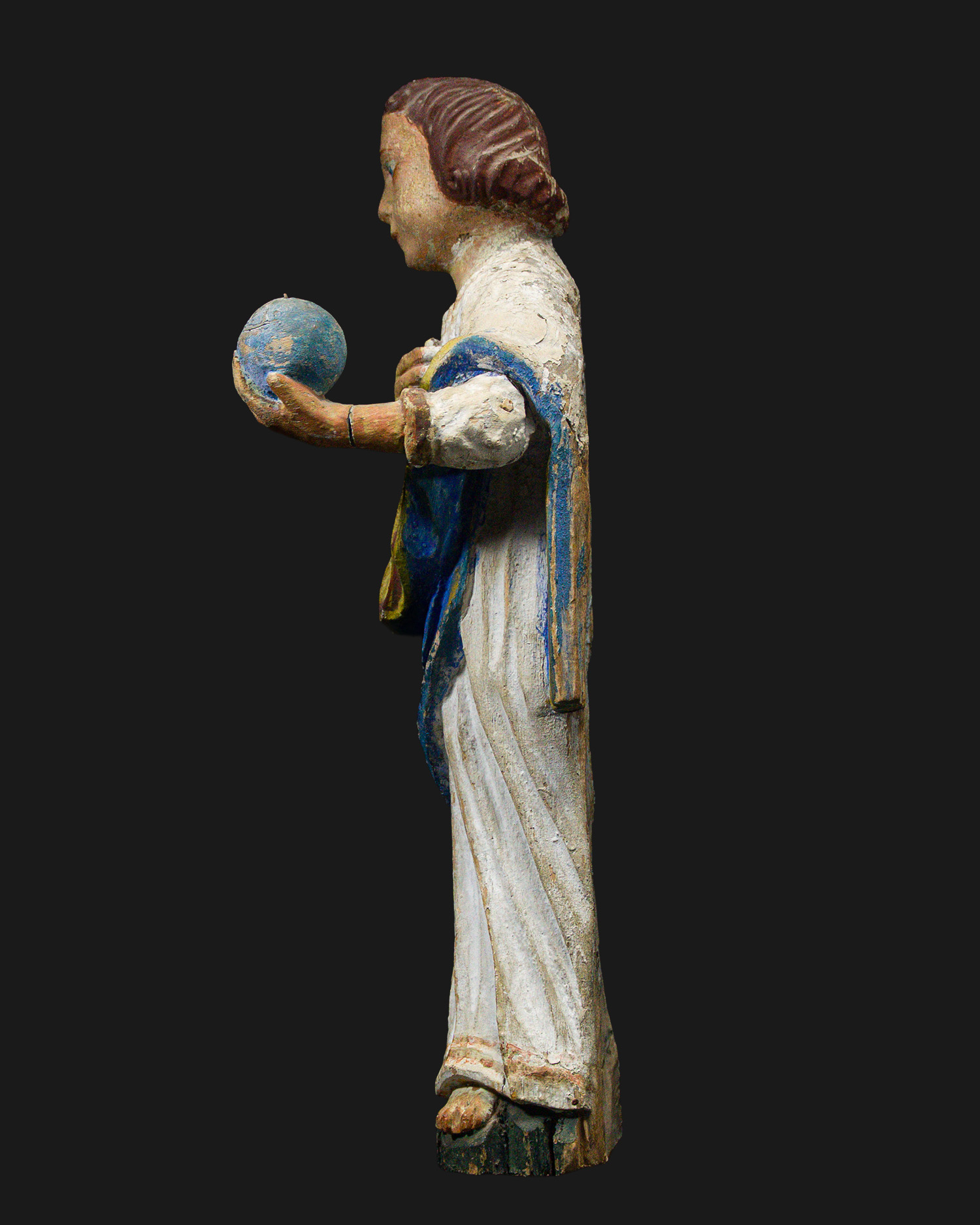
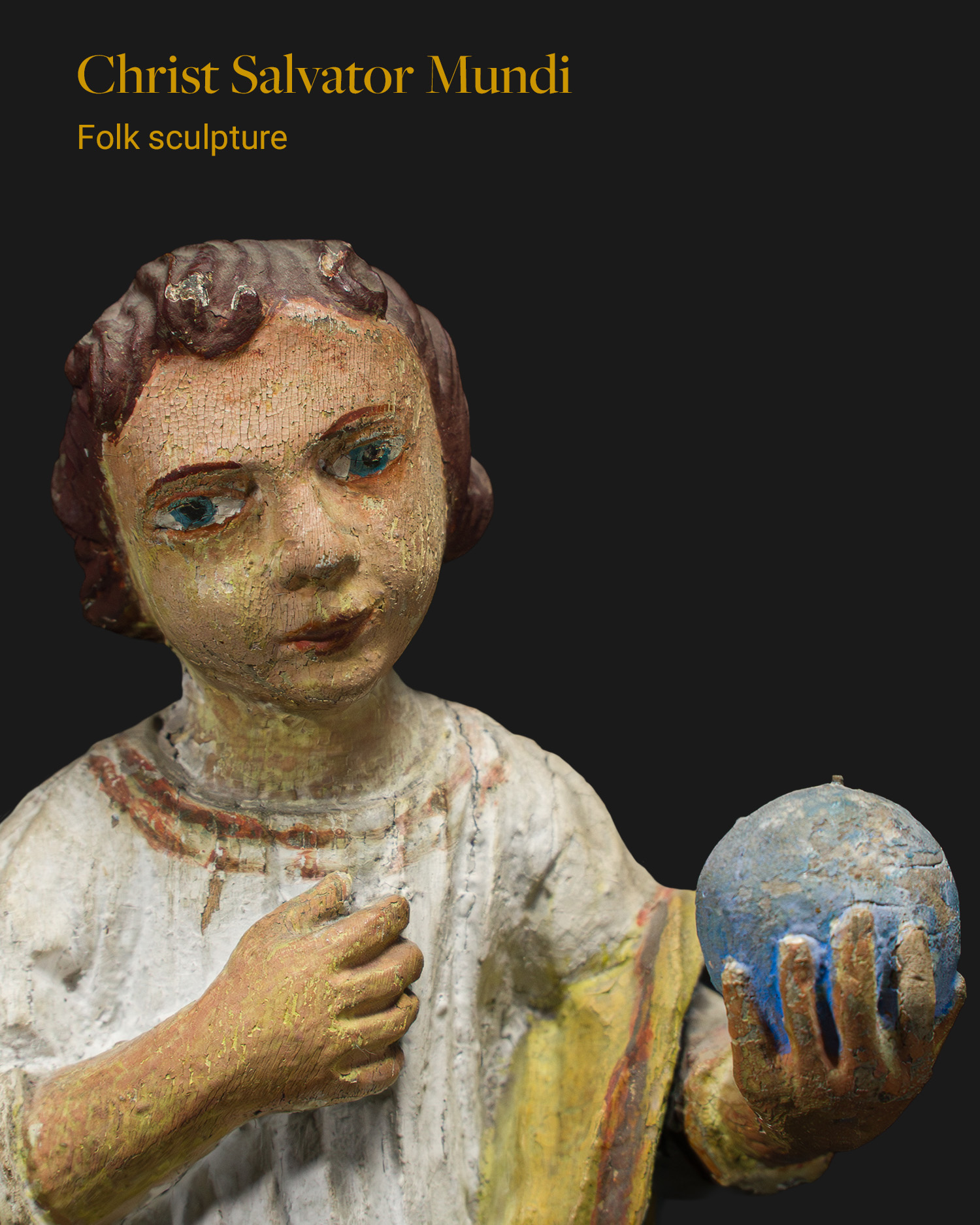
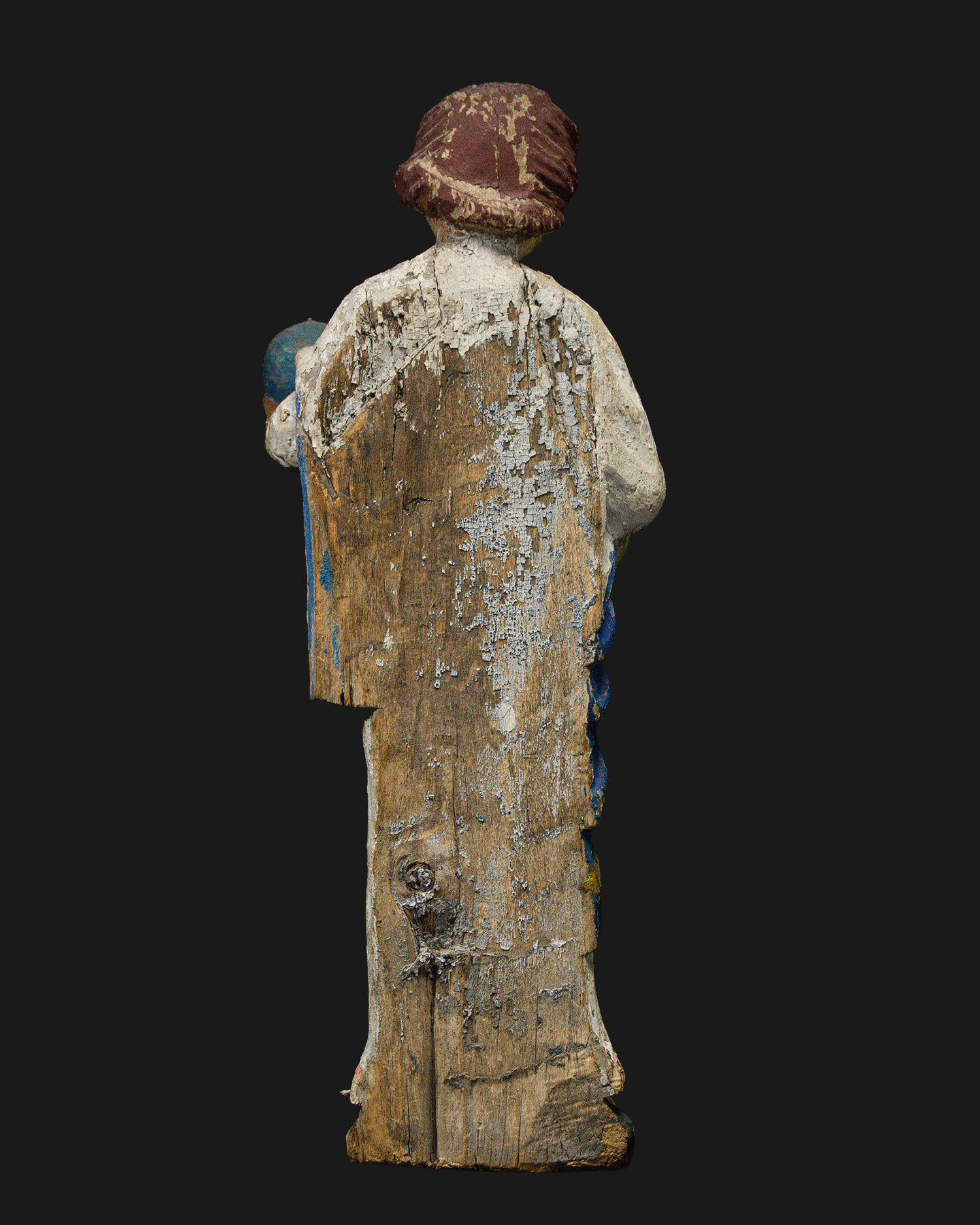
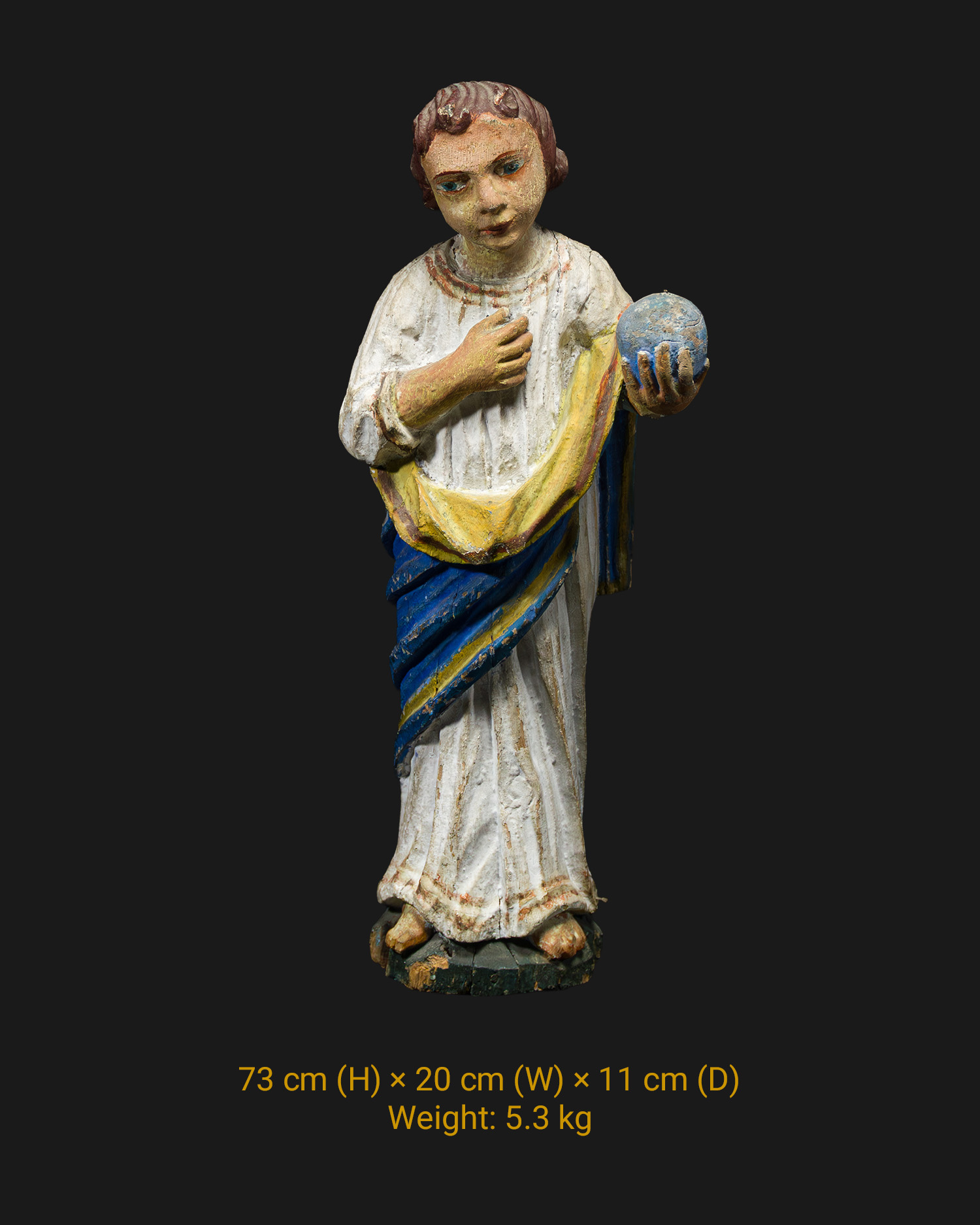
Christ Salvator Mundi, polychrome wood, Poland, 19th century.
2200,00 zł
Wooden sculpture depicting Christ as Salvator Mundi (Savior of the World), made in Poland in the 19th century. An example of folk Baroque sculpture, combining a religious theme with a simple, legible form. The full-plastic, frontal figure shows a young Jesus in a gesture of blessing, with a globe in his left hand.
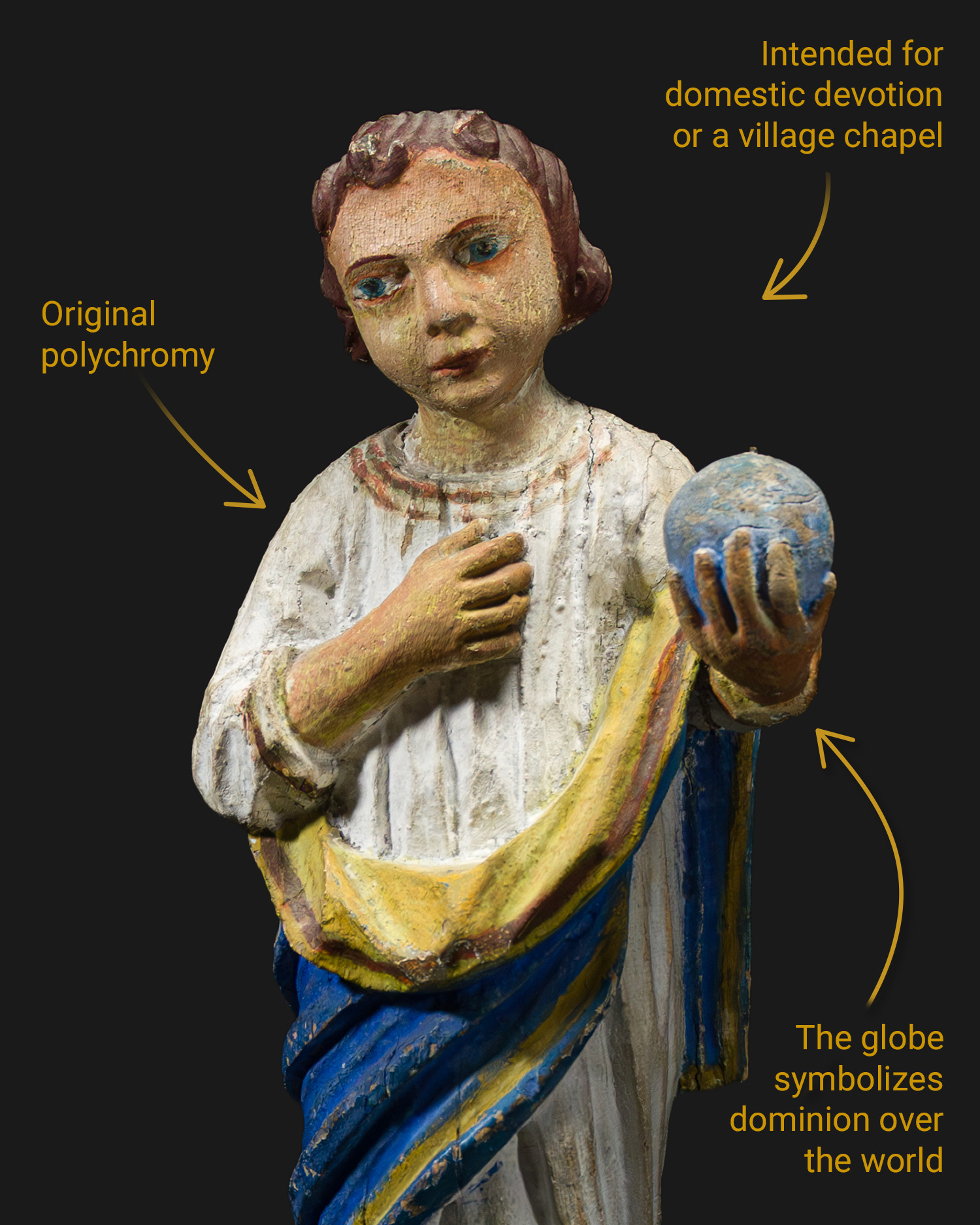
The figure is dressed in a white tunic and blue coat with yellow piping. Remnants of the original polychrome and natural traces of use are visible. The simplified modeling, linear folds and expressive face indicate a folk workshop from southern Poland, representing the late Baroque tradition of devotional sculpture.
Symbolism
Salvator Mundi theme shows Christ as Savior and ruler of the world. The right hand in the blessing gesture signifies spiritual authority, while the globe in the left hand symbolizes dominion over all creation. It was a popular Counter-Reformation motif in Baroque art, emphasizing the presence of Christ as the mediator between God and man.
Historical context
The sculpture was created in Poland in the 18th century, during the Counter-Reformation period , when religious art had a didactic and devotional function. Salvator Mundi representations were made for side altars, monastery chapels and private shrines.
The sculpture represents the folk Baroque variety, in which realism has been replaced by symbolism and a synthetic approach to form. Features typical of rural sculpture workshops of the 18th century are evident: frontal positioning of figures, shortened body proportions, strongly marked gestures and contrasting, saturated colors.
In Western iconography, the Salvator Mundi motif has appeared since the 13th century, but during the Baroque period it gained special significance as a symbol of Christ's authority over the mortal world. Sculptures with a globe were often placed in domestic altars or monastery refectories as a sign of protection and blessing.
Collector's value
Salvator Mundi sculptures preserved in their original polychrome are sought after on the sacred art market. This specimen is distinguished by its good state of preservation, the complete capture of the figure and the authentic surface color. It is a valuable example of Baroque folk sculpture from the Polish area.
Artistic qualities
The proportions of the figures are balanced, and the frontal composition facilitates altar display. The figure is developed simply, with limited modeling and schematic treatment of the folds of the robe. The face and gesture are framed sparingly, which places the figure in the character of late Baroque folk sculpture.
Application
The statue may have been intended for home worship, a monastery shrine or a side altar. Today it represents a collector's and educational object, useful for the study of Counter-Reformation iconography and sculpture workshops of the 18th century.
| Weight | 1,6 kg |
|---|---|
| Dimensions | 45,5 × 17 × 14 cm |
| Type |
Sacred sculpture |
| Form |
Full-figure, frontal figure showing young Jesus in a gesture of blessing – right hand raised, left hand holding a blue globe symbolizing power over the world |
| Materiał |
Polychrome wood |
| Kolorystyka |
Blitz ,Brown ,White ,Yellow |
| Czas powstania |
18th century (1701-1800) |
| Era |
Baroque |
| Kraj pochodzenia |
Poland |
| State of preservation |
Very good; visible rubbing and cracking of wood, well-preserved colors, original polychromy |
Related products
Cabinet Reliquary with Relic of the True Cross and 26 Saints, wood, textiles, Central Europe, 18th century
An 18th-century Baroque cabinet reliquary, a freestanding wooden display case of trapezoidal form, containing a total of 27 relics. The side walls and top are chamfered, widening toward the front. The interior is lined with burgundy velvet, trimmed with decorative borders of gold bullion thread.
At the center, set slightly forward from the back, is a raised textile reliquary in the form of a monstrance, embroidered with gold thread and richly adorned with bullion, filigree, miniature beads, and multicolored glass imitating precious stones. On the base and shaft are placed six relics, identified by inscriptions painted in gold on dark blue banderoles.
Within the central repository is a reliquary capsule with a convex glass cover, containing two fragments of the True Cross, surrounded by a radiant glory.
Above the “monstrance” is an oval image with an indistinct representation, encircled by 20 additional relics interspersed with decorative elements of bullion, beads, gold thread embroidery, and colored glass. At the level of the nodus are two larger relics (Ex Ossibus) of Saint Vincent and Saint Fortunatus, uniquely labeled on white banderoles.
A distinction should be made between a reliquary and a reliquary cabinet: a reliquary is a vessel that directly contains relics, whereas a cabinet reliquary serves as a structure housing and presenting them. This object is therefore not a typical example, as—besides the central textile reliquary in the form of a monstrance containing fragments of the Cross on which Jesus Christ died—it also incorporates an additional 26 relics of various saints placed directly within the composition, without individual containers.
Their preservation is ensured either by a fine mesh covering or solely by labeled banderoles. The relic of the True Cross is the only one enclosed within a glazed, and undoubtedly sealed, capsule.
The interior of the case, measuring 37.3 × 26.5 × 10 cm, is lined with burgundy velvet, trimmed with gold bullion thread.
Fragment of an antiphonary page with illuminated initial, parchment, Europe, 15th century
Gallo-Roman male portrait head, marble, Roman Empire, Province of Gaul (area of modern France), 1st-3rd century after Chr.
Head of an Angel (Putta), gilded linden wood, Poland, 1st half of the 18th century.
Irish (Celtic) cross, stone sculpture, Ireland, 19th century.
Saint John the Evangelist, late Gothic wooden sculpture, ca. 1500
The work may have been part of a winged altarpiece (retabulum), most likely in the Crucifixion group.
Sculpture of a god’s head (Zeus or Hercules), marble, Mediterranean basin, Hellenistic period
Vajrabhairava in Tantric Union (Yab-Yum) with Vajravetali, gilt and polychromed bronze, Tibet (?), 19th century
The sculpture depicts Vajrabhajrava, or more specifically, his Tantric form. The deity has three heads with angry expressions, crowned with a crown of skulls, symbolizing the direct destruction of illusion. Inside the crown, flames burst forth, a fire of wisdom burning away ignorance. Emerging from them is the head of a gentle animal - it belongs to Vajrabhajrava himself (his higher aspect).
The figure has six arms, symbolizing the multifaceted activity of the enlightened mind, and holds ritual attributes. The outstretched wings are a rarer but significant feature, representing a transcendental aspect and the overcoming of samsaric limitations. Vajrabhairava stands in a dynamic pose on a lotus base, trampling a male and female figure. These figures symbolize ignorance (avidya), attachment, anger, ego, and the illusion of duality.
