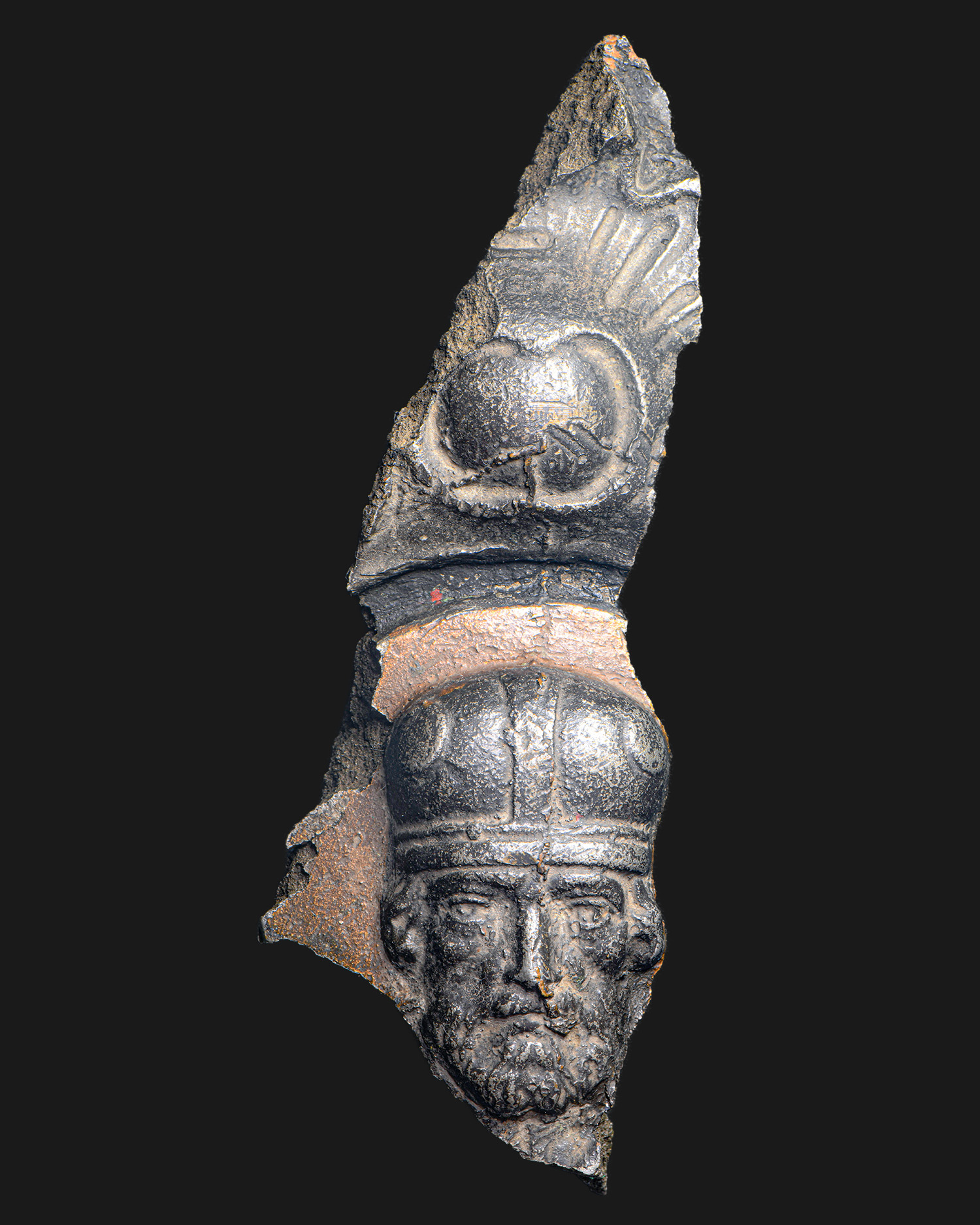
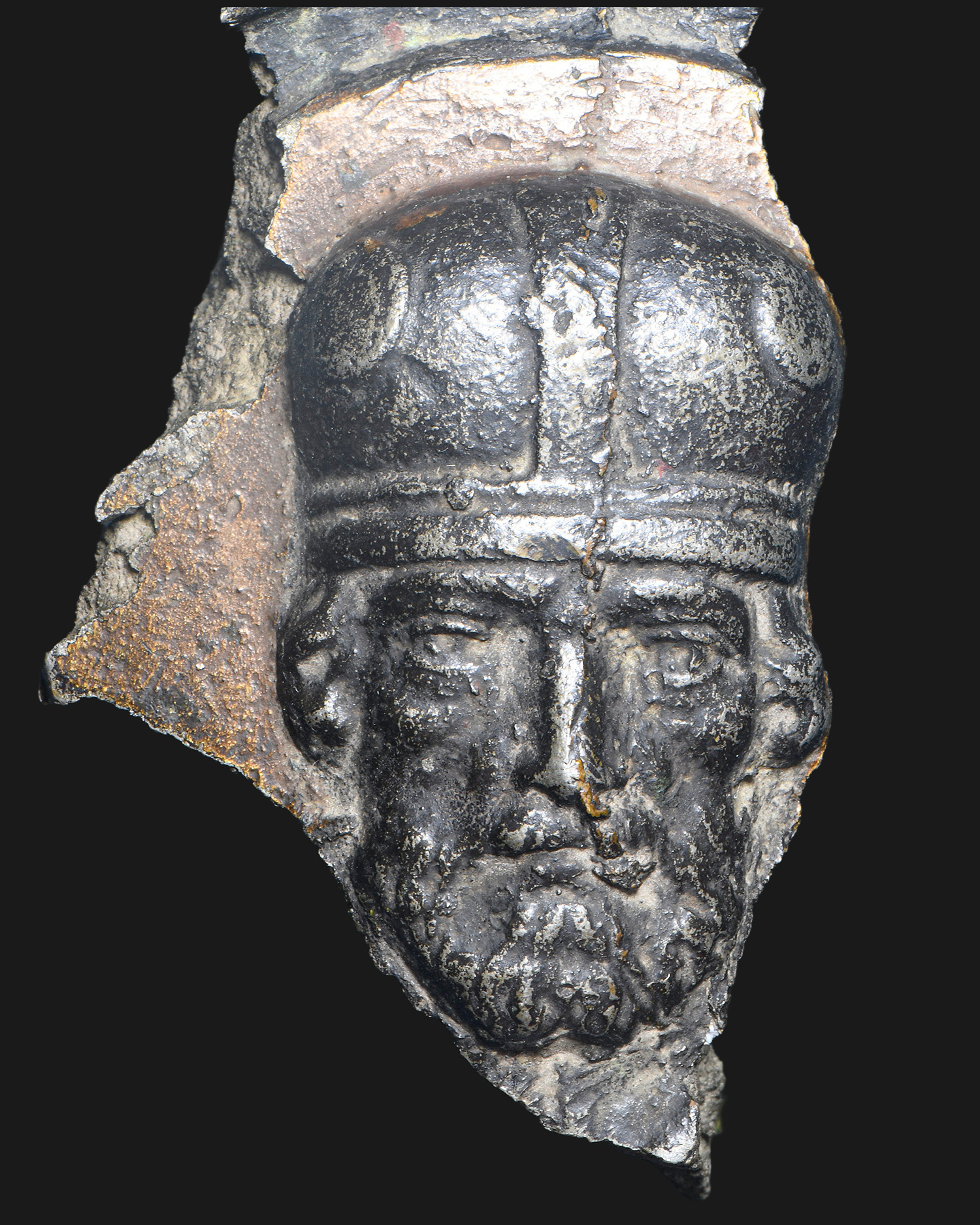
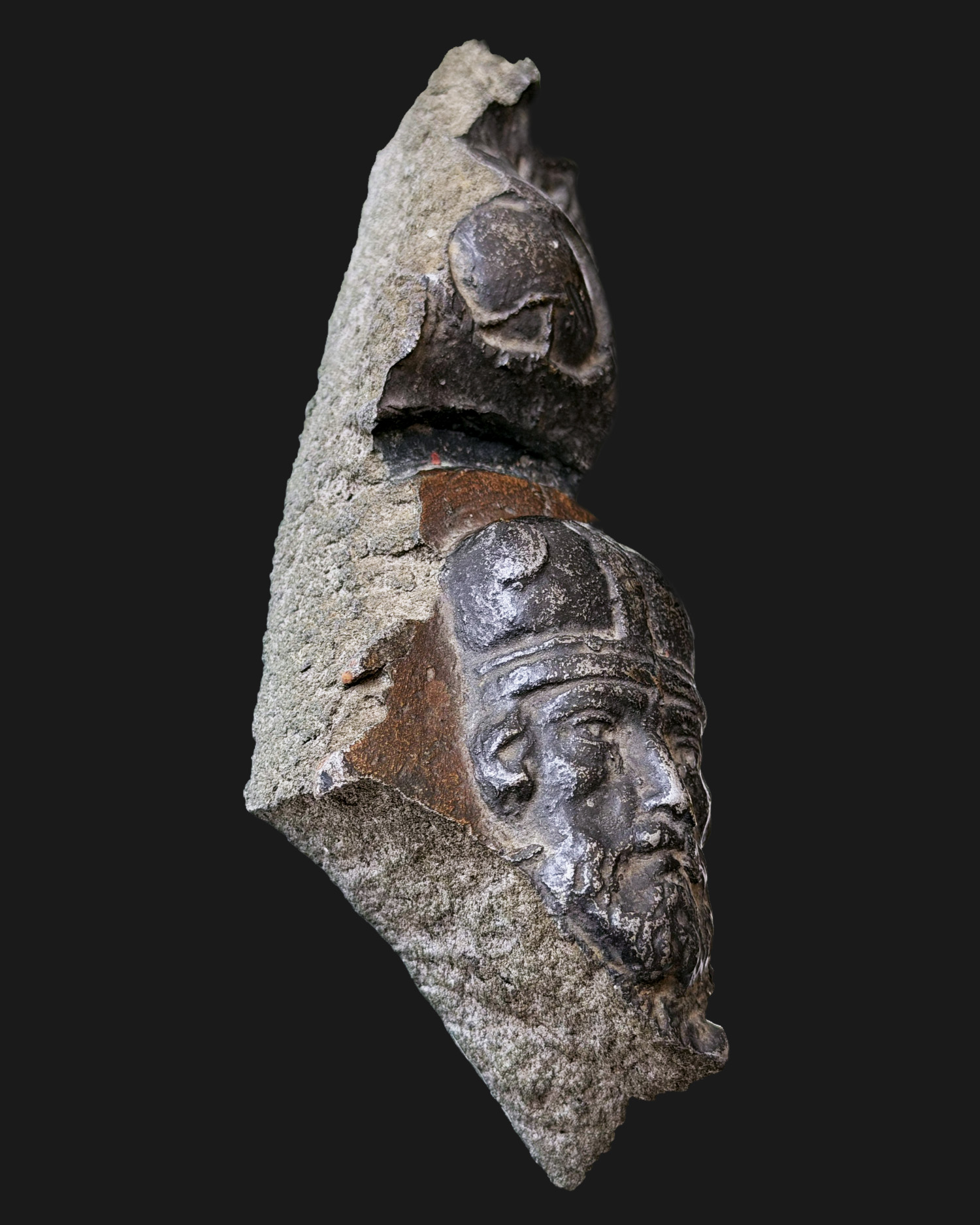
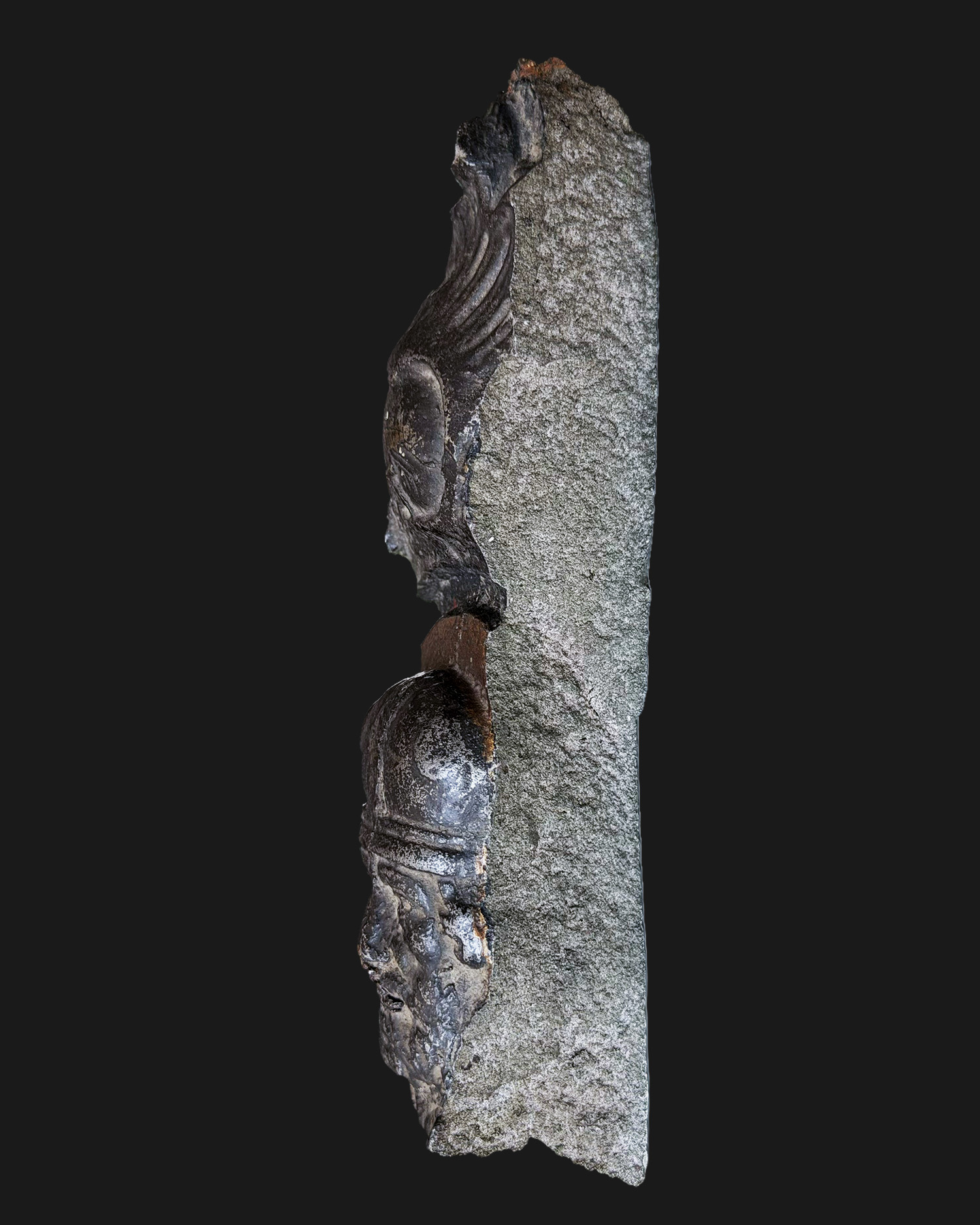
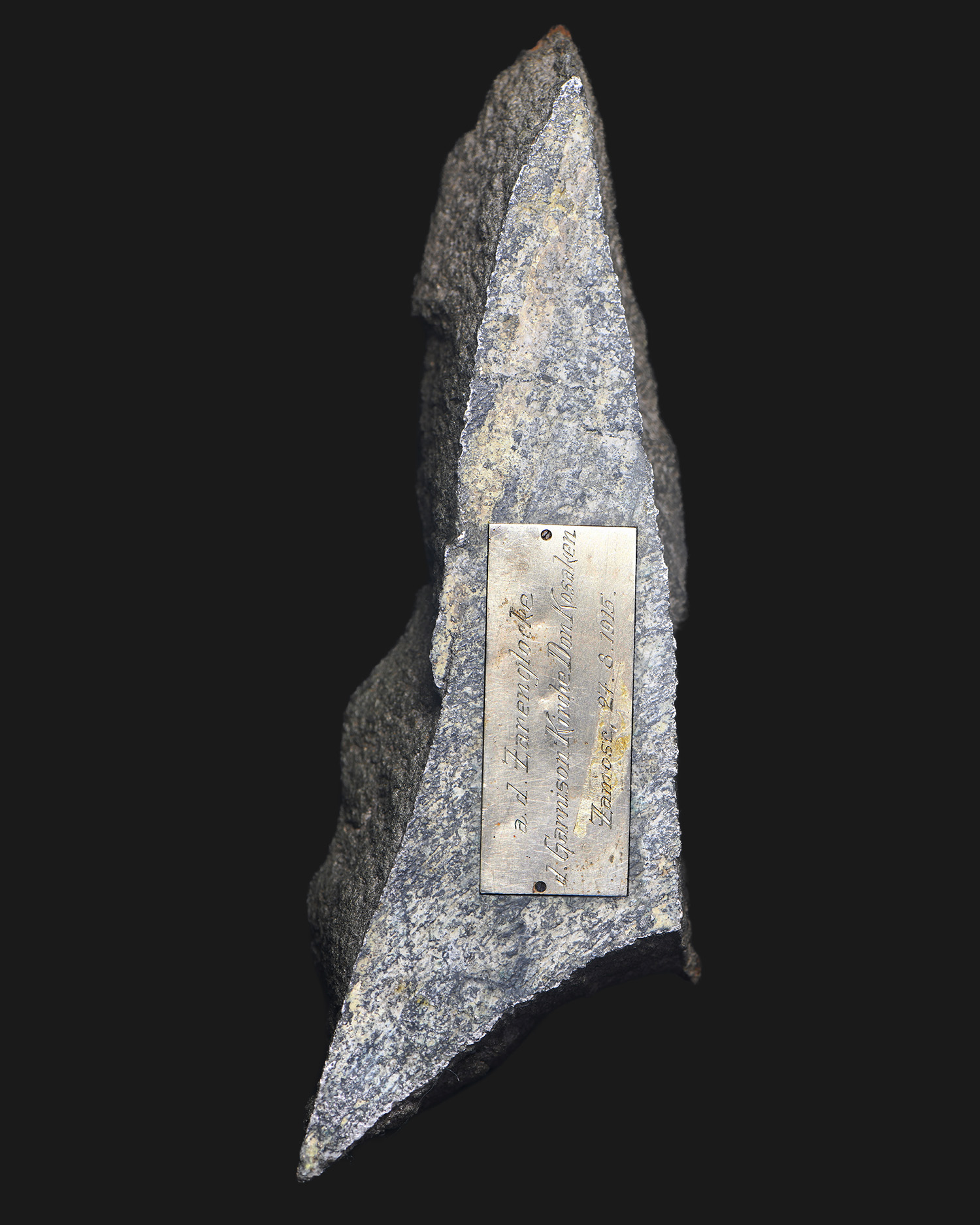
Bell fragment from the garrison church in Zamość, bronze, Poland, 1915.
3200,00 zł
Commemorative fragment of a church bell (so-called Kriegsandenken / Grabenschmuck), an irregular bronze shard from the mantle with distinct, sharp edges, typical of a mechanical fracture.
On the outer surface of the bronze, a fragment of rich, plastic relief decoration in the Byzantine-Russian style has been preserved. It depicts a distinct bust/face of a bearded saint wearing a dignified, ceremonial headdress (a bishop’s miter or an Eastern princely crown). The anatomical features of the figure and the details of the vestments indicate the high sculptural artistry of the Tsarist manufacture. Most likely, this is an image of Saint Nicholas the Wonderworker or Saint Prince Vladimir. Above the figure’s head, the outline of a decorative frieze (vegetal ornament or cherub’s wings) is visible.
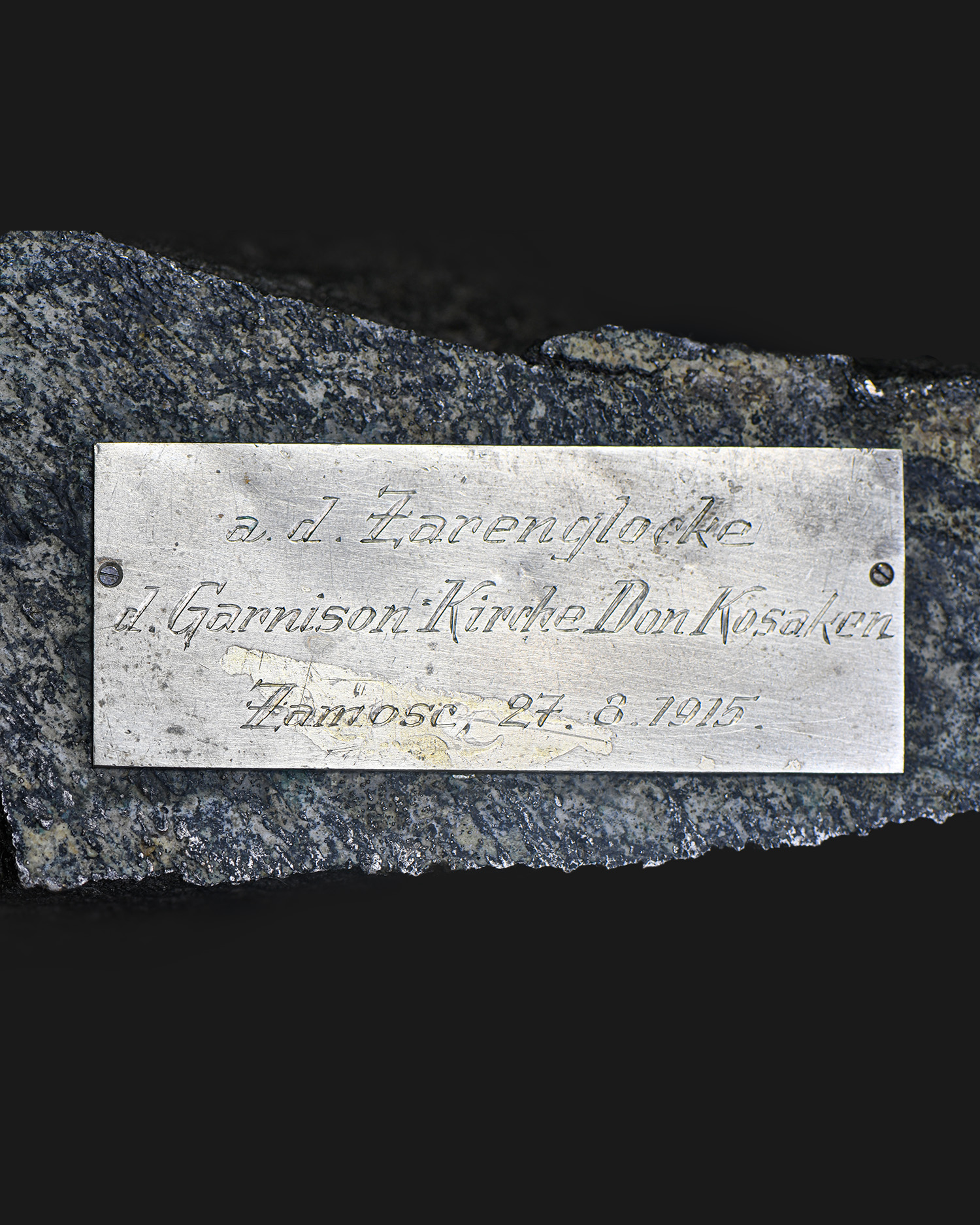
A rectangular metal plate with an engraved, German-language inscription in decorative cursive has been attached to the fragment with two rivets:
a. d. Zarenglocke
d. Garnison Kirche Don Kosaken
Zamosc, 27.8.1915
1 in stock
Extraordinary historical souvenir
This exhibit is an extraordinary historical souvenir, a unique testament to the events of World War I in the Zamość region. It serves as direct evidence of the Central Powers' occupation of Zamość in the summer of 1915 and the liquidation of the Russian garrison.
The metal originates from the Tsarist bell of the Transfiguration of the Lord Orthodox military church (erected in 1911 on the barracks grounds for the 1st Don Cossack Cavalry Division). After the Russians' retreat, the bell was seized by the Germans for raw material requisition and deliberately broken on site. One of the soldiers or officials secured the most decorative fragment with the image of the saint, transforming it into a unique, patriotic war trophy (vaterländisches Andenken). This is evidenced by the engraved declaration of the raw material's origin: “From the Tsarist bell of the Don Cossack garrison church. Zamość, 27.8.1915” .
The bell was most likely made in the Russian Empire – probably in Moscow (at the renowned P.I. Olovianishnikov foundry / formerly Finlandsky or Samgin Brothers).
While most requisitioned bells were irretrievably melted down in foundries for ammunition, this object survived as a unique personal memento. It is one of the few tangible elements of the original furnishings of the Zamość Cossack church, which was completely rebuilt into the Catholic garrison church of St. Michael the Archangel after 1918. Without exaggeration, this item can be described as a museum-grade unique piece.
History of the church in Zamość
After the withdrawal of Russian troops in 1915 and the end of World War I, the abandoned Transfiguration of the Lord Church became the property of the reborn Polish State. As part of the campaign to reclaim former Tsarist sacred objects, the temple was handed over to the Polish Army and the Roman Catholic Church. In the years 1920–1921, the building underwent a radical architectural reconstruction, aiming to completely remove the external features of the Byzantine-Russian style, then perceived as a symbol of the recent dominance of the partitioner. In this process, the characteristic onion domes were dismantled, the roof structure was rebuilt, the facade was plastered, and the Orthodox iconostasis was removed from the interior. The temple received a new dedication to St. Michael the Archangel and served throughout the interwar period as a garrison church for the soldiers of the Polish 9th Legions Infantry Regiment stationed in the city. During World War II, the object survived front-line destruction, but during the communist era, it lost its military function and gradually began to deteriorate. During this period, the interior of the church was finally repainted, which led to the covering of unique, original frescoes from the Cossack era. Only in subsequent decades did the building undergo necessary repairs and renovations that adapted it to contemporary liturgical needs. Currently, the former church functions as a Roman Catholic rectoral church on Wojska Polskiego Street, and its simple, classical form almost completely belies its original, monumental appearance from 1911.
Image source: https://przewodnicyzamosc.pl/archiwa/18935
| Weight | 1,14 kg |
|---|---|
| Dimensions | 16,5 × 5,5 × 4 cm |
| Type |
War souvenir |
| Form |
Irregular fragment |
| Materiał |
grey stone |
| Kolorystyka |
Copper ,Dark grey |
| Technika |
Bas-relief (bell) ,Casting ,Chiseling ,Mechanical engraving ,Rivet assembly (plate) |
| Czas powstania |
1911 (church construction) ,August 1915 (creation of the souvenir) |
| Era |
20th century |
| Kraj pochodzenia |
Poland ,Russia |
| Autor |
Unknown |
| State of preservation |
Very good / cabinet condition. Natural patina visible on the bronze, stable fracture edges, legible relief and engraving text. |
Related products
“Apostle” spoon with St. Simon, silver, England, 18th century.
“Apostle” spoon with St. Thomas, silver, England, 18th century.
Belt link, gilded silver, Poland, 17th century
Heraldic Plaque with Knut and Ślepowron Coats of Arms, Silver, Poland, 17th Century.
Mask of Shame – “Schandmaske,” Central Europe (Germany?), ca. 1550-1700
Moneybox in the form of a skull, wood, iron, Central Europe (Germany?), 18th century.
Plaque with Suchekomnaty coat of arms and panoplies, silver and silk, Poland, 18th century.
Oval plaque made of forged silver sheet, from the second half of the 18th century, with an engraved Suchekomnaty coat of arms on a shield surrounded by panoplies, surmounted by a crown, and a monogram “P. J.” . In the 1820s–1830s the plaque was sewn onto an ornate, soft textile backing made of alternating layers of amaranth and ecru silk fabrics. The background is adorned with hand embroidery crafted from silver purl, sequins, and sheet metal appliqués forming floral compositions. Two wax seals are preserved on the reverse.
Originally, the plaque may have served a sepulchral function, placed on a coffin or above an epitaph. Its placement on a silk cushion and the presence of seals likely indicate a family and sentimental character. The panoplies resemble compositions known from gorgets of the Bar Confederation era. This may suggest that the person with the initials “P. J.” was a participant. Little is known about the object's origin; it was reportedly owned by a monk from Greater Poland.