


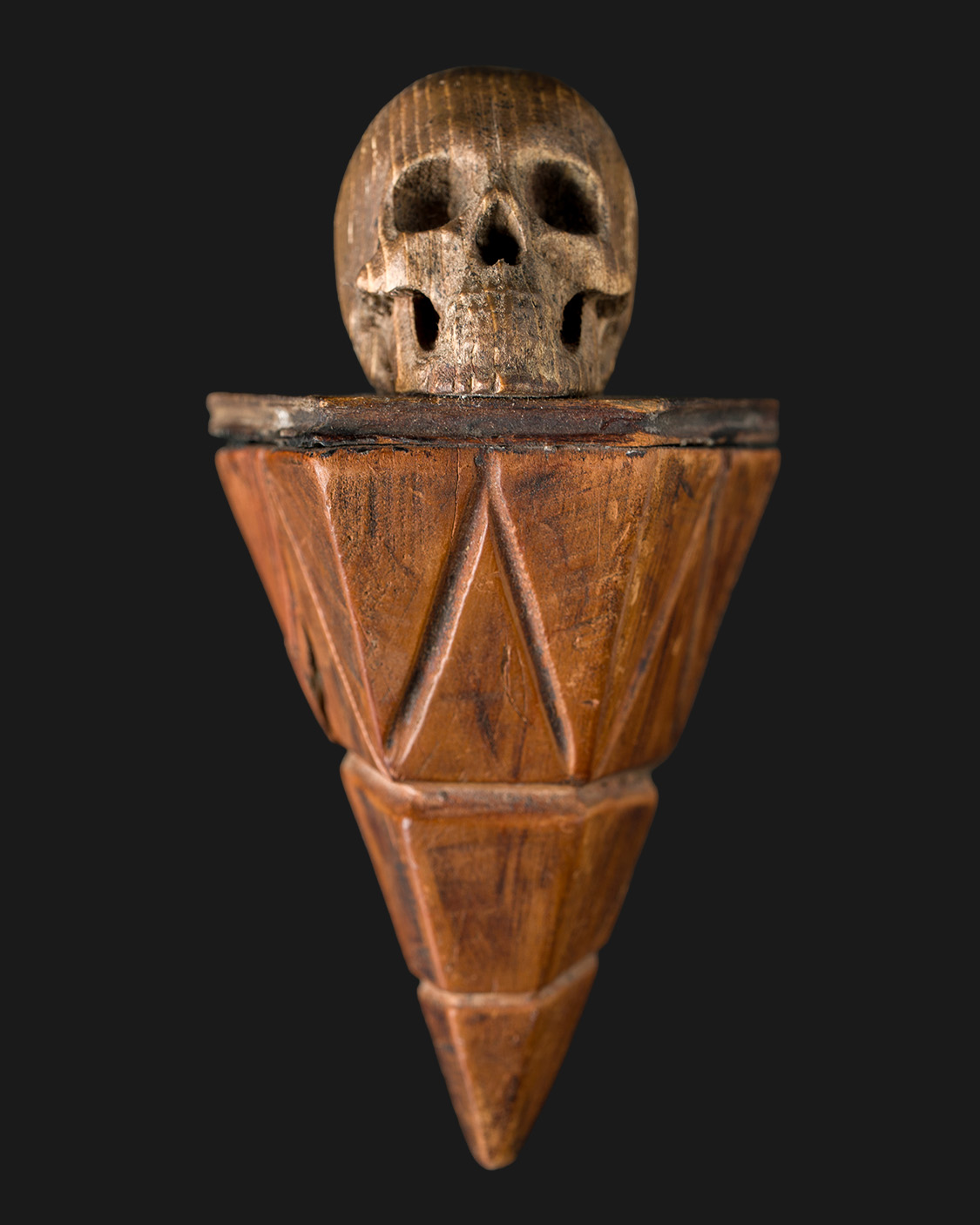
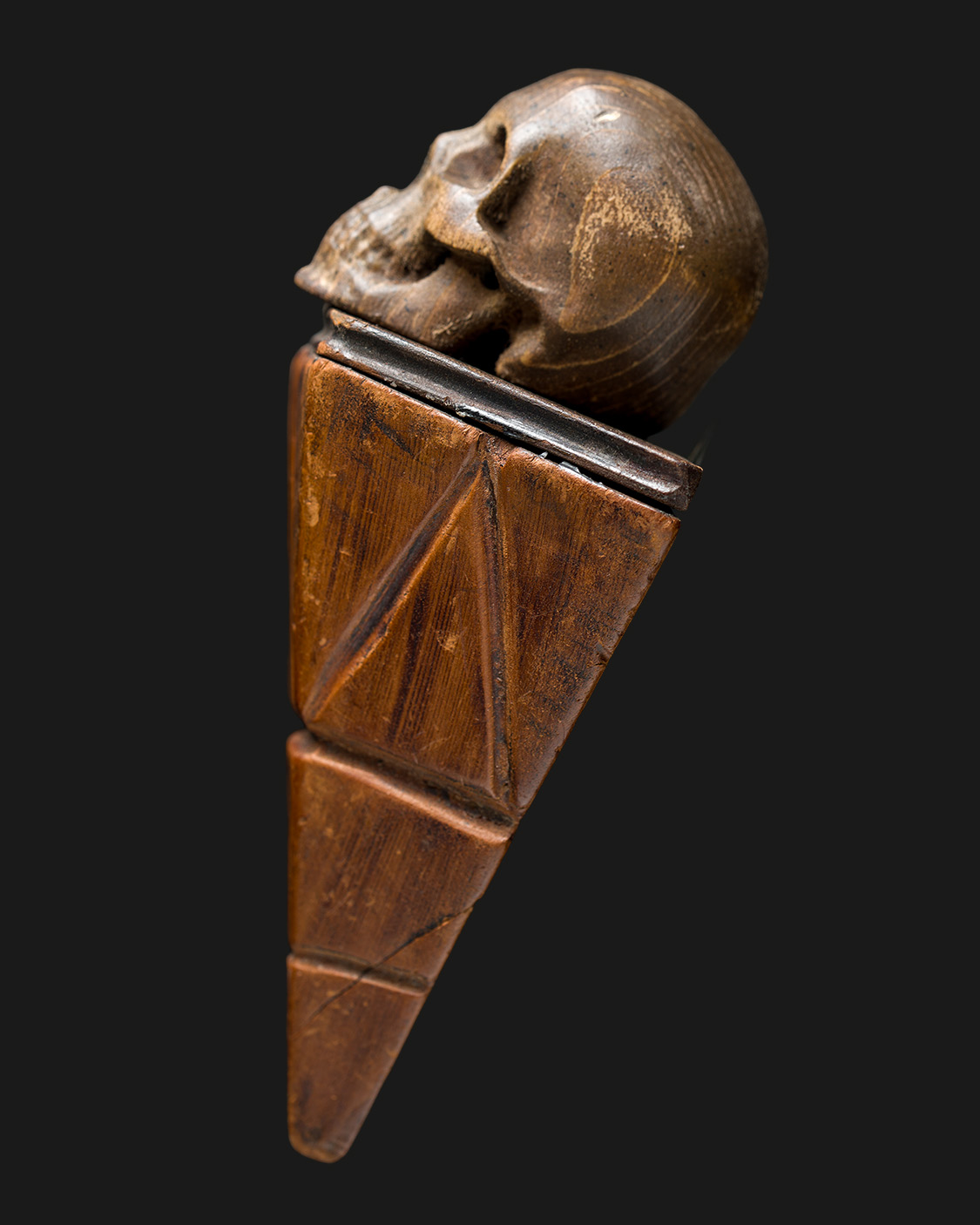
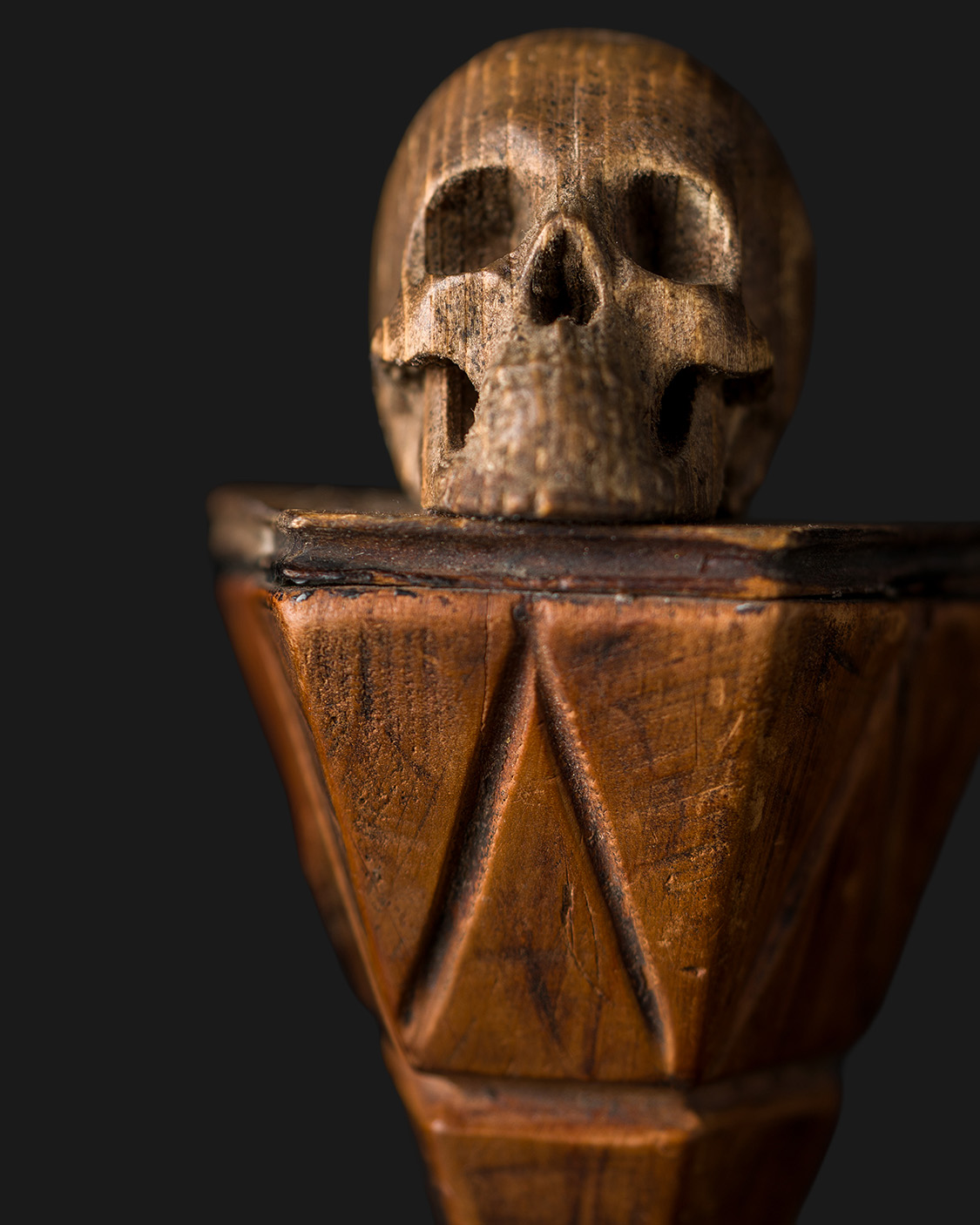
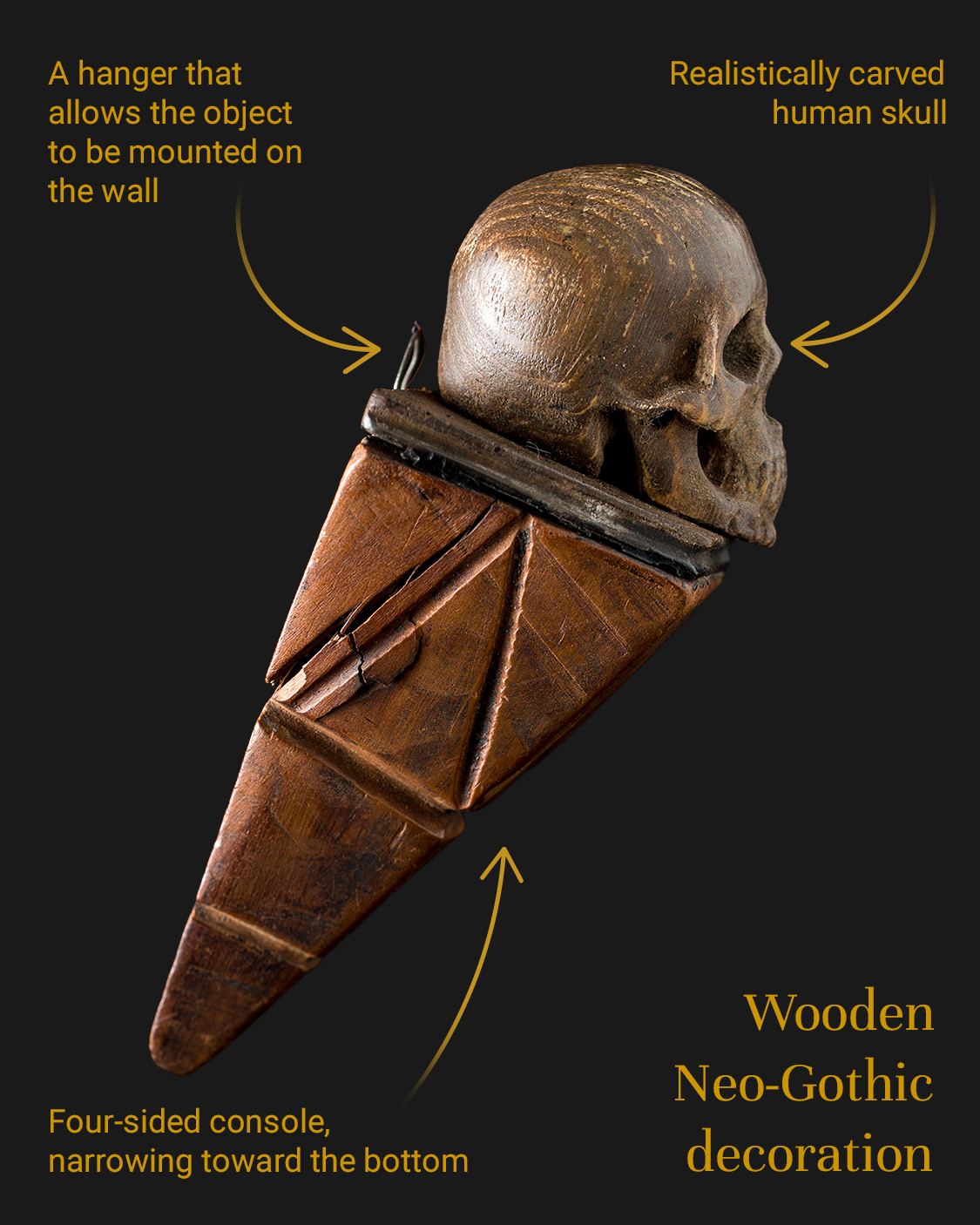
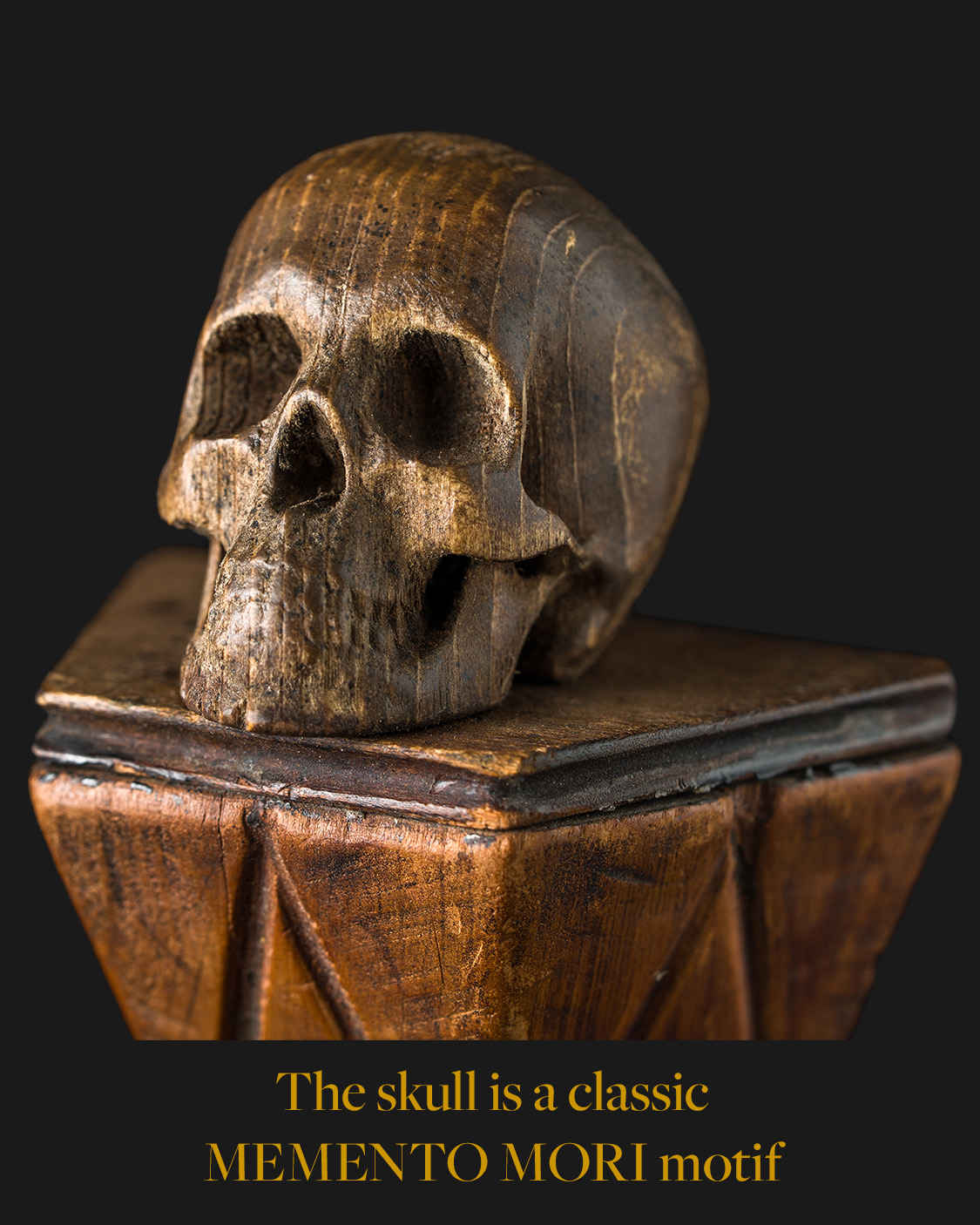
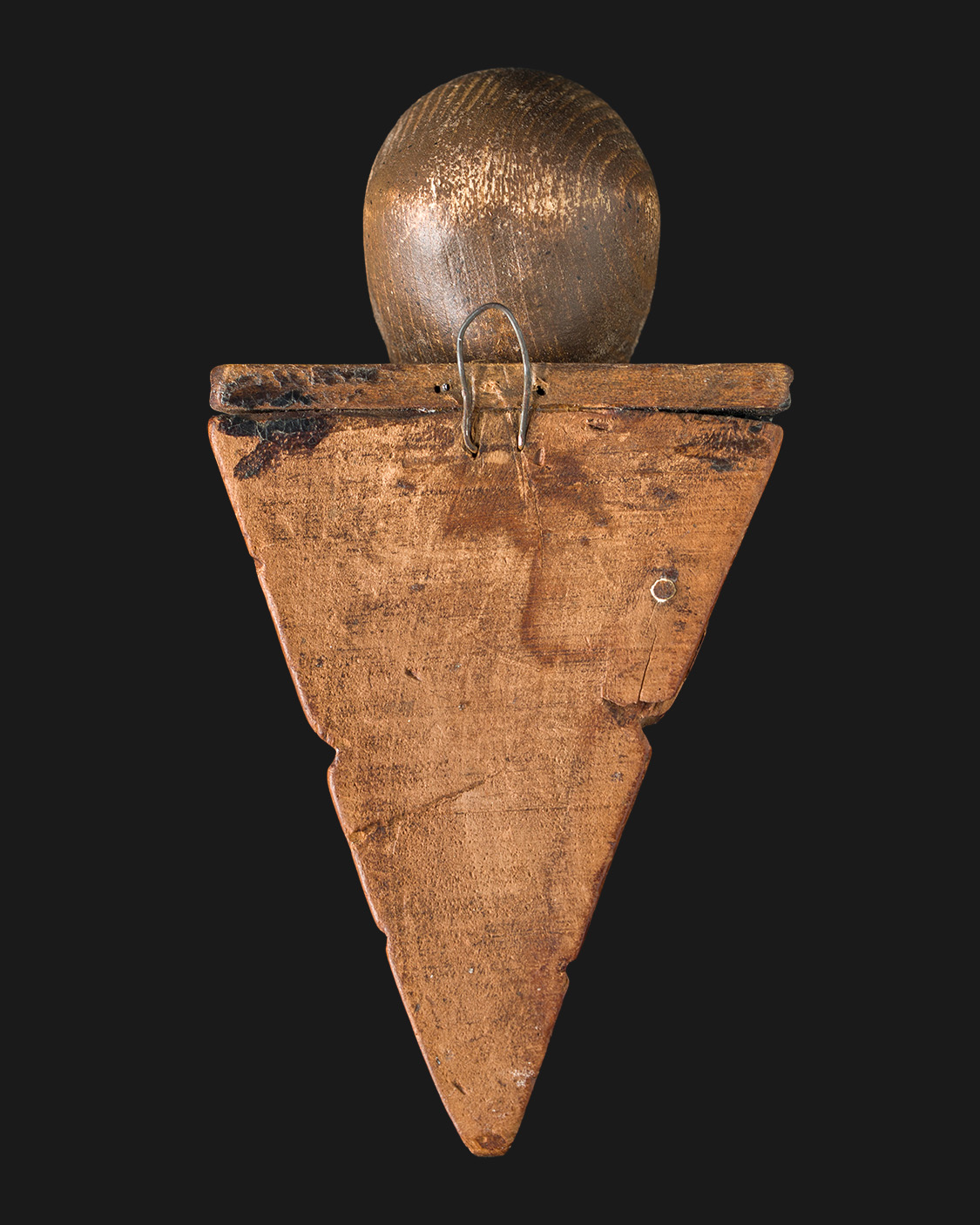
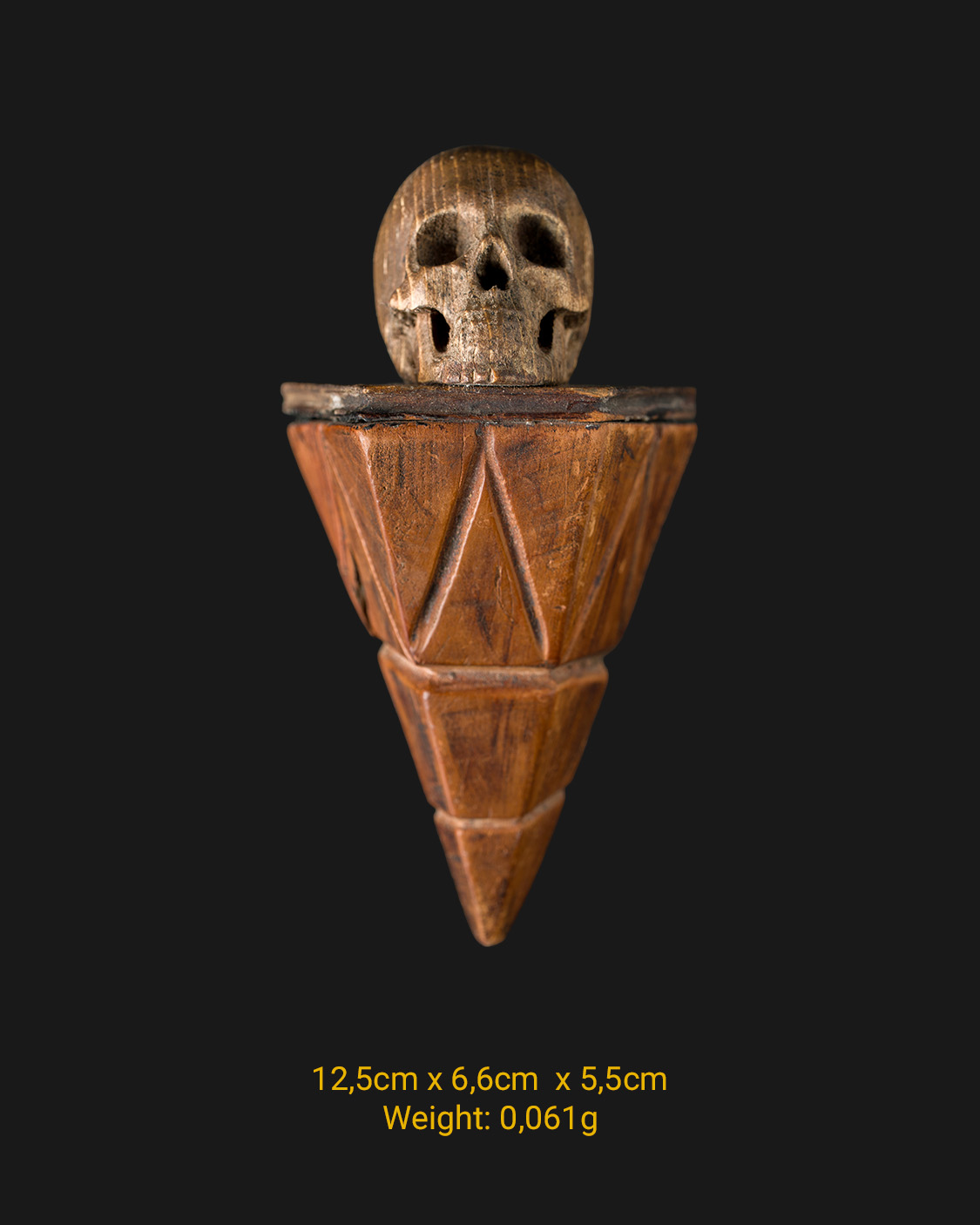

Skull on a quadrilateral console, wood, Germany (?), 18th, 19th century.
630,00 zł
A realistic representation of a human skull, set on a console with a trapezoidal cross-section, tapering downwards. The console is decorated with a geometric ornament of simple grooves. On the back there is a wire for hanging the sculpture on the wall. The skull was made of a different kind of wood than the console, and is undoubtedly older than it. It is probably dated to the 18th century, when sculptures depicting miniature skulls symbolizing “memento mori” were particularly widespread. At the same time, it cannot be ruled out that it did not constitute a separate entity, but was an element of some representation, such as placed at the base of a crucifix.
Related products
Bell fragment from the garrison church in Zamość, bronze, Poland, 1915.
Commemorative fragment of a church bell (so-called Kriegsandenken / Grabenschmuck), an irregular bronze shard from the mantle with distinct, sharp edges, typical of a mechanical fracture.
On the outer surface of the bronze, a fragment of rich, plastic relief decoration in the Byzantine-Russian style has been preserved. It depicts a distinct bust/face of a bearded saint wearing a dignified, ceremonial headdress (a bishop's miter or an Eastern princely crown). The anatomical features of the figure and the details of the vestments indicate the high sculptural artistry of the Tsarist manufacture. Most likely, this is an image of Saint Nicholas the Wonderworker or Saint Prince Vladimir. Above the figure's head, the outline of a decorative frieze (vegetal ornament or cherub's wings) is visible.
A rectangular metal plate with an engraved, German-language inscription in decorative cursive has been attached to the fragment with two rivets:
a. d. Zarenglocke d. Garnison Kirche Don Kosaken Zamosc, 27.8.1915
Crucifix base in the form of a skull topped with a stylized tree trunk, wood, Germany (?), 18th-19th century
Heraldic Plaque with Knut and Ślepowron Coats of Arms, Silver, Poland, 17th Century.
Nadziak (war hammer/pick), iron, bronze, wood, Poland, head: 17th century, haft: 18th century.
The head (iron part) is forged from high-carbon steel, terminating on one side in a hammer (blunt end) with a quadrangular cross-section and a distinctly convex collar. This shape mitigated the risk of the weapon slipping off rounded armor surfaces (e.g., cuirasses or helmets) and concentrated the entire impact energy at a single point. On the other side, the iron part is fitted with a beak (spike), massive, arcuately curved downwards, with a thick and wide profile at its base.
A unique feature of this object is the ornamentation of the iron part – exceptionally rare for Polish combat weapons, which are typically unadorned. The decoration consists of vertical brass strips, precisely inlaid (damascened) into grooves cut into the steel. A strip running parallel to the edge is placed on the beak, featuring an engraving resembling a vegetal scroll motif.
On the underside of the iron part, near the haft's socket, a series of marks (blacksmith's marks/ciphers) is stamped, likely representing the signature of a guild master armorer or an inventory number from a former magnate's armory.
The haft, made of hardwood, is set into the head using brass damping sleeves and is clad with bronze sheet, joined with hard copper-based solder. The space between the fittings is covered with black leather. The lower part of the haft terminates in a metal fitting with a through-hole for a loop/ring. This was used for threading a leather loop (sword knot) worn on the hussar's wrist, preventing the loss of the weapon during a charge.
Weighing 1325 grams with an almost 80-centimeter haft, this specimen is unequivocally defined as a combat offensive weapon of national cavalry (hussars, pancerni), not a light, civilian walking stick. Nadziaks with such powerful parameters were carried on the horse's saddle (most often under the rider's right thigh) and served as a crucial argument in clashes with heavily armored opponents (e.g., reiters), where a traditional saber proved ineffective against plate armor.
In the 18th century, the weapon underwent professional re-hafting.
Overall length (haft): 78.5 cm. Head length (hammer): 17.5 cm
Pair of skulls joined by occiputs, wood, Germany, 1635
Patriotic-devotional gorget (ryngraf), silvered copper, painted, Poland, ca. 1768–1772
An exceptional, double-sided military gorget (ryngraf) from the time of the Bar Confederation (1768–1772), crafted in the form of an Amazon shield (crescent shape with raised and rounded corners, known as "buffalo horns").
Two round holes were cut in the upper corners (buffalo horns), around which old patina and traces of copper oxides are visible. These originally served for threading a cord, ribbon, or strap, enabling the gorget (ryngraf) to be suspended on the chest (over armor or a kontusz).
The edges of the shield along its entire perimeter have been carefully folded back (toward the reverse side). The edging not only protected the edges from damaging clothing, but above all significantly stiffened and strengthened the construction made of thick, forged copper sheet. The manner of this finishing bears clear traces of hand hammering.
Skull (Memento Mori), marble, Italy, 18th-19th century
Elegant, decorative skull made of natural gray marble, maintained in a realistic style: the eye sockets, cranial seam lines and zygomatic arches are clearly formed. The faded dentition alludes to the concept of Vanitas.
The characteristic feature of the stone used for the sculpture is irregular veining in shades of beige, cream and gray, which gives it a unique character. The surface is polished, with natural discolorations and small marks due to the properties of the material, which emphasizes the authenticity and nobility of the marble. The skull is provided with a lead pin underneath, set on a minimalist, contemporary base in black, which exposes the sculpture and gives it a museum-like character.
The object is ideal for collectors of curiosities, lovers of the art of Vanitas - Memento Mori, cabinets of curiosities and as an expressive element of interior design in classical, industrial or eclectic style. An object with a strong aesthetic and symbolic expression, which is difficult to pass by indifferently.