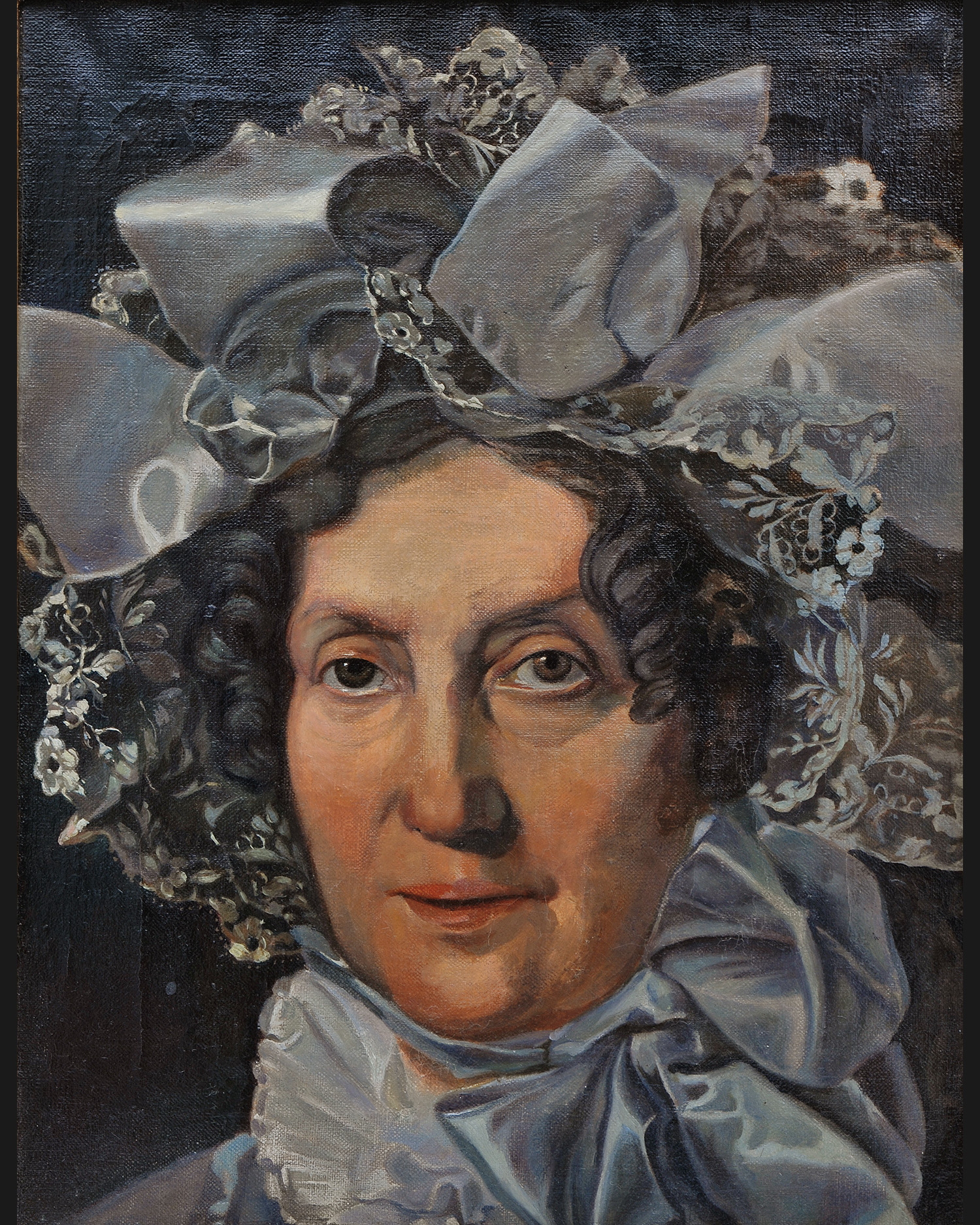
Alexander Sochaczewski (1843-1923), Portrait of an elderly woman, oil on canvas, Munich, 1884-1897
4400,00 zł
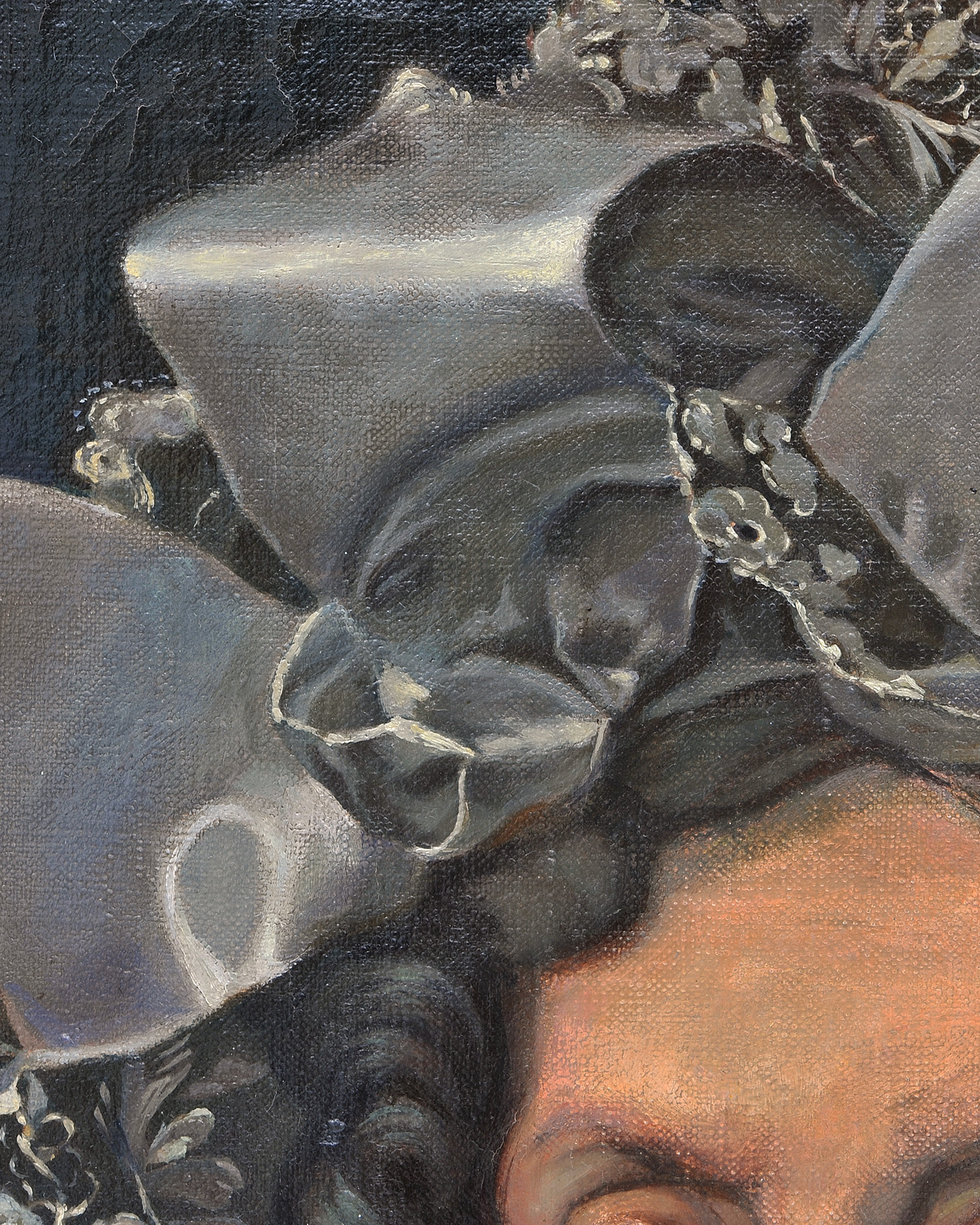
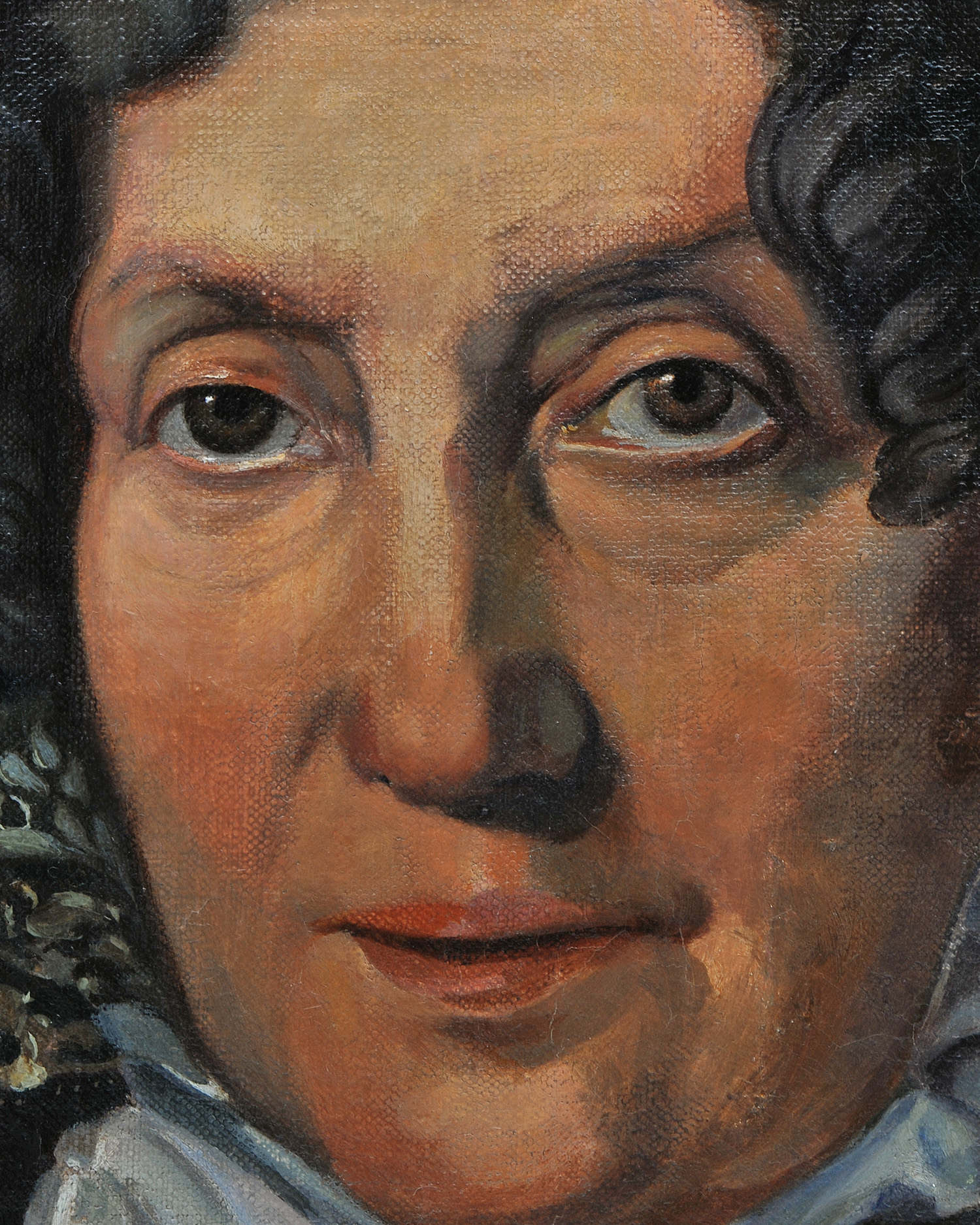
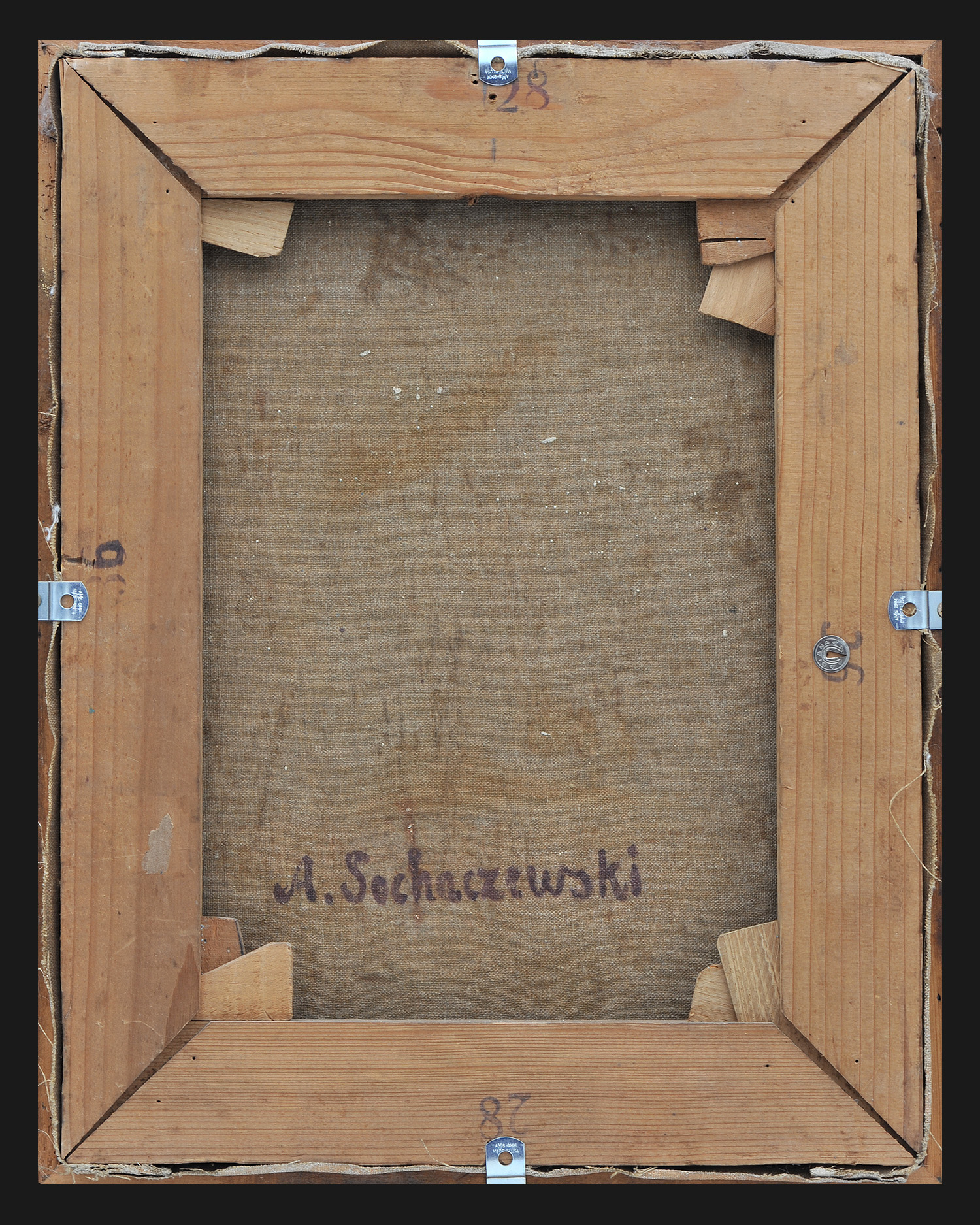
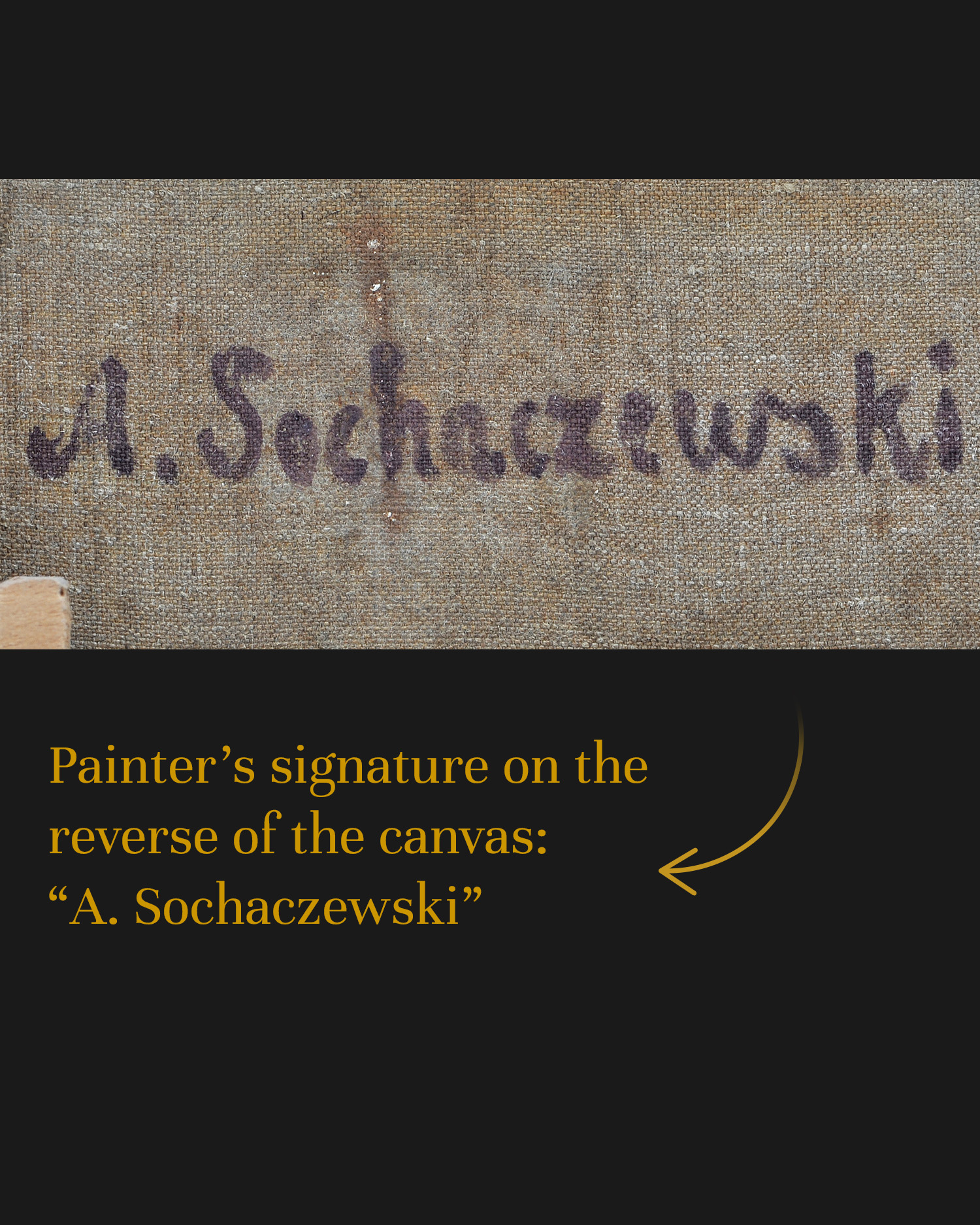
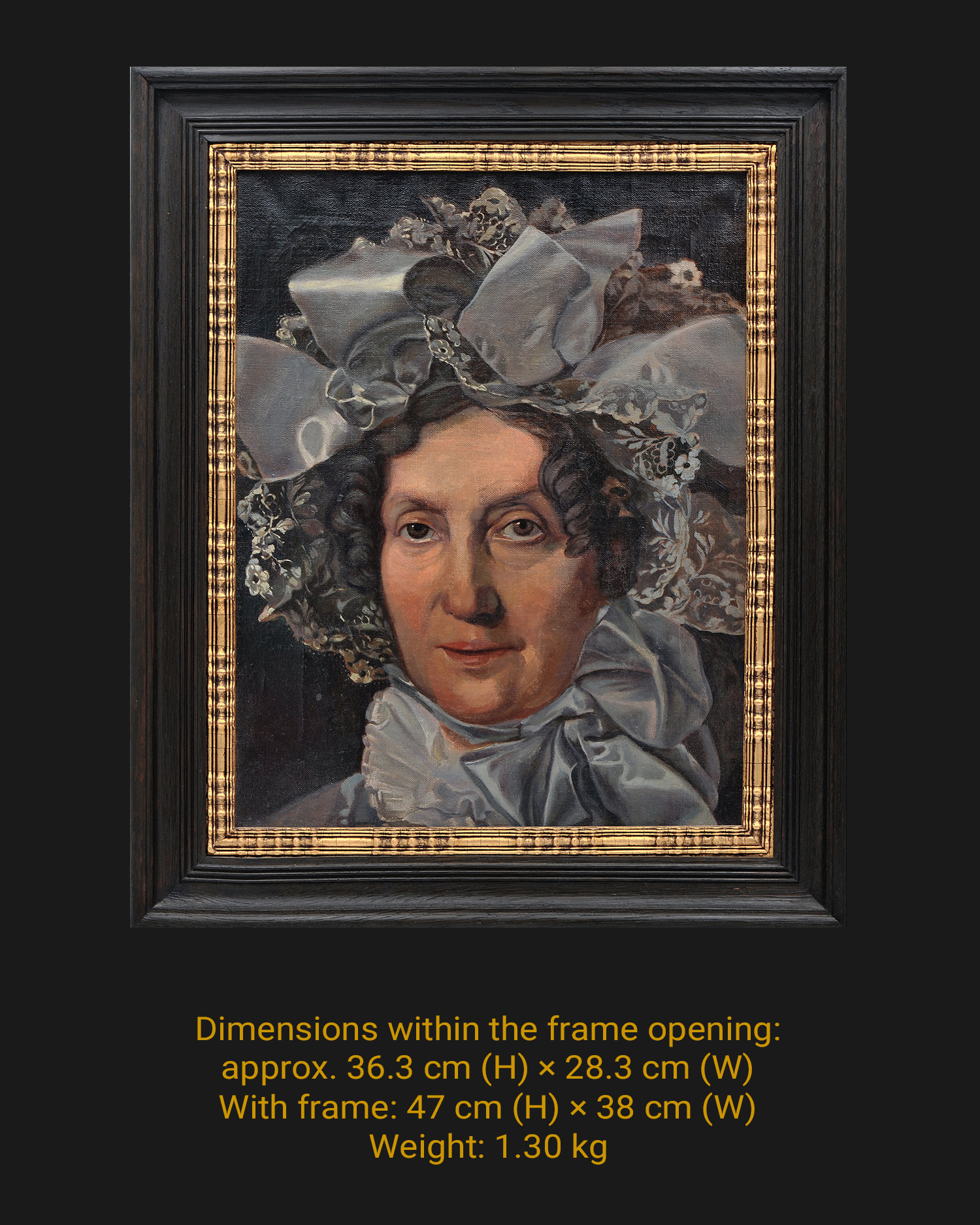
The painting depicts an elderly woman, shown in a bust view, against a dark, neutral background. The figure is wearing a magnificent headdress – a large decorative cap with lace and a wide satin bow, from under which dark curls protrude. The woman’s face has been portrayed in a realistic manner, with attention paid to fine details such as delicate wrinkles, subtle shadows around the eyes and soft chiaroscuro transitions on the skin. A large, softly placed shawl is visible under the neck, completing the elegant character of the portrait. The painting is signed on the back and framed in a Biedermeier style frame.
1 in stock
Artistic qualities
The painting is based on a clear, traditional portrait composition. The most important elements - the face, the cap and the headscarf - are painted precisely, with faithful rendering of textures and attention to detail. The refined details and simple form emphasize the classical nature of the representation. It's a calm, well-done portrait, where reliable technique counts above all.
Historical context
The painting was probably created during Sochaczewski's stay in Munich, where he made a living painting portraits.
Collector's value
Although portraits were Sochaczewski's main source of income during the Munich period, they appear relatively rarely on the art market today. However, their significance goes beyond their painterly value - the artist is a special figure for Polish history. Although he came from a Jewish family, from his youth he was involved in national causes, and his patriotic stance, paid for by imprisonment, a death sentence and many years of imprisonment in Siberia, inspires great respect to this day. Sochaczewski's works, including portraits, are therefore valued not only as works of art, but also as testimony to the life of a man deeply devoted to Poland.
Application
The classic depiction of the figure makes the painting easy to incorporate into various types of interiors, both residential and office, where it will add elegance to the space. This is a striking and solidly painted portrait, which will perfectly appeal to lovers of Biedermeier aesthetics - the characteristic headdress and hairstyle perfectly capture the spirit of the era. It is also a valuable collector's item, adding to collections related to portrait painting of the 19th century.
- Birth and descent (1843) - Alexander Sochaczewski (Sonder Lajb) was born in Ilovo into the family of a Jewish shamash.
- First education - He studied at a cheder and briefly at the Rabbinical School, from which he dropped out to devote himself to painting.
- Art studies (1858) - He began his studies at the Warsaw School of Fine Arts with Jozef Simmler and quickly became one of his most talented students.
- Patriotic activities - He was involved in independence demonstrations, published a conspiratorial press and probably took part in the assassination attempt on Wielopolski.
- Arrest (1862) - He was arrested, and weapons and illegal prints were found in his apartment, which, according to Helena Boczek, indicated ties to the "red" organization.
- Death sentence and exile - He was sentenced to be hanged, but just before his execution his sentence was commuted to 22 years of exile in Siberia.
- Return from exile (1884) - After regaining his freedom, he was banned from settling in the Russian partition.
- Munich creative period - He married Rosa Lorenstein, but the marriage quickly fell apart, and during this time he created a series of 125 paintings known as the "painter's diary of an exile," and made a living by painting portraits.
- Brussels (1897) - He moved to Brussels, where he continued his Siberian themes and entered into a second, also unsuccessful, marriage to Maria Wurm.
- Exhibition "Siberia" (1900) - Presented his work at a solo exhibition in Cracow.
- Vienna - his greatest work - He settled in Vienna, where his most famous painting, "Farewell to Europe," was created.
- Death (1923) - He died in Biedenmansdorf and was buried in Vienna.
- Posthumous honor (1924) - He was awarded the Knight's Cross of the Order of Polonia Restituta.
| Weight | 1,3 kg |
|---|---|
| Dimensions | 28,3 × 36,3 cm |
| Type |
Image |
| Form |
Portrait of a woman |
| Kolorystyka |
Black ,Brown ,Flesh ,Gray |
| Technika |
Oil on canvas |
| Czas powstania |
1884-1897 |
| Kraj pochodzenia |
Germany |
| Autor |
Alexander Sochaczewski (1843-1923) |
| State of preservation |
Very good, after maintenance |
Related products
Battle of Mohacz, oil on canvas, Krakow, 1886
Italian (Roman) School, Goddess Roma (Dea Roma / Roma Barberini), oil on canvas, Italy, c. 1760-1800
The painting depicts a frontal, dignified, and majestic portrayal of the Goddess Roma seated on a monumental throne, modeled after the famous 4th-century ancient fresco (“Dea Roma” from the Barberini collection, discovered in Rome in 1655).
The Goddess is depicted in attire reminiscent of traditional Roman tutelary deities. She wears a yellow-gold tunic tied below the breasts with a dark band and a cascading, pink-red cloak (palla). Her head is adorned with a golden parade helmet featuring a magnificent, dense plume of white and dark feathers. Her facial features are idealized, with smooth skin, large eyes, and small lips – reflecting the academic canon of beauty of early Neoclassicism. Classic red Roman sandals (calcei) are visible on her feet.
In her open right hand, the goddess holds aloft a winged figurine of the goddess of victory (Nike), who raises a red banner and holds a golden apple (orb) – a symbol of dominion over the world. With her left hand, Roma leans on a tall, golden scepter. Beside her rests a large, round shield (ancile) with a richly ornamented surface.
At the bottom of the painting, on a gray plinth stylized as antique stone, a meticulously calligraphed inscription in Roman capital script is visible: VIRTVS HONOR IMPERIVM This formulates the triad of Roman state values: Valor (Virtue), Honor, and Sovereign Power (Imperium). The triangular points separating the words (hederae) are a direct reference to classical Latin epigraphy.
Dimensions: 47.5 x 34.5 cm, framed (period frame)Stanisław Chlebowski (1835-1884), Genre Scene – Dance, watercolor on paper, Istanbul (?), 1874
A small watercolor by Stanisław Chlebowski (artist's signature in the lower left corner: "St. Chlebowski 1874 ), depicting an intimate, dynamic and graceful genre scene of Oriental character. It reflects the artist's fascination with the culture of the Middle East and the Caucasus, which he explored during his many years of work as court painter to the Sultan in Istanbul.
With frame 50 x 42, visible area: 31.5 x 23.5 cm
