


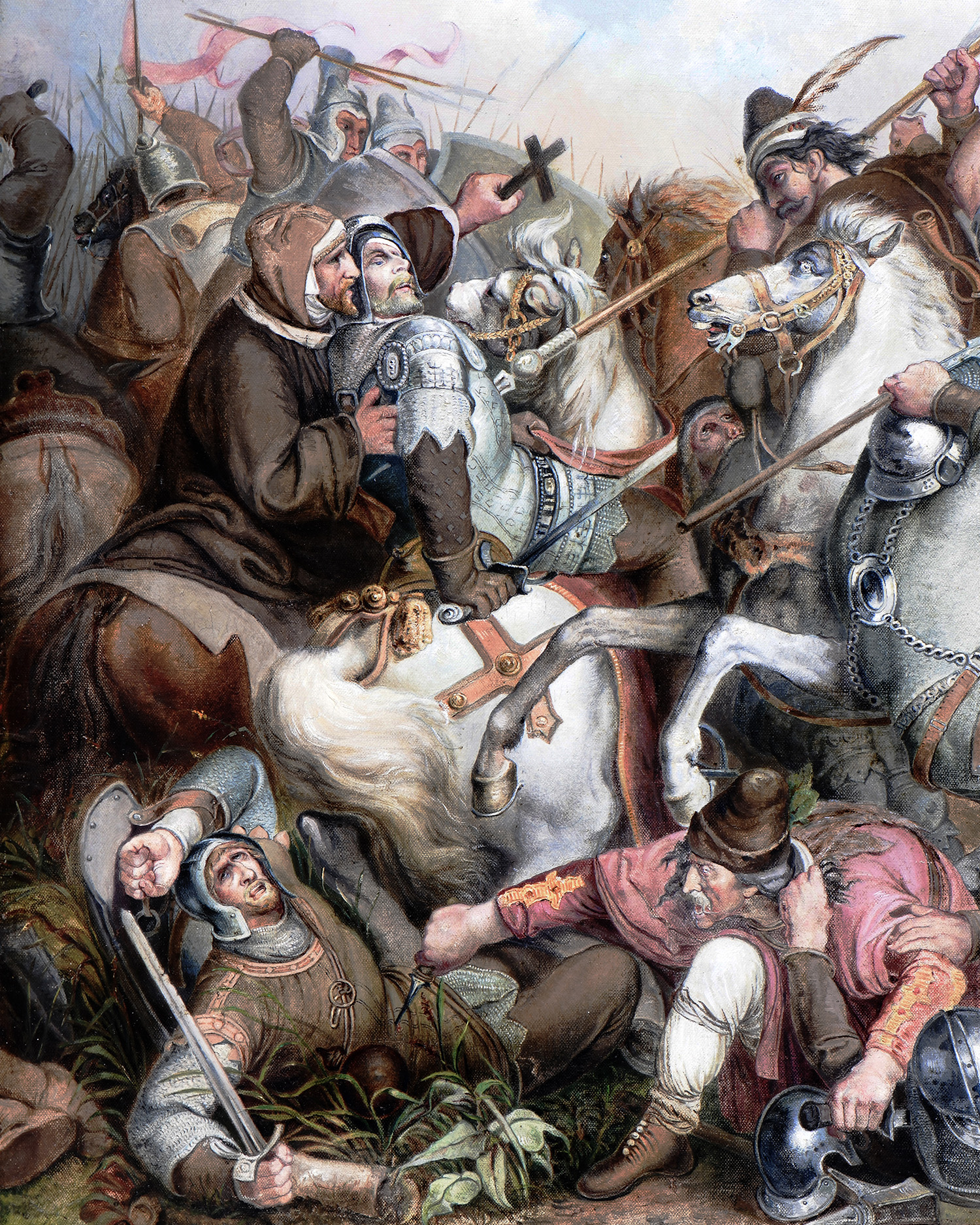
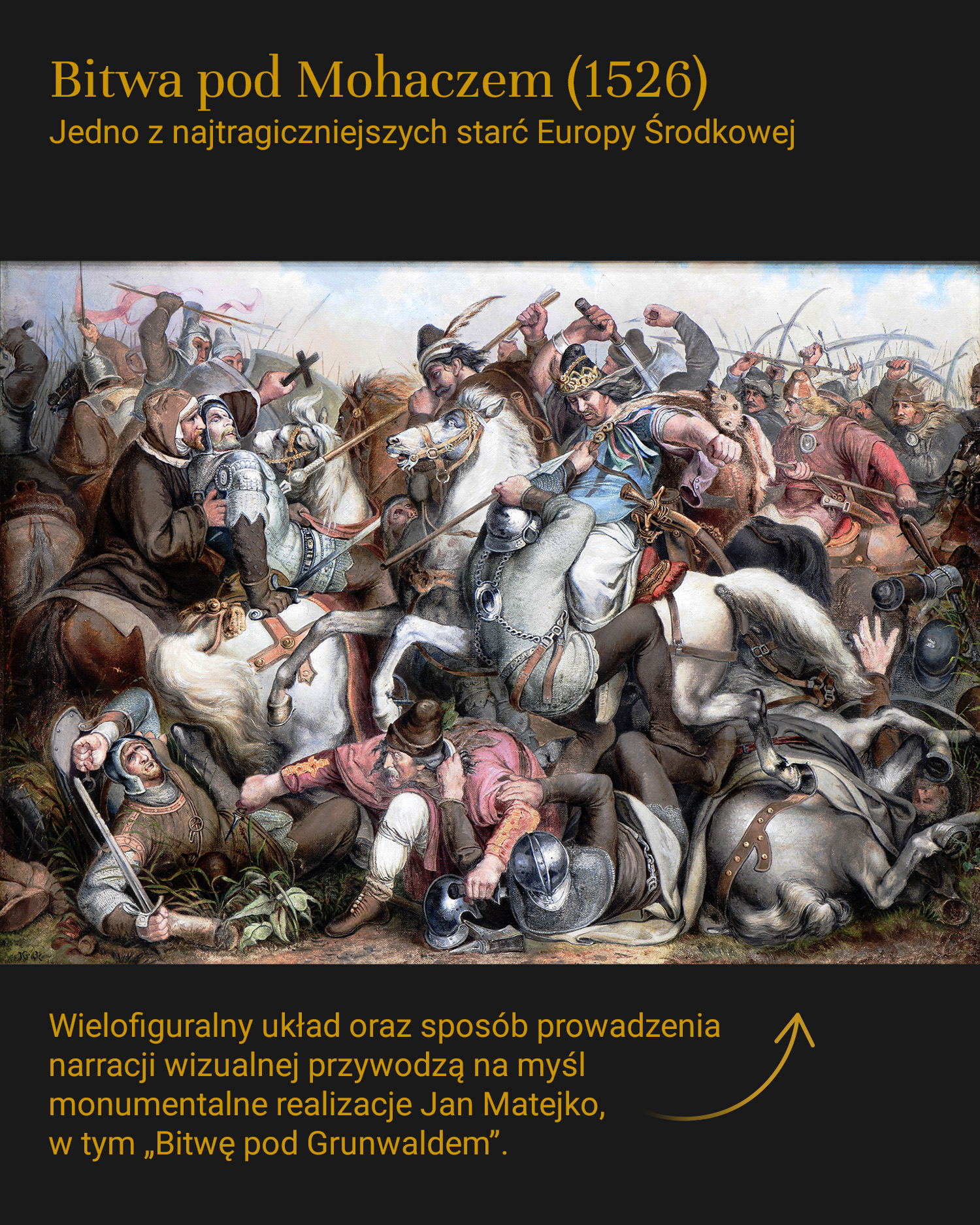
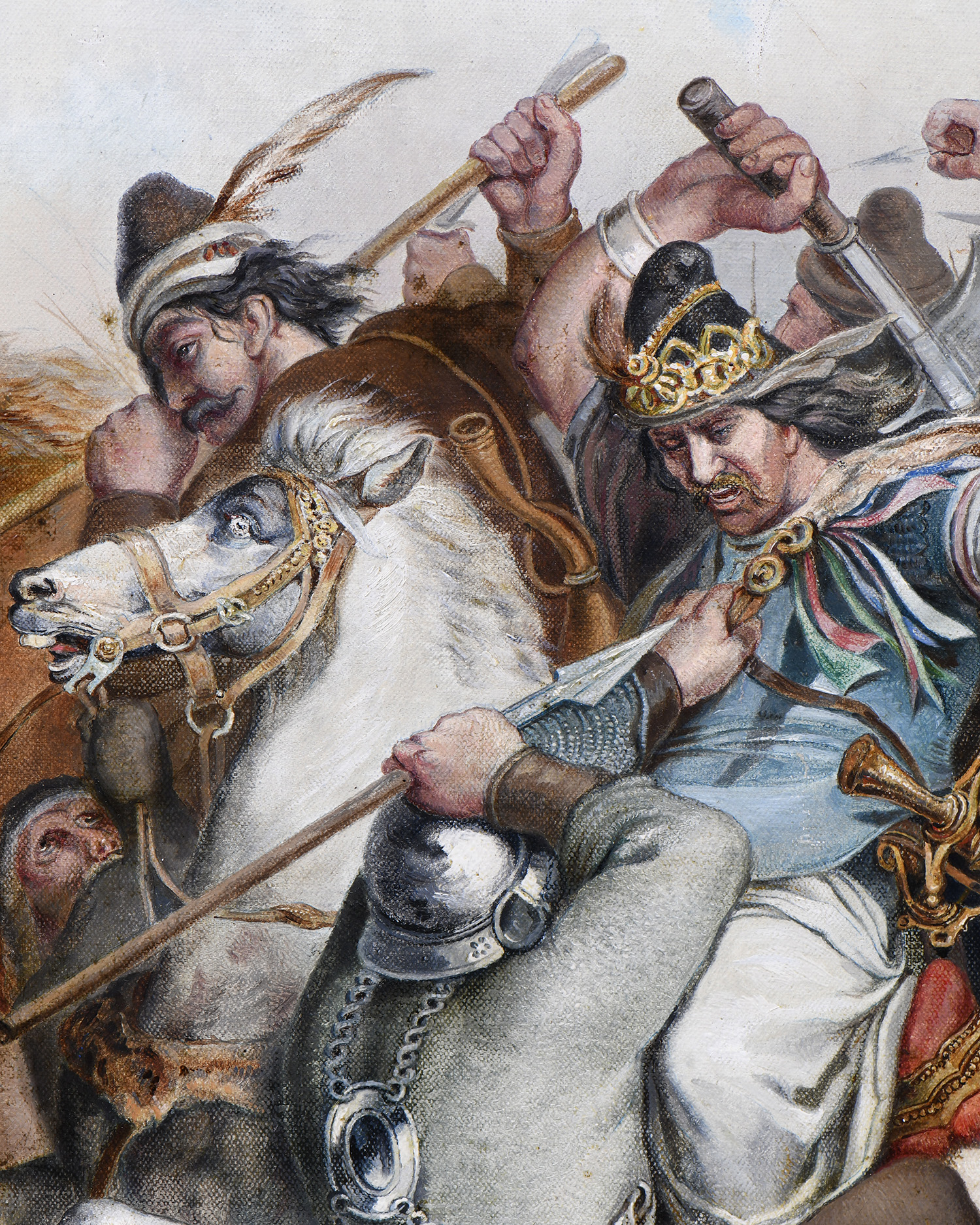
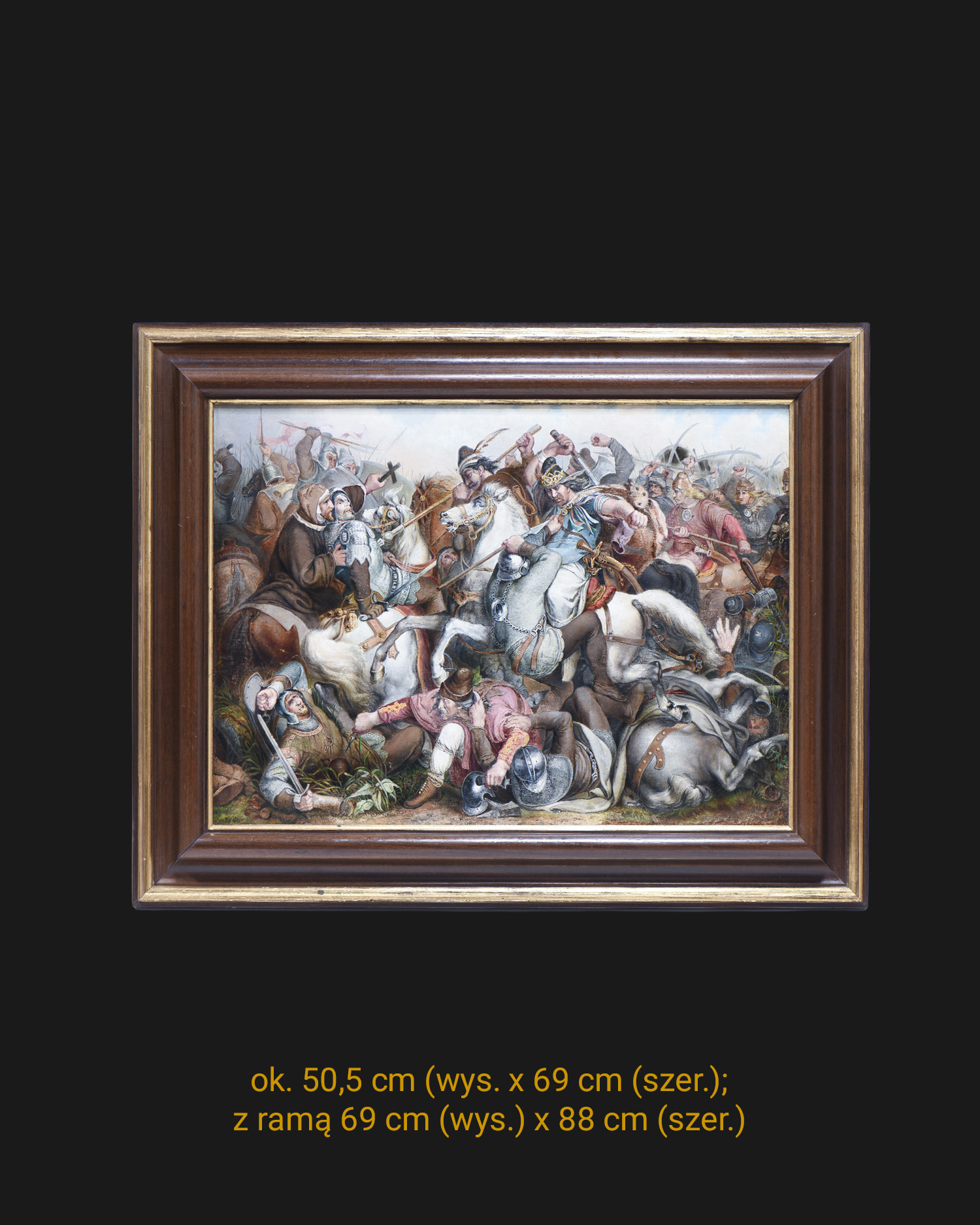

Battle of Mohacz, oil on canvas, Krakow, 1886
30000,00 zł
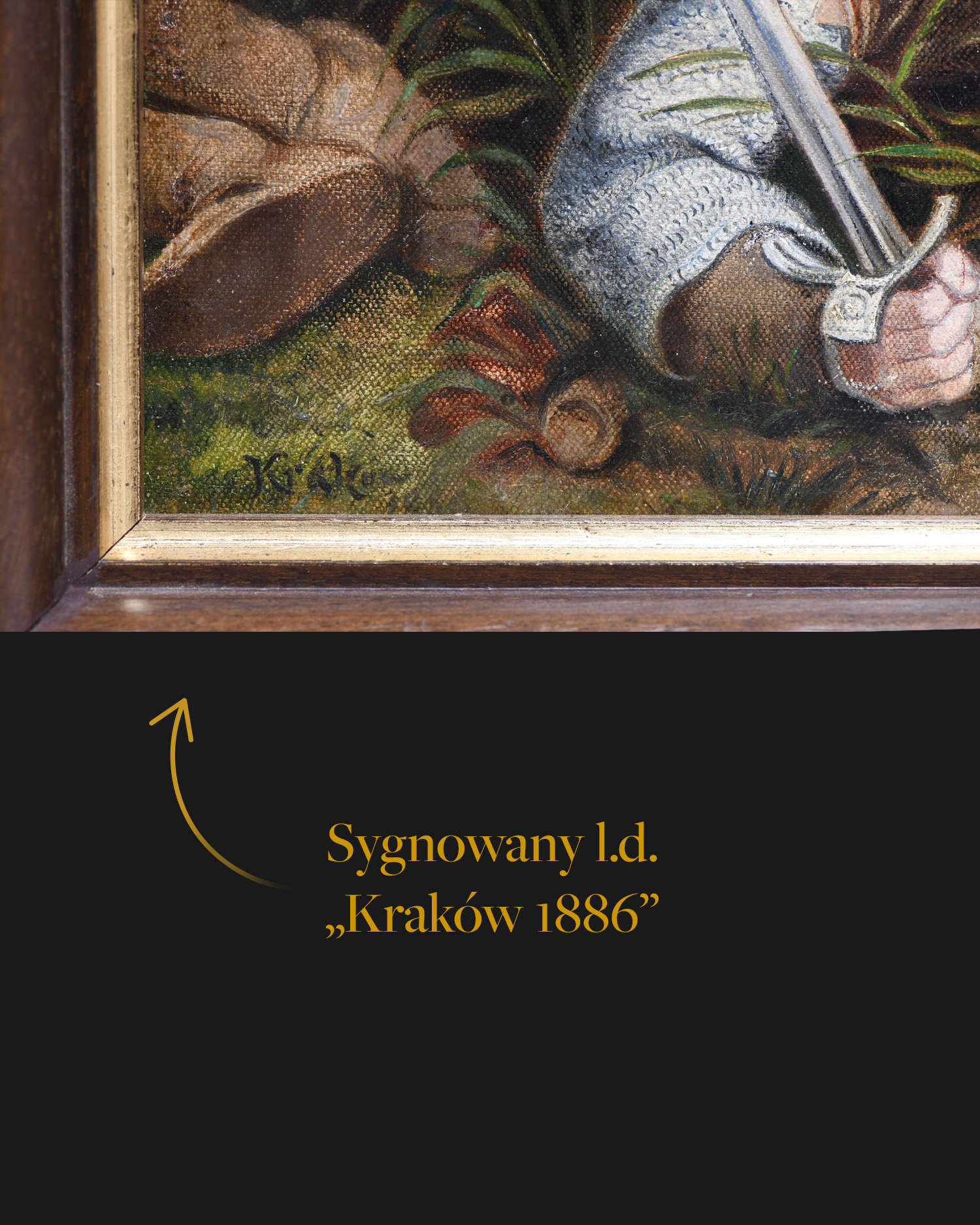
The painting depicts the Battle of Mohács of 1526, showing the moment of violent clash between Christian forces and the Ottoman army. The composition is a multi-figure battle scene, focused on the dynamic combat of cavalry and infantry, with clear emphasis on the chaos and drama of the battlefield. The artist employs a compact, densely populated composition in which the silhouettes of fighting men and horses fill nearly the entire canvas surface. The work was executed in oil on canvas (lined) and is signed in the lower left corner: “Kraków 1886”.
1 in stock
Related products
Death of Cleopatra, oil on canvas, Italy, 17th-18th centuries.
Egbert van Heemskerck I (1634 – 1704) – attributed, Scene with Soldiers in a Tavern, oil on canvas, Netherlands, second half of the 17th century.
Egbert van Heemskerck I (1634 Haarlem – 1704 London) – attributed, Scene with Soldiers in a Tavern, oil on canvas, relined on panel, framed.
The painting, created in the second half of the 17th century, depicts an intimate yet expressive genre scene with a satirical-political undertone, set within the austere interior of a 17th-century Dutch tavern. The composition centers on a group of five men intently analyzing a document in the form of a large book spread out on a barrel, which serves as a table.
One of the men wears a distinctive metal soldier's helmet (a cabasset or morion type), while another clearly has a rapier attached to his side. The presence of these props indicates that the protagonists of this scene are not ordinary peasants, but rather soldiers, veterans, or members of a local civic militia (the so-called schutterij). The document they are studying thus gains a military-political context; it could be news from the front (a broadsheet), a mobilization order, a royal decree, or a letter of safe conduct, which they are suspiciously verifying.
The artist masterfully employs caricatured facial features, exposing human flaws and creating an ironic narrative about "armchair strategists" or "weekend soldiers," haphazardly dressed and armed. Egbert van Heemskerck delighted in showcasing this contrast for comedic effect. For the painter, such individuals were a brilliant satirical subject – here is a group of common craftsmen or villagers attempting to impersonate great military strategists. One has donned an old helmet, another has strapped on an oversized weapon, yet their attire and physiognomy betray that they are far from a regular army. Each character represents a different emotional state – from deep concentration and suspicion to violent gesticulation (the figure in the light shirt on the left). The composition relies on contrasting, localized chiaroscuro. Light effectively glides across the texture of the paper, drawing hands and grimaces of the characters from the darkness, and reflecting off the metallic surface of the helmet, showcasing the painter's technical skill.
The reverse side bears traces of old paper ownership or auction labels, which once protected the wood from oxidation but have since crumbled. The condition of the support indicates that the relining process onto period wood was carried out a very long time ago (likely at the turn of the 18th and 19th centuries).
Dimensions: 31 cm (width) x 21 cm (height)
German-Italian Master, Image from the Cross, oil on board, Western Europe, 16th century.
Nathan Gutman (1914 Warsaw – 1990 Paris), Female Nude, oil on cardboard, Paris (?)
Pieter Neefs II (1620 – 1675/1685), Night Mass in a Gothic Church, oil on board, Flanders, 17th century.
The painting depicts the interior of a Gothic church, by Pieter Neefs the Younger (1620–after 1675), a Flemish painter specializing in 17th-century sacred interiors. The composition based on a precise linear perspective leads the eye towards the main altar, around which the faithful and clergy participating in the liturgy are gathered.
The painting was made in oil technique on board, without a visible signature. The upper part of the composition has been cropped, resulting in the loss of the original format and probably also the author's signature.
The work represents the mature style of Pieter Neefs the Younger - precise rendering of space, controlled light and realistic depiction of architecture, characteristic of the Antwerp school. Paintings of almost identical composition appear in several well-known collections and collections - including the Szépművészeti Múzeum (Museum of Fine Arts) in Budapest and a Sotheby's auction (2021).
It is worth mentioning that works from this series are also sometimes attributed to Pieter Neefs the Elder (c. 1578-1656), confirming the strong stylistic affinity between the works of father and son.
Bibliography / links:
- Peeter Neefs I - Invaluable
- Pieter Neefs II - Art Salon
- Pieter Neefs I - Museum of Fine Arts Budapest (Wikimedia Commons)
- Pieter Neefs II - Sotheby's Auction 2021
Portrait miniature of King Augustus III, gouache and watercolor on bone, Poland, c. 1734–1750
A portrait miniature depicting Augustus III the Saxon (Wettin), King of Poland and Elector of Saxony – gouache and watercolor on a thin, semi-transparent ivory plaque. The monarch's effigy represents the iconographic canon established in the first years of his reign, immediately following his coronation in Wawel Cathedral in January 1734.
Stanislaw Gibinski (1882-1971), Winter scene “On the way to church”, watercolor and gouache on cardboard, Poland, ca. 1930-1940
Symeon Shimin (1902–1984), Gum Chum / This Mortal Coil, oil / mixed media on canvas, United States, circa 1945-1955
The presented canvas is a museum-quality easel painting by the esteemed American painter and muralist of Jewish-Russian descent, Symeon Shimin. The painting is an outstanding example of post-war socially engaged expressionism, combining features of narrative painting with poster-like persuasion. Signed lower right: S. Shimin (artist's signature, authenticated)
The work is characterized by an extremely condensed, claustrophobic composition with a powerful emotional charge. The foreground is dominated by the expressively deformed figure of an elderly man captured in a theatrical, accusatory gesture – his hand points directly at the viewer. This technique, intensifying the cinematic drama, directly refers to Shimin's rich experience in creating iconic political and film posters for Hollywood (the artist was, among others, the author of the original poster for the 1939 film "Gone with the Wind"). In the background, in a dark shadow, the melancholic face of a second sage emerges. The entire piece is rendered in a stark, earthy, monochromatic palette dominated by deep browns, blacks, and muted blue garments, with a masterful use of chiaroscuro.
Dimensions: 82.5 x 59.5 cm (with frame 85 x 62 cm)