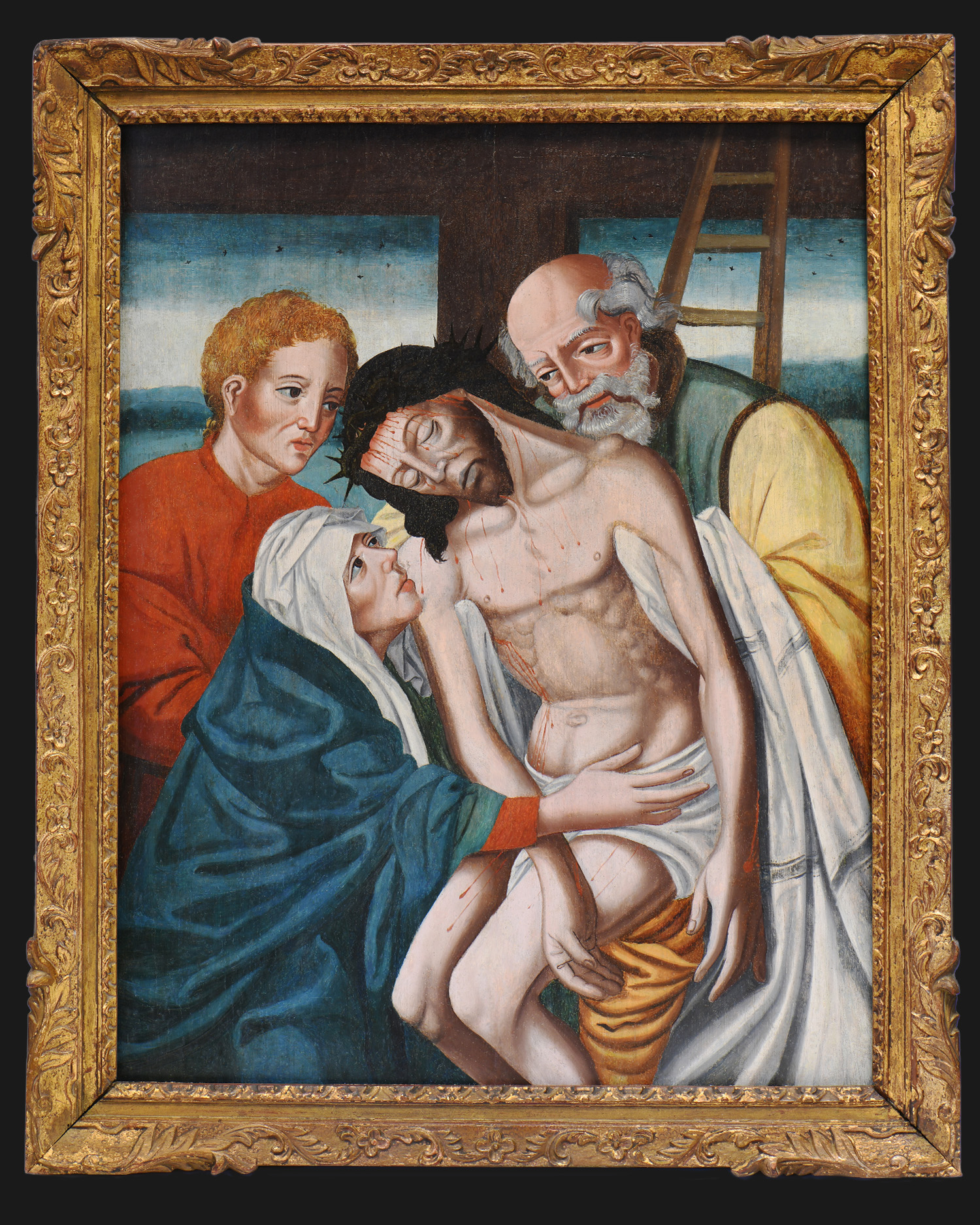
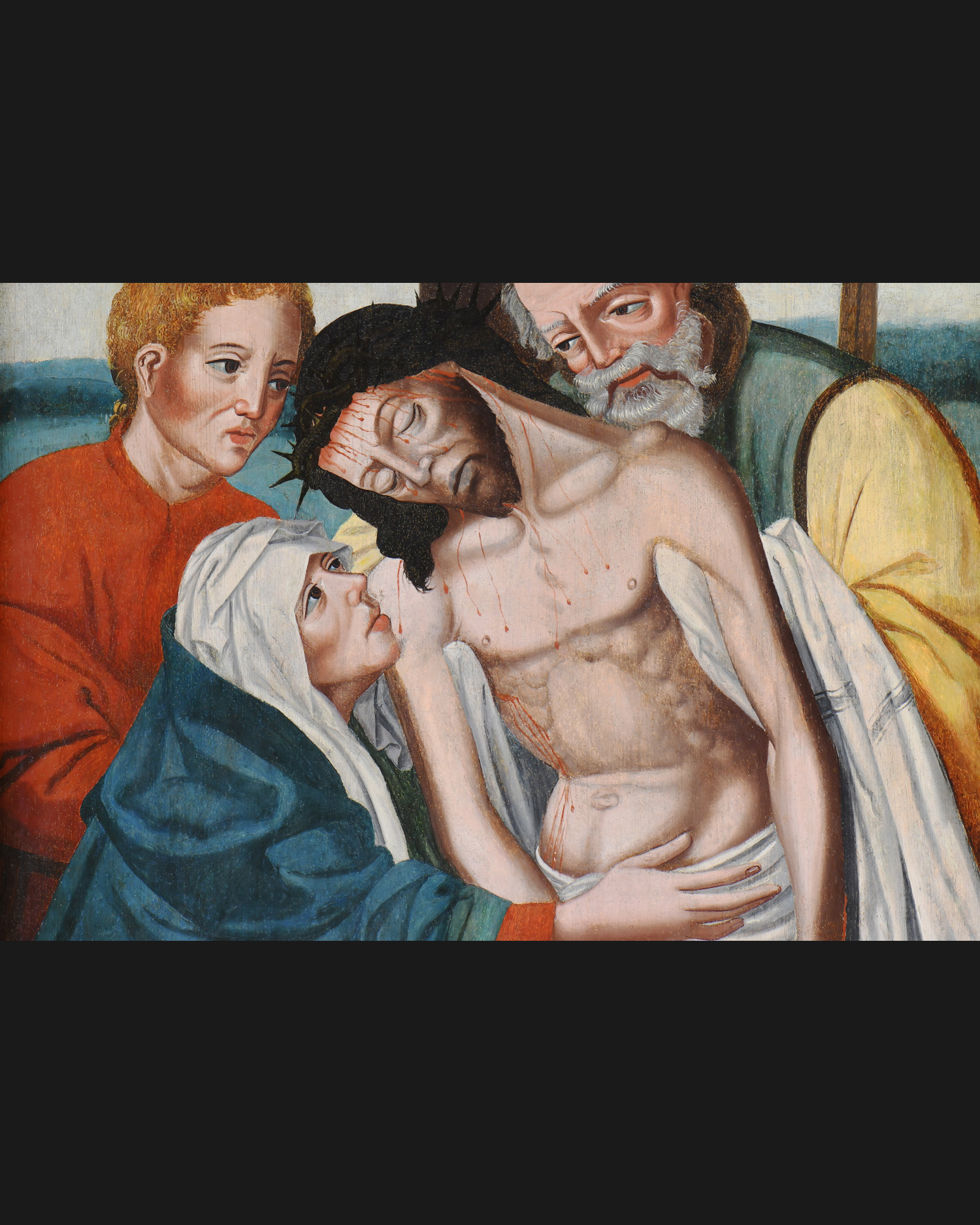
German-Italian Master, Image from the Cross, oil on board, Western Europe, 16th century.
6600,00 zł
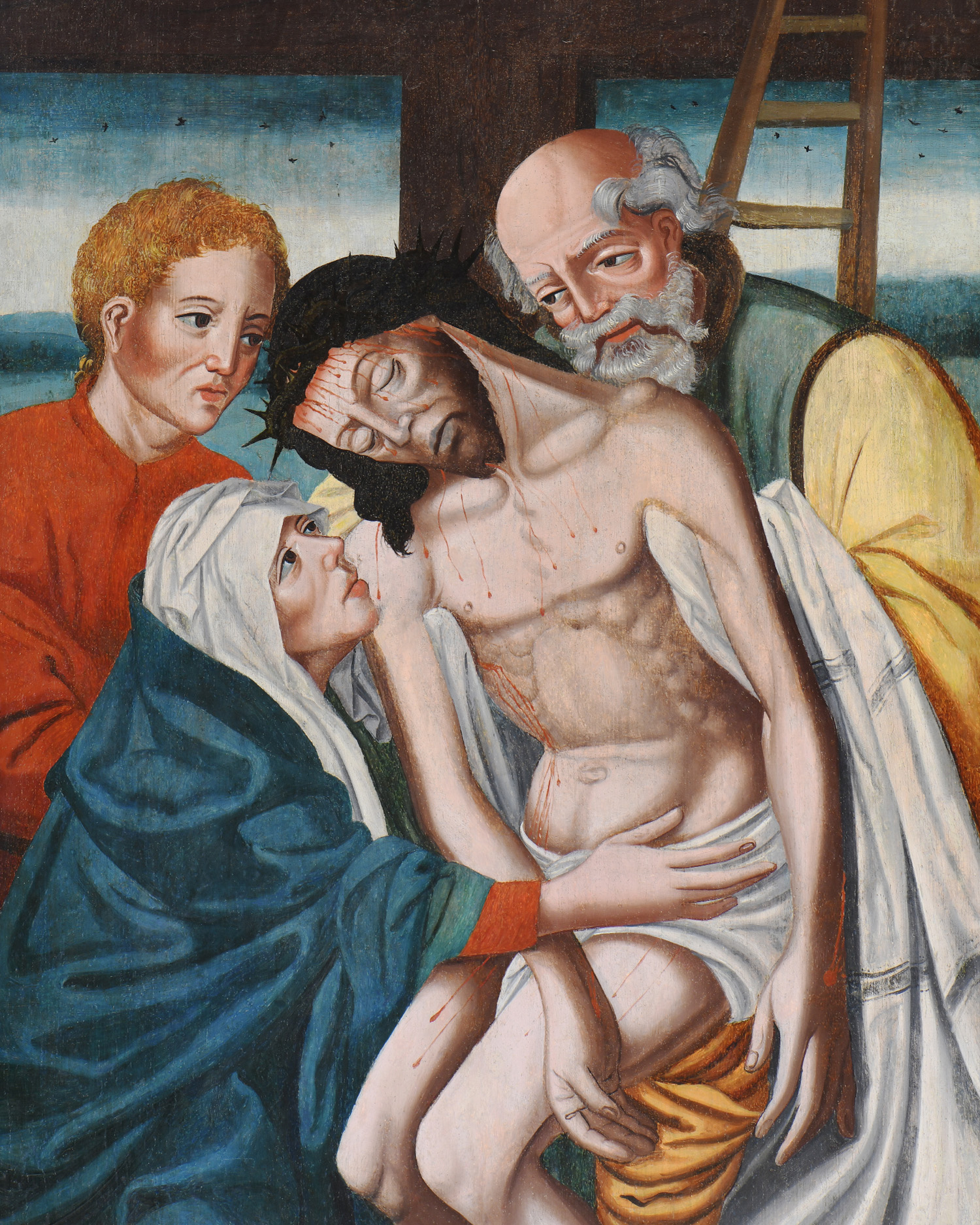
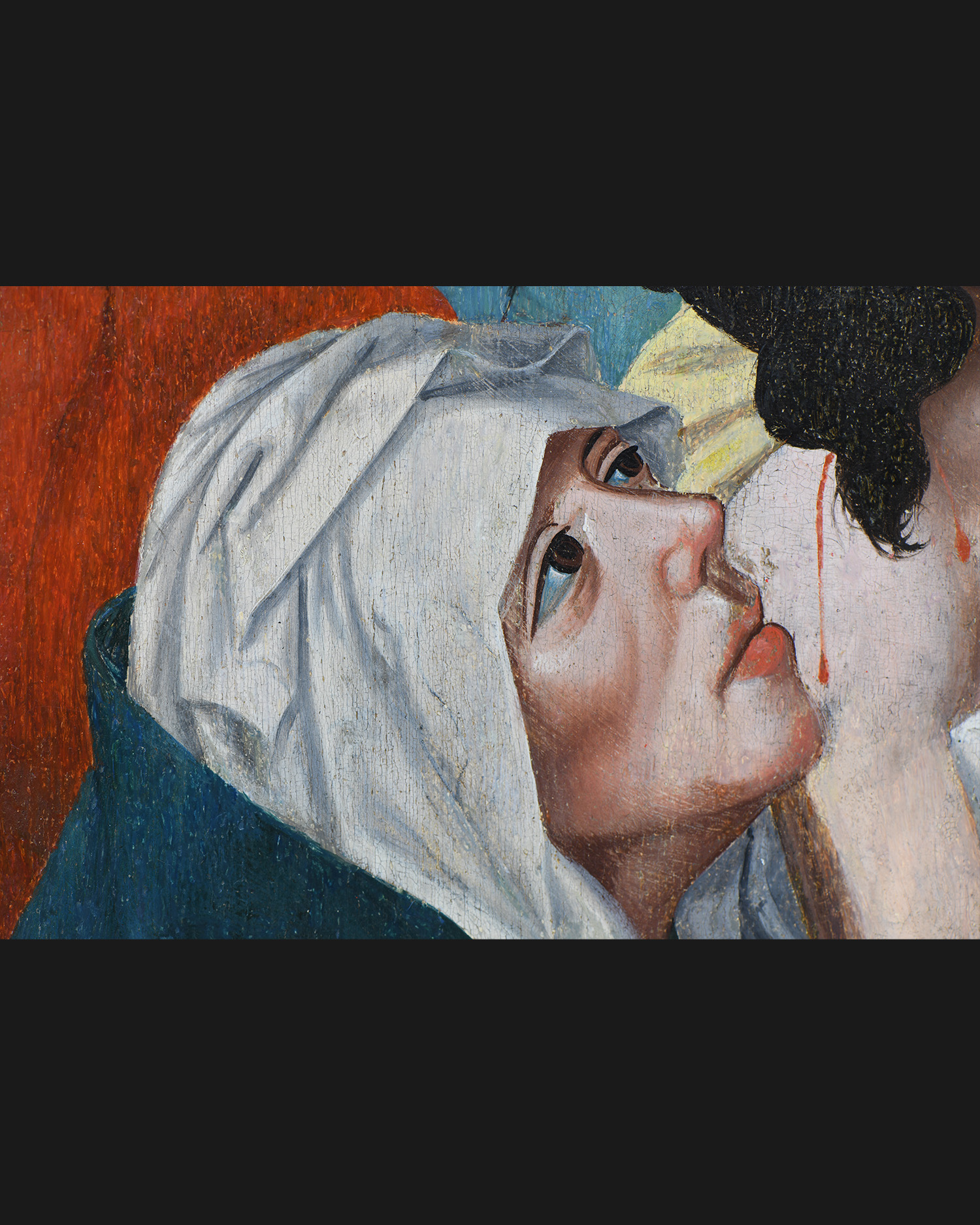
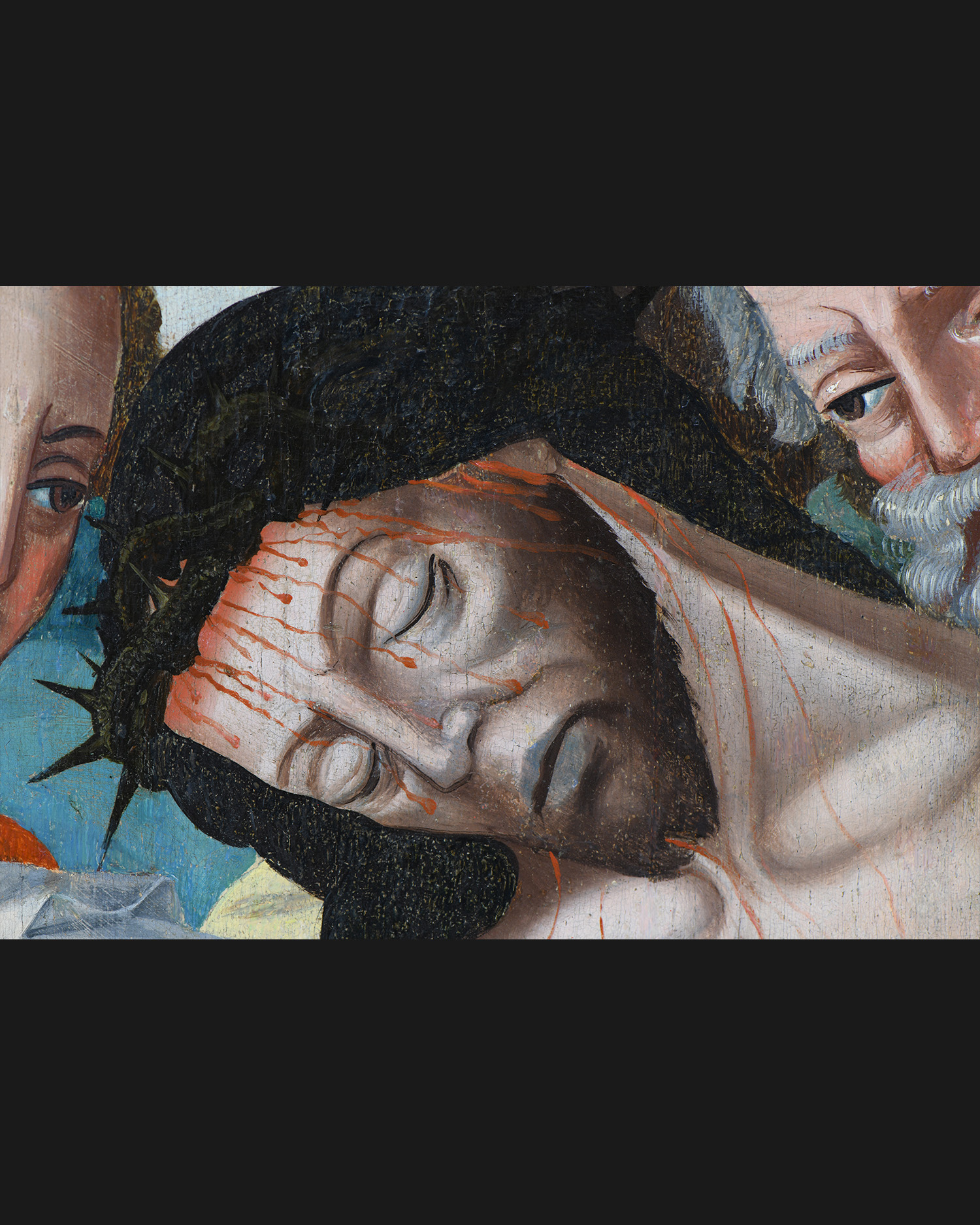
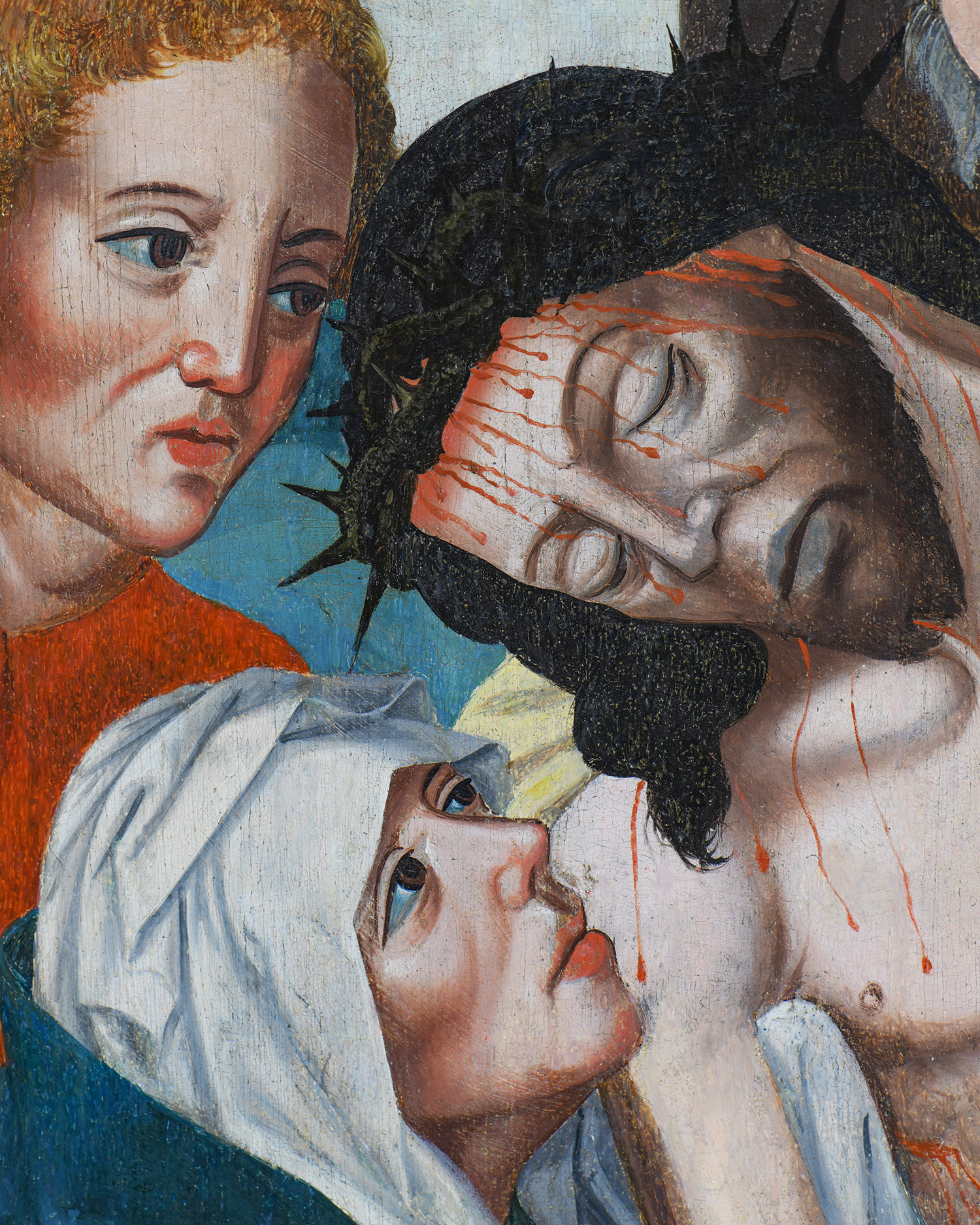
German-Italian master from the 16th century (imitator of Rogier van der Weyden), Picture from the Cross. The foreground depicts Jesus taken down from the cross with his eyes closed and Mary kneeling before him in a dark blue cloak and white headdress. She looks lovingly at her son and embraces Him with her right hand. In the back on the right stands Joseph of Arimathea, supporting the body, and on the left St. John the Evangelist. In the background, the view stretches into the distance, revealing parts of the cross and a ladder. The scene is depicted mainly in primary colors.
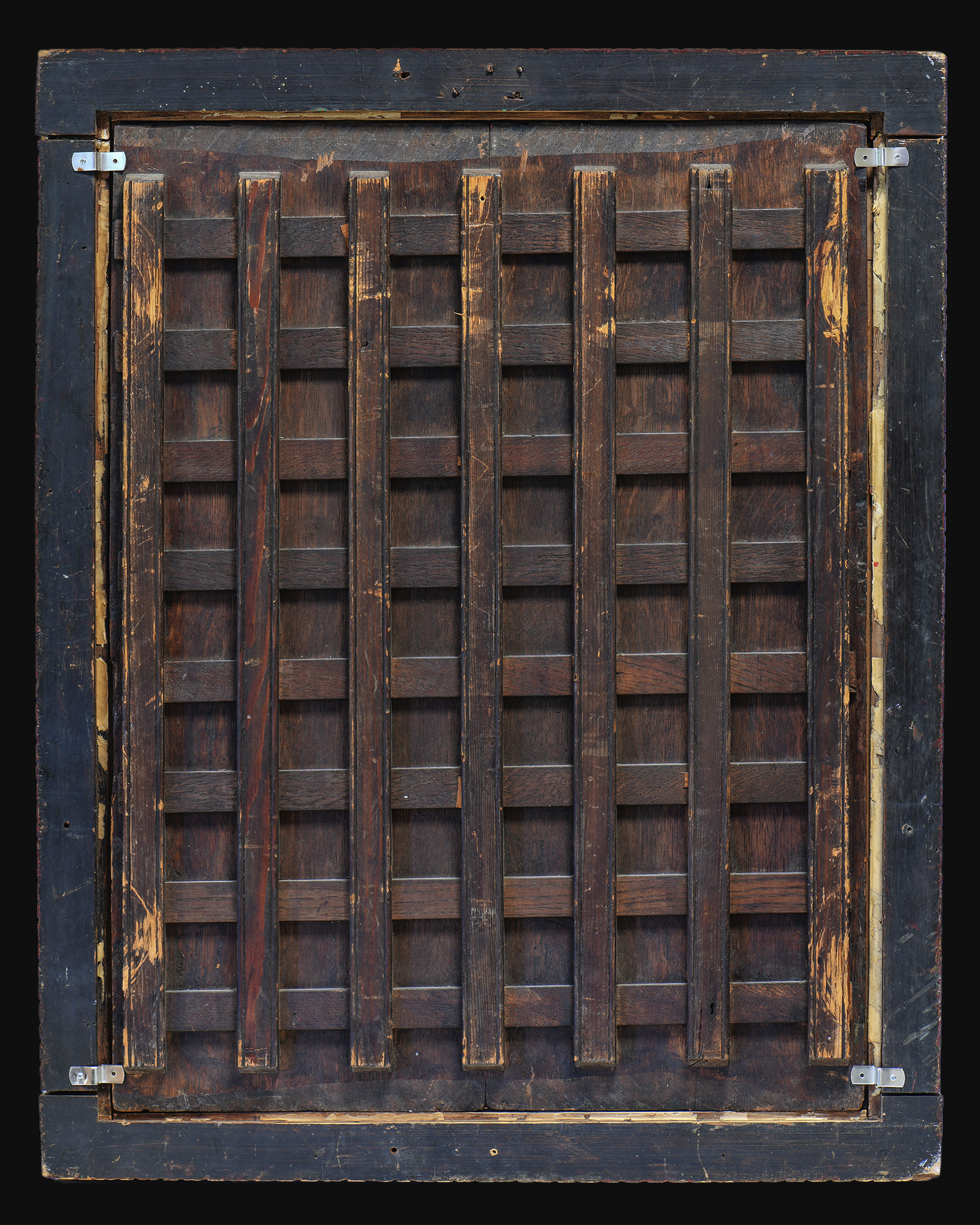
Board dimensions: 70 x 53 cm; framed painting, carved frame, gilded 18th century (dimensions with frame: 79.5 x 64 cm).
Painting on display at the auction of paintings by old masters of the Hampel auction house in Munich (Ale Meister, part II, 27.06.2019, lot No. 770).
It is believed that there are many versions of this design, all of which probably derive from a lost prototype from the 1540s by Rogier van der Weyden.
1 in stock
| Weight | 5,7 kg |
|---|---|
| Dimensions | 70 × 53 cm |
| Material / Technique |
Oil on parquet board |
| Kolorystyka |
Multicolor palette |
| Czas powstania |
16th century |
| Era |
Renaissance |
| Kraj pochodzenia |
Western Europe |
| Autor |
German-Italian champion |
| State of preservation |
Very good |
Related products
Death of Cleopatra, oil on canvas, Italy, 17th-18th centuries.
Devotional Ring, Silver, Lviv, 1872-1920
Fragment of an antiphonary page with illuminated initial, parchment, Europe, 15th century
Govert Camphuysen (1623/1624-1672) – attributed, Landscape with cattle grazing in front of a hut, oil on board
In front of the village thatched hut, sheep, a cow and a goat are grazing. Next to it, a villager is sleeping under a tree. To the left of the composition, a second scene is visible: a man leading a bull over a small bridge over a stream. In the background is a landscape with trees and gentle hills, and the sky occupies a large part of the painting, building the mood of the whole scene. What draws attention is the exquisite way in which the animals are depicted. This was a specialty of Camphuysen, whose work was inspired by the style of Paulus Potter. Warm, earthy colors dominate - browns, ochres, dim greens and broken yellows. The light is soft, diffused, as if in the early morning or towards evening. The sky has shades of gray, beige and soft pink, suggesting changing weather or impending dusk. The contrast between the bright sky on the left and the darker, more saturated part with the cottage on the right gives the image depth and balance.
Hendrik van Steenwijk II (ca. 1580 – 1649) – circle, Interior of a Gothic church, oil on board, Flemish school, 17th century.
The painting depicts the interior of a Gothic church, executed in the Flemish school of the 17th century, in the circle of Hendrick van Steenwijk i.e. one of the pioneers of perspective painting. The composition, built on an axis leading towards the main altar, shows a monumental interior with pillars, cross-ribbed vaults and side chapels. Figures of the faithful and clergy are visible in the space, introduced to emphasize the scale of the architecture and the mood of concentration.
The painting was made with oil technique on board, in typical Flemish school style. The frame is original, wooden, veneered, with preserved gilt edge.
The composition refers to the solutions used by Hendrick van Steenwijk the Elder and Younger, as well as Pieter Neefs and Bartholomeus van Bassen, developing the genre of architectural painting in Antwerp and Delft.
Pieter Neefs II (1620 – 1675/1685), Night Mass in a Gothic Church, oil on board, Flanders, 17th century.
The painting depicts the interior of a Gothic church, by Pieter Neefs the Younger (1620–after 1675), a Flemish painter specializing in 17th-century sacred interiors. The composition based on a precise linear perspective leads the eye towards the main altar, around which the faithful and clergy participating in the liturgy are gathered.
The painting was made in oil technique on board, without a visible signature. The upper part of the composition has been cropped, resulting in the loss of the original format and probably also the author's signature.
The work represents the mature style of Pieter Neefs the Younger - precise rendering of space, controlled light and realistic depiction of architecture, characteristic of the Antwerp school. Paintings of almost identical composition appear in several well-known collections and collections - including the Szépművészeti Múzeum (Museum of Fine Arts) in Budapest and a Sotheby's auction (2021).
It is worth mentioning that works from this series are also sometimes attributed to Pieter Neefs the Elder (c. 1578-1656), confirming the strong stylistic affinity between the works of father and son.
Bibliography / links:
- Peeter Neefs I - Invaluable
- Pieter Neefs II - Art Salon
- Pieter Neefs I - Museum of Fine Arts Budapest (Wikimedia Commons)
- Pieter Neefs II - Sotheby's Auction 2021
Portrait of a nobleman (Sarmacki portrait), oil on canvas, Poland, 18th century.
The portrait, originally rectangular and later cut down to an oval and relined, depicts an elderly man in noble (szlachecki) attire characteristic of the 18th century. The figure is shown half-length, facing frontally with a slight turn of the torso and one hand resting on the hip, which lends the composition a sense of dignity and static elegance.
The face, with mature features such as a high forehead, short, thinning grey hair, and subtle wrinkles — is rendered realistically, with attention to individual physiognomic traits. The gaze is calm and restrained, conveying charisma and composure, as well as an established social standing. This is further emphasized by the impressive noble (szlachecki) attire: a żupan embroidered with gold thread, a dark blue kontusz lined with red fabric, fastened with large gold buttons, and a wide, light-colored sash tied around the hips.
The painting is an excellent example of the so-called “Sarmacki portrait”, emphasizing social class affiliation, wealth, and official position. It stands out for its solid artistic craftsmanship, naturalistic treatment, and the mature age of the sitter.
