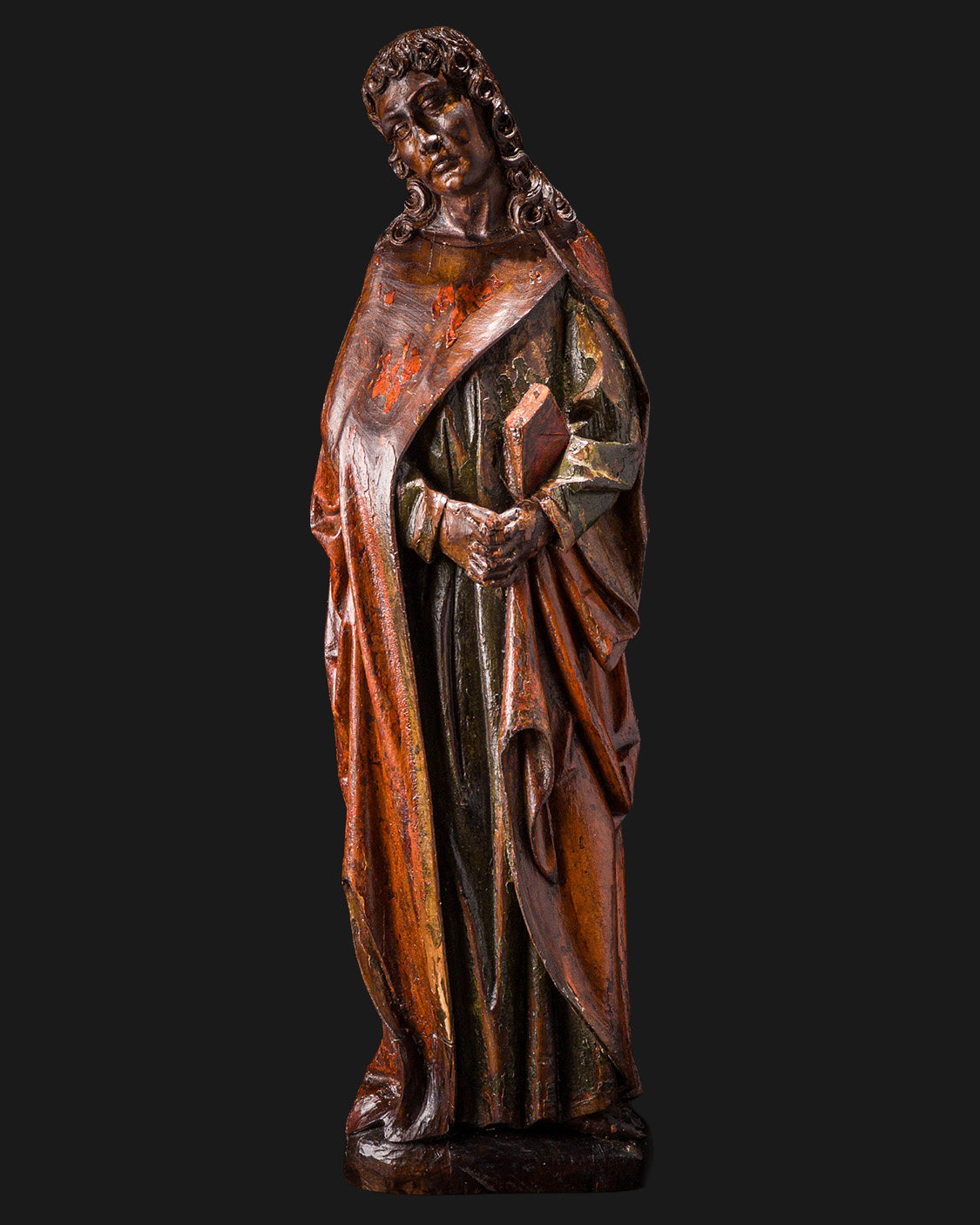
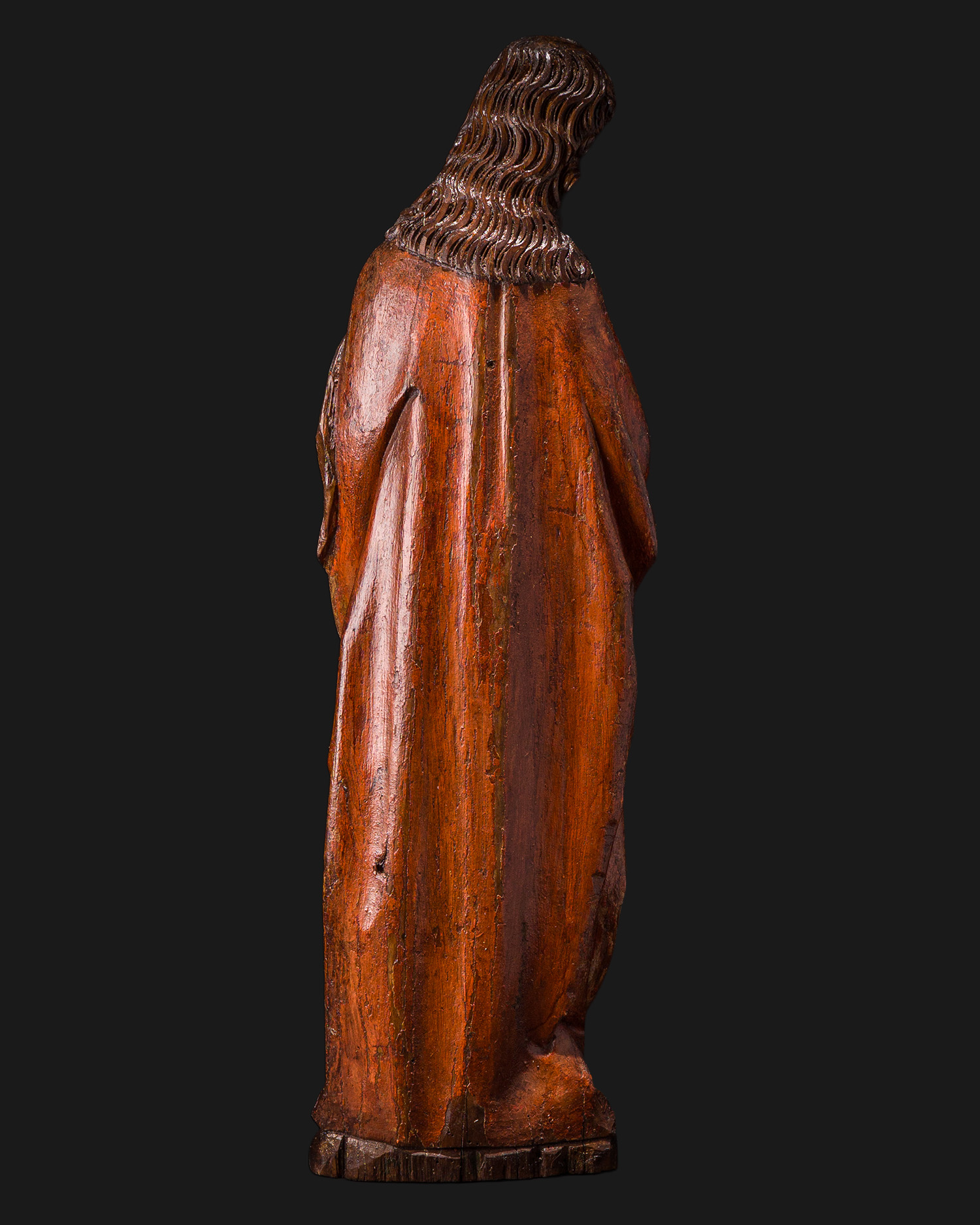
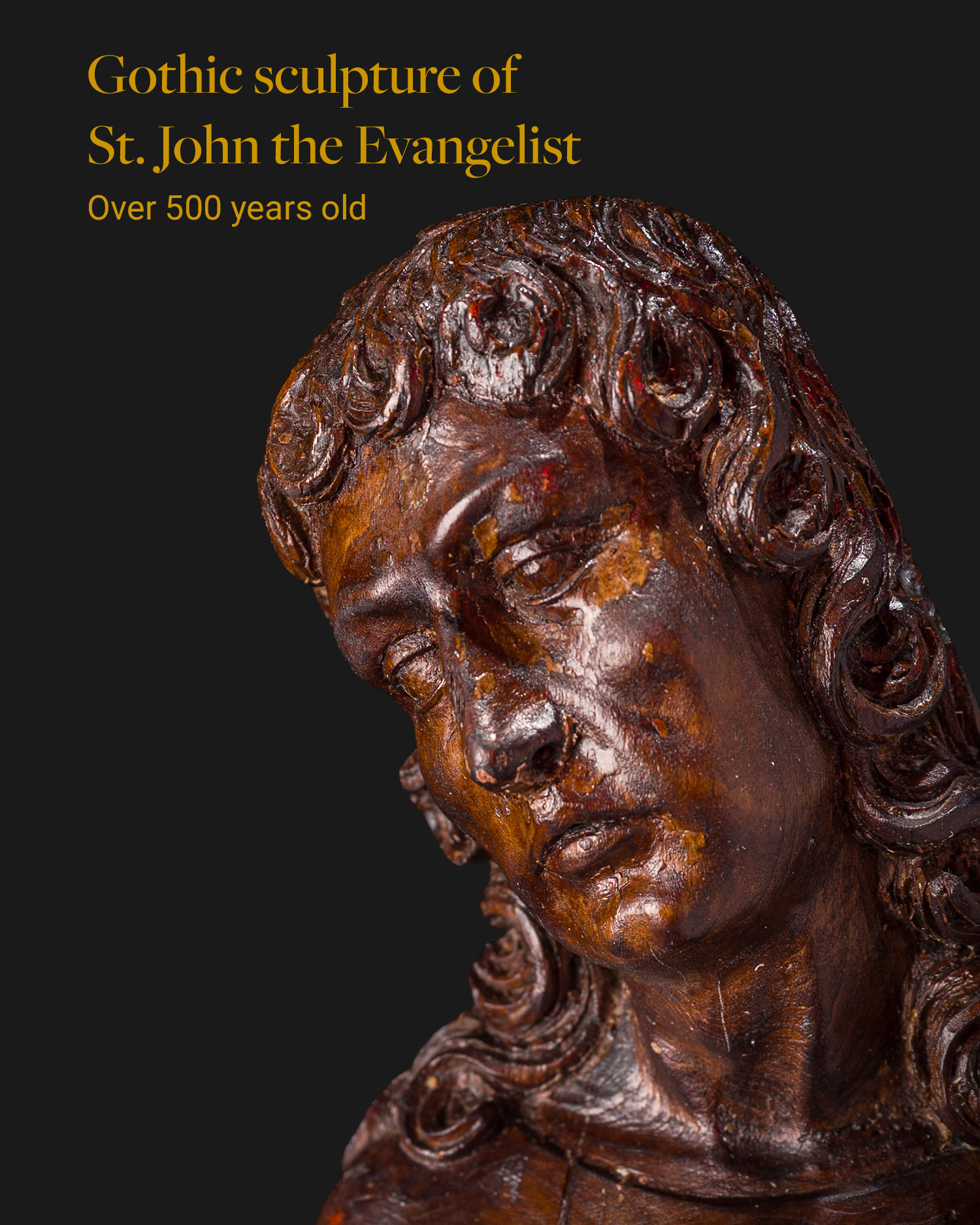
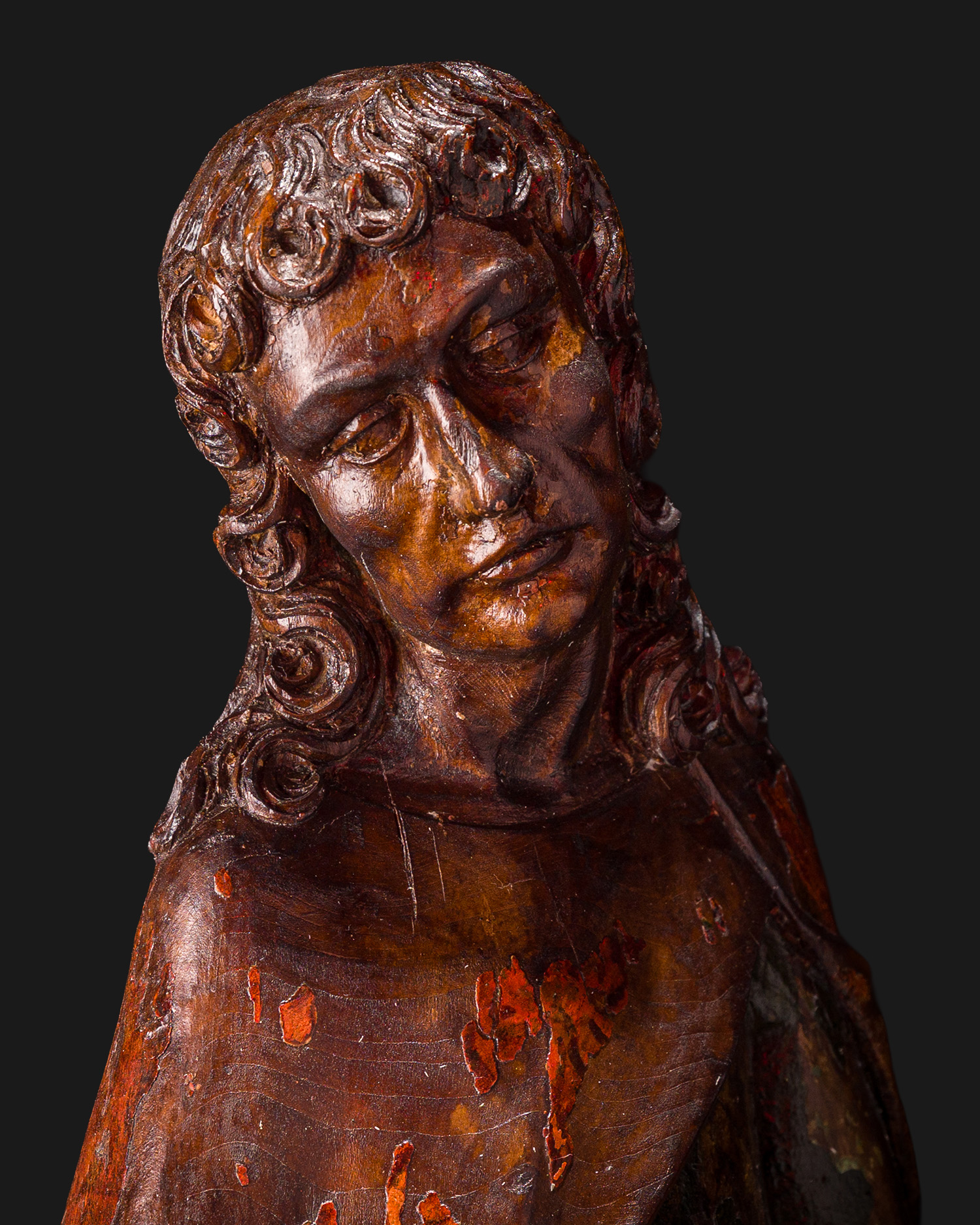
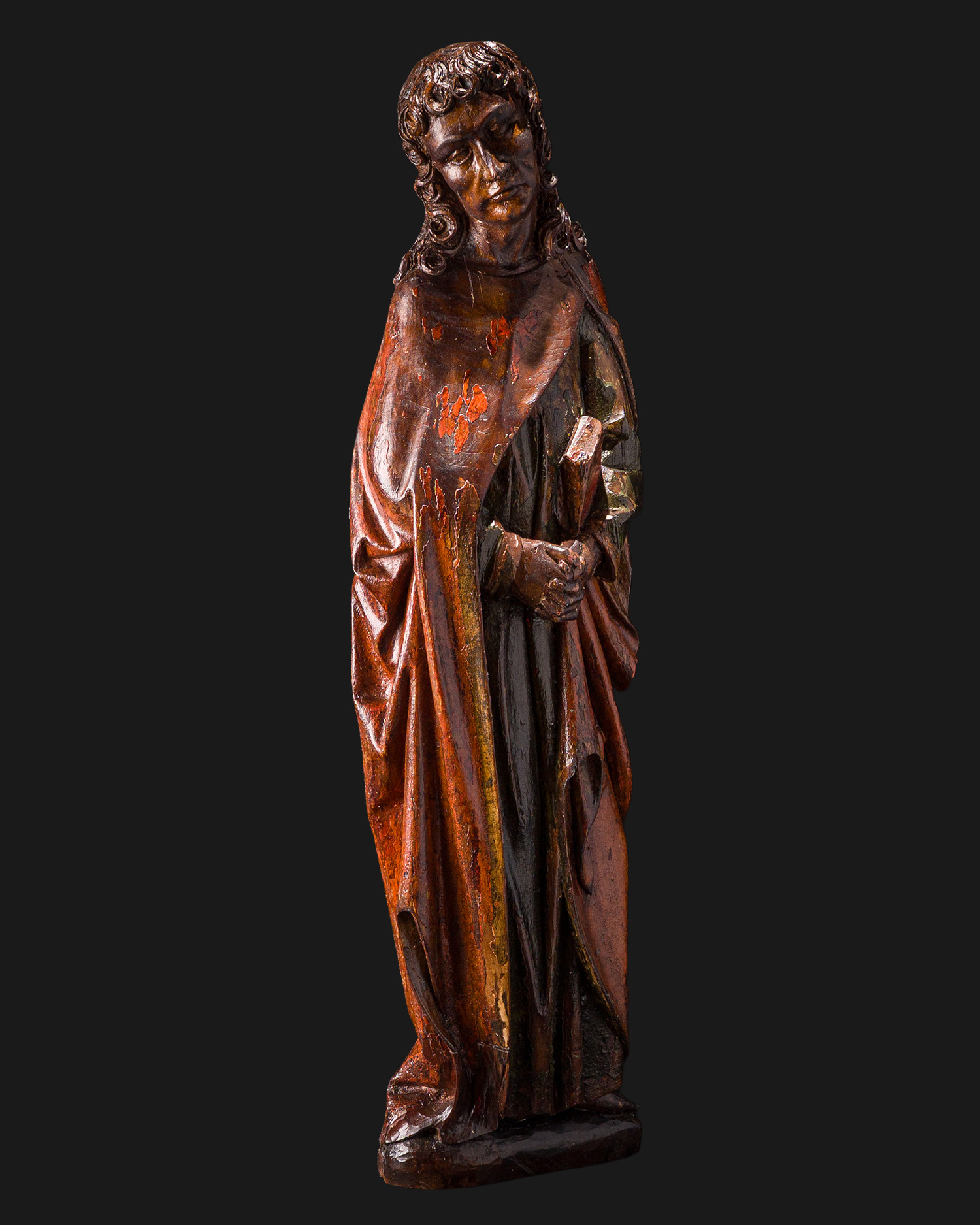
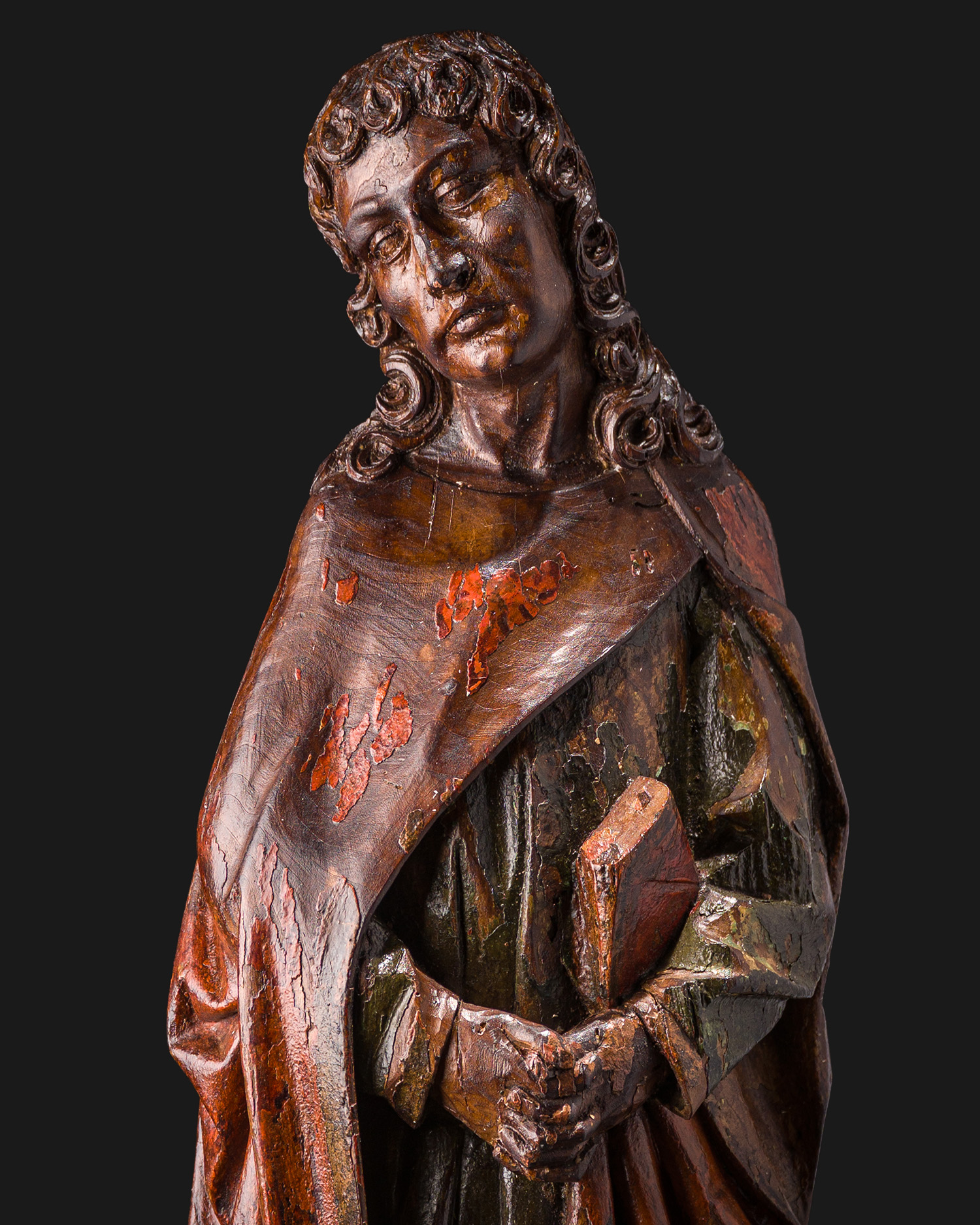
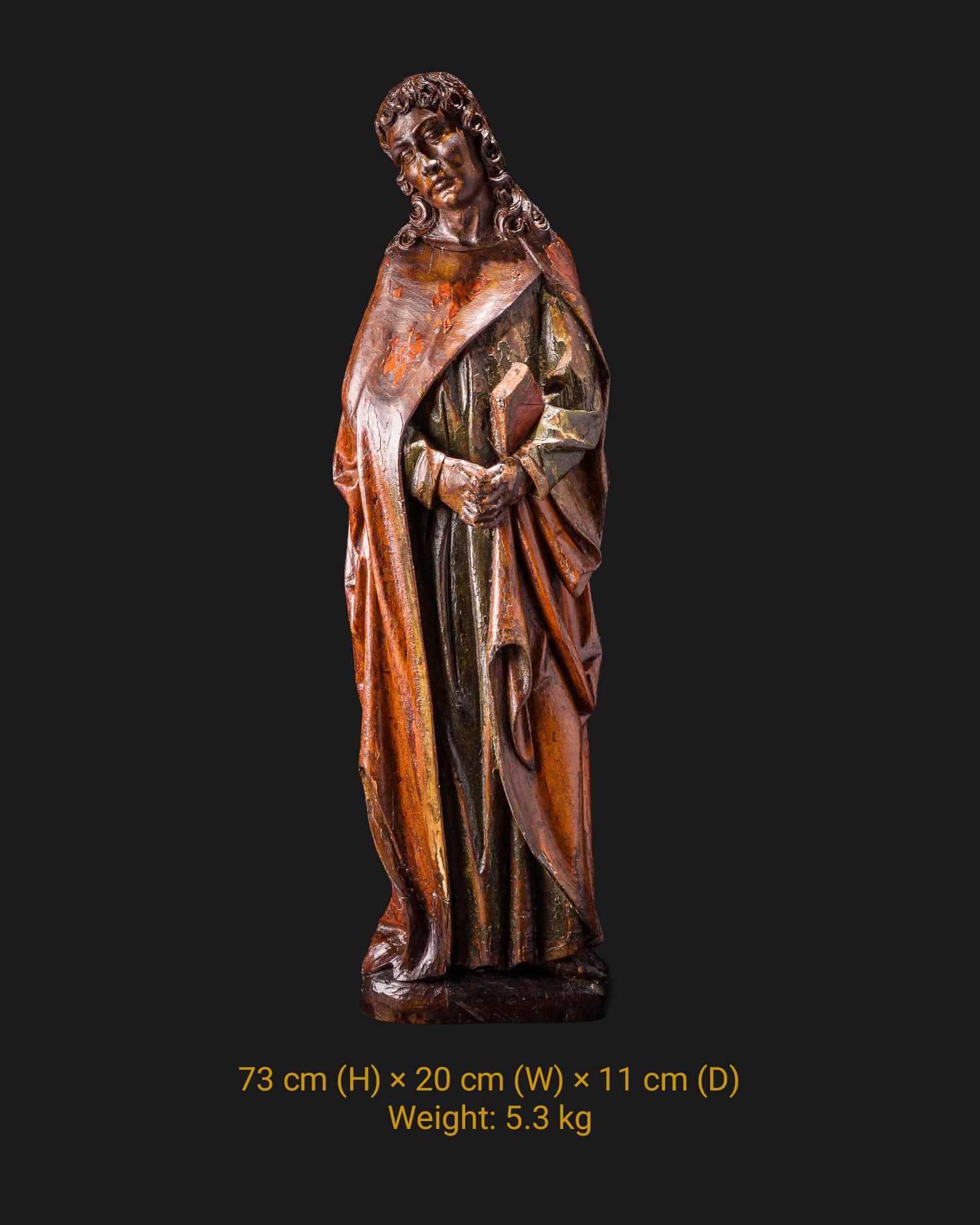
Saint John the Evangelist, late Gothic wooden sculpture, ca. 1500
6400,00 zł
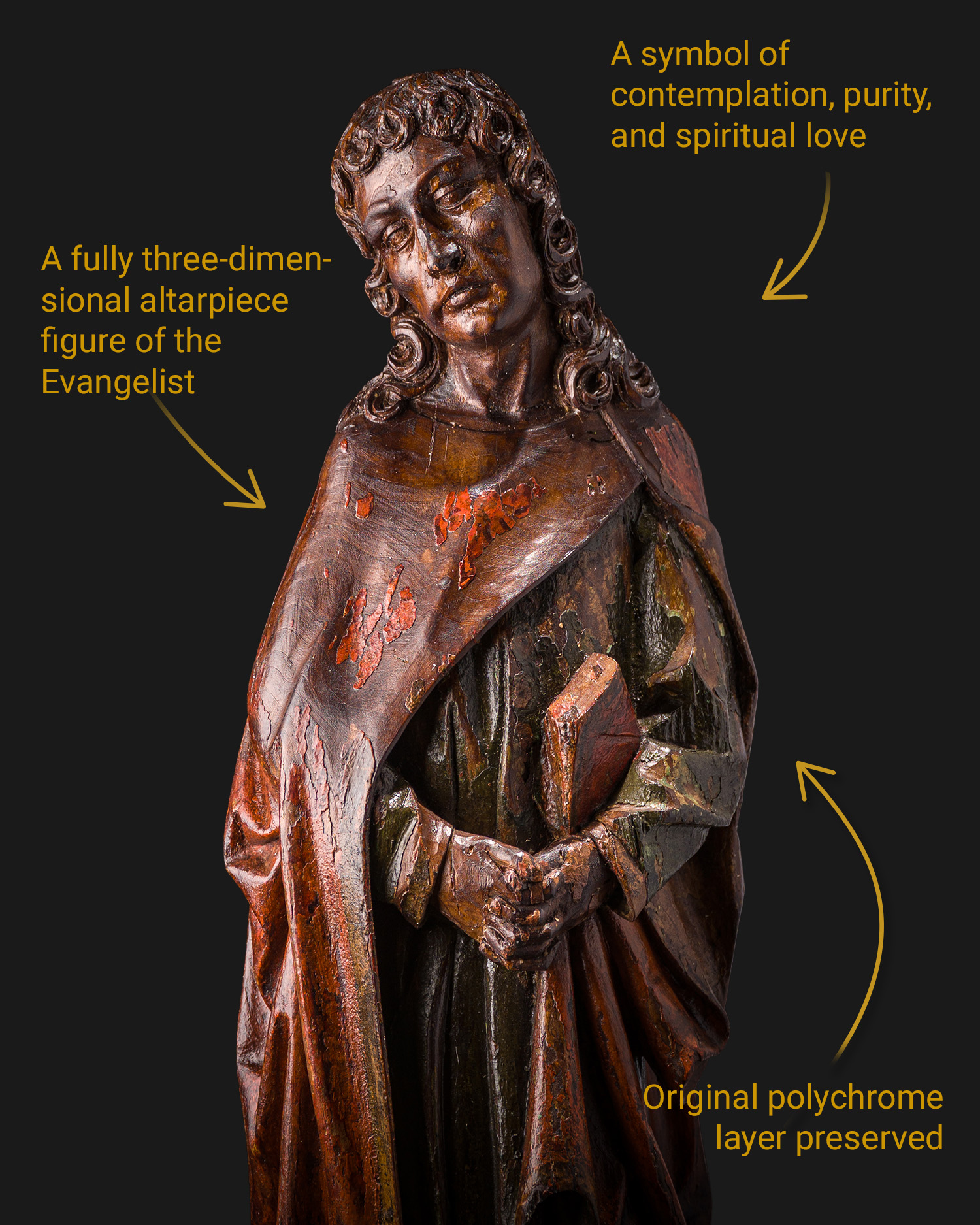
Full-plastic sculpture depicting St. John the Evangelist , made of wood, dated around 1500. The figure is shown in counterpoint, with a slightly bowed head and entwined hands holding a book – an attribute of the Evangelist. The sculpture is preserved in its original polychrome, with a visible structure of pigment layers and natural cracking of the wood.
The work may have been part of a winged altarpiece (retabulum), most likely in the Crucifixion group.
Sprzedane
| Weight | 5,3 kg |
|---|---|
| Dimensions | 20 × 11 × 73 cm |
| Type |
Sacred sculpture |
| Form |
full-plastic statue of St. John the Evangelist |
| Materiał |
Polychrome wood |
| Kolorystyka |
Brown ,Dark green ,Red |
| Czas powstania |
ca. 1500 |
| Era |
Gothic ,The Middle Ages |
| Kraj pochodzenia |
Central Europe |
| State of preservation |
Very good, no losses; natural cracks in the wood and traces of the original polychrome visible |
Related products
Cabinet Reliquary with Relic of the True Cross and 26 Saints, wood, textiles, Central Europe, 18th century
An 18th-century Baroque cabinet reliquary, a freestanding wooden display case of trapezoidal form, containing a total of 27 relics. The side walls and top are chamfered, widening toward the front. The interior is lined with burgundy velvet, trimmed with decorative borders of gold bullion thread.
At the center, set slightly forward from the back, is a raised textile reliquary in the form of a monstrance, embroidered with gold thread and richly adorned with bullion, filigree, miniature beads, and multicolored glass imitating precious stones. On the base and shaft are placed six relics, identified by inscriptions painted in gold on dark blue banderoles.
Within the central repository is a reliquary capsule with a convex glass cover, containing two fragments of the True Cross, surrounded by a radiant glory.
Above the “monstrance” is an oval image with an indistinct representation, encircled by 20 additional relics interspersed with decorative elements of bullion, beads, gold thread embroidery, and colored glass. At the level of the nodus are two larger relics (Ex Ossibus) of Saint Vincent and Saint Fortunatus, uniquely labeled on white banderoles.
A distinction should be made between a reliquary and a reliquary cabinet: a reliquary is a vessel that directly contains relics, whereas a cabinet reliquary serves as a structure housing and presenting them. This object is therefore not a typical example, as—besides the central textile reliquary in the form of a monstrance containing fragments of the Cross on which Jesus Christ died—it also incorporates an additional 26 relics of various saints placed directly within the composition, without individual containers.
Their preservation is ensured either by a fine mesh covering or solely by labeled banderoles. The relic of the True Cross is the only one enclosed within a glazed, and undoubtedly sealed, capsule.
The interior of the case, measuring 37.3 × 26.5 × 10 cm, is lined with burgundy velvet, trimmed with gold bullion thread.
Capital with Figural Decoration, Sandstone, France, 12th-14th Century
Gallo-Roman sculpture of the head of Eros (?), marble, 1st-3rd century A.D.
Madonna and Child, polychrome wood, gilded, Central Europe, 18th/19th century
Rama, marble, India, 19th century.
A sculpture depicting Rama, one of the most important deities of Hinduism, considered the seventh avatar of Vishnu. The object was hand-carved in white marble in India, probably in the 19th century.
The figure is depicted standing, facing forward. The face has a gentle expression with a soft smile and slightly closed eyes. The head is crowned with a decorative crown, and long necklaces are visible on the chest.
The figure is dressed in a draped robe with clearly marked folds. On its back is a quiver with arrows, characteristic of Rama's depictions.
The hands of the sculpture are not preserved, originally in one of them the figure held a bow - a characteristic element of representations of this deity. Further about these cavities do not write that they are consistent.
Rama is the hero of the epic Ramayana and in the Hindu tradition symbolizes righteousness and fidelity to the principle of dharma. His images occupy an important place in Indian sacred art, although full-figure marble sculptures of this scale are less common.
The object is preserved in good condition, with clear legibility of form and detail.
