

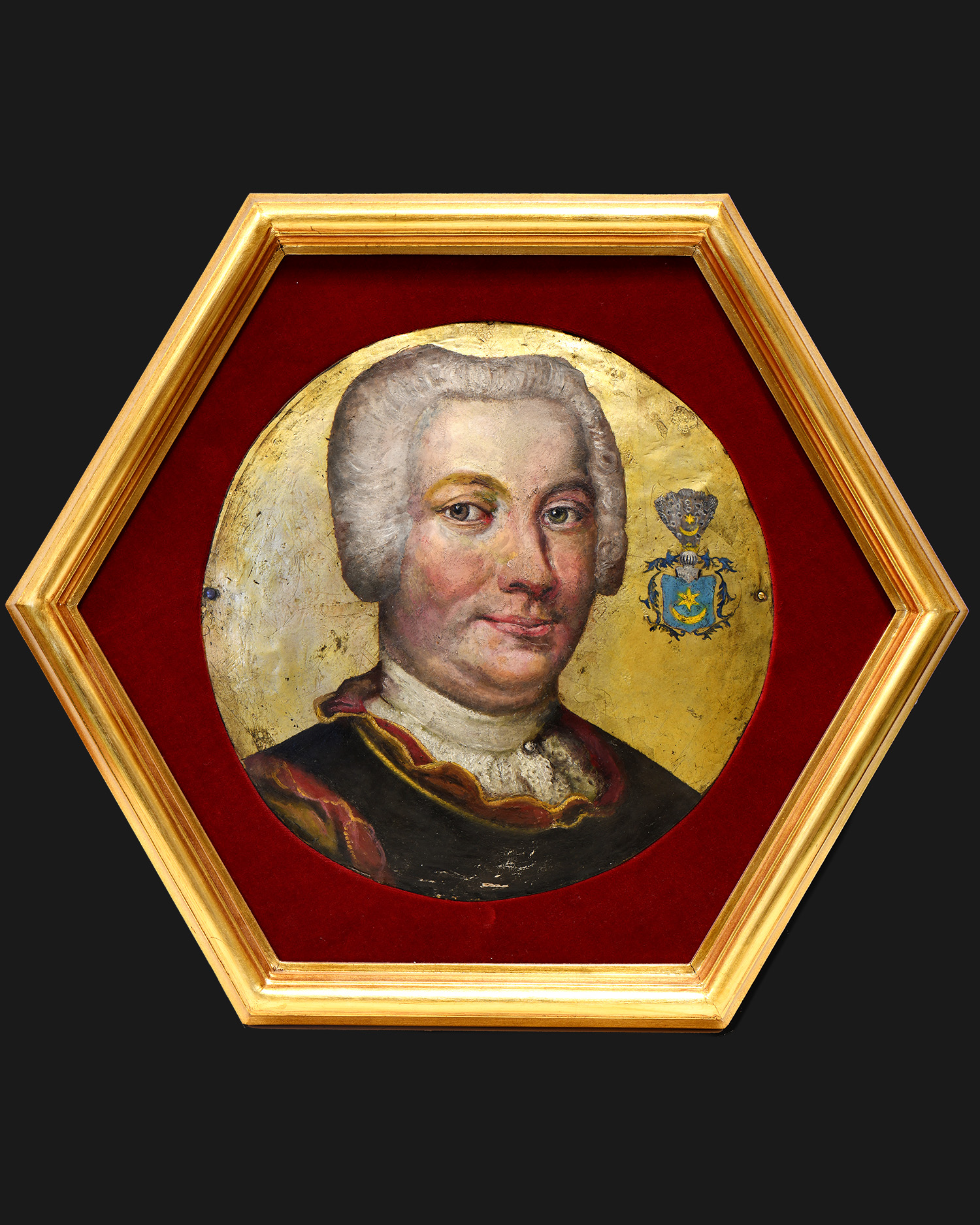
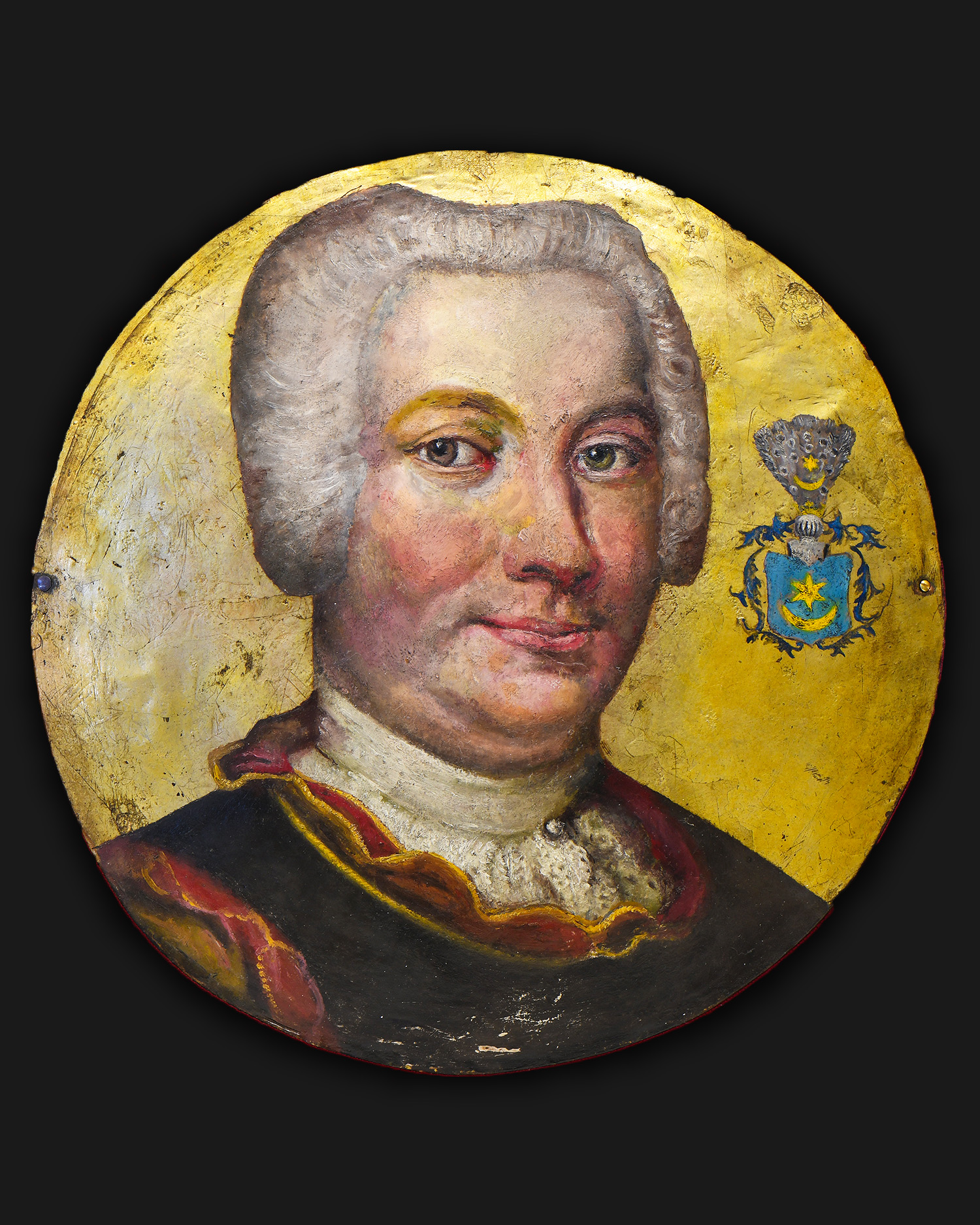
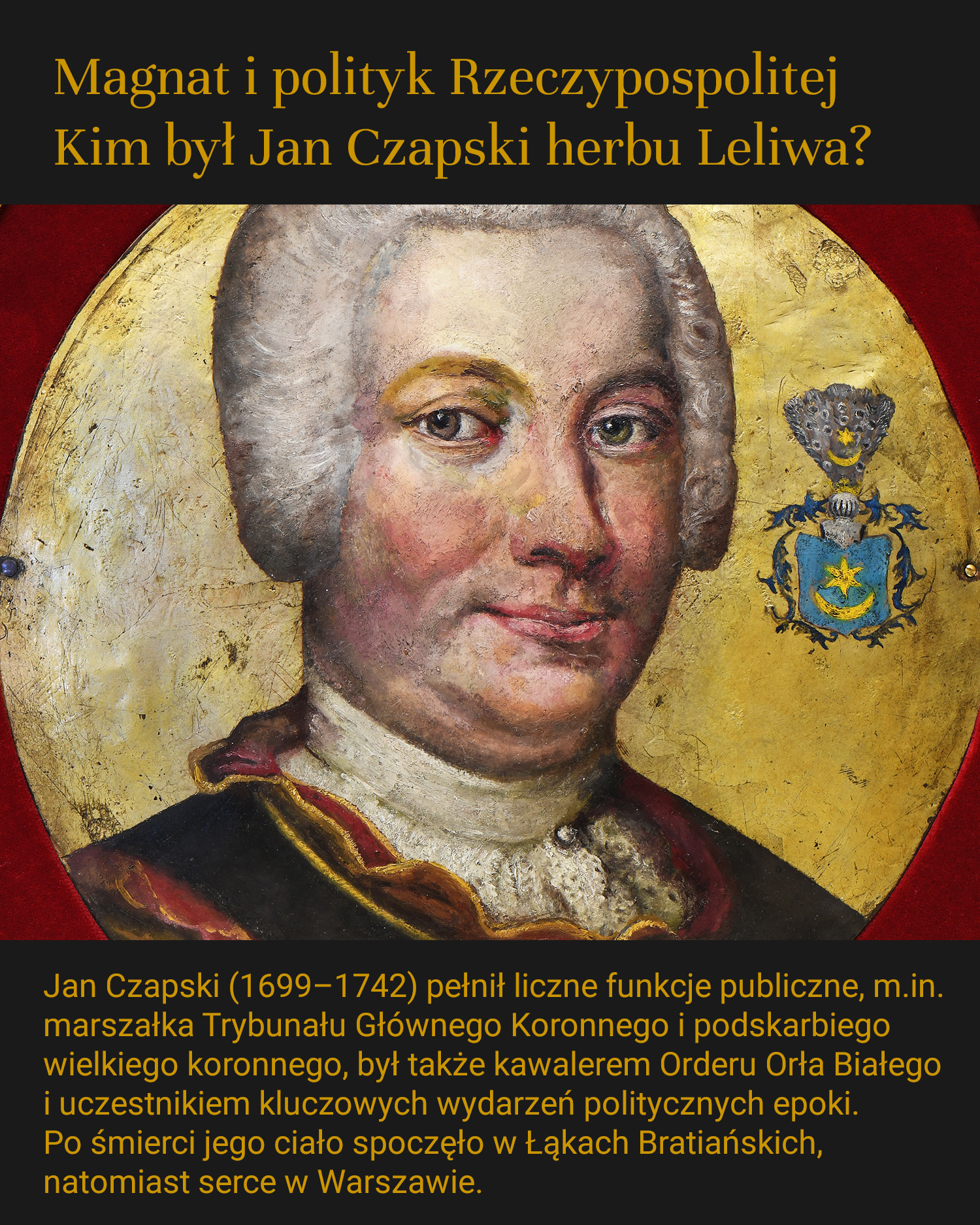
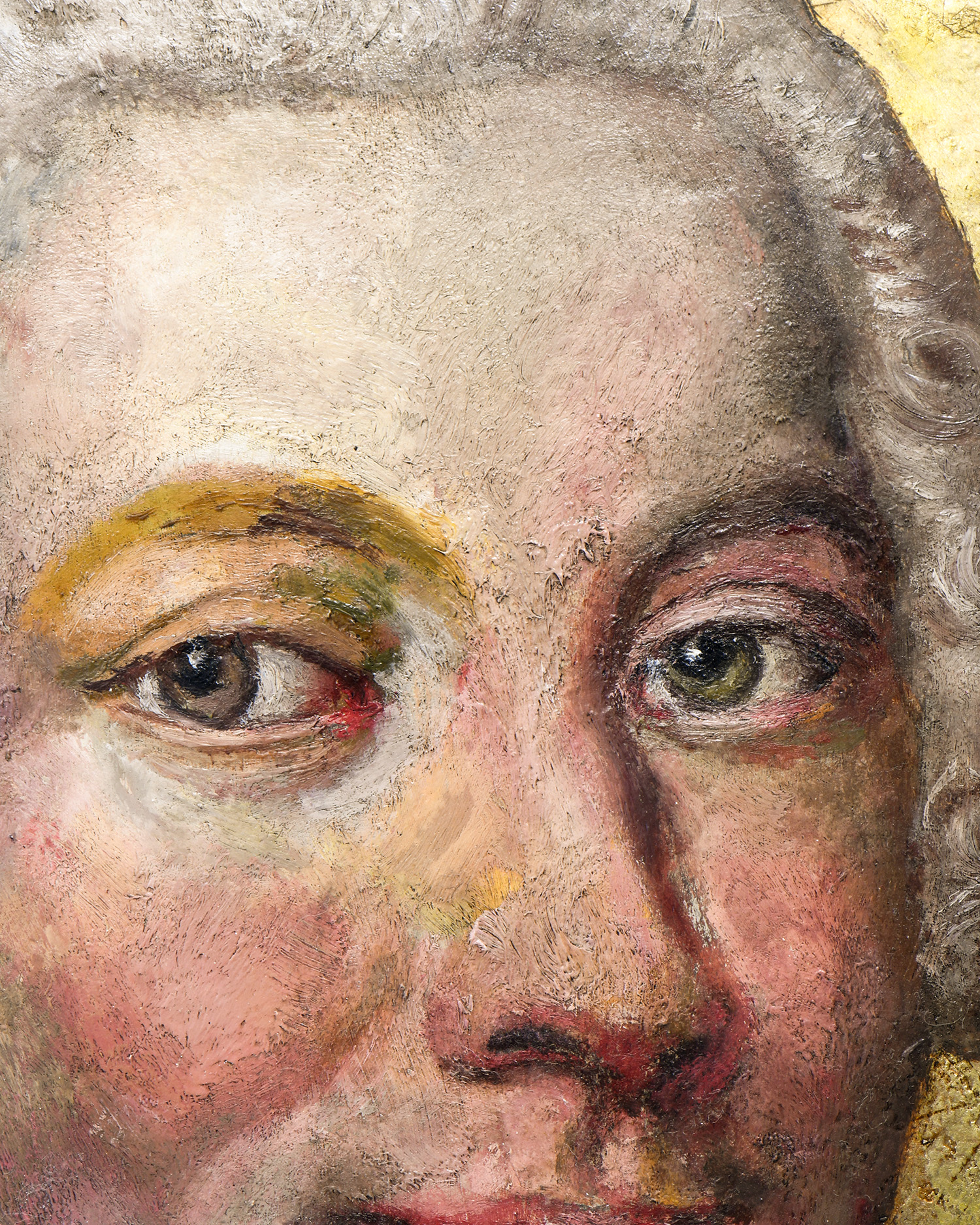
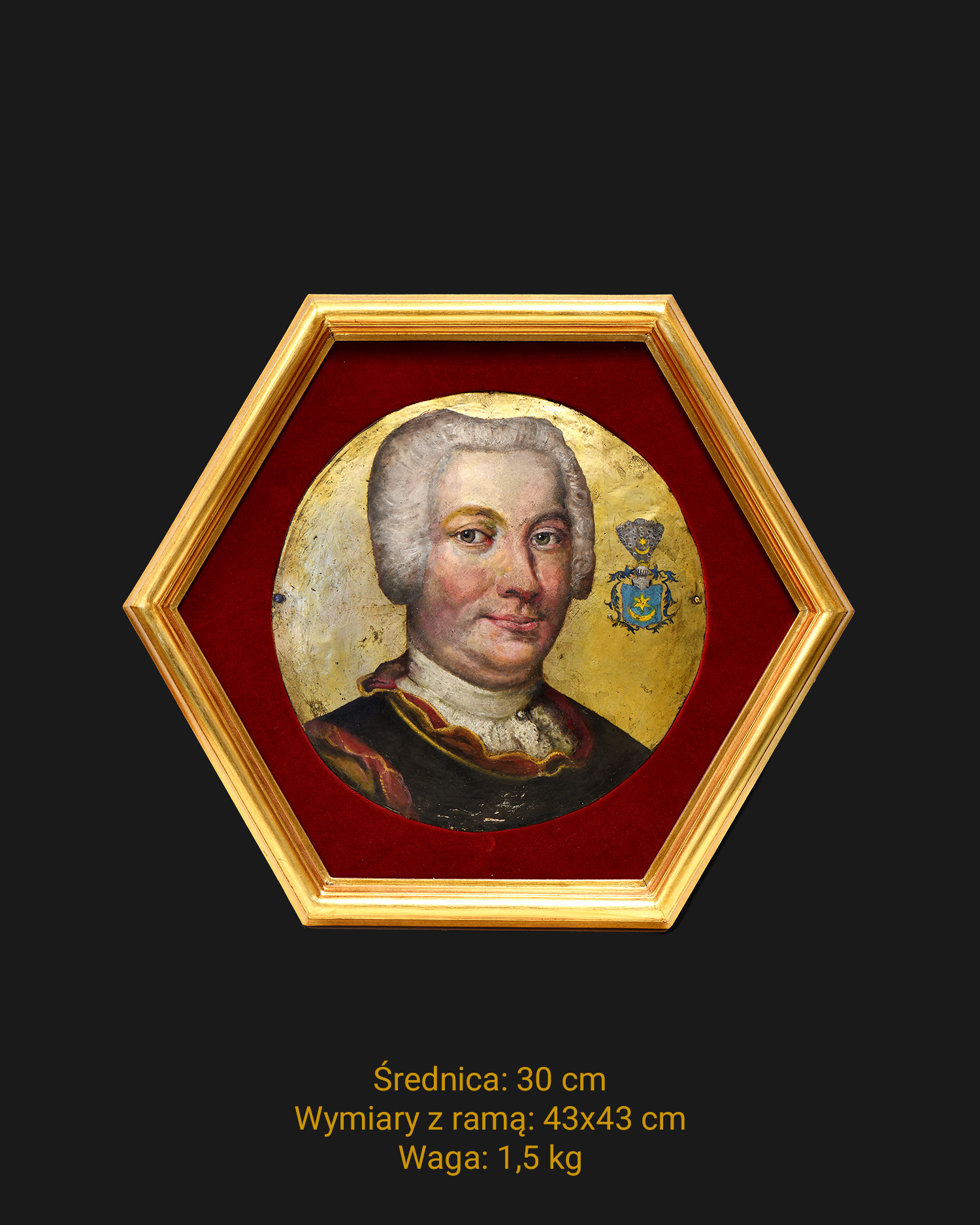

Epitaph portrait of Jan Czapski (1699-1742), oil on copper, Poland, 1740s.
20000,00 zł
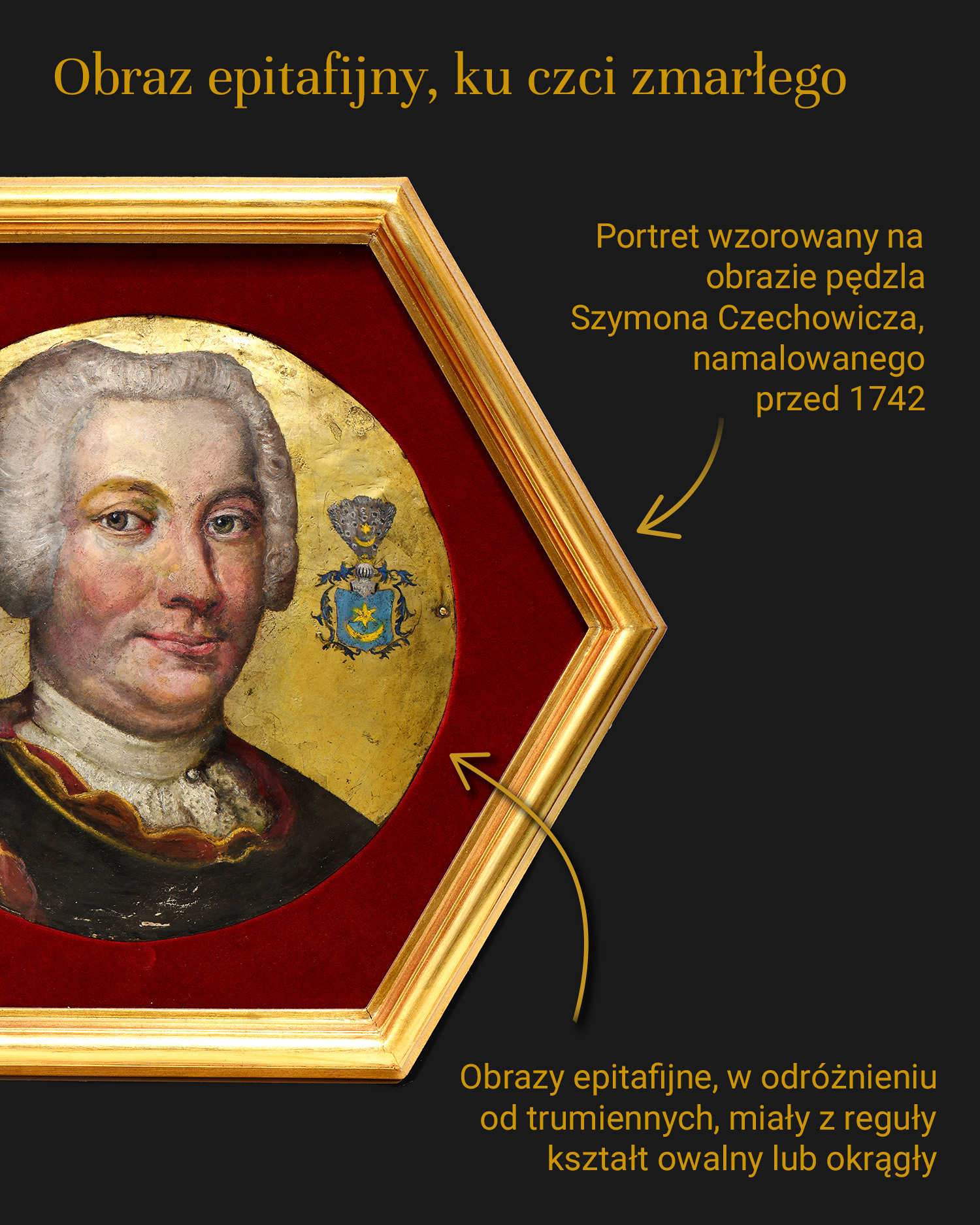
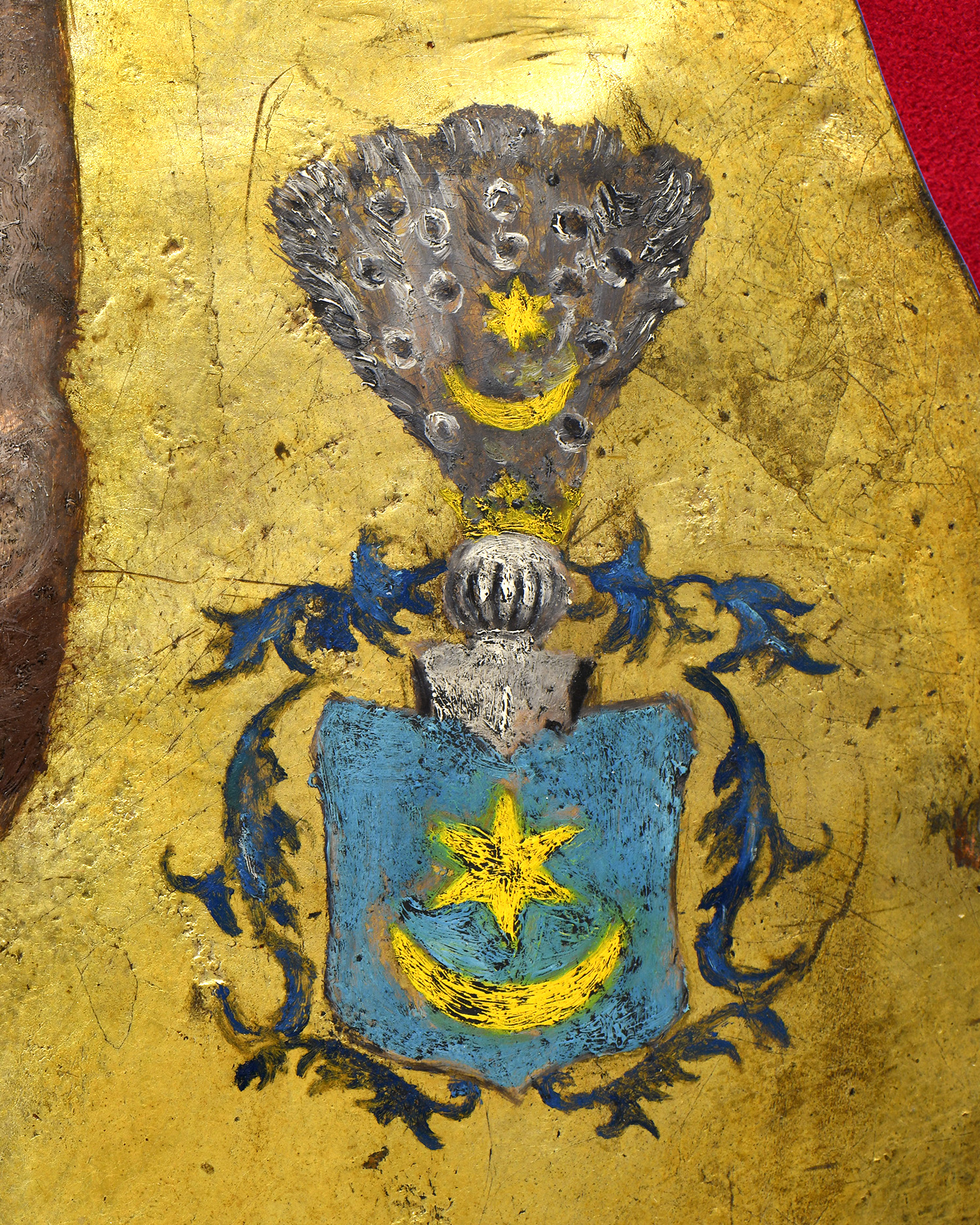
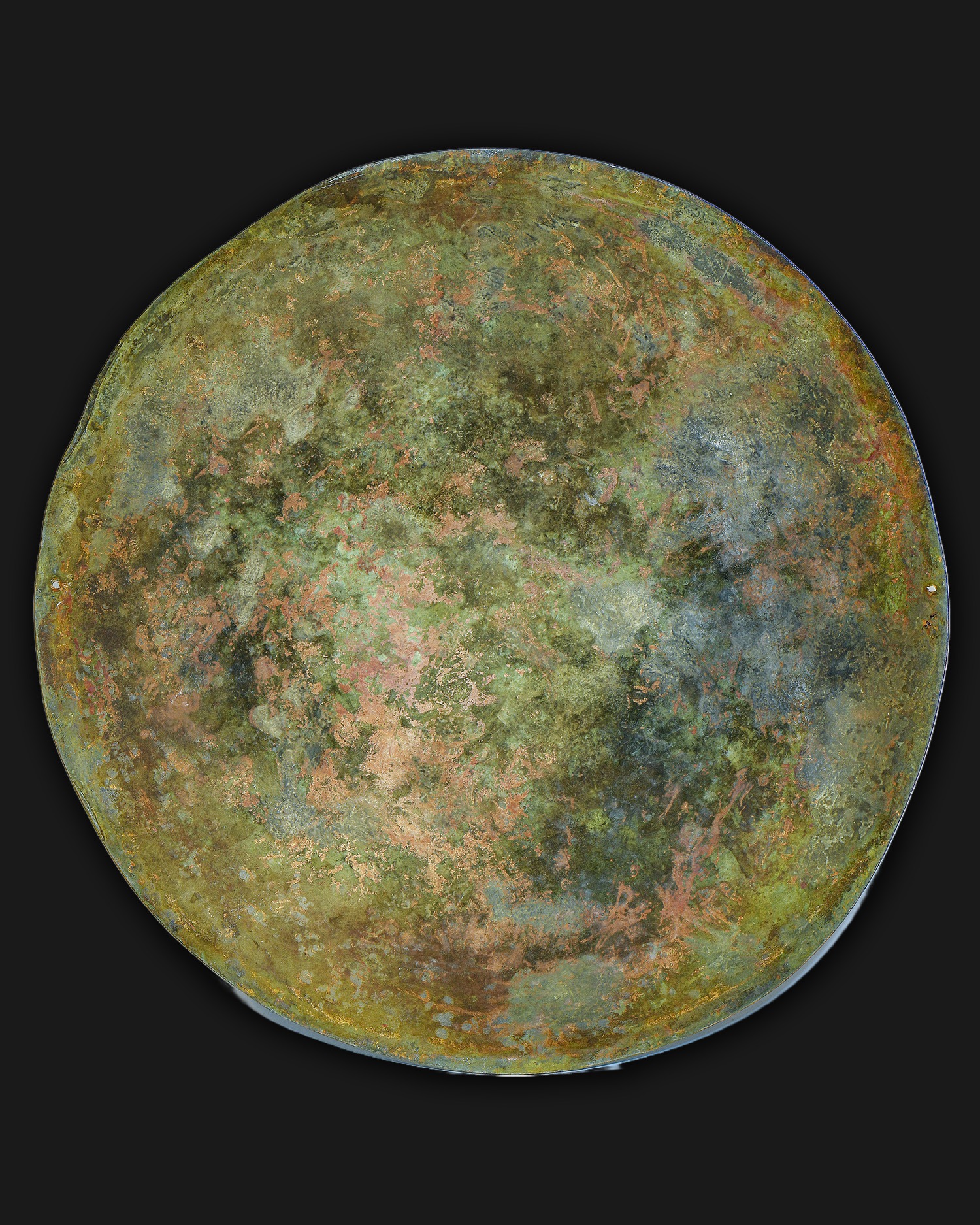
The circular-shaped painting was executed in oil technique on a forged, convex copper sheet, fire-gilded. The portrait shows a middle-aged man framed in bust, en trois quarts to the left. Oval, plump face with high forehead and second chin. On his head is a white powdered curly wig. The costume is a steel breastplate, from under which parts of the garment, including a white shirt collar, protrude. To the right of the portrait is the Leliwa coat of arms in an ornamental shield topped by a knight’s helmet with peacock feathers, on which the emblem of the Leliwa coat of arms is repeated. Around the shield is a floral ornament. The portrait is modeled on a painting by the brush of Szymon Czechowicz, painted before 1742.
Epitaph images, unlike coffin images, were generally oval or circular in shape. They were part of pictorial epitaphs – memorials in honor of the deceased or deceased (e.g. family), usually placed not at the burial site, but in another place associated with the person, most often in a church – on a wall or pillar. They consisted of the epitaph proper, i.e. a slab with an inscription, and a picture or pictures, most often painted or carved, less often made in other artistic techniques. A pictorial epitaph usually shows a portrait of the deceased or deceased, sometimes accompanied by his patron saint or patrons.
Diameter: 30 cm
Dimensions with frame: 43×43 cm
Related products
Chapel with Our Lady of Czestochowa and Eagle, Poland, 19th century.
Giacomo Francesco Cipper – “il Todeschini”, Young man eating from a wooden bowl, oil on canvas, Italy, 1st third of the 18th century
Govert Camphuysen (1623/1624-1672) – attributed, Landscape with cattle grazing in front of a hut, oil on board
In front of the village thatched hut, sheep, a cow and a goat are grazing. Next to it, a villager is sleeping under a tree. To the left of the composition, a second scene is visible: a man leading a bull over a small bridge over a stream. In the background is a landscape with trees and gentle hills, and the sky occupies a large part of the painting, building the mood of the whole scene. What draws attention is the exquisite way in which the animals are depicted. This was a specialty of Camphuysen, whose work was inspired by the style of Paulus Potter. Warm, earthy colors dominate - browns, ochres, dim greens and broken yellows. The light is soft, diffused, as if in the early morning or towards evening. The sky has shades of gray, beige and soft pink, suggesting changing weather or impending dusk. The contrast between the bright sky on the left and the darker, more saturated part with the cottage on the right gives the image depth and balance.
John Baptist Lambrechts (1680 – after 1731), Genre scene in an inn, oil on board, ca. mid-18th century.
Portrait of Franciszka Krasinska, oil on canvas, Poland, ca. 1760
Stanisław Chlebowski (1835-1884), Genre Scene – Dance, watercolor on paper, Istanbul (?), 1874
A small watercolor by Stanisław Chlebowski (artist's signature in the lower left corner: "St. Chlebowski 1874 ), depicting an intimate, dynamic and graceful genre scene of Oriental character. It reflects the artist's fascination with the culture of the Middle East and the Caucasus, which he explored during his many years of work as court painter to the Sultan in Istanbul.
With frame 50 x 42, visible area: 31.5 x 23.5 cm