


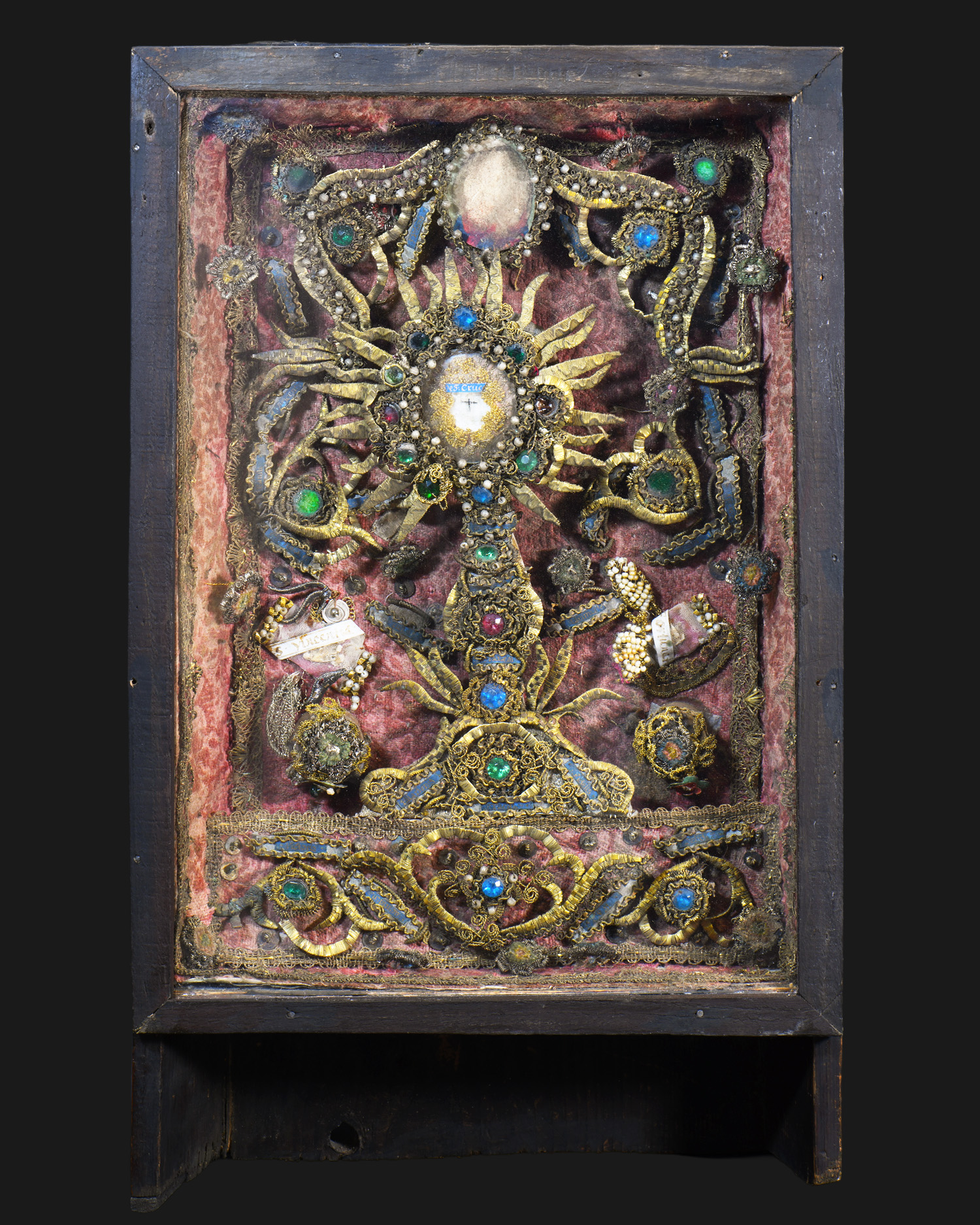
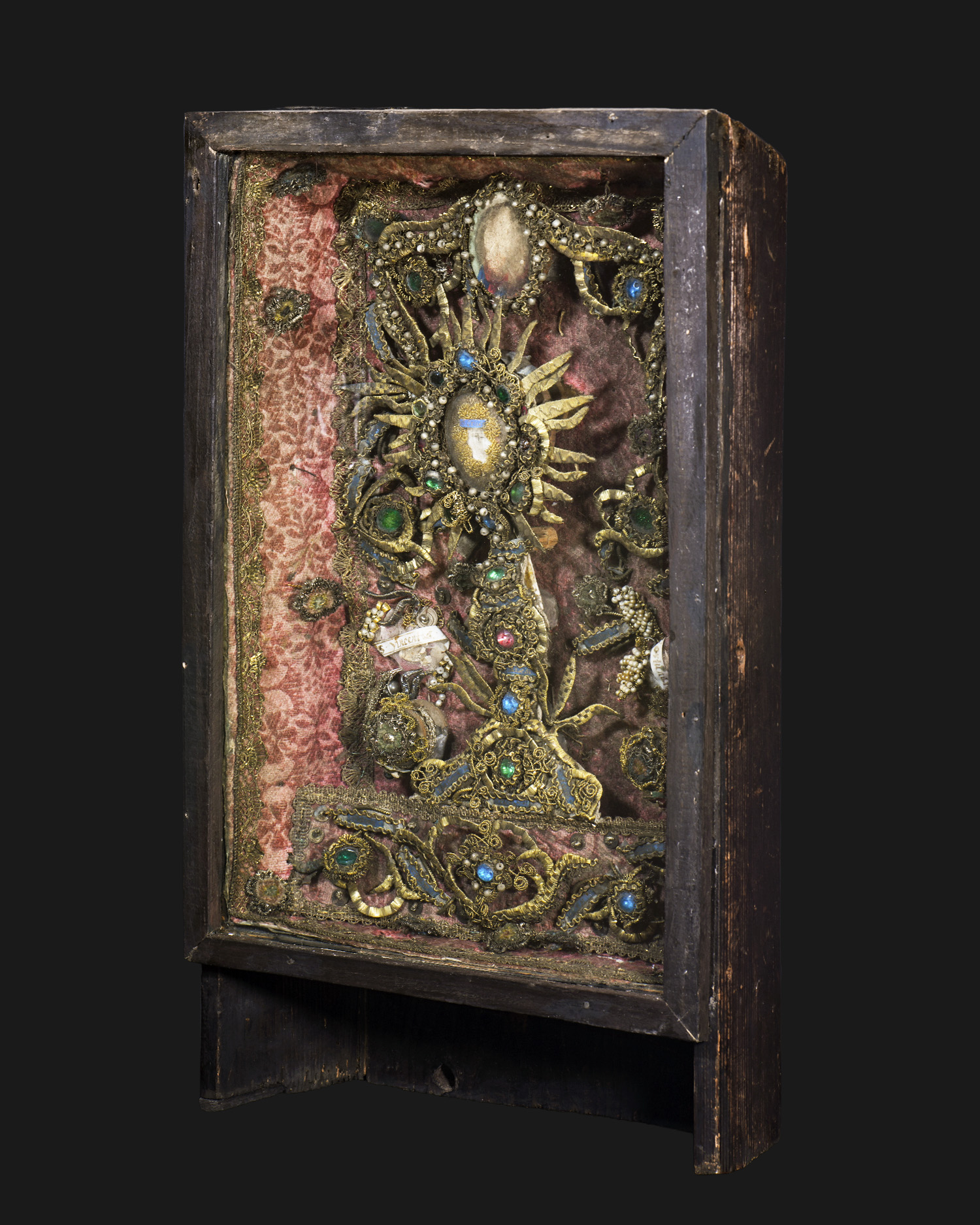

Cabinet Reliquary with Relic of the True Cross and 26 Saints, wood, textiles, Central Europe, 18th century
4000,00 zł
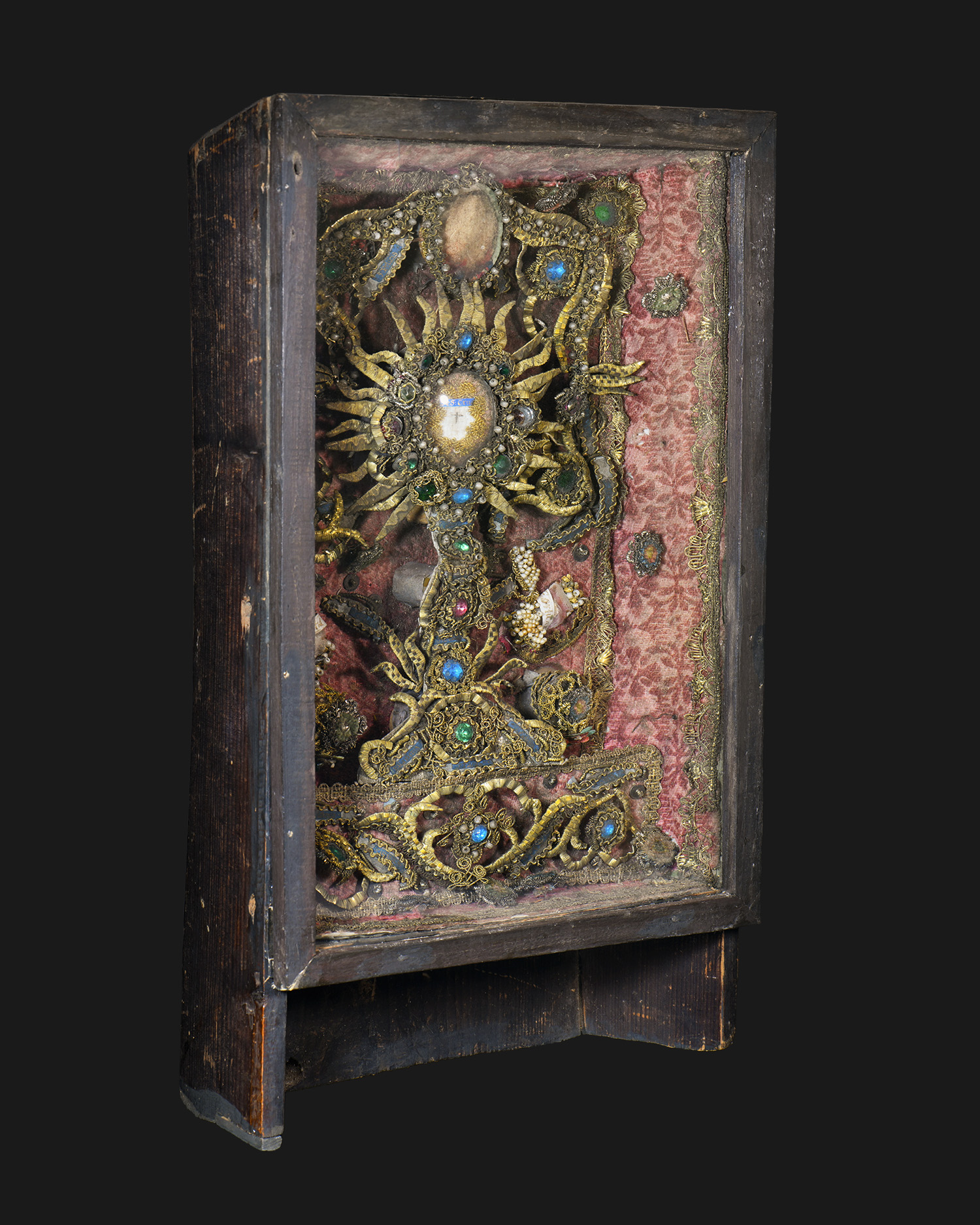
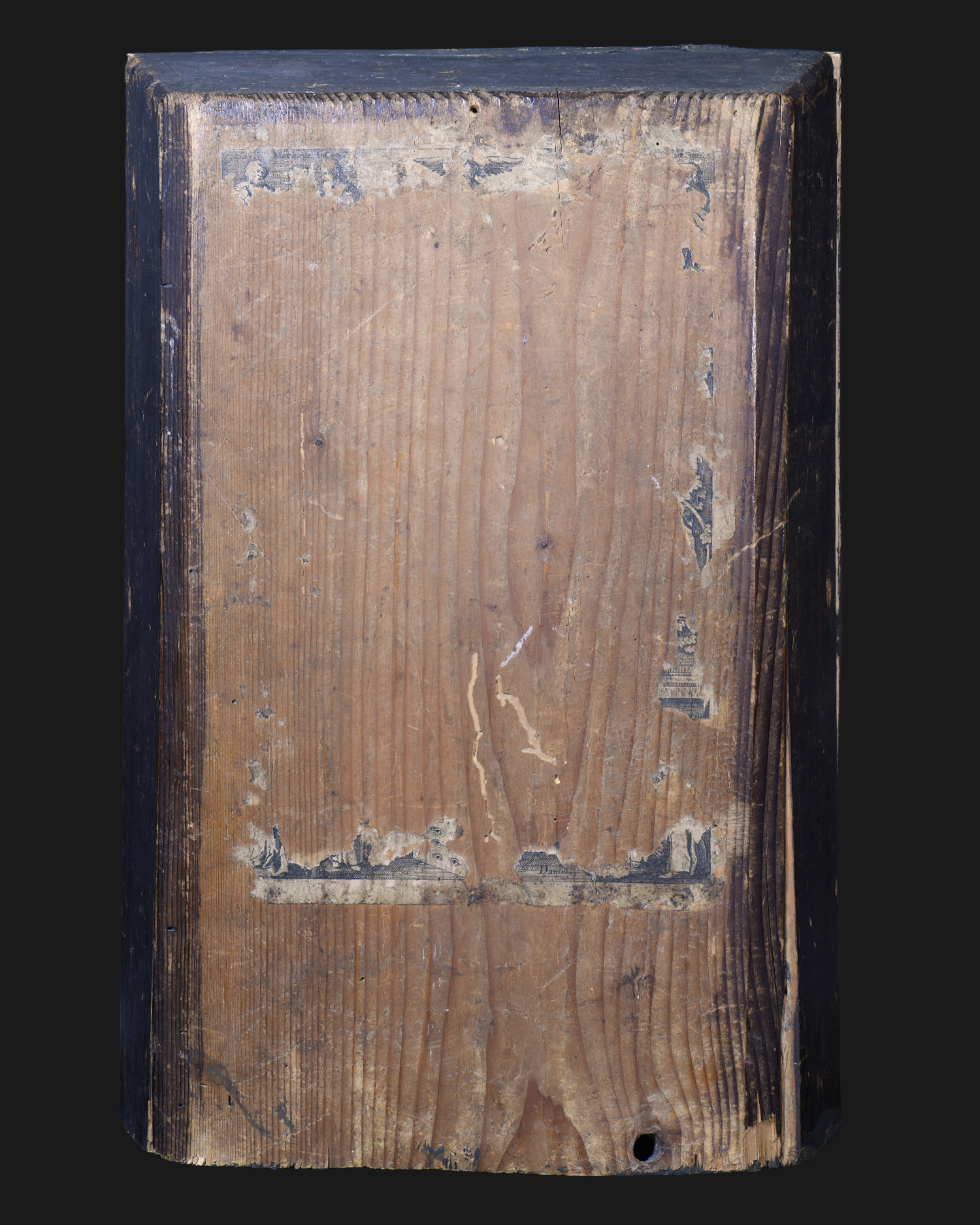
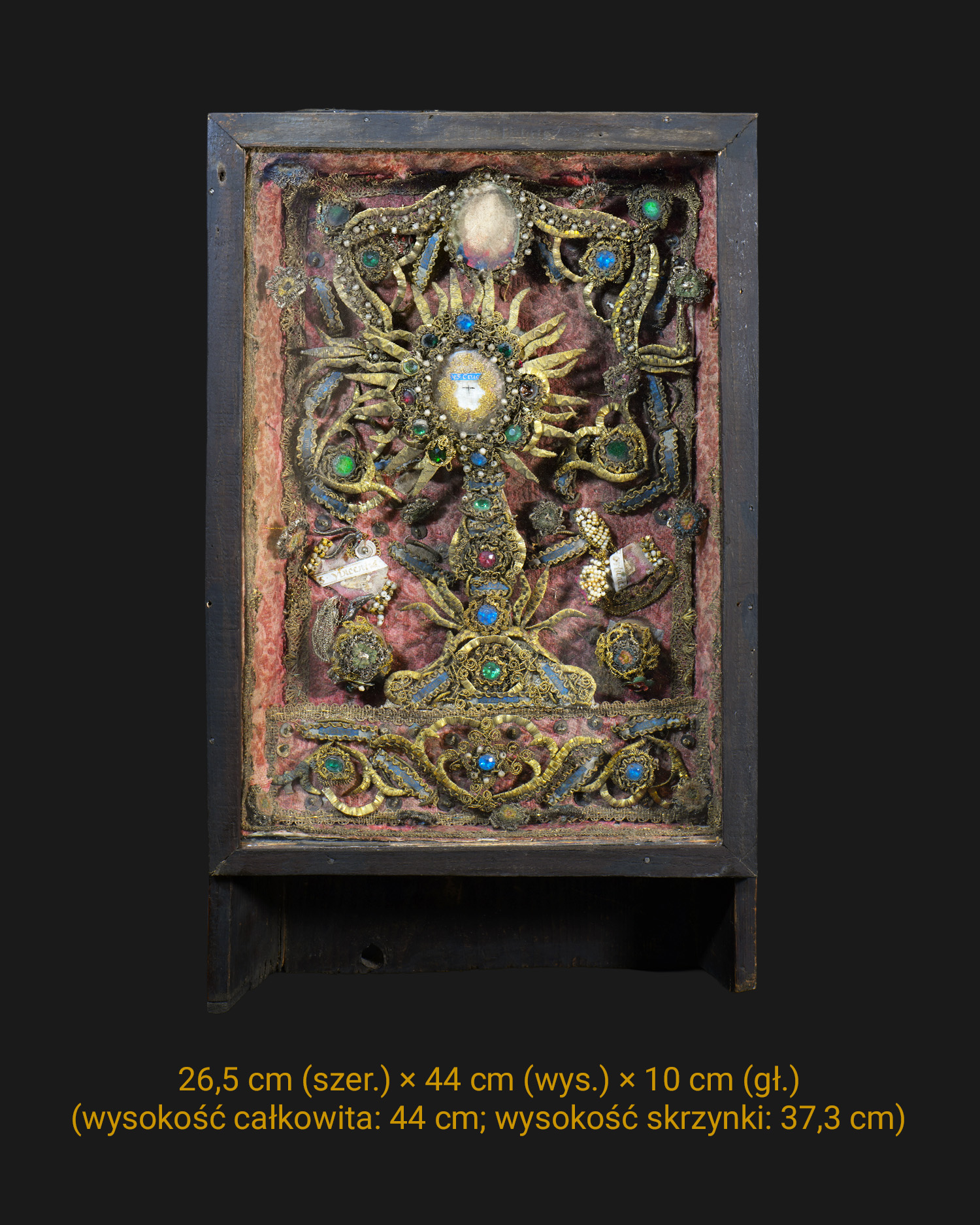
An 18th-century Baroque cabinet reliquary, a freestanding wooden display case of trapezoidal form, containing a total of 27 relics. The side walls and top are chamfered, widening toward the front. The interior is lined with burgundy velvet, trimmed with decorative borders of gold bullion thread.
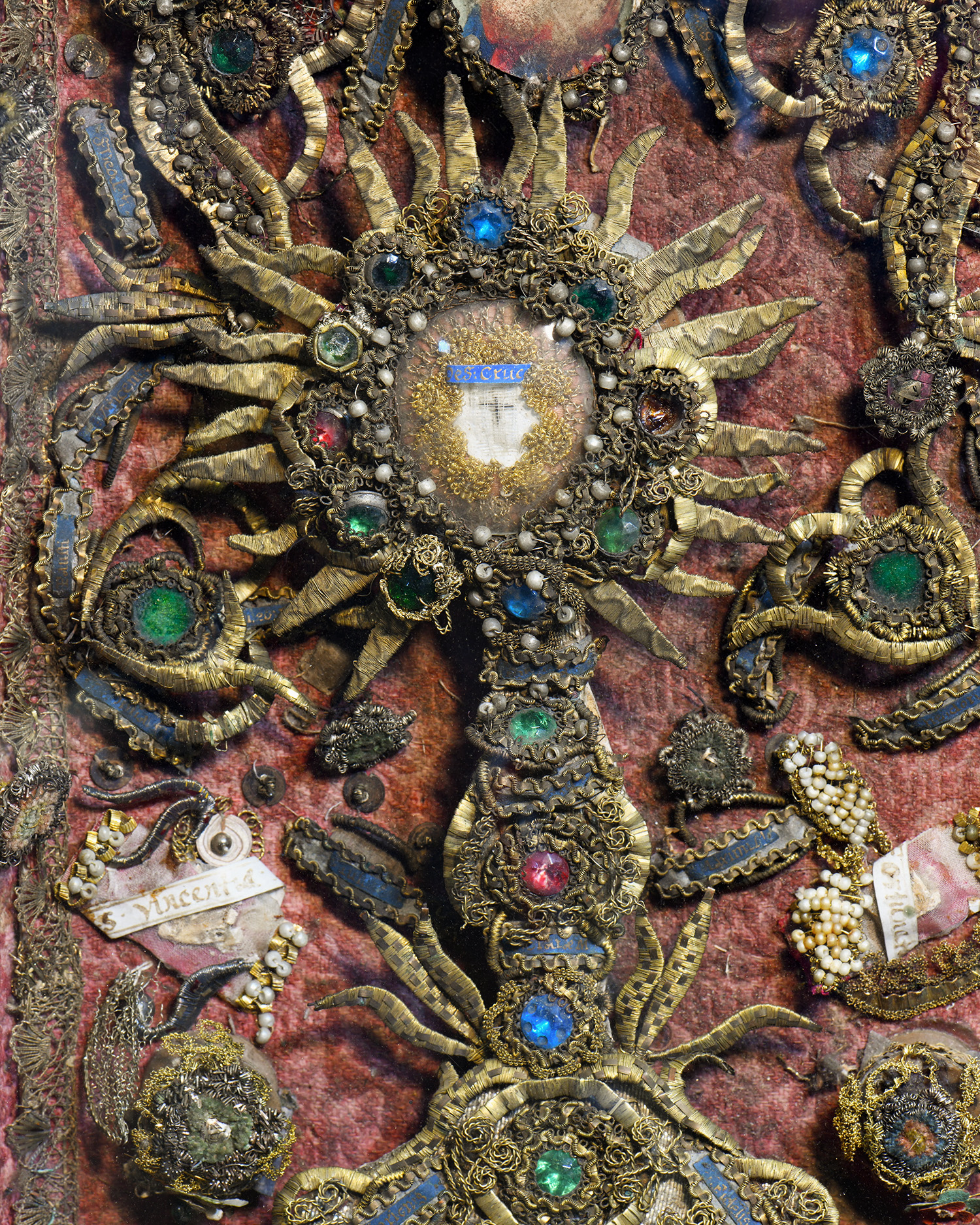
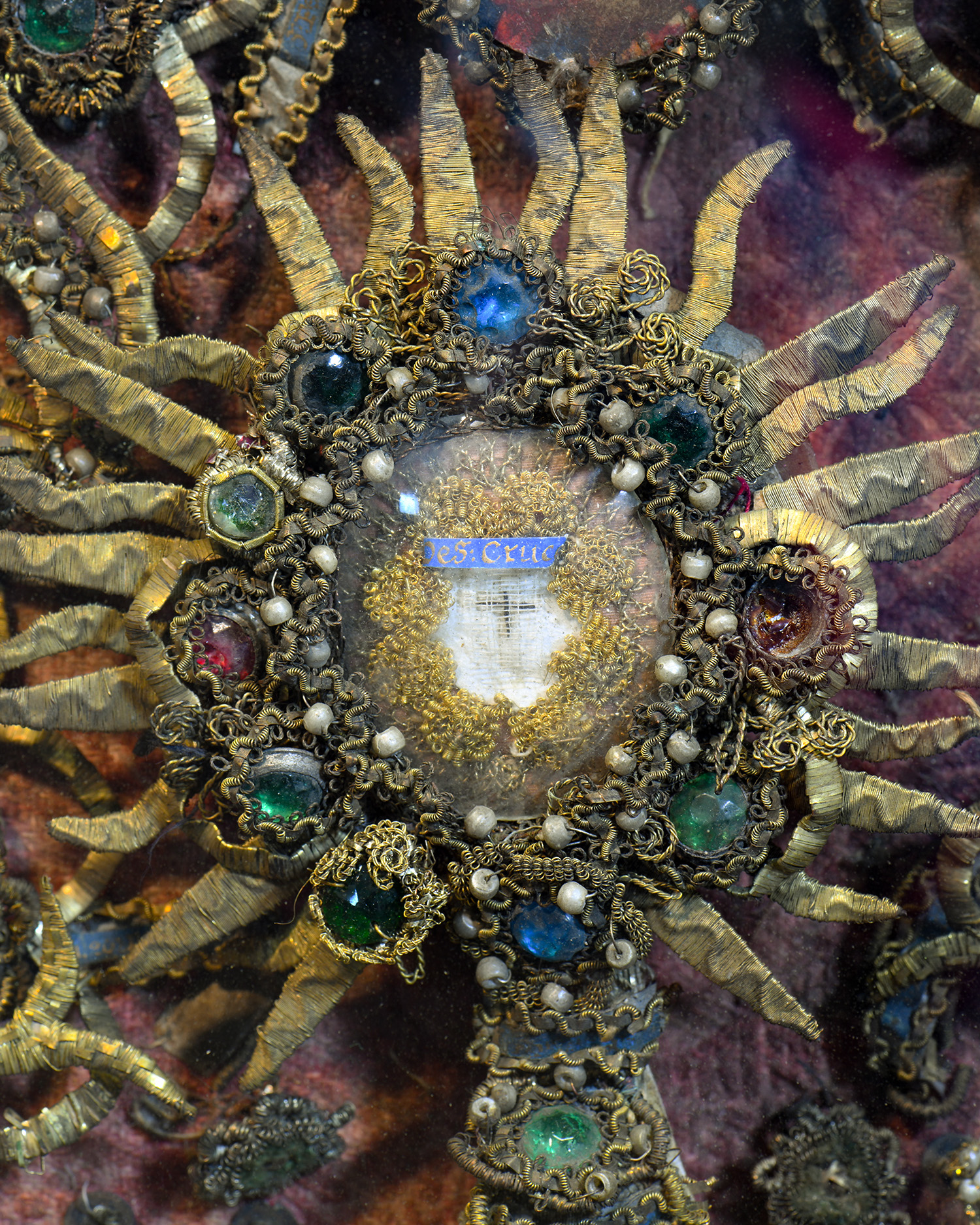
At the center, set slightly forward from the back, is a raised textile reliquary in the form of a monstrance, embroidered with gold thread and richly adorned with bullion, filigree, miniature beads, and multicolored glass imitating precious stones. On the base and shaft are placed six relics, identified by inscriptions painted in gold on dark blue banderoles.
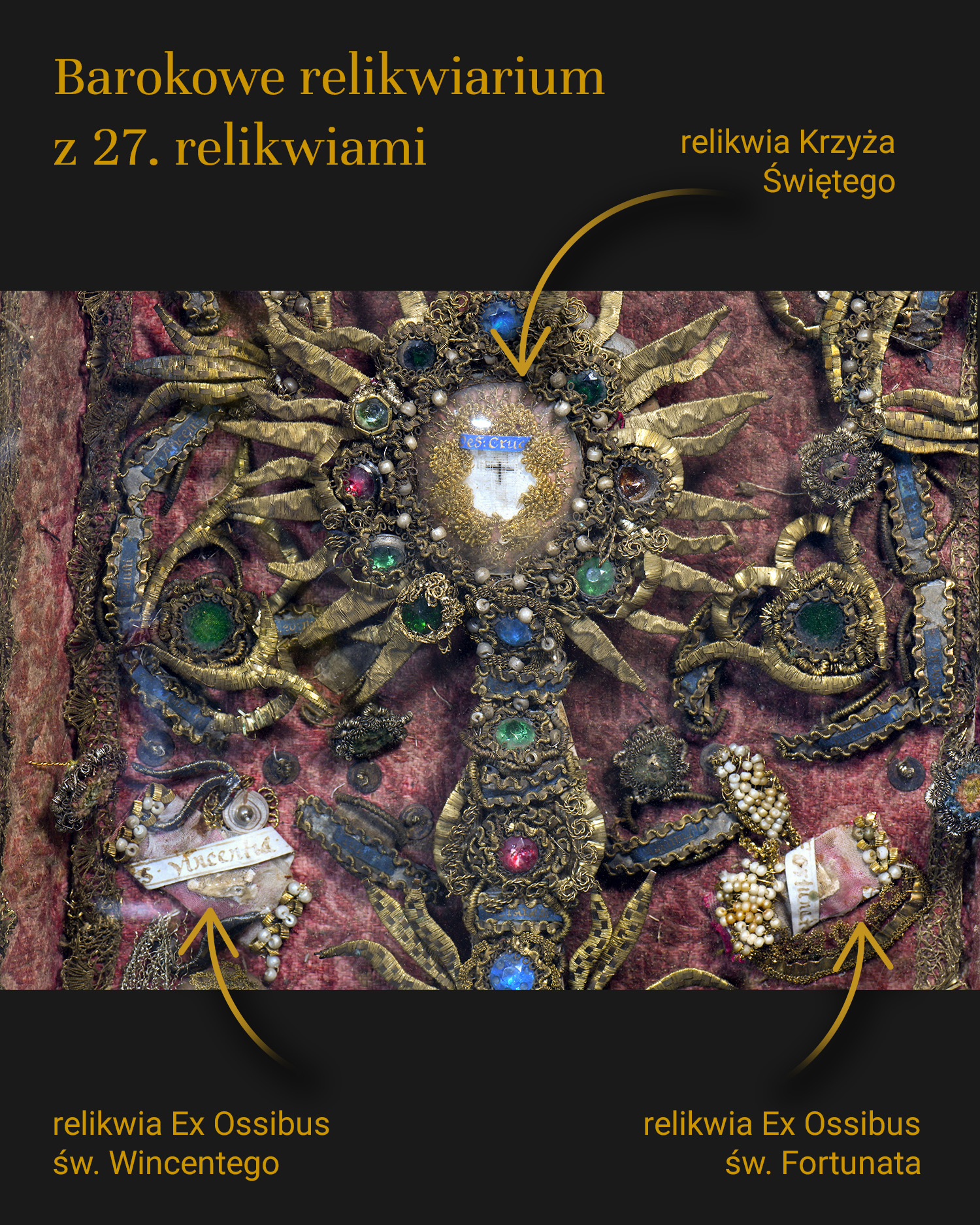
Within the central repository is a reliquary capsule with a convex glass cover, containing two fragments of the True Cross, surrounded by a radiant glory.
Above the “monstrance” is an oval image with an indistinct representation, encircled by 20 additional relics interspersed with decorative elements of bullion, beads, gold thread embroidery, and colored glass. At the level of the nodus are two larger relics (Ex Ossibus) of Saint Vincent and Saint Fortunatus, uniquely labeled on white banderoles.
A distinction should be made between a reliquary and a reliquary cabinet: a reliquary is a vessel that directly contains relics, whereas a cabinet reliquary serves as a structure housing and presenting them. This object is therefore not a typical example, as—besides the central textile reliquary in the form of a monstrance containing fragments of the Cross on which Jesus Christ died—it also incorporates an additional 26 relics of various saints placed directly within the composition, without individual containers.
Their preservation is ensured either by a fine mesh covering or solely by labeled banderoles. The relic of the True Cross is the only one enclosed within a glazed, and undoubtedly sealed, capsule.
The interior of the case, measuring 37.3 × 26.5 × 10 cm, is lined with burgundy velvet, trimmed with gold bullion thread.
1 in stock
| Dimensions | 10 × 26,5 × 44 cm |
|---|---|
| Type |
Relic |
| Form |
Trapezoidal glass display case |
| Materiał |
Byre ,Golden thread ,Velvet ,Wood |
| Kolorystyka |
Brown ,Gold ,Red |
| Czas powstania |
18th century |
| Era |
Baroque |
| Kraj pochodzenia |
Central Europe |
| Autor |
Unknown |
| State of preservation |
Visible signs of age, minor loss of velvet lining, non-original glass, otherwise very good. |
Related products
Christ Salvator Mundi, polychrome wood, Poland, 19th century.
Frame reliquary in ostensory type, silver repoussed on wood core, Naples, 1778
Richly decorated front covered with repoussed silver sheet. Decoration in the type of mature Baroque with floral (acanthus leaves, volutes) and figurative (plastic heads of putti / angels) motifs. In the lower part next to the ovolo there is a clear municipal punca of Naples: NAP 78 (marking the Kingdom of Naples with the abbreviated date 1778). Silver plate applied to a carved wooden core. The back polychromed in light color, with the original bracket preserved. Wooden base, stepped, with traces of original gilding. Authentic object, preserved in good condition. The silver is covered with a natural dark age patina. The original custody (glazing) and the relic in the central oval are missing. A very interesting and decorative item, not only for those interested in "Neapolitans". Naples in 1778 was a bustling metropolis under the Bourbons, and the goldsmiths' workshops there were famous for their finesse and panache, as can be seen in the dynamic carvings of the angels on the offered reliquary.
German-Italian Master, Image from the Cross, oil on board, Western Europe, 16th century.
Icon of Our Lady of the Dawn Gate, brass, enamel on metal, Poland, 19th century.
Madonna and Child, polychrome wood, gilded, Central Europe, 18th/19th century
Monstrance reliquary in the form of a crucifix with relics of the Holy Cross, gilt bronze, silver-plated, Central Europe, 18th century.
A rococo double-sided reliquary in the shape of a cross with decorative three-leafed arm ends, decorated with silver rosettes and ruby-colored glass. The glazed box (ostensorium) contains a metal, glazed capsule. At its very center, against a bright background, are two splinters arranged in a cross. The relic is surrounded by an elaborate decoration made of silver or gilded metal threads twisted into tiny springs and weaves (known as biont). They form the form of a radial nimbus around a central point. The wreath around the relic is decorated with eight pearls (probably river pearls). The whole was composed on a silk or parchment pad.
Around the capsule a rich, openwork gloria with a dynamic, asymmetrical rococo composition. The decoration is based on rocaille motifs and fancifully twisted volutes of the C and S type, supplemented with artistic floral details (cartilaginous and bivalve ornament). Surface finely chiseled, with preserved gilding in the recesses of the ornament.
The back of the reliquary has a passion character. The figure of the Crucified Christ (Corpus Christi) is placed here. A decorative rosette with green glass is preserved on the right arm of the cross. Mounting holes and rivets can be seen on the other arms.
Baluster shaft, in a simple geometric form. Oval foot, wide and profiled, decorated with repoussed motifs of leaves and flowers, silvered.
Monstrance, brass with silver-plated elements, France, ca. 1860-1890
Reliquary with relic of the Holy Cross and four saints, gilded bronze, Central Europe, 18th century.
Baroque reliquary in the form of a monstrance, made of gilded bronze. Oval foot, multi-stepped, decorated with repoussed and engraved floral ornament. Smooth shaft with profiled nodus. Reservaculum surrounded by a gloria The gloria of the reliquary was formed of frayed, numerous rays, over which is superimposed a contrasting decorative wreath covered with rocaille and floral motifs. In the repository is placed an oval capsule made of silver sheet, glazed from the front. Glass at the edge decorated with octagonal faceting. On the back there is a wax seal on strings. The seal bears a coat of arms: in an ornamental cartouche a lion to the left, and below - separated by a beam - an opposite griffin to the left. The whole is crowned with a cardinal's hat (Galero): a hat with a wide brim and dangling strings with brads (fiocchi), which is a sign of cardinal dignity. Inside the capsule are 5 relics, described in ink on bandoliers - read more in the extended content below.