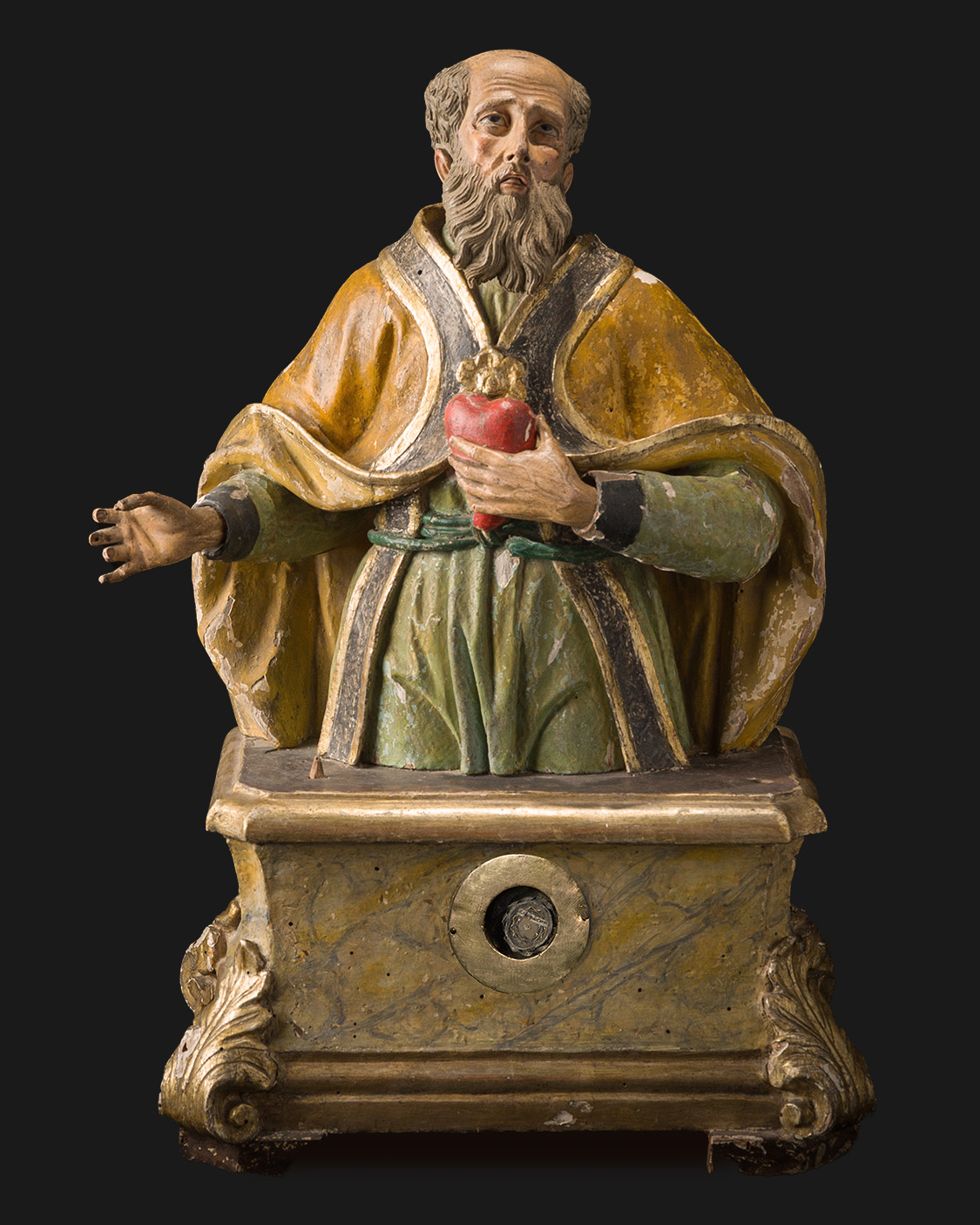
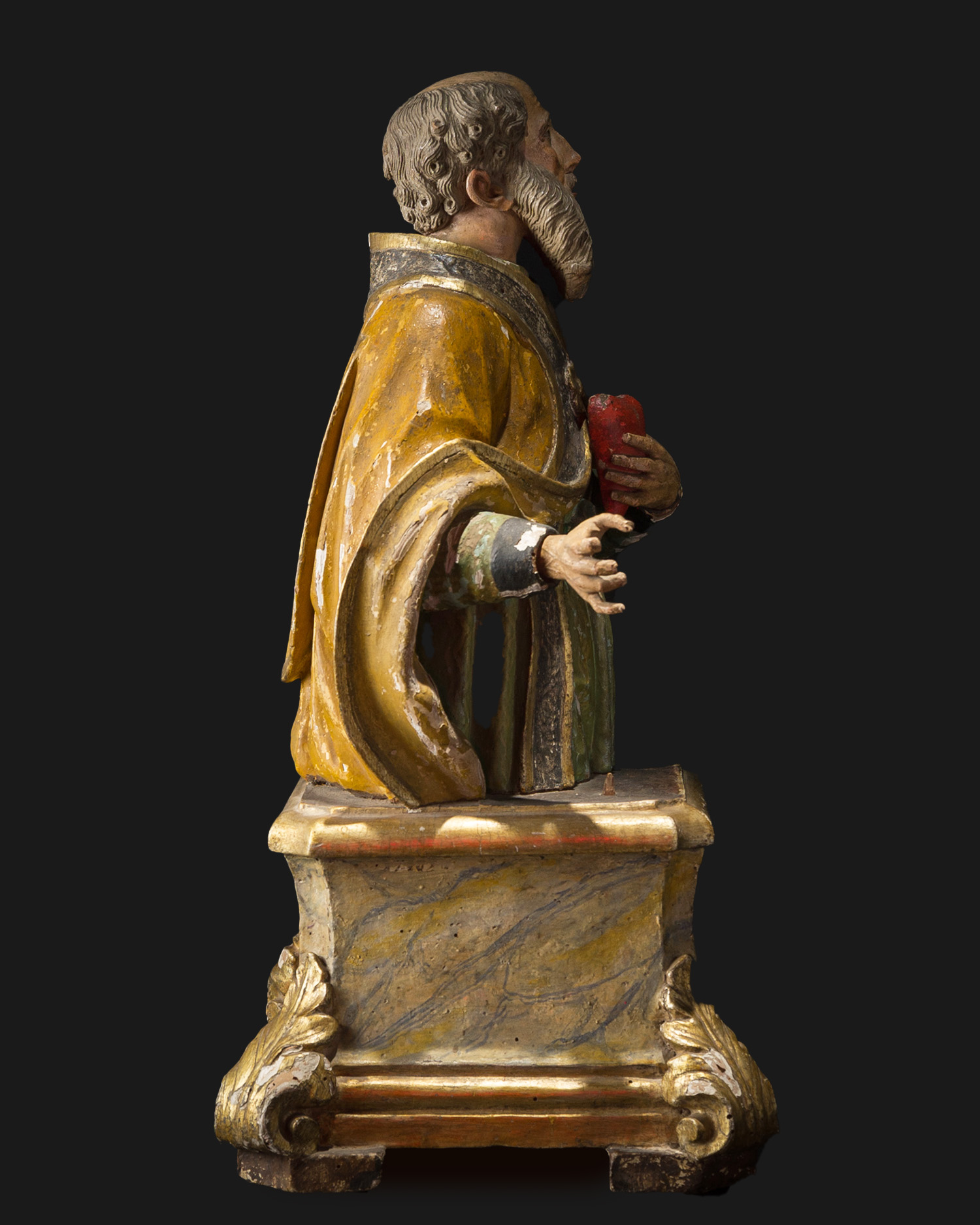
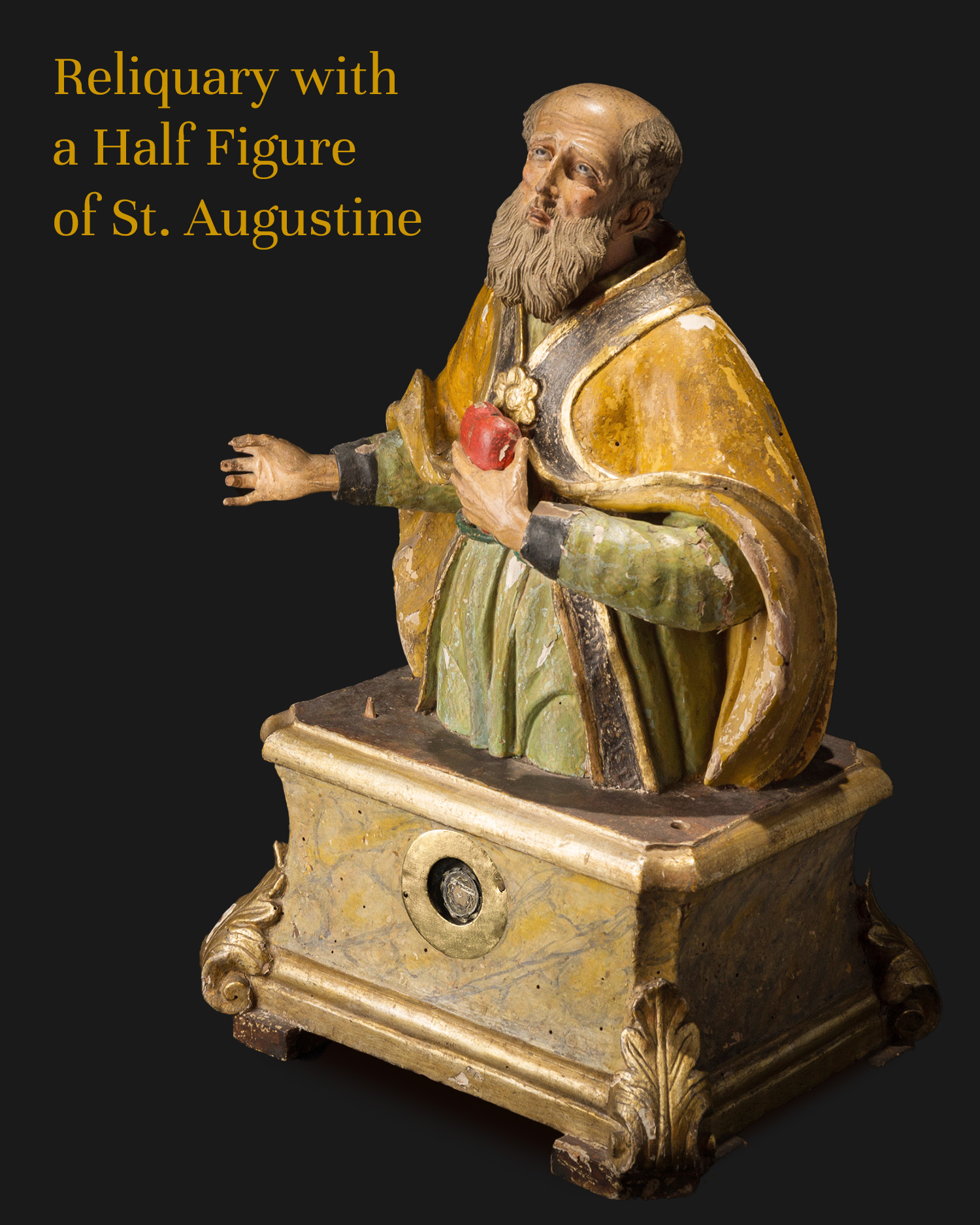
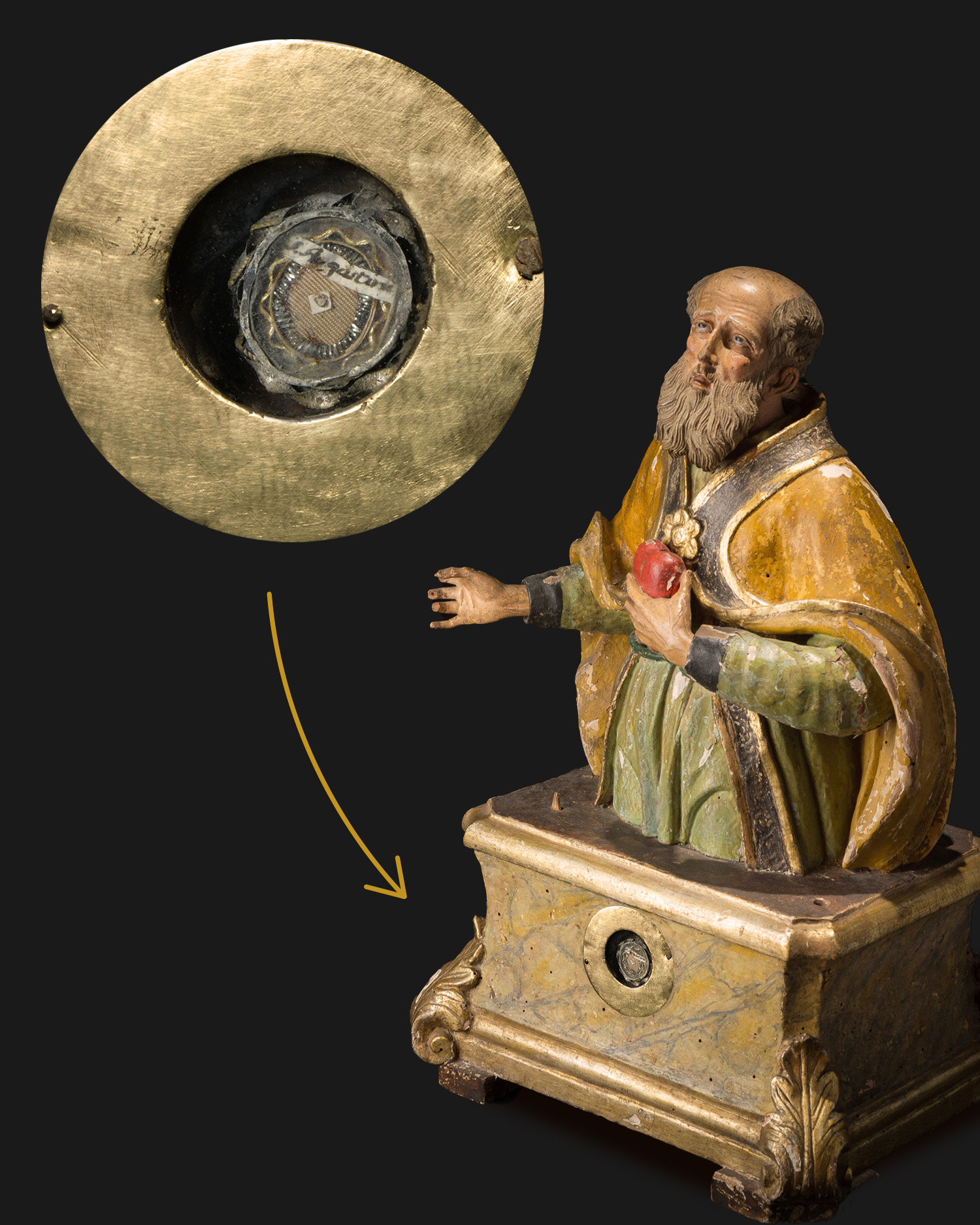
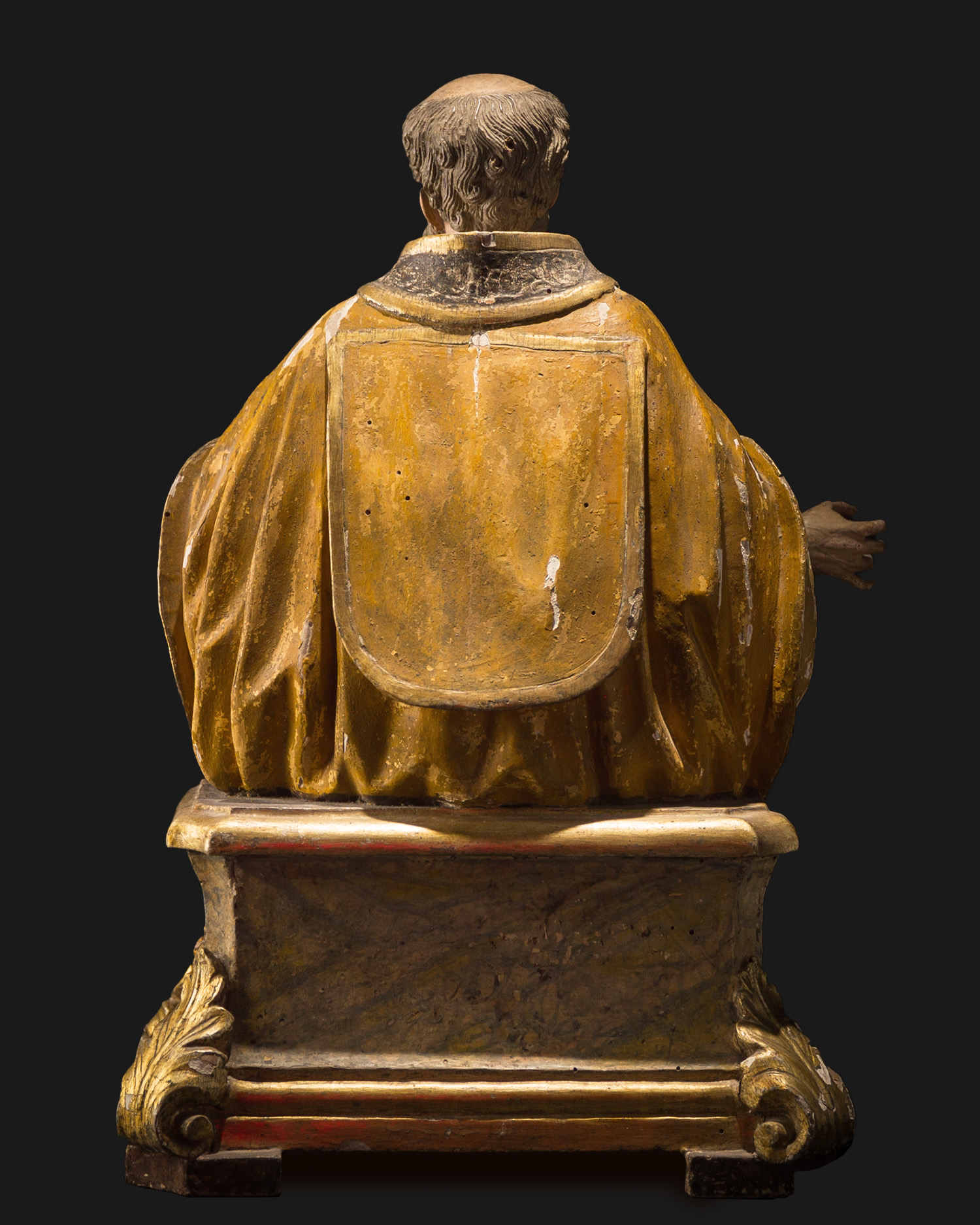
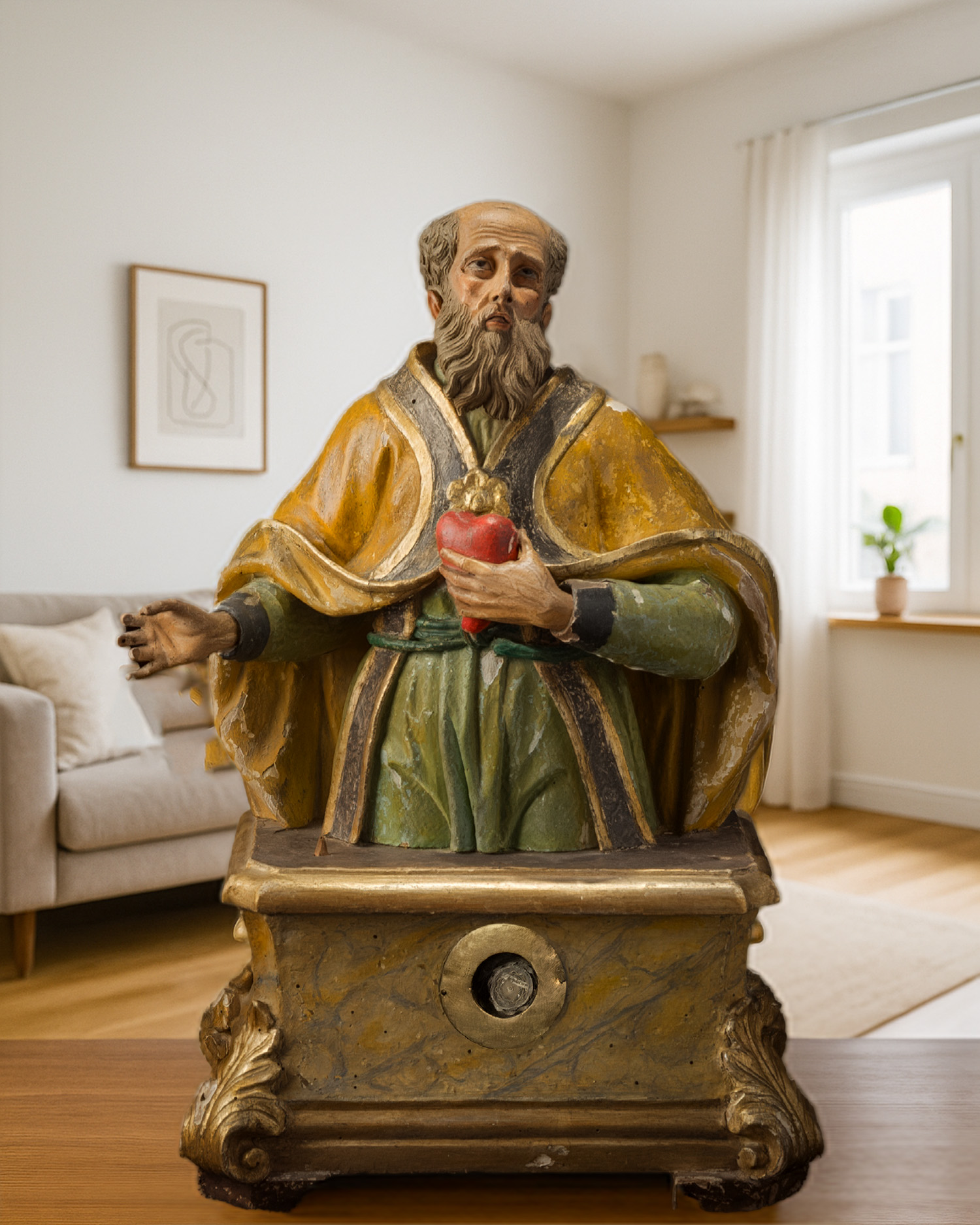
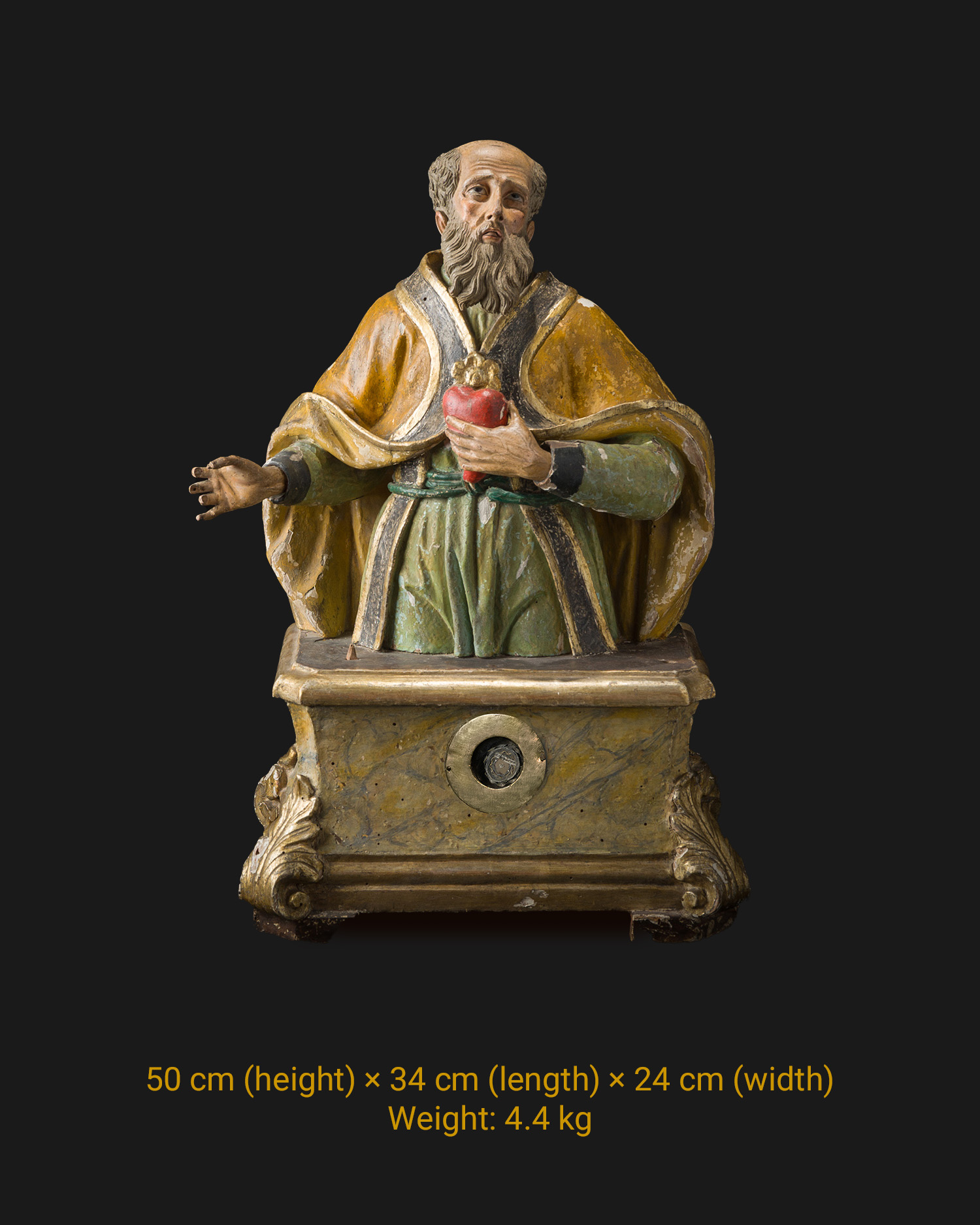
St. Augustine reliquary with Ex Ossibus relic, polychrome wood, gilded, Italy, 18th century.
4100,00 zł
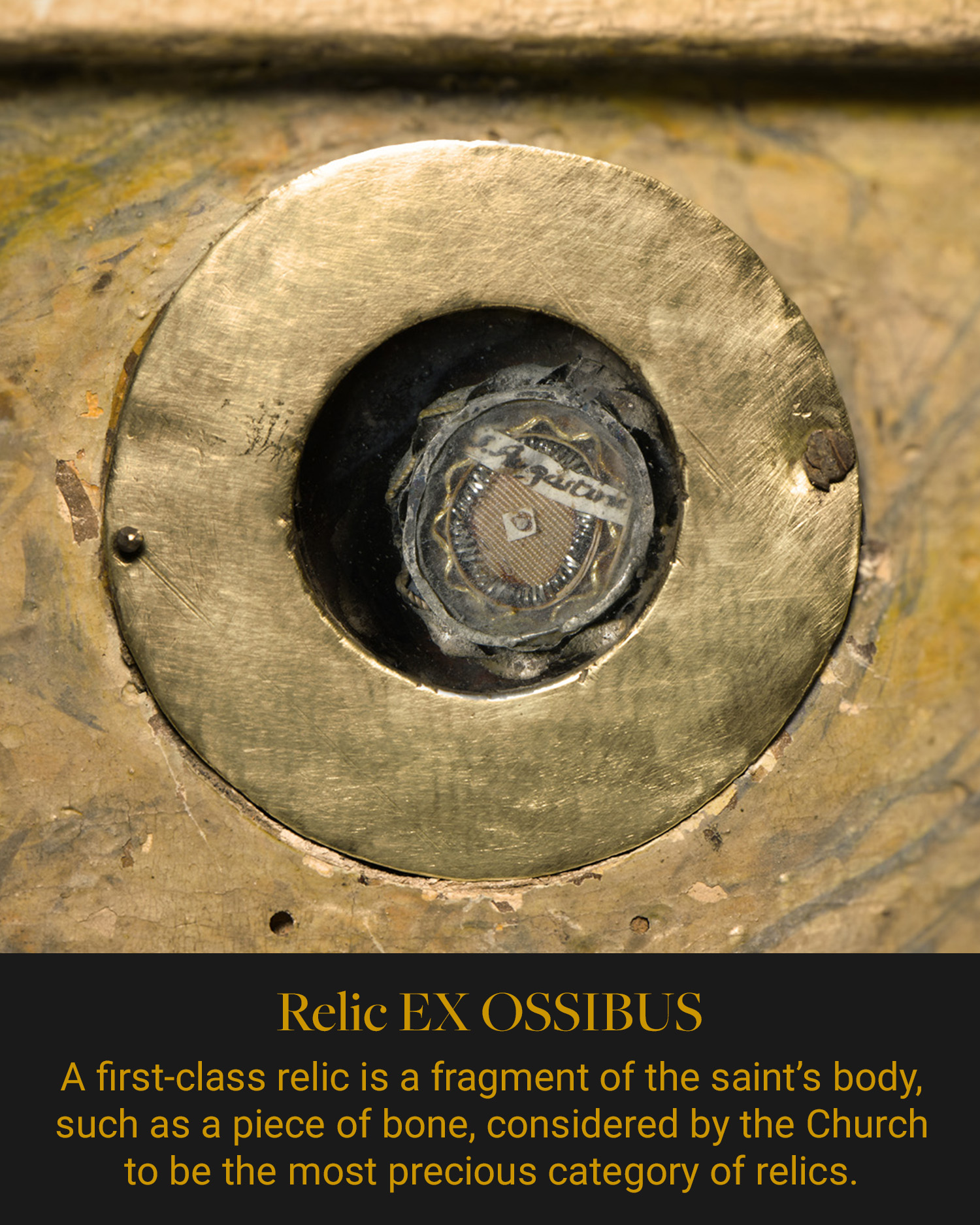
An expressive figural sculpture depicting a half-figure of St. Augustine in episcopal vestments, with a heart in his hand. The sculpture is the finial of a console in which was placed a relic of the first class (Ex Ossibus), described “S. Augustini”, protected by an intact church seal. The work of polychrome and gilded wood, made in the 18th century, in an Italian workshop, representing a good artistic level.
Sprzedane
Relics of St. Augustine
St. Augustine's first-class relic (Ex Ossibus) is a a relic of the saint's body, typically a bone fragment, secured with an intact ecclesiastical seal, inscribed “S. Augustini” and placed in a metal capsule within the console beneath the figure.
Historical context
Baroque religious sculpture typical of Italian woodcarving. Reliquaries with bone from the saint, with the original Church seal served a sacred and educational function, attracting pilgrims, as an object of worship and adoration, used in Catholic religious practice.
Artistic qualities
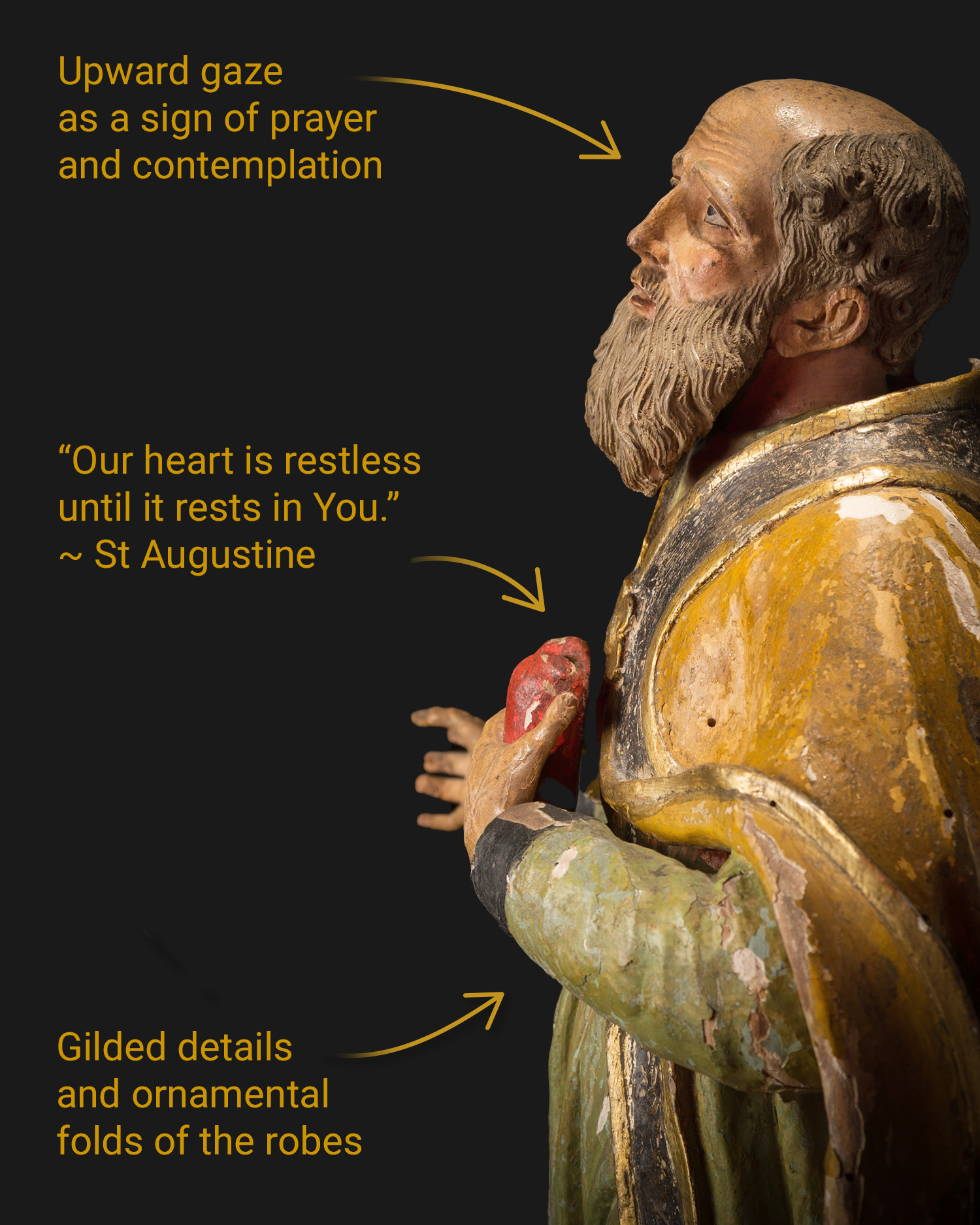
Baroque sacred art showing a saint in ecstasy with an emotional expression on his face and heavily undulating robes. Glass eyes and a heart in the hand (a symbol of spiritual devotion) enhance the emotional message of the figure. The reliquary is distinguished by its realistic modeling and high level of workmanship characteristic of Roman and Lombard centers.
Collector's value
A collector's or display object, but also a religious object. It can be displayed in private chapels, sacred spaces, museums or galleries of religious art. Old reliquaries, especially figural ones, with their dedicated relics preserved, are a rarity on the antiquarian market.
St. Augustine - the Church Father who thought with his heart
St. Augustine of Hippo (354–430) is one of the most important figures in Church history – a philosopher, theologian, bishop, and author of works that shaped foundations of christian doctrine and spirituality. His writings, such as "Confessions" and "On the State of God," combined deep introspection with intellectual reflection on the human destiny, sin and grace.
As Father of the Church and Doctor of the Western Church, Augustine had an enormous influence on medieval theology, philosophy and liturgy. In iconography, he was often depicted as an old man in episcopal robes, with a book or a heart - symbols of knowledge and spiritual fervor.
In the Baroque era, his figure returned as an emblem of learned holiness and spiritual struggle, perfectly aligning with the Counter-Reformation's need for a deeper experience of faith. Sculptures such as this combined intellectual and emotional messages, making Augustine not only a saint, but a spiritual guide of entire generations.
Are you looking for Baroque sacred sculpture or antique religious art?
The offer of the SYBARIS Early Art Gallery includes carefully selected objects from the field of European sacred woodcarvingincluding statues of saints, works of religious art from the 18th century and other examples of baroque wooden sculpture.
We invite you to purchase this unique sculpture of St. Augustine with the EX OSSIBUS relic, or browse our collection of religious artifacts available in our permanent offer.
| Weight | 4,4 kg |
|---|---|
| Dimensions | 34 × 24 × 50 cm |
| Form |
Half figure of St. Augustine with a red heart in his hand |
| Technika |
Baroque workshop woodcarving ,Gildings ,Layered polychromy |
| Kolorystyka |
Gold ,Green ,Red |
| Czas powstania |
18th century (1701-1800) |
| Era |
Baroque |
| Kraj pochodzenia |
Italy |
| Autor |
Typical of the Italian Baroque period ,Unknown |
| Stan zachowania |
Light losses in polychrome ,Potholes from inactive woodchucks ,Secured relic ,Several fingers of the right hand are missing ,Very good |
Related products
Brahma, marble, India, 19th (?) century.
Cabinet Reliquary with Relic of the True Cross and 26 Saints, wood, textiles, Central Europe, 18th century
An 18th-century Baroque cabinet reliquary, a freestanding wooden display case of trapezoidal form, containing a total of 27 relics. The side walls and top are chamfered, widening toward the front. The interior is lined with burgundy velvet, trimmed with decorative borders of gold bullion thread.
At the center, set slightly forward from the back, is a raised textile reliquary in the form of a monstrance, embroidered with gold thread and richly adorned with bullion, filigree, miniature beads, and multicolored glass imitating precious stones. On the base and shaft are placed six relics, identified by inscriptions painted in gold on dark blue banderoles.
Within the central repository is a reliquary capsule with a convex glass cover, containing two fragments of the True Cross, surrounded by a radiant glory.
Above the “monstrance” is an oval image with an indistinct representation, encircled by 20 additional relics interspersed with decorative elements of bullion, beads, gold thread embroidery, and colored glass. At the level of the nodus are two larger relics (Ex Ossibus) of Saint Vincent and Saint Fortunatus, uniquely labeled on white banderoles.
A distinction should be made between a reliquary and a reliquary cabinet: a reliquary is a vessel that directly contains relics, whereas a cabinet reliquary serves as a structure housing and presenting them. This object is therefore not a typical example, as—besides the central textile reliquary in the form of a monstrance containing fragments of the Cross on which Jesus Christ died—it also incorporates an additional 26 relics of various saints placed directly within the composition, without individual containers.
Their preservation is ensured either by a fine mesh covering or solely by labeled banderoles. The relic of the True Cross is the only one enclosed within a glazed, and undoubtedly sealed, capsule.
The interior of the case, measuring 37.3 × 26.5 × 10 cm, is lined with burgundy velvet, trimmed with gold bullion thread.
Capital with Figural Decoration, Sandstone, France, 12th-14th Century
Chapel with Our Lady of Czestochowa and Eagle, Poland, 19th century.
Head of an Angel (Putta), gilded linden wood, Poland, 1st half of the 18th century.
Sculpture of a god’s head (Zeus or Hercules), marble, Mediterranean basin, Hellenistic period
Singa Barong, polychrome wood, Indonesia, 19th century.
Skull (Memento Mori), marble, Italy, 18th-19th century
Elegant, decorative skull made of natural gray marble, maintained in a realistic style: the eye sockets, cranial seam lines and zygomatic arches are clearly formed. The faded dentition alludes to the concept of Vanitas.
The characteristic feature of the stone used for the sculpture is irregular veining in shades of beige, cream and gray, which gives it a unique character. The surface is polished, with natural discolorations and small marks due to the properties of the material, which emphasizes the authenticity and nobility of the marble. The skull is provided with a lead pin underneath, set on a minimalist, contemporary base in black, which exposes the sculpture and gives it a museum-like character.
The object is ideal for collectors of curiosities, lovers of the art of Vanitas - Memento Mori, cabinets of curiosities and as an expressive element of interior design in classical, industrial or eclectic style. An object with a strong aesthetic and symbolic expression, which is difficult to pass by indifferently.
