


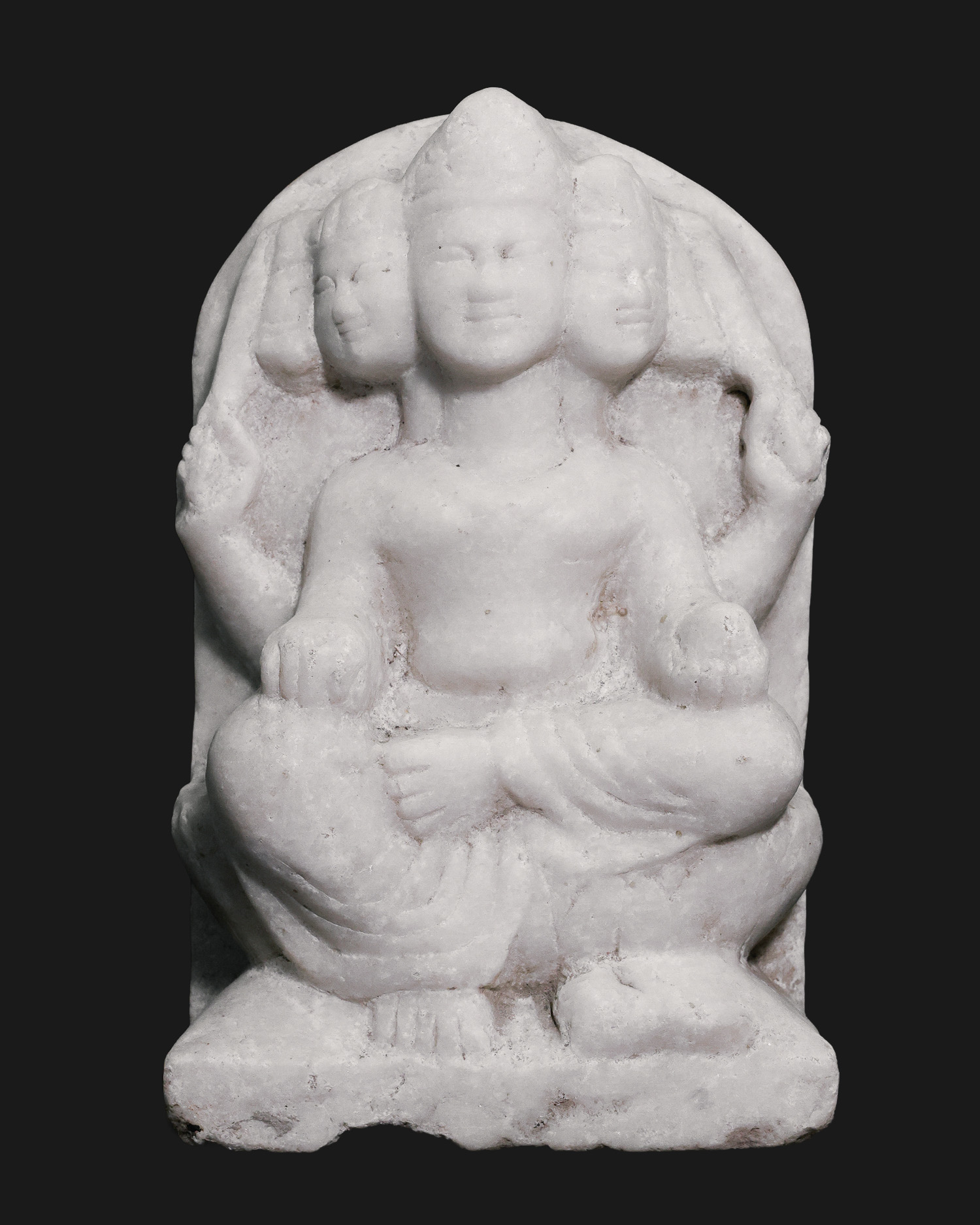
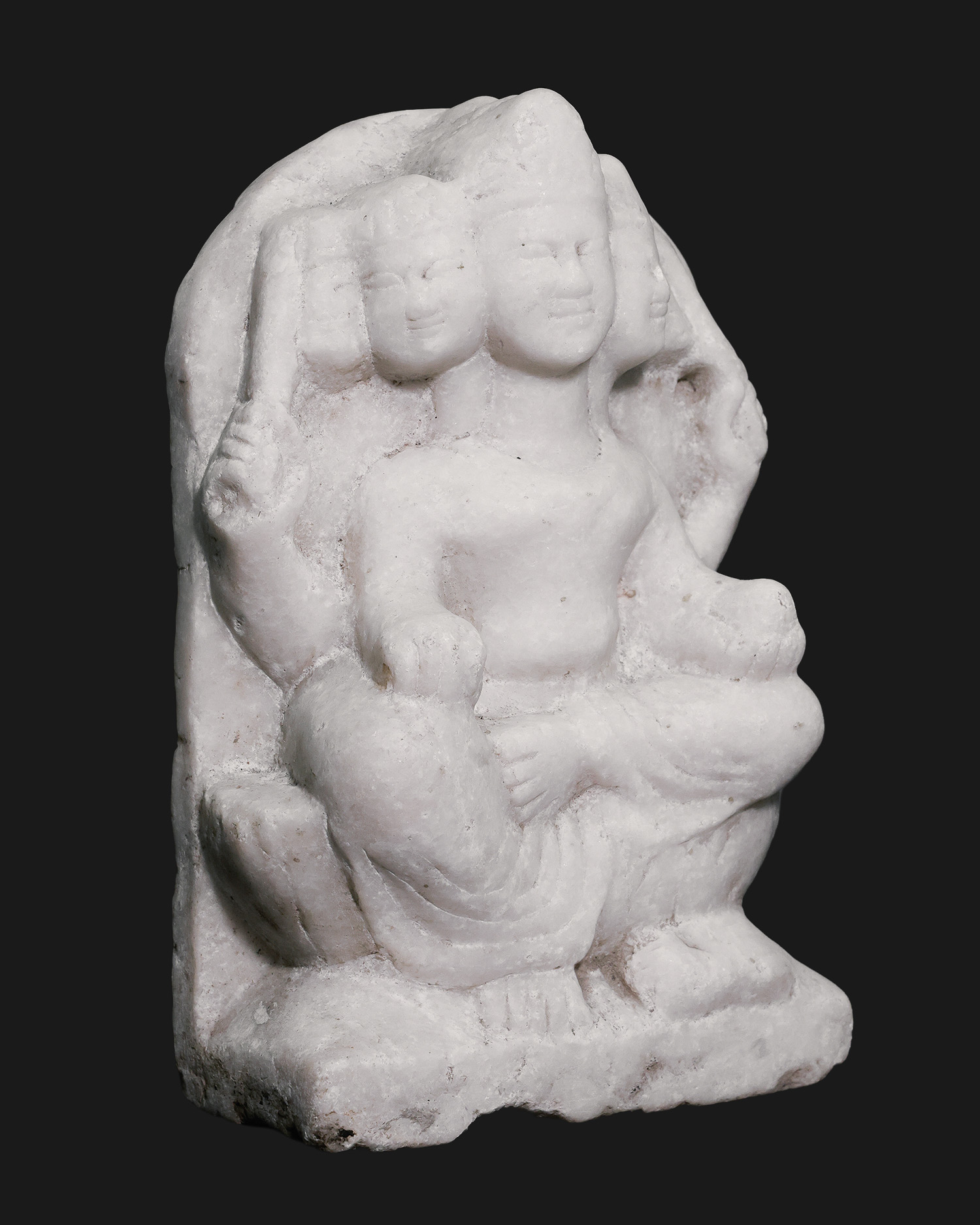
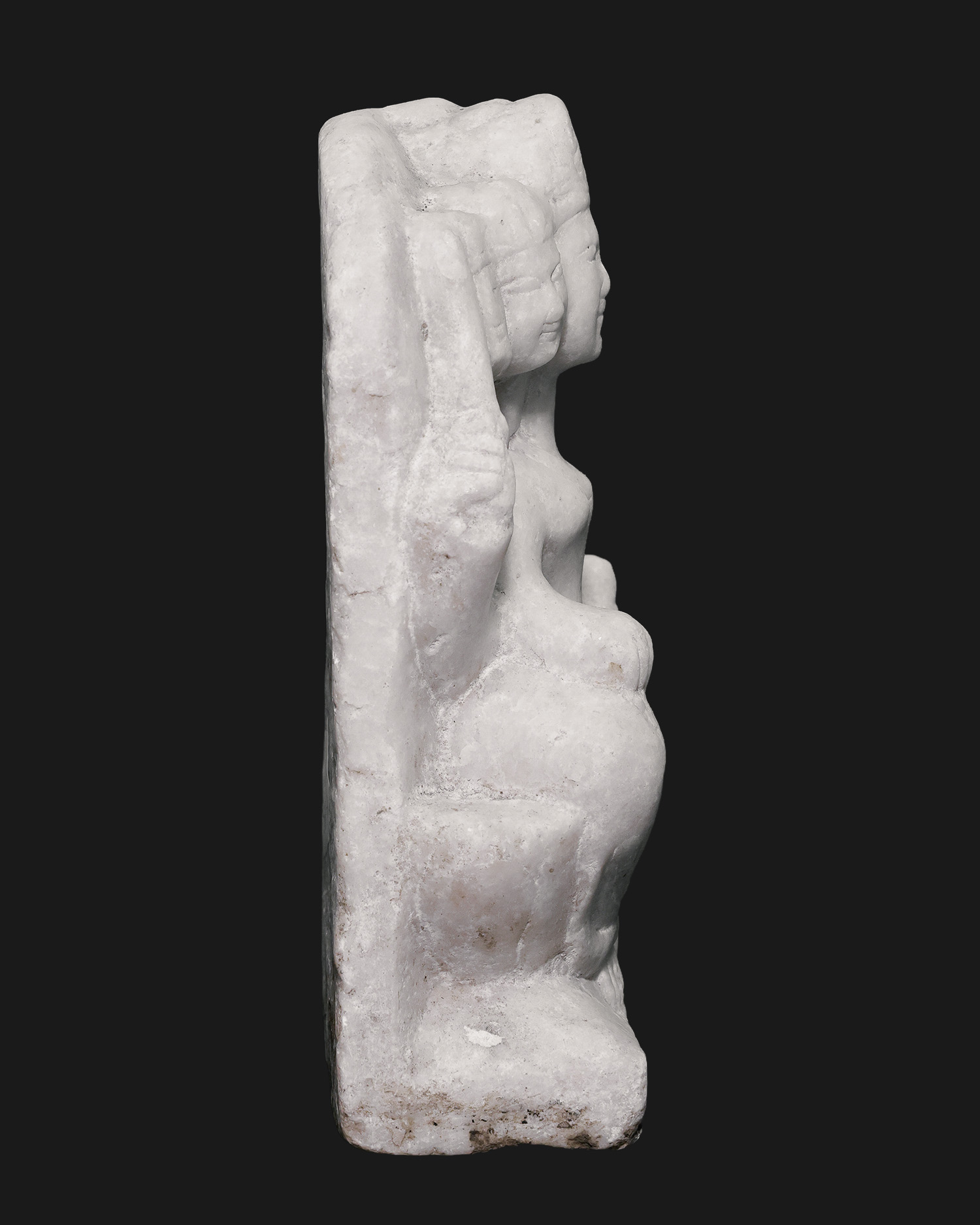
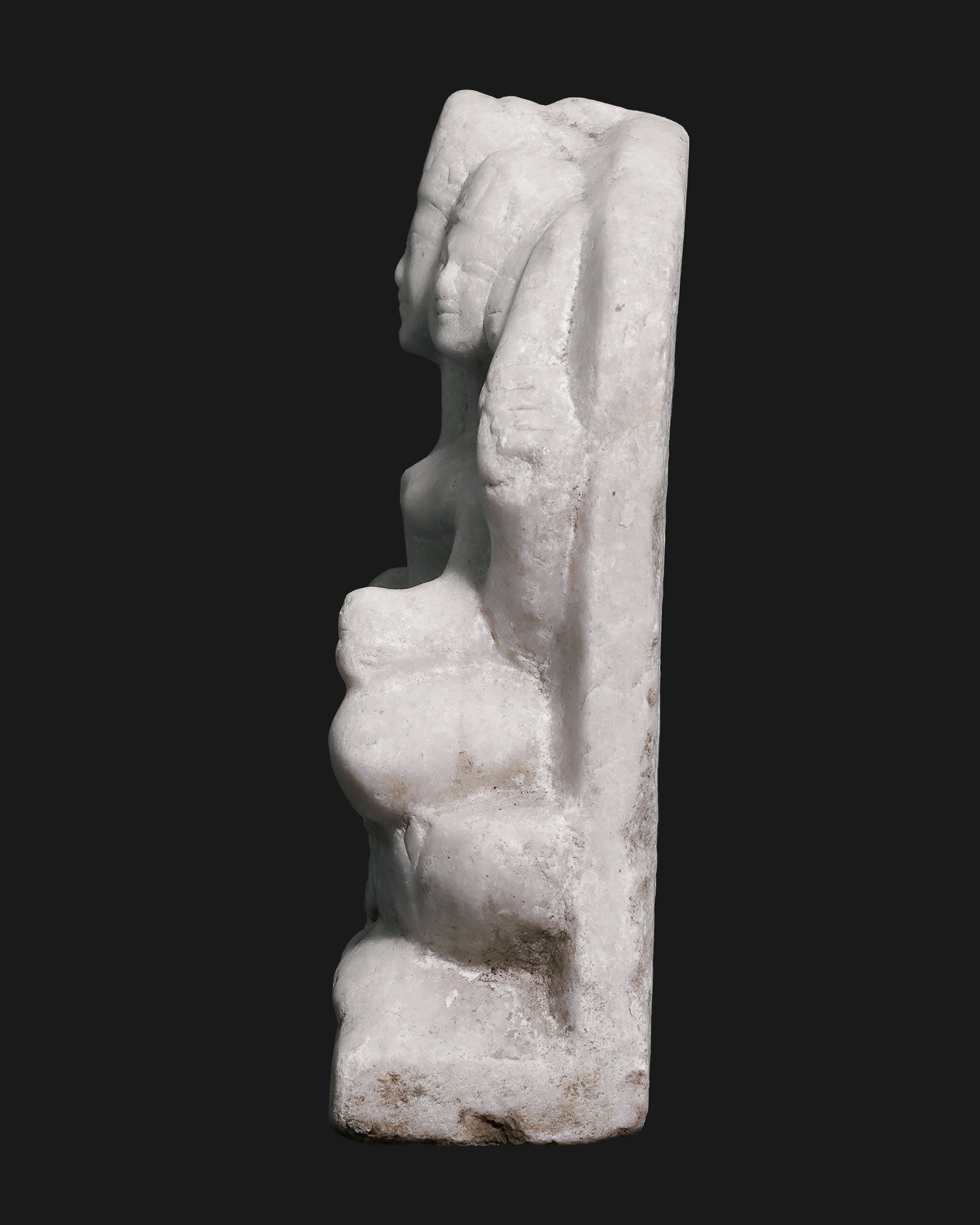
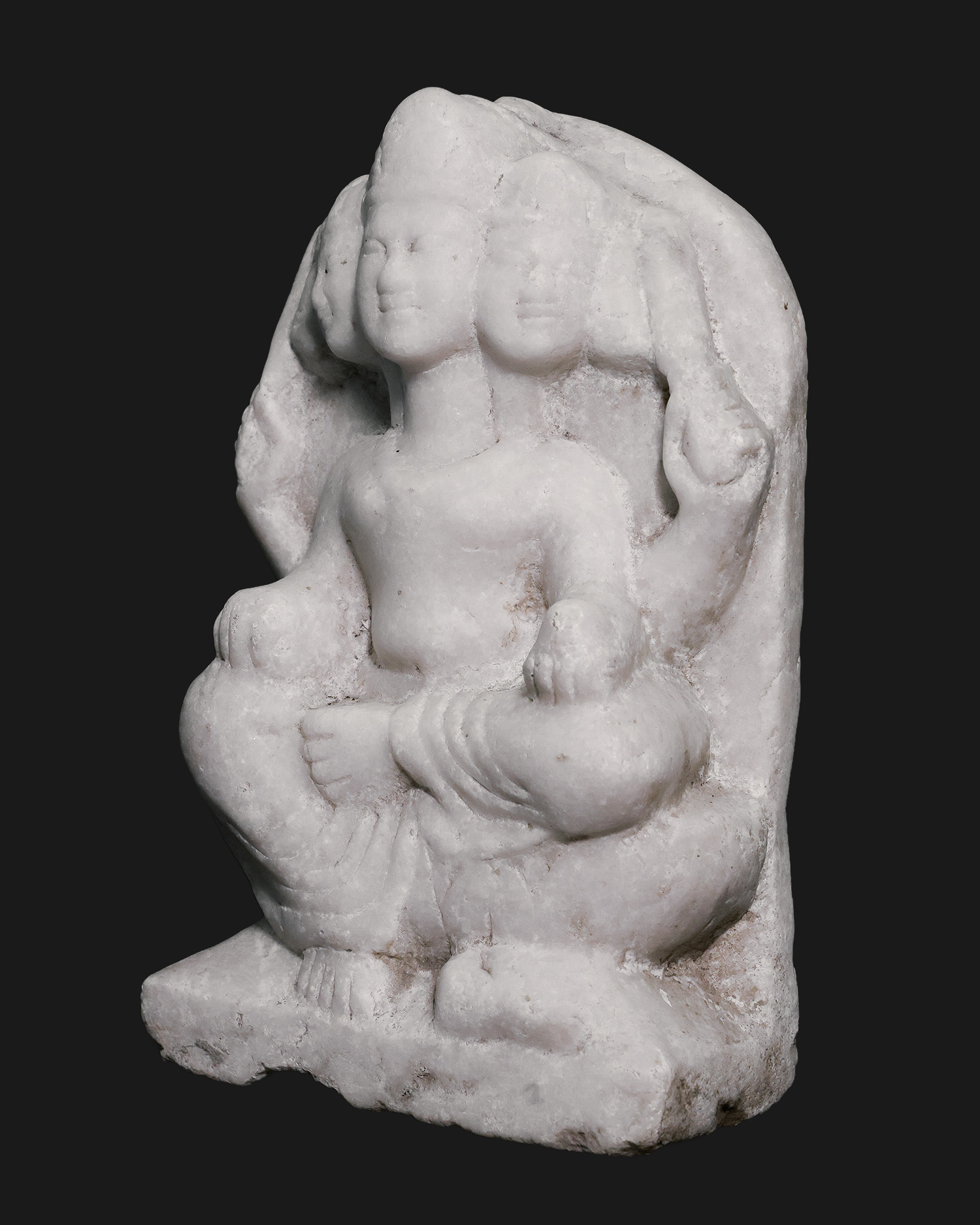
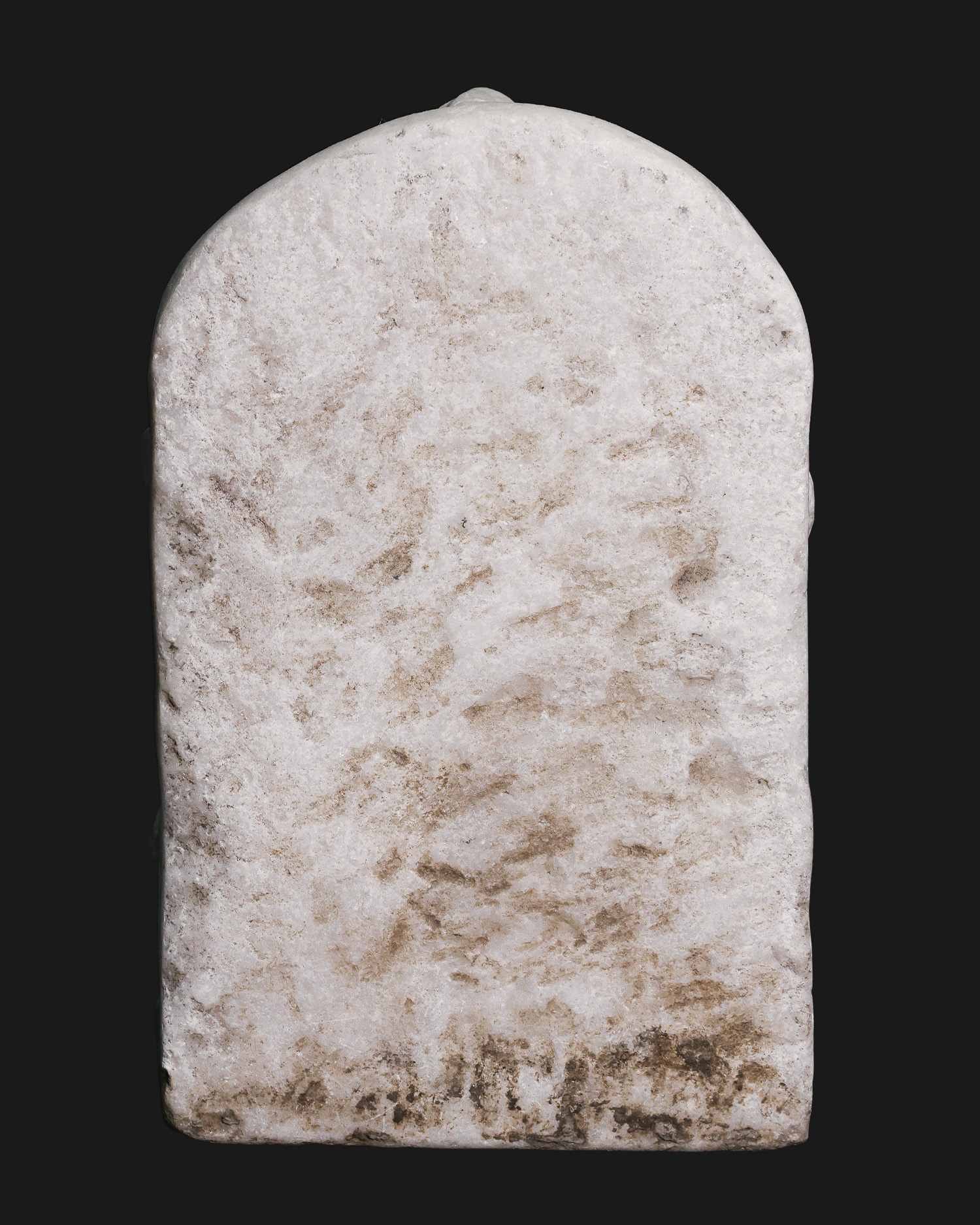
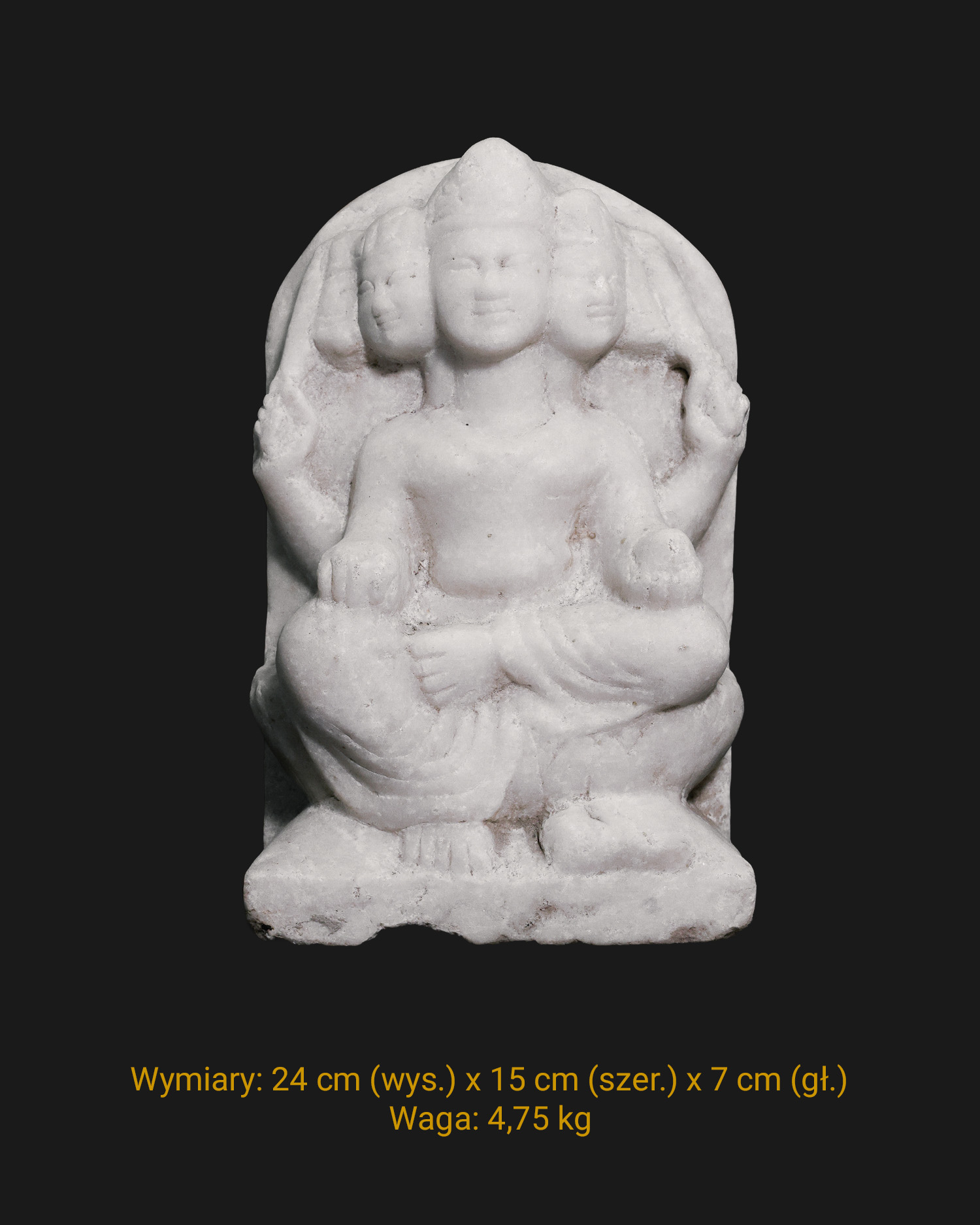

Brahma, marble, India, 19th century.
600,00 zł
Marble sculpture depicting Brahma – the Hindu creator god and personification of cosmic wisdom, belonging to the Trimurti trinity alongside Vishnu and Shiva. The deity has four faces (Caturmukha), which, according to iconography, should face the four sides of the world. In the case of the sculpture on offer, the representation is simplified and the faces are laid out in an arc against a smooth, semicircular wall (stele) from which the figure emerges – two to the left of the central face and one to the right. They symbolize omniscience and the four Vedas, the oldest sacred texts of Hinduism. The figure is depicted in a seated position with one leg on the ground and the other placed on the seat, perpendicular to the body. Brahma has two pairs of hands, in keeping with classical iconography. One pair of hands rests on his knees. In his hand, the deity holds a sphere, interpreted as a symbol of the earth or the entire cosmos and referring to the act of creation and the order of the world. The other pair of hands is raised to shoulder height and holds other attributes, but due to the simplified form their identification is uncertain. The whole work is characterized by a compact body and simplicity of form, sparing details, which gives the work an austere character.
Dimensions: 24 cm (height) x 15 cm (width) x 7 cm (depth)
Weight: 4.75 kg
1 in stock
| Weight | 4,75 kg |
|---|---|
| Dimensions | 24 × 15 × 7 cm |
| Type |
Sculpture |
| Form |
Semi-plastic figure sculpture |
| Materiał |
Marble |
| Kolorystyka |
White-Gray |
| Technika |
Carving |
| Czas powstania |
XIX century. |
| Kraj pochodzenia |
India |
| Autor |
Unknown |
| State of preservation |
Very Good. Sculpture without major losses, with slightly rubbed details |
Related products
Bust of Krishna, marble, India, 19th century.
Gallo-Roman male portrait head, marble, Roman Empire, Province of Gaul (area of modern France), 1st-3rd century after Chr.
Head of an angel (?), sandstone, France, ca. 1300
Krishna, marble, India, 19th century.
Madonna and Child, polychrome wood, gilded, Central Europe, 18th/19th century
Saint John the Evangelist, late Gothic wooden sculpture, ca. 1500
The work may have been part of a winged altarpiece (retabulum), most likely in the Crucifixion group.
Singa Barong, polychrome wood, Indonesia, 19th century.
Vajrabhairava in Tantric Union (Yab-Yum) with Vajravetali, gilt and polychromed bronze, Tibet (?), 19th century
The sculpture depicts Vajrabhajrava, or more specifically, his Tantric form. The deity has three heads with angry expressions, crowned with a crown of skulls, symbolizing the direct destruction of illusion. Inside the crown, flames burst forth, a fire of wisdom burning away ignorance. Emerging from them is the head of a gentle animal - it belongs to Vajrabhajrava himself (his higher aspect).
The figure has six arms, symbolizing the multifaceted activity of the enlightened mind, and holds ritual attributes. The outstretched wings are a rarer but significant feature, representing a transcendental aspect and the overcoming of samsaric limitations. Vajrabhairava stands in a dynamic pose on a lotus base, trampling a male and female figure. These figures symbolize ignorance (avidya), attachment, anger, ego, and the illusion of duality.