

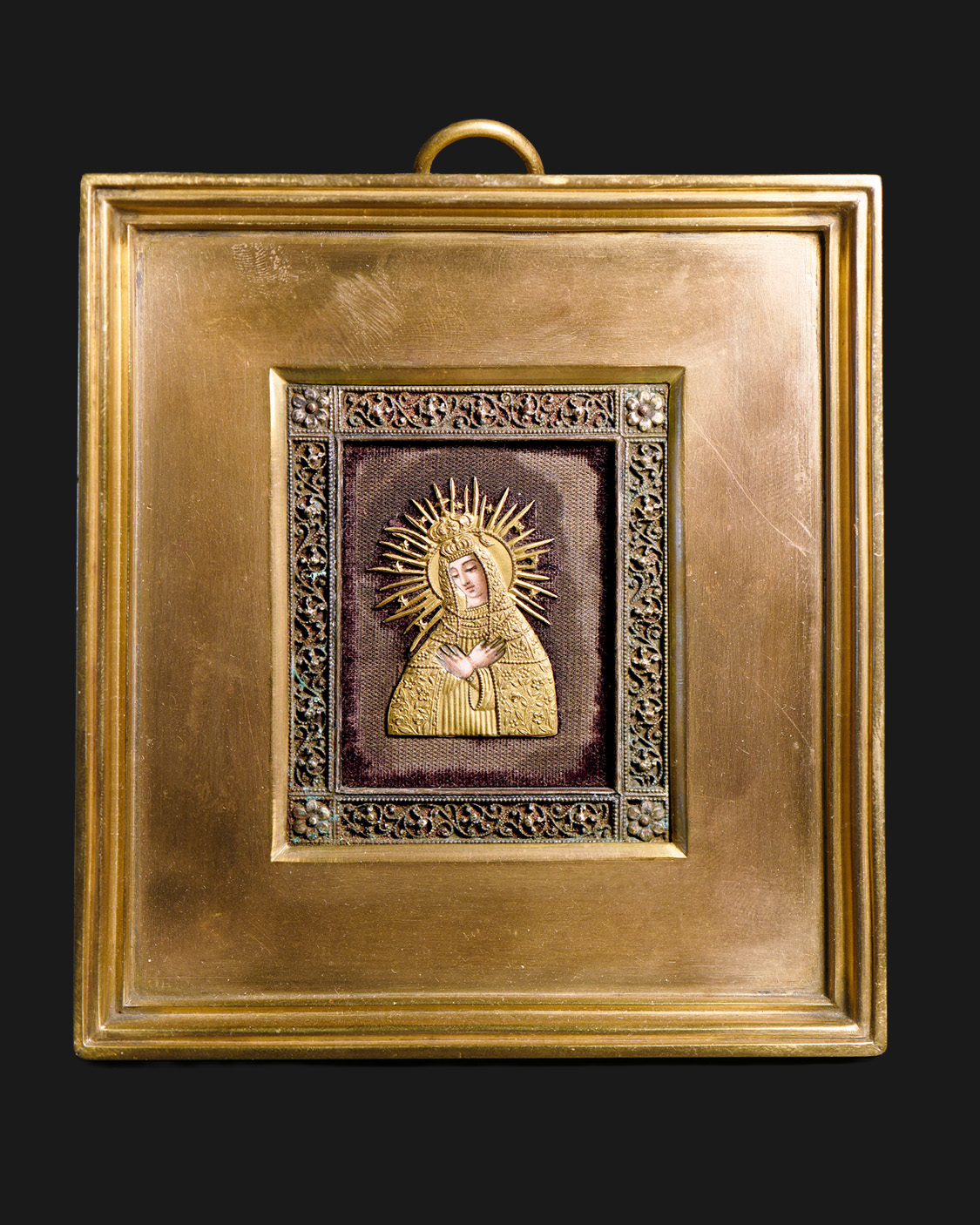
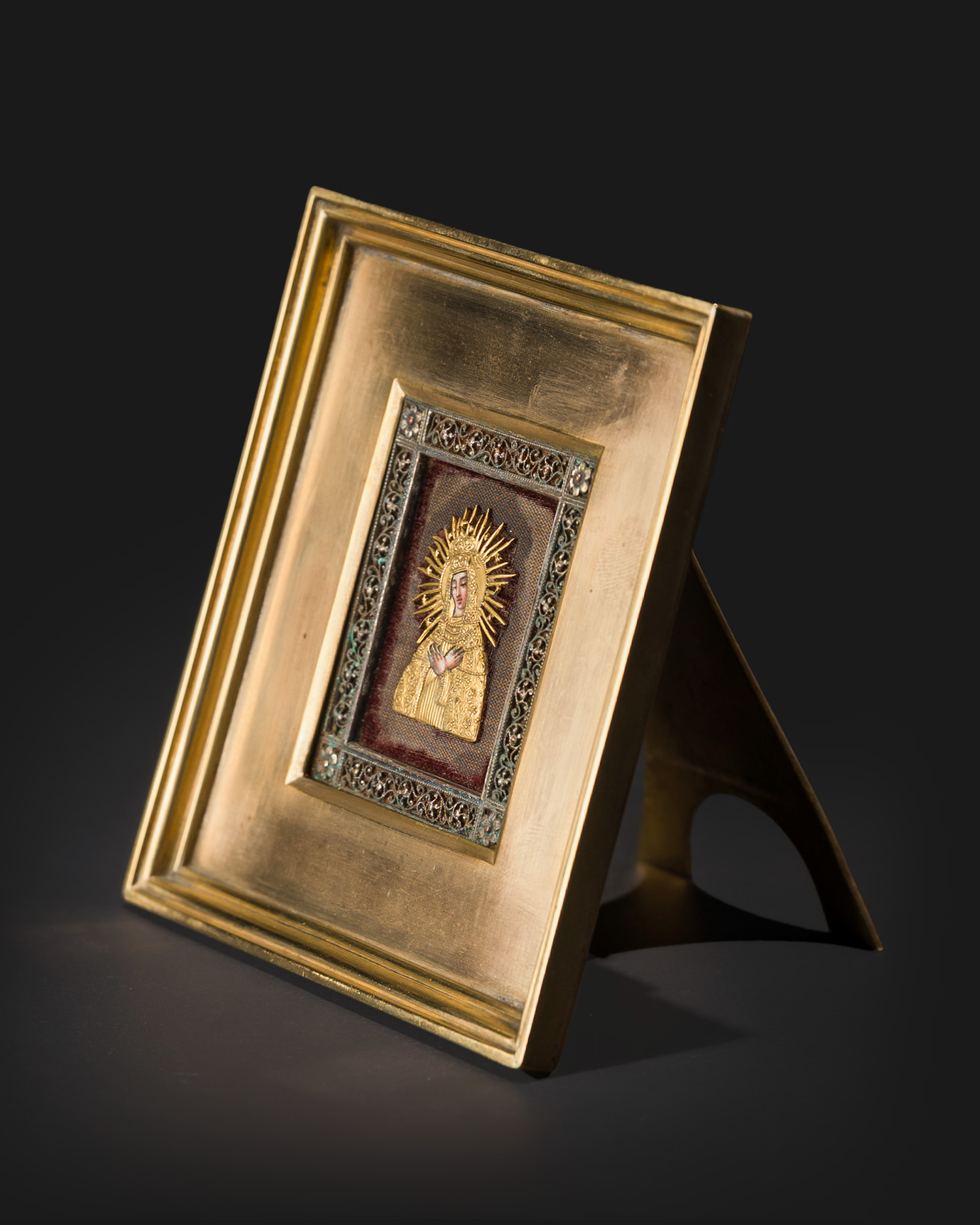
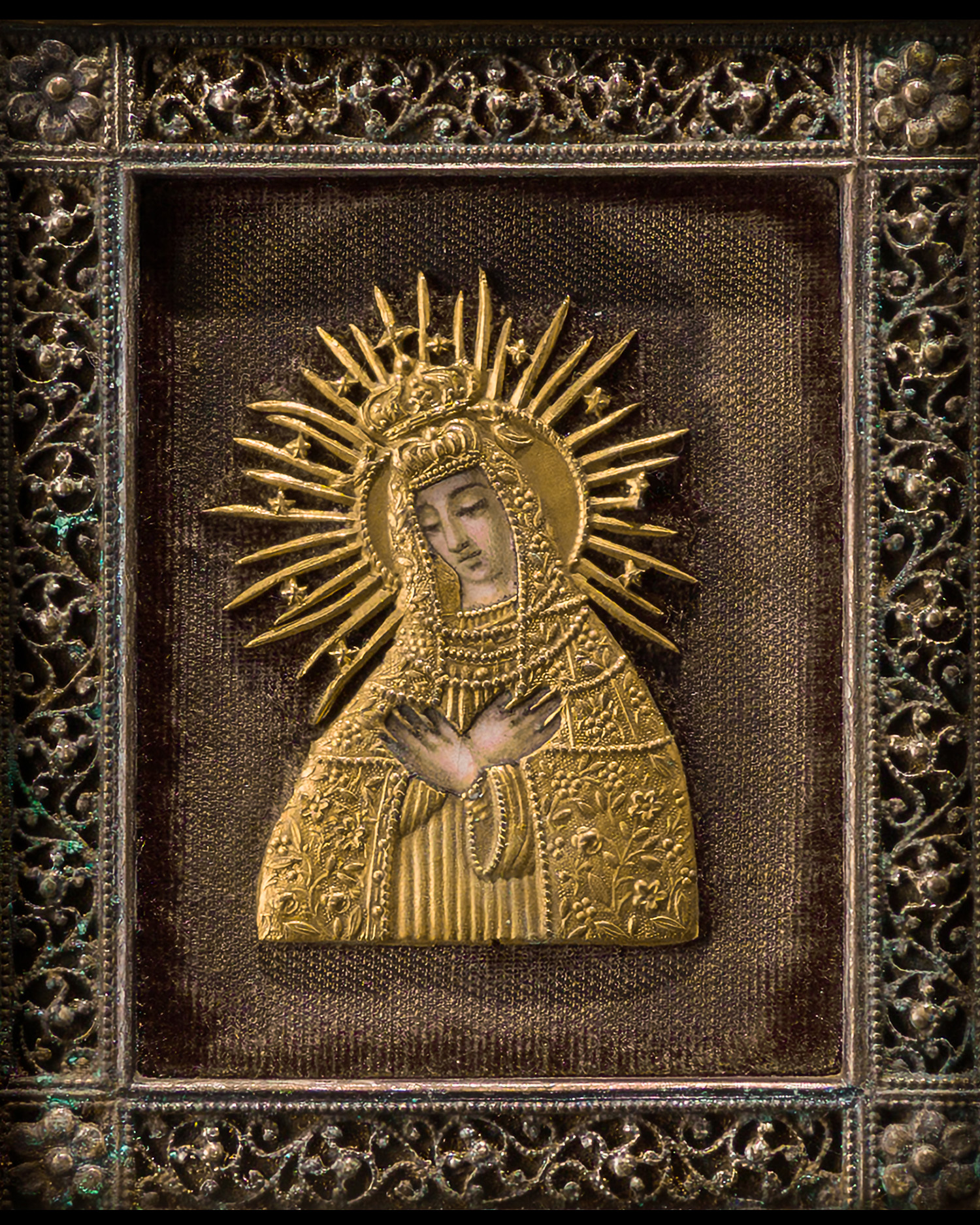
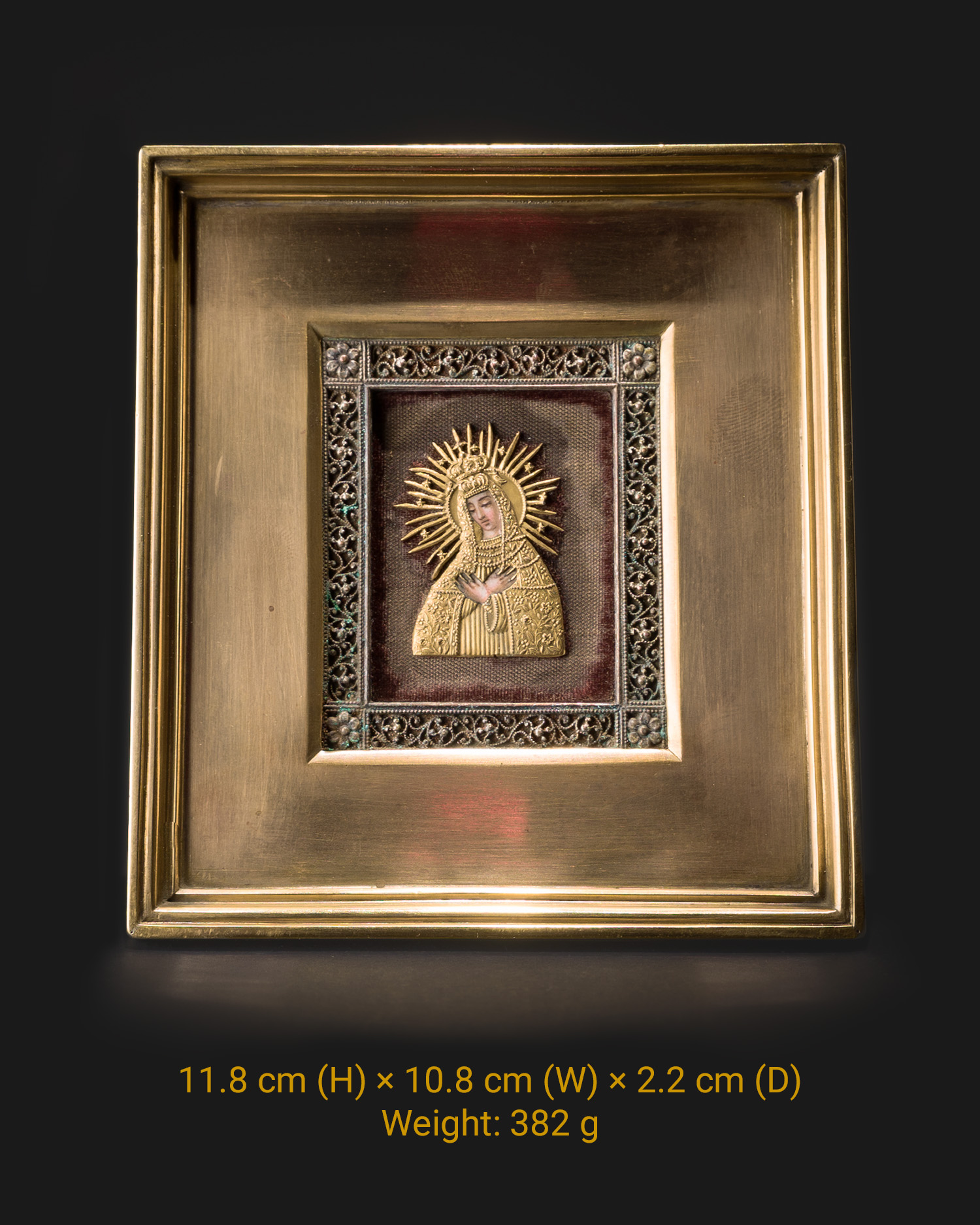

Icon of Our Lady of the Dawn Gate, brass, enamel on metal, Poland, 19th century.
1200,00 zł
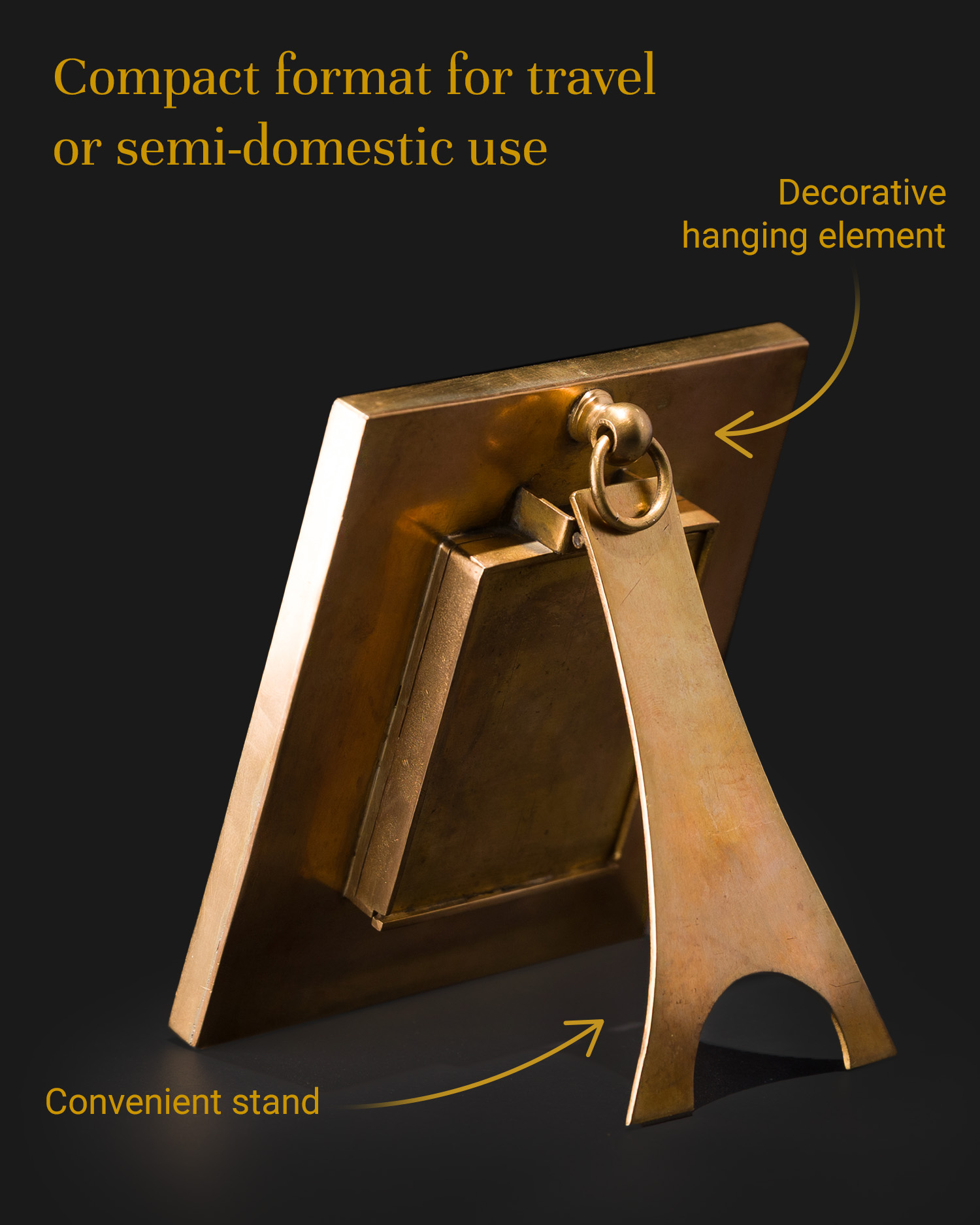
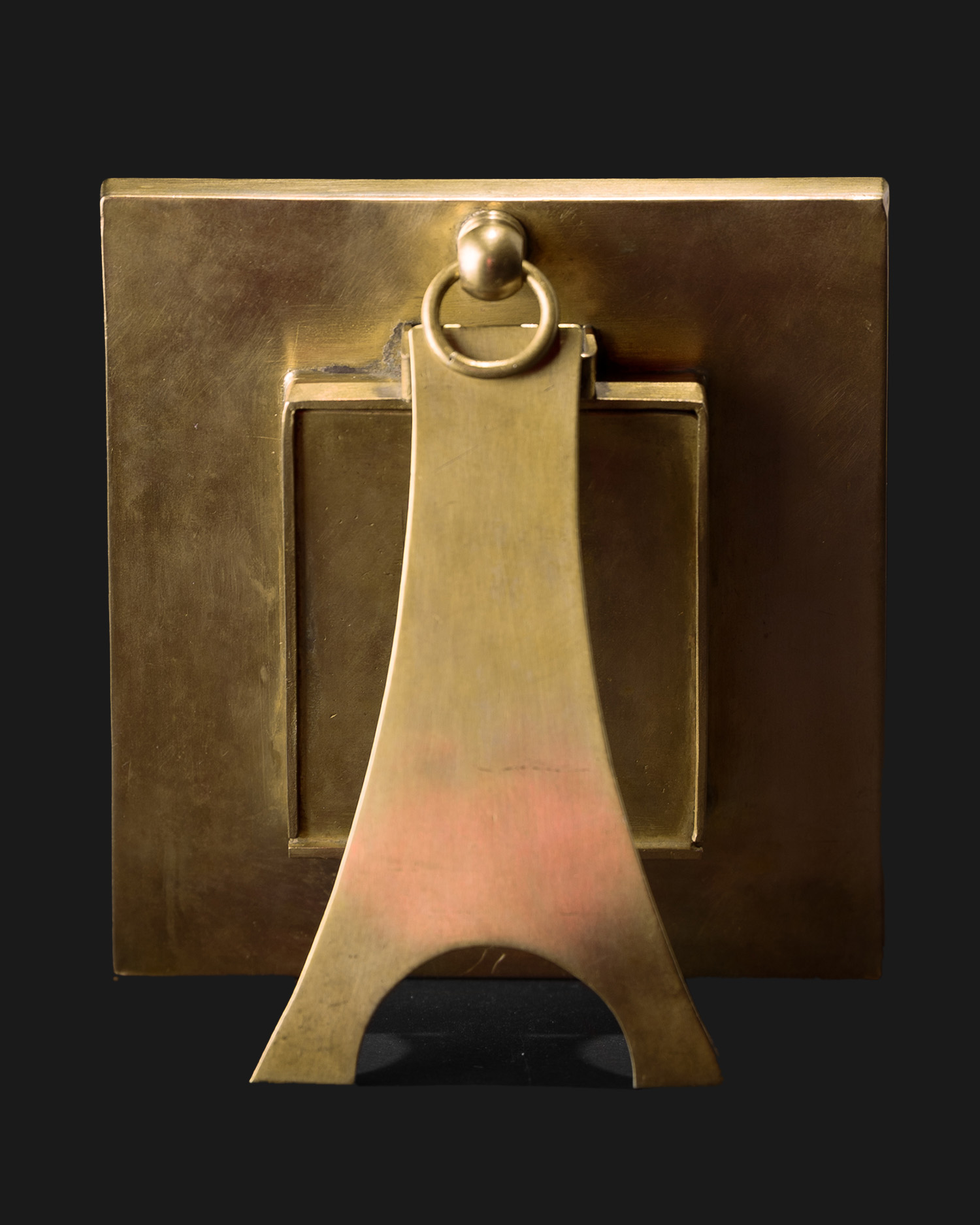
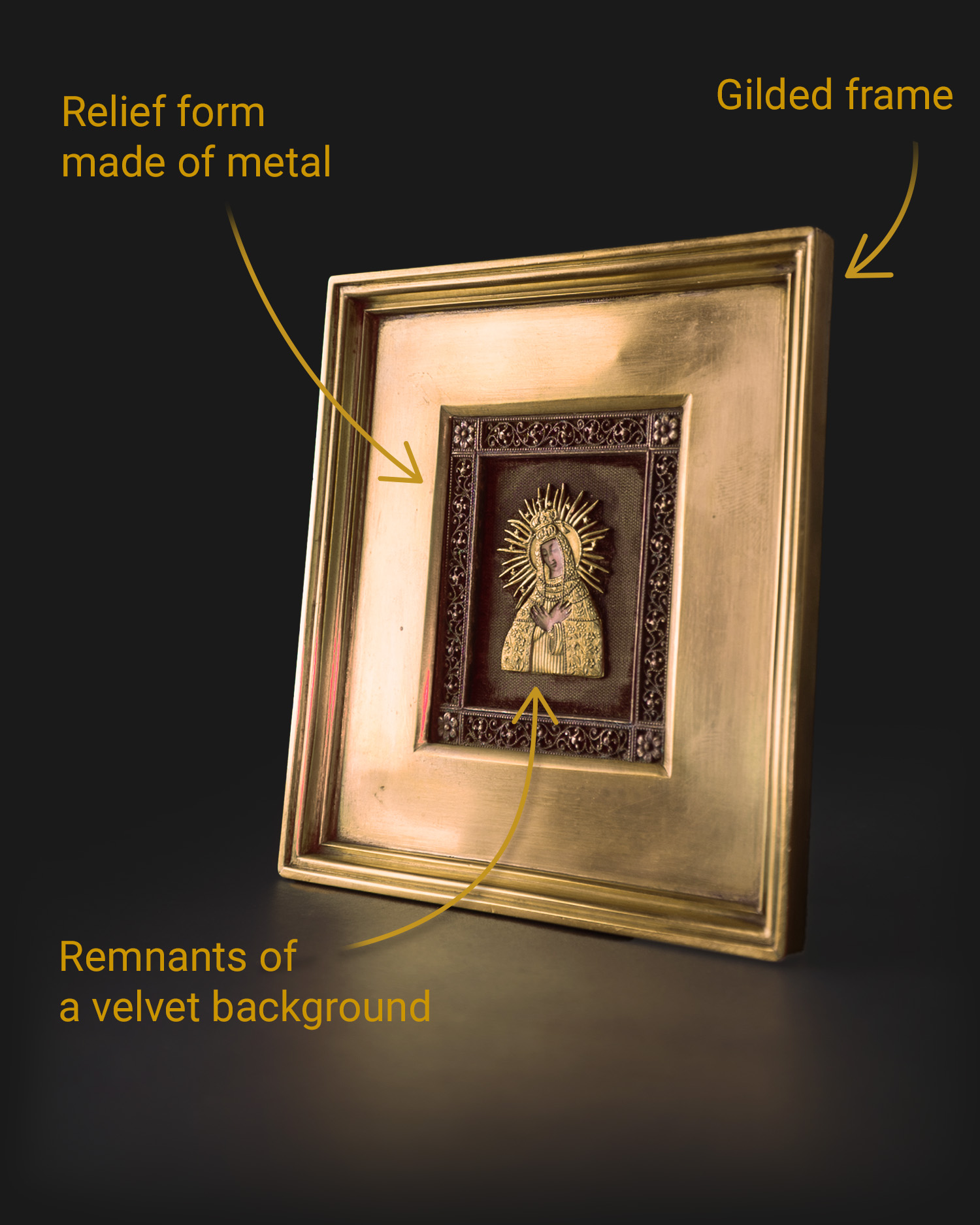
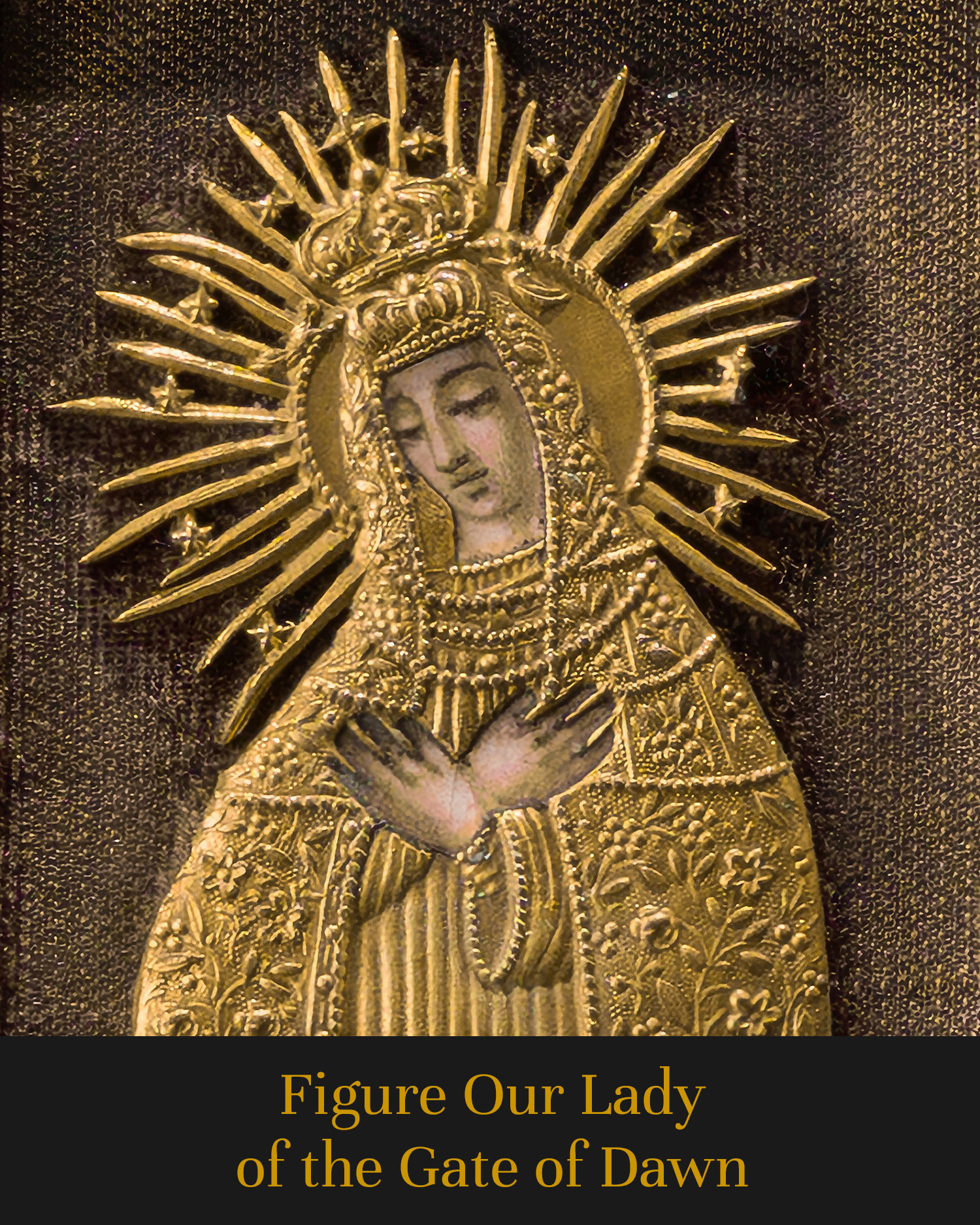
Decorative icon depicting Our Lady of the Dawn Gate, set in an elaborate brass frame with gilding. The representation is made of embossed sheet metal; the face and hands are covered with painted enamel. Background covered with maroon velvet. On the back of the frame a foot for standing and a pendant.
Sprzedane
| Weight | 0,3 kg |
|---|---|
| Dimensions | 11,8 × 10,8 × 2,2 cm |
| Type |
Portable sacred icon |
| Form |
Our Lady of Ostra Brama in metalwork with enamel, framed in a frame with leg and pendant |
| Materiał |
Enameled metal ,Gilded brass ,Velvet |
| Kolorystyka |
Burgundy ,Gold ,Silver ,White |
| Technika |
Applied jeweler's enamel ,Frame gilding ,Hand stamping |
| Czas powstania |
19th century (1801-1900) |
| Era |
National romanticism ,Partition period |
| Kraj pochodzenia |
Poland |
| Style |
Neo-Baroque ,Pilgrimage style ,Religious folk art |
| Autor |
Unknown |
| State of preservation |
Very good – traces of time (velvet rubbing), fully functional stand and pendant |
Related products
Cabinet Reliquary with Relic of the True Cross and 26 Saints, wood, textiles, Central Europe, 18th century
An 18th-century Baroque cabinet reliquary, a freestanding wooden display case of trapezoidal form, containing a total of 27 relics. The side walls and top are chamfered, widening toward the front. The interior is lined with burgundy velvet, trimmed with decorative borders of gold bullion thread.
At the center, set slightly forward from the back, is a raised textile reliquary in the form of a monstrance, embroidered with gold thread and richly adorned with bullion, filigree, miniature beads, and multicolored glass imitating precious stones. On the base and shaft are placed six relics, identified by inscriptions painted in gold on dark blue banderoles.
Within the central repository is a reliquary capsule with a convex glass cover, containing two fragments of the True Cross, surrounded by a radiant glory.
Above the “monstrance” is an oval image with an indistinct representation, encircled by 20 additional relics interspersed with decorative elements of bullion, beads, gold thread embroidery, and colored glass. At the level of the nodus are two larger relics (Ex Ossibus) of Saint Vincent and Saint Fortunatus, uniquely labeled on white banderoles.
A distinction should be made between a reliquary and a reliquary cabinet: a reliquary is a vessel that directly contains relics, whereas a cabinet reliquary serves as a structure housing and presenting them. This object is therefore not a typical example, as—besides the central textile reliquary in the form of a monstrance containing fragments of the Cross on which Jesus Christ died—it also incorporates an additional 26 relics of various saints placed directly within the composition, without individual containers.
Their preservation is ensured either by a fine mesh covering or solely by labeled banderoles. The relic of the True Cross is the only one enclosed within a glazed, and undoubtedly sealed, capsule.
The interior of the case, measuring 37.3 × 26.5 × 10 cm, is lined with burgundy velvet, trimmed with gold bullion thread.
Chapel with Our Lady of Czestochowa and Eagle, Poland, 19th century.
Christ Crucified, wood, Spain (Pyrenees?), 12th-13th century.
The sculpture impresses with the pronounced rigidity of the body, typical of early Roman depictions. The calm yet poignant expression of Christ's face is emphasized by huge, forward-facing eyes set in deep eye sockets.
His gaze, however, is slightly lowered, emphasized by a prominent nose and large, spreading ears that frame his face. His hair falls symmetrically on his shoulders; a peculiar hairstyle draws attention - the hair, separated by a parting on top of the head, is arranged in rollers covered with densely diagonal cuts. Very similarly arranged hair, resembling braids, has the famous statue of Christ of Mig Aran, located in the church of Sant Miquèu de Vielha (Val d'Aran valley). The beard and mustache end in artificial, volute curls.
Christ Salvator Mundi, polychrome wood, Poland, 19th century.
Devotional Ring, Silver, Lviv, 1872-1920
Fragment of an antiphonary page with illuminated initial, parchment, Europe, 15th century
Irish (Celtic) cross, stone sculpture, Ireland, 19th century.
Reliquary with relic of the Holy Cross and four saints, gilded bronze, Central Europe, 18th century.
Baroque reliquary in the form of a monstrance, made of gilded bronze. Oval foot, multi-stepped, decorated with repoussed and engraved floral ornament. Smooth shaft with profiled nodus. Reservaculum surrounded by a gloria The gloria of the reliquary was formed of frayed, numerous rays, over which is superimposed a contrasting decorative wreath covered with rocaille and floral motifs. In the repository is placed an oval capsule made of silver sheet, glazed from the front. Glass at the edge decorated with octagonal faceting. On the back there is a wax seal on strings. The seal bears a coat of arms: in an ornamental cartouche a lion to the left, and below - separated by a beam - an opposite griffin to the left. The whole is crowned with a cardinal's hat (Galero): a hat with a wide brim and dangling strings with brads (fiocchi), which is a sign of cardinal dignity. Inside the capsule are 5 relics, described in ink on bandoliers - read more in the extended content below.