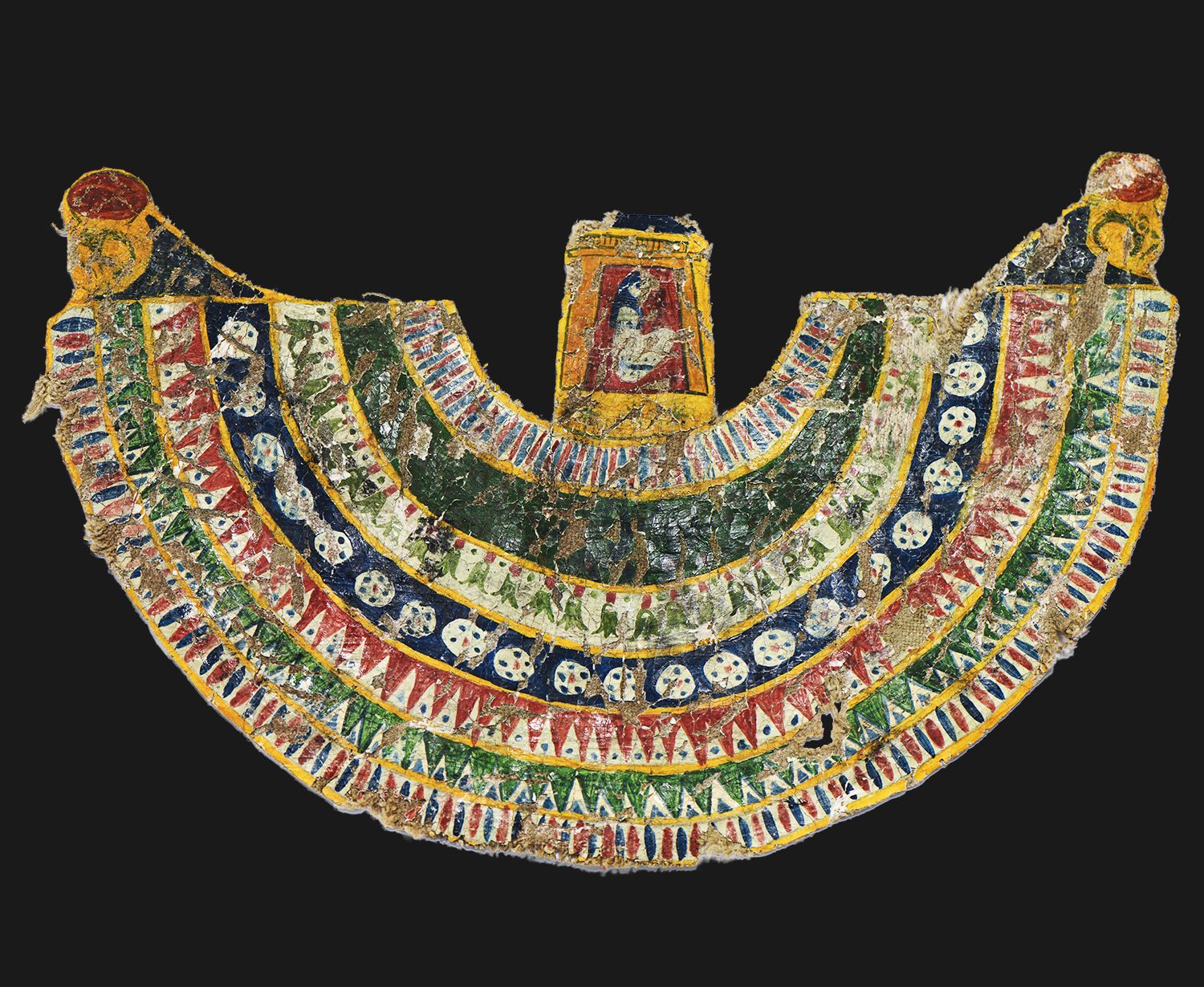
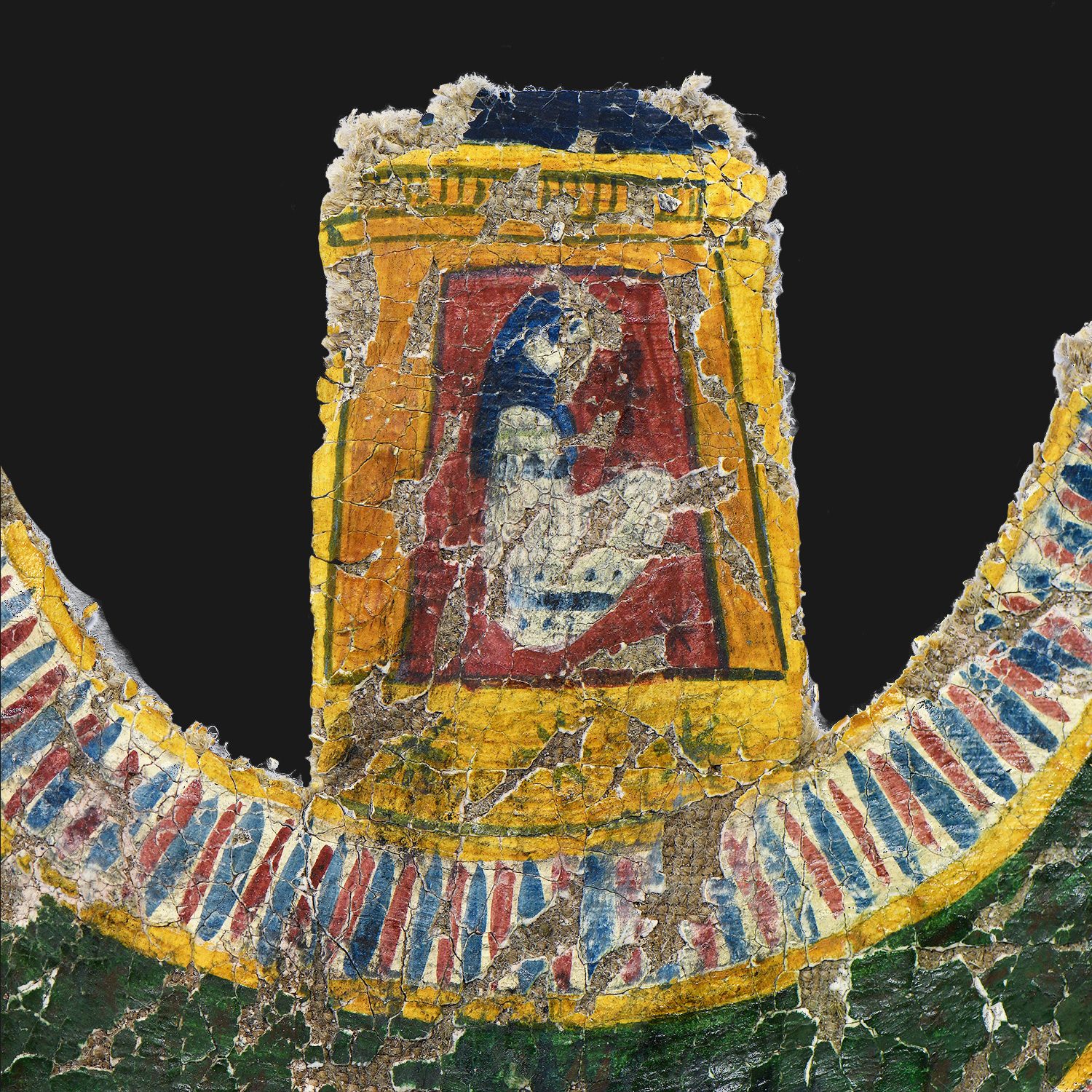
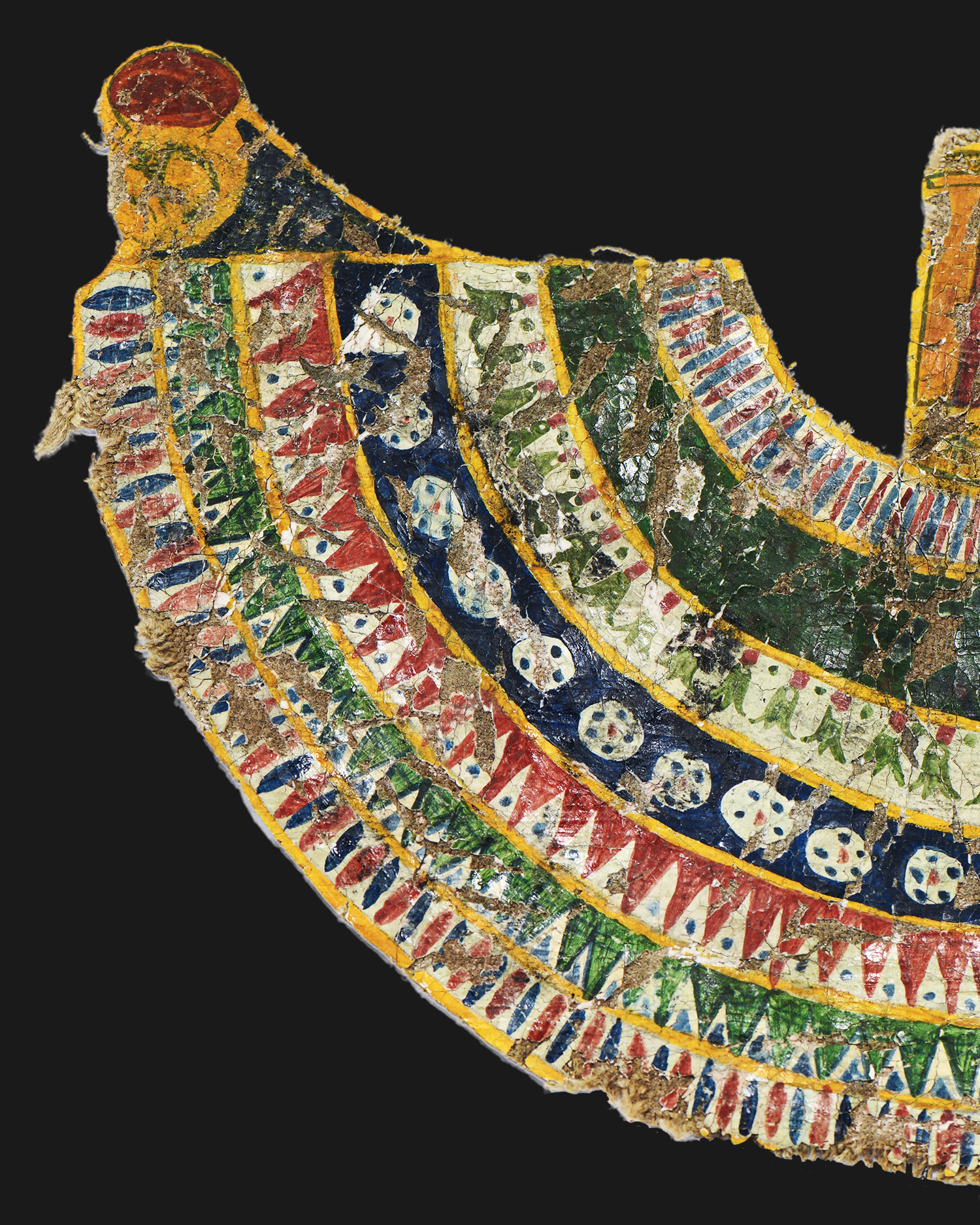
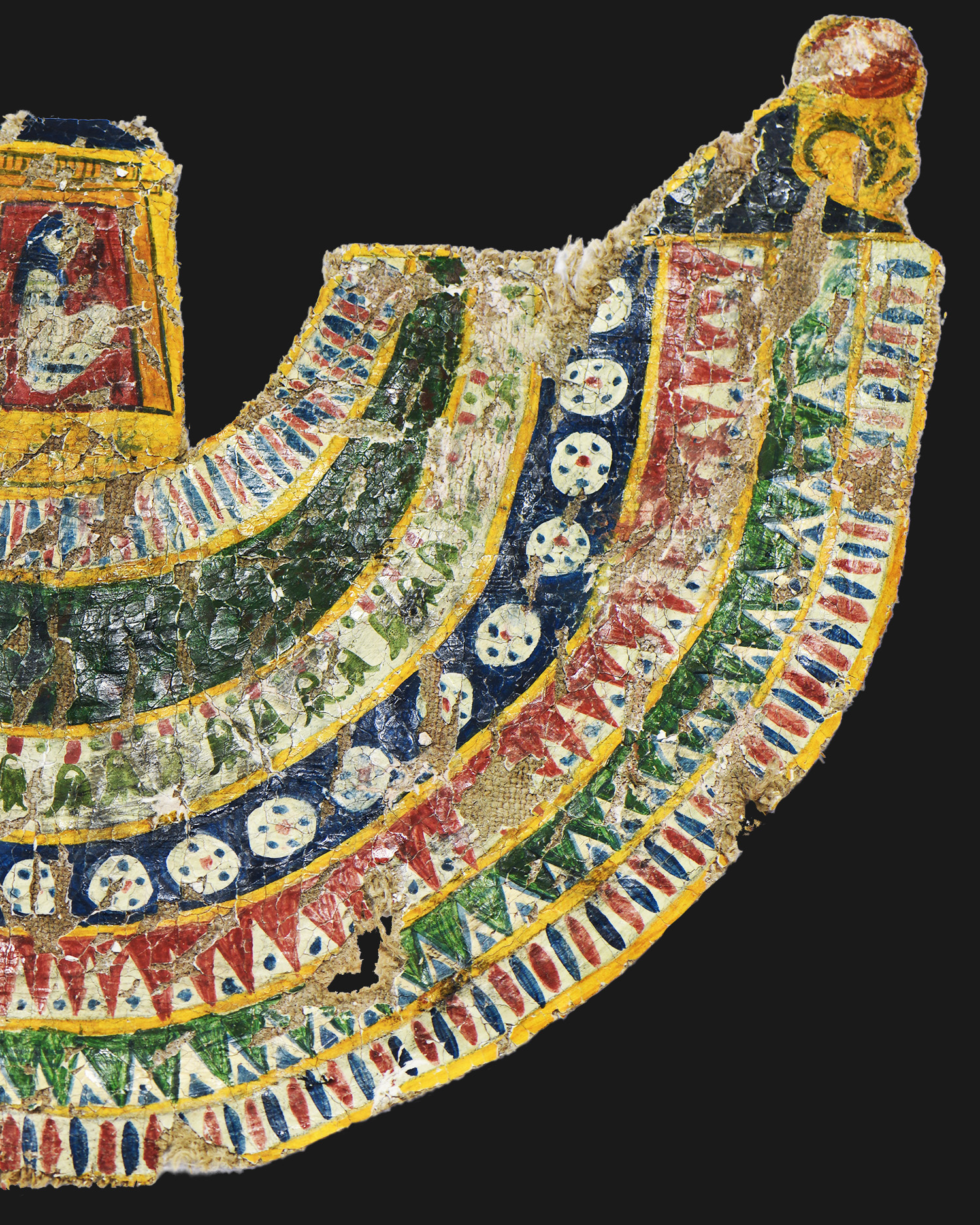
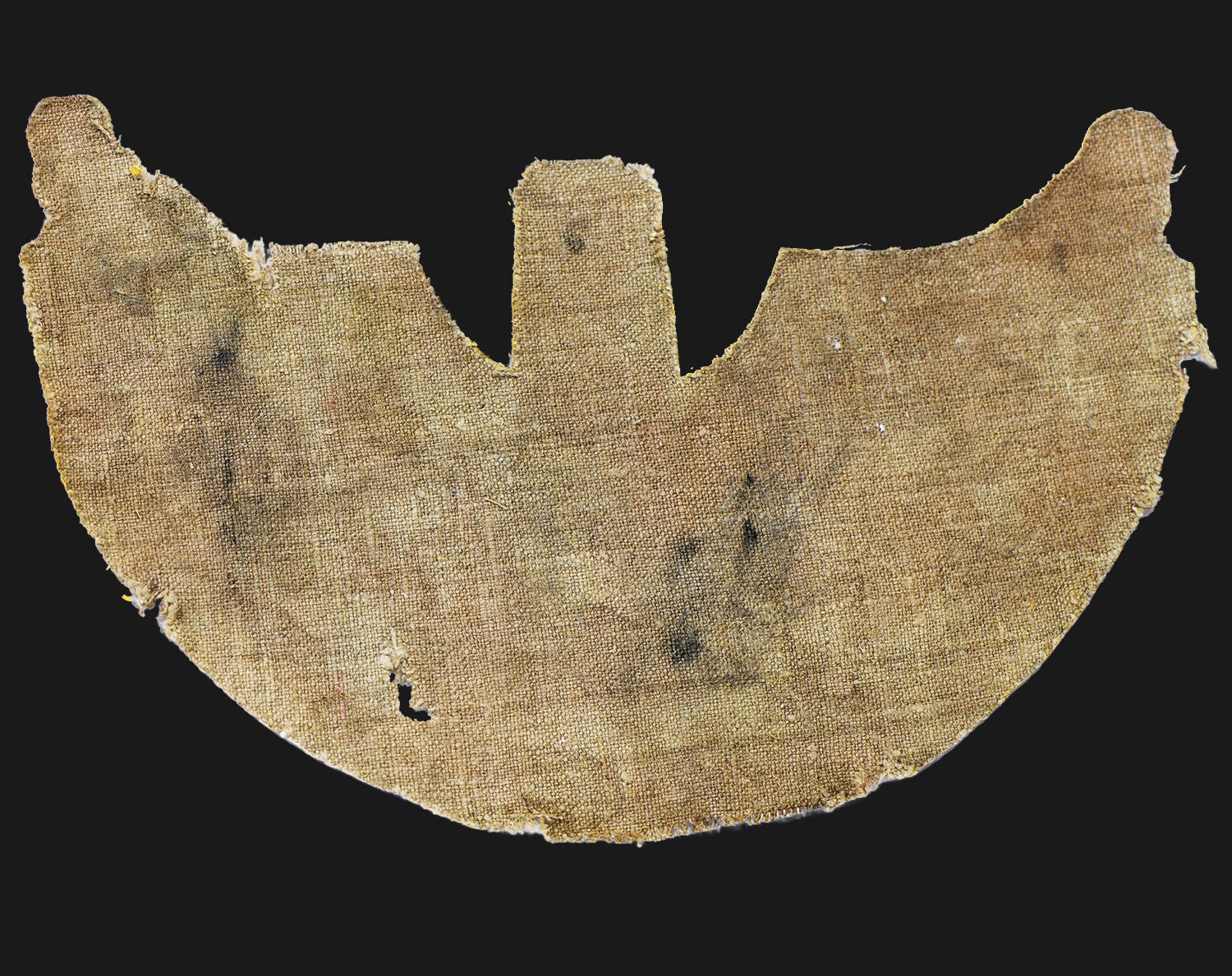
Cardboard panel (canvas covered with plaster and polychrome) depicting a wide necklace known as an “usekh” collar, Ancient Egypt, 1st millennium BCE. The collar is semicircular in shape and consists of several ornamental zones separated by narrow yellow bands. The individual zones are filled with varied decorative motifs: a row of circular ornaments filled with dots, imitating glass or faience beads; stylized “pendants”; stripes with alternating triangular segments, and rows of spindle-shaped ornaments. In the upper center is a rectangular panel depicting Horus, shown in profile in a seated position, facing right, inside a stylized temple. On either side of the collar are depictions of a red disk above the head of a falcon or hawk—most likely a representation of the head of the god Ra with a solar disk.
It is impossible to say conclusively whether the offered collar covered the coffin or directly the mummy of the deceased, as both possibilities are possible. Without specialized research, its dating should be placed in a wide range covering the 1st millennium B.C. However, it is worth noting that similar decorative motifs appear on a cartonage collar from the collection of The Michael C. Carlos Museum in Atlanta, dated to 1069-750 B.C. (object no. 2018.010.254).
Collar necklaces in ancient Egypt were called “usekh” or “wesekh” (meaning “wide”), were commonly worn by both men and women of high social status, as well as by deities. Consisting of numerous rows of tubular or teardrop-shaped beads—often made of faience, gold, or semiprecious stones—this necklace was a staple of Egyptian fashion from the Old Kingdom through the New Kingdom. Depictions of it were a staple of the grave goods of the deceased, most often in the form of cartonnage. The word “cartonnage” has two meanings in the context of ancient Egyptian culture. First, it refers to the material—canvas (sometimes papyrus)—bonded with plaster, somewhat resembling today’s papier-mâché. Second, it refers to a type of coffin made from this material, painted and gilded.