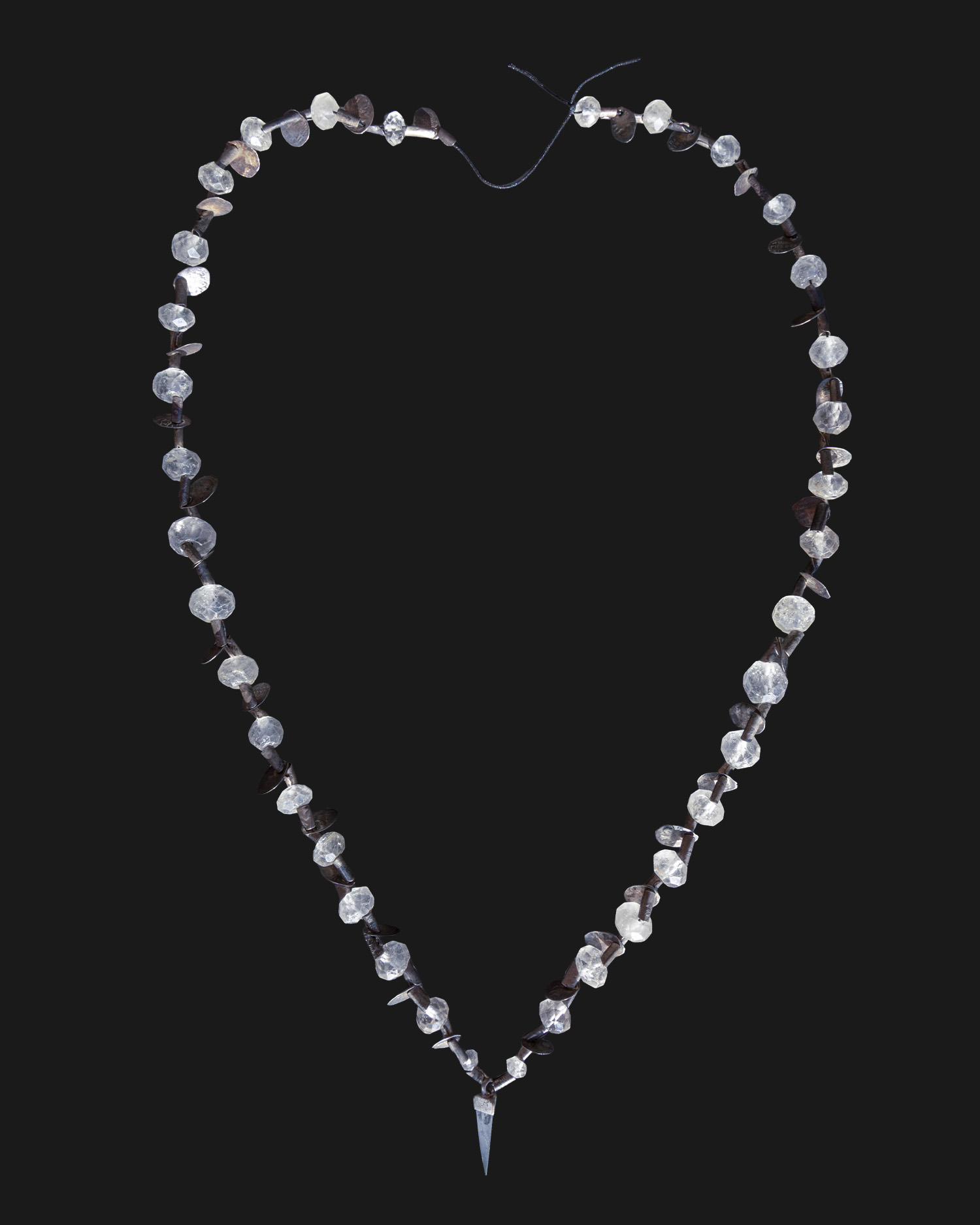
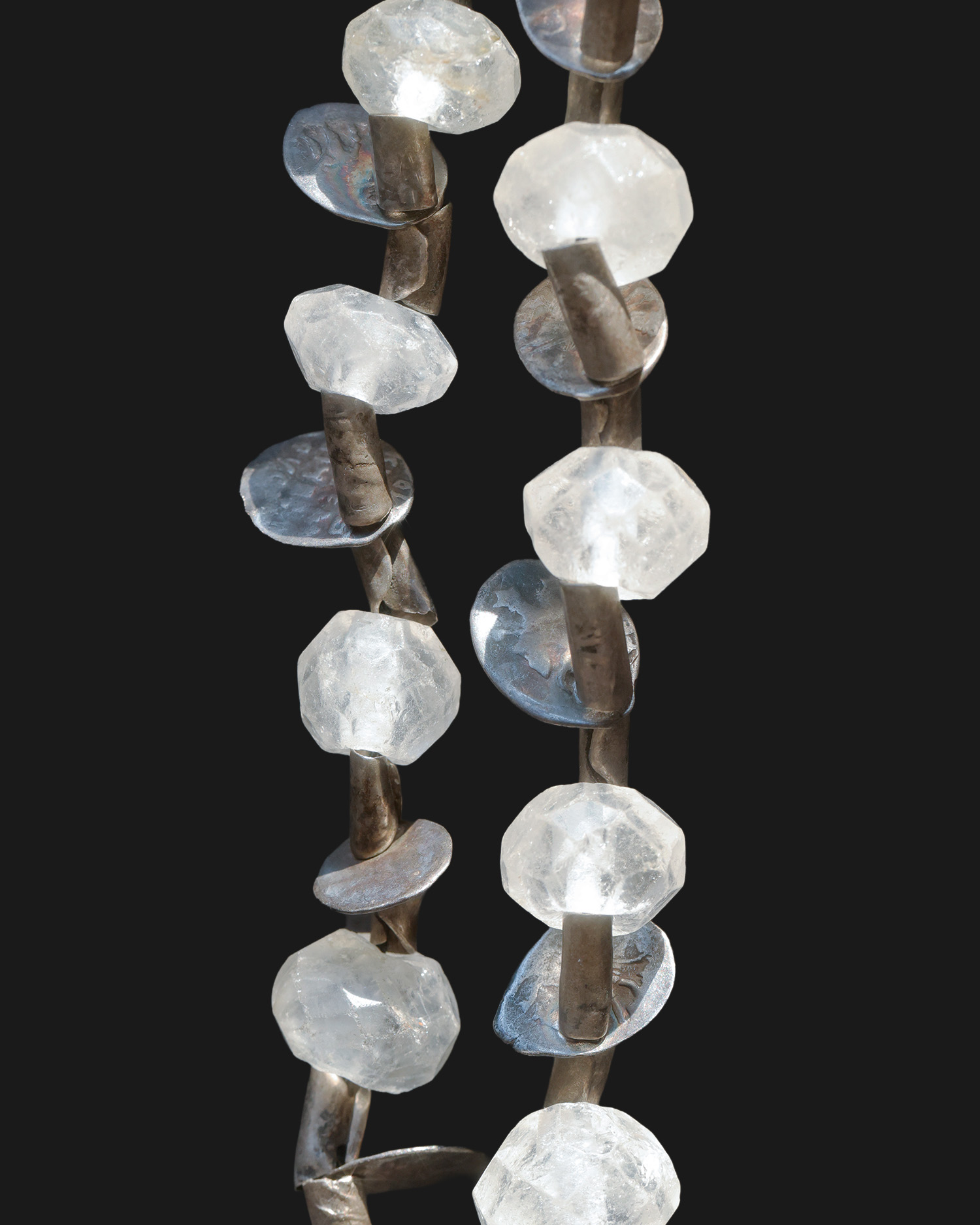
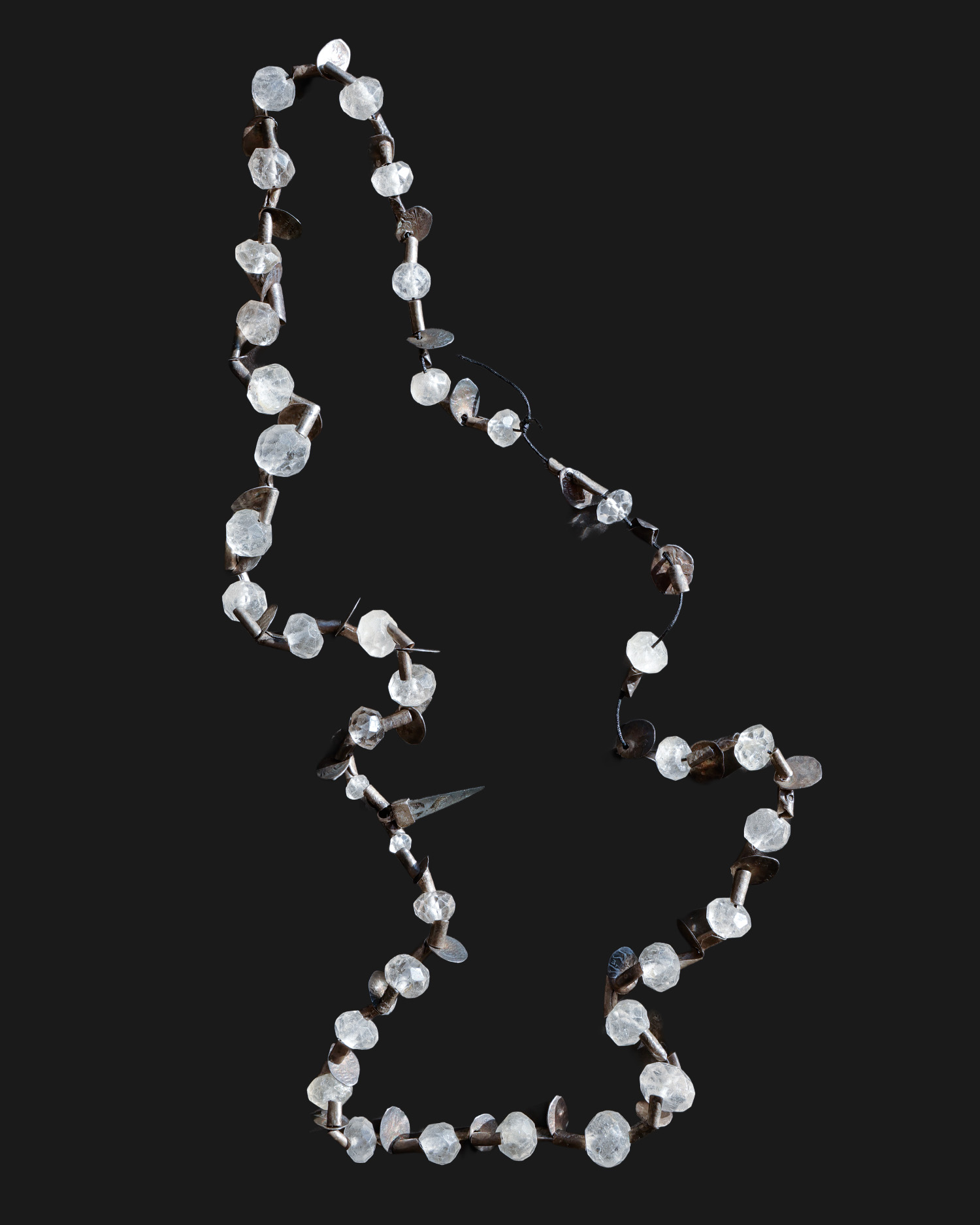
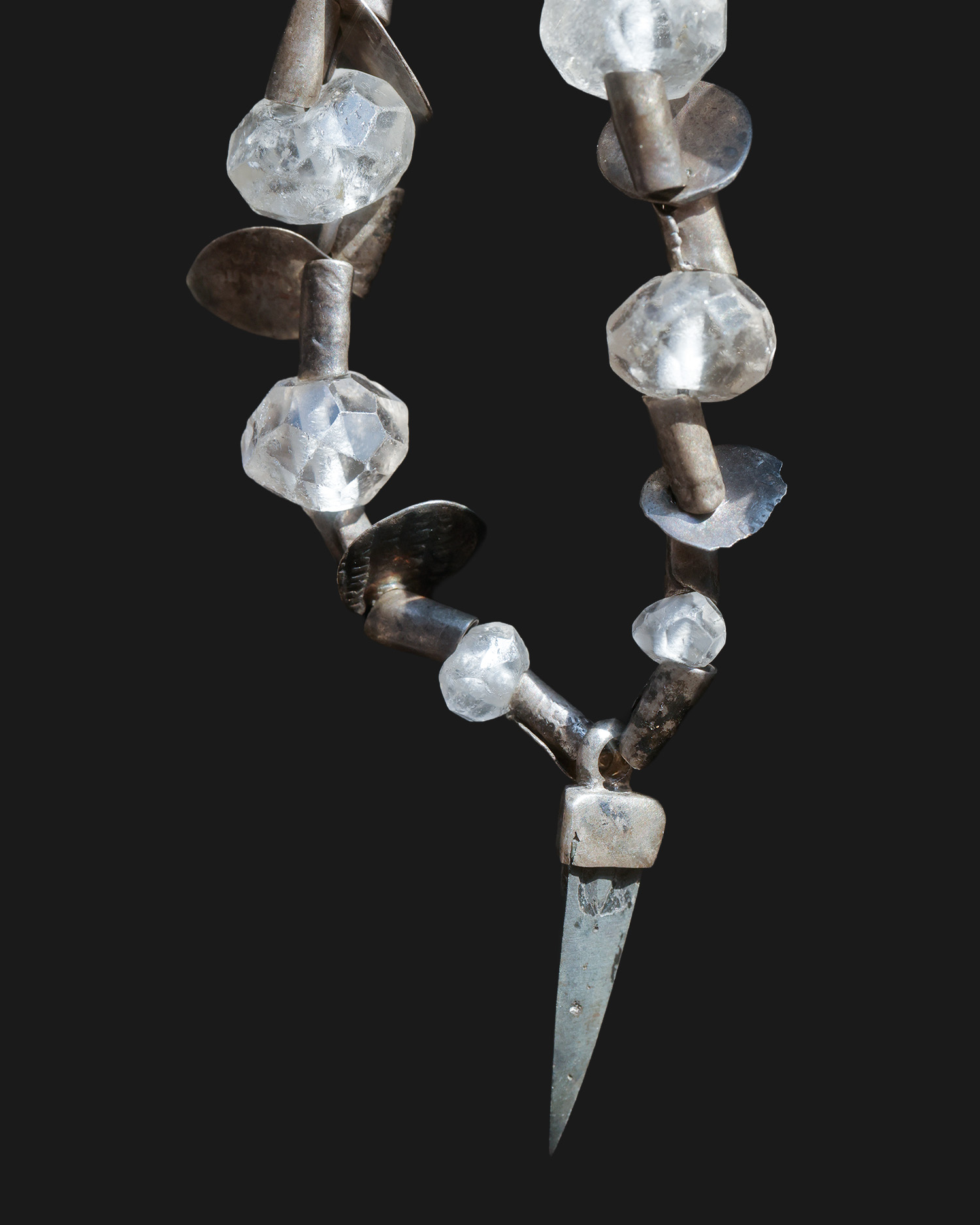
A necklace crafted from faceted beads of cut rock crystal, varying in size and clarity, and Russian silver kopecks. These are small coins known as 'teardrops' or 'wire coins' due to their distinctive shape. Some coins were left flat, with specially made perforations allowing them to be strung onto a cord.
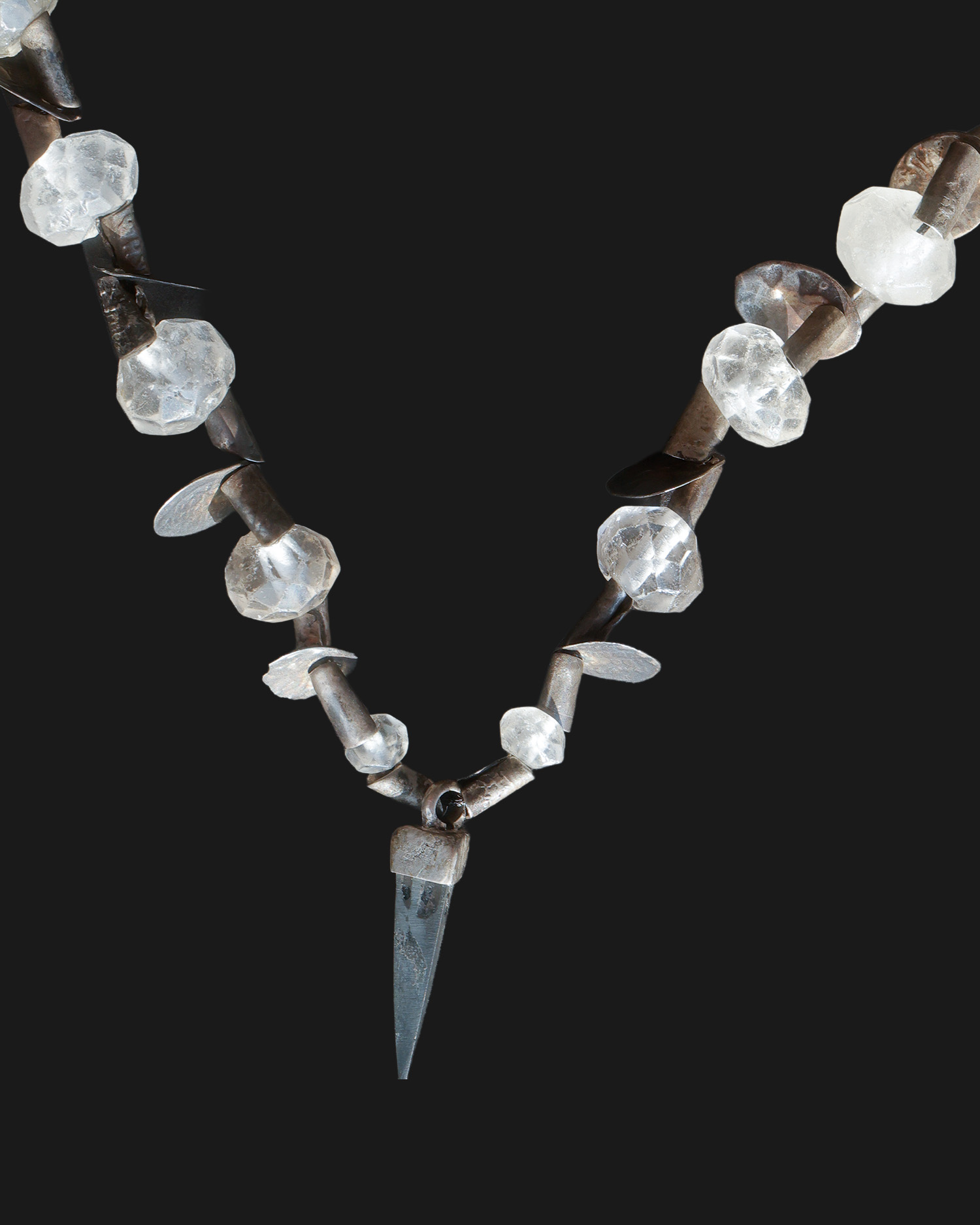
The central accent of the composition is an ancient, three-edged Scythian bronze arrowhead, dated to approximately the 7th–6th century BC. In the 17th century, it was set in silver and fitted with a loop for suspension. Its presence indicates that certain finds were perceived as extraordinary objects endowed with special significance, regardless of any lack of knowledge about their origin and function. Undoubtedly, the creator of the necklace had no knowledge of ancient Scythians or their weaponry.
The necklace should rather be associated with wealthier peasantry or poorer gentry of Ruthenian origin, rather than with Polonized noble strata. The necklace has the character of a regional ornament and can be linked to the eastern part of the Polish-Lithuanian Commonwealth, as this type of jewelry is not known from central Poland; it was probably created in a provincial goldsmith's workshop.
These coins owed their teardrop-like shape to their manufacturing technology. Mint masters drew silver wire, which was cut into portions of a specific weight, and then struck with dies. On a small piece of silver, approximately 10-15 mm long, there was no room for the inscription: the ruler's name, often with his patronymic, and his titles, all arranged in several lines. Therefore, only fragments of inscriptions are usually visible on these 'teardrops' – striking the entire legend was practically impossible. The same applied to the reverse, which featured St. George on horseback with a spear or saber, often with a mint mark below. From the famous spear of the saint, these 'wire kopecks' began to be called kopecks, giving the name to Moscow's coinage for centuries. Due to their small size and shape, these coins were perfectly suited to be rolled into a tube and serve as spacers in the necklace.