


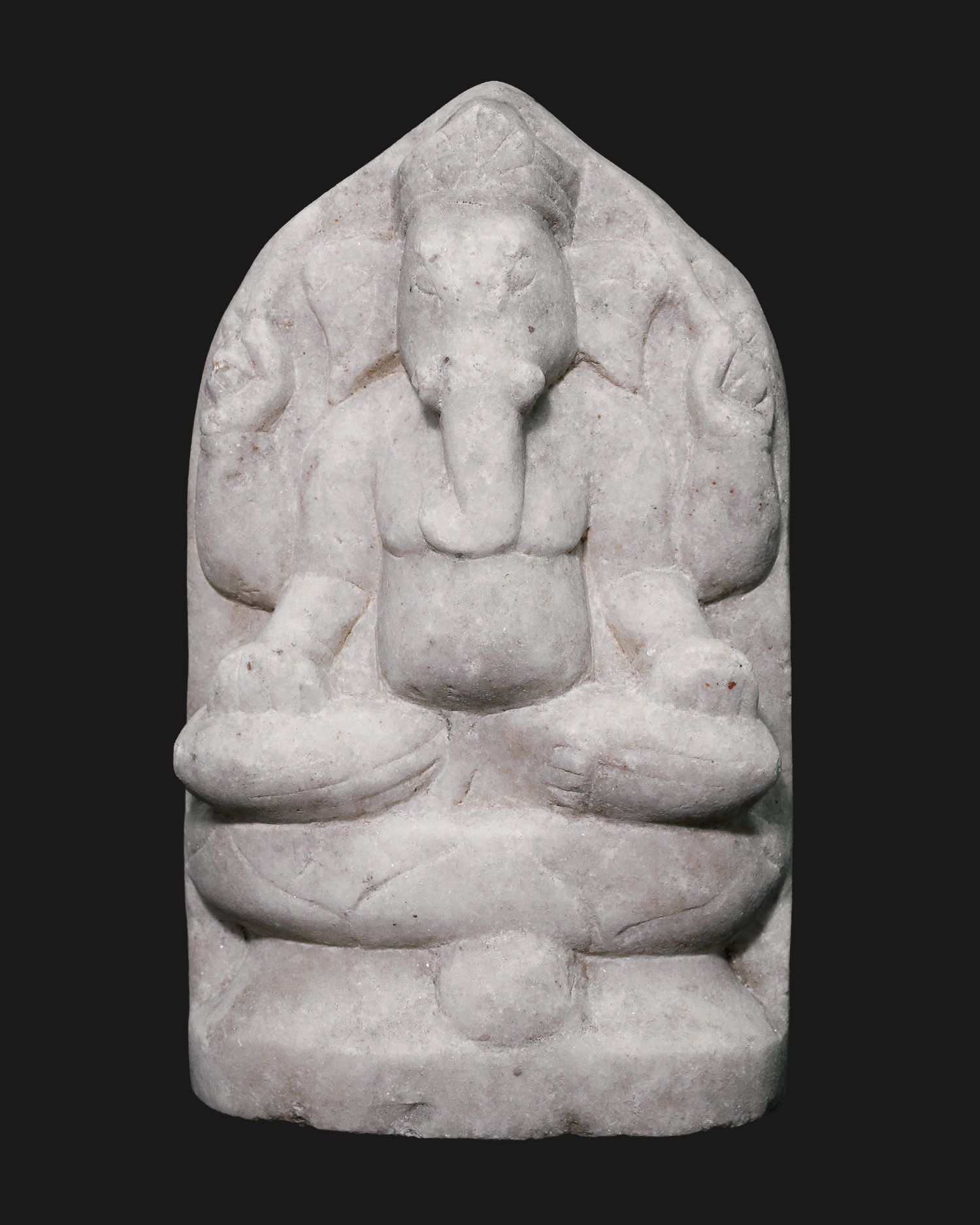
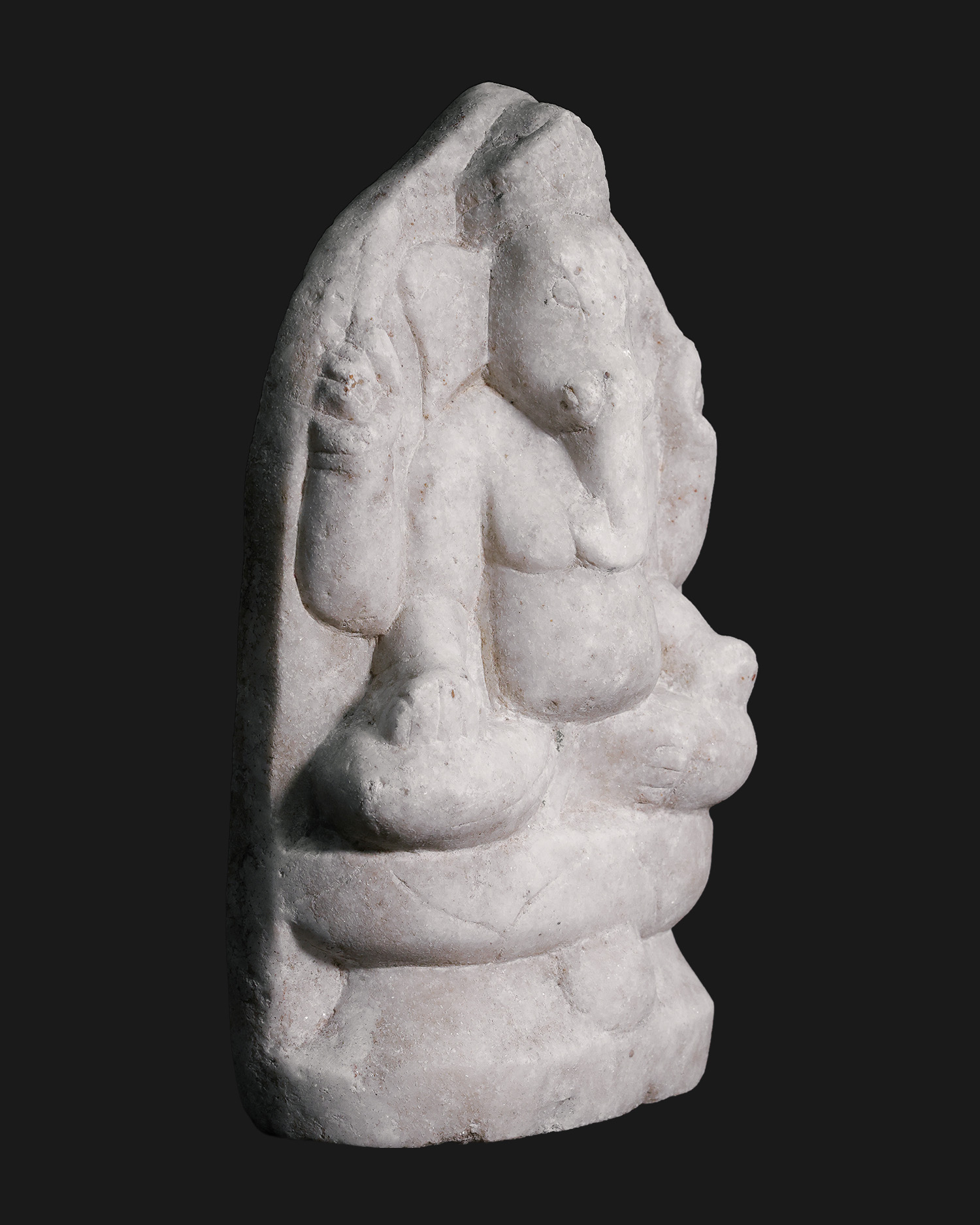
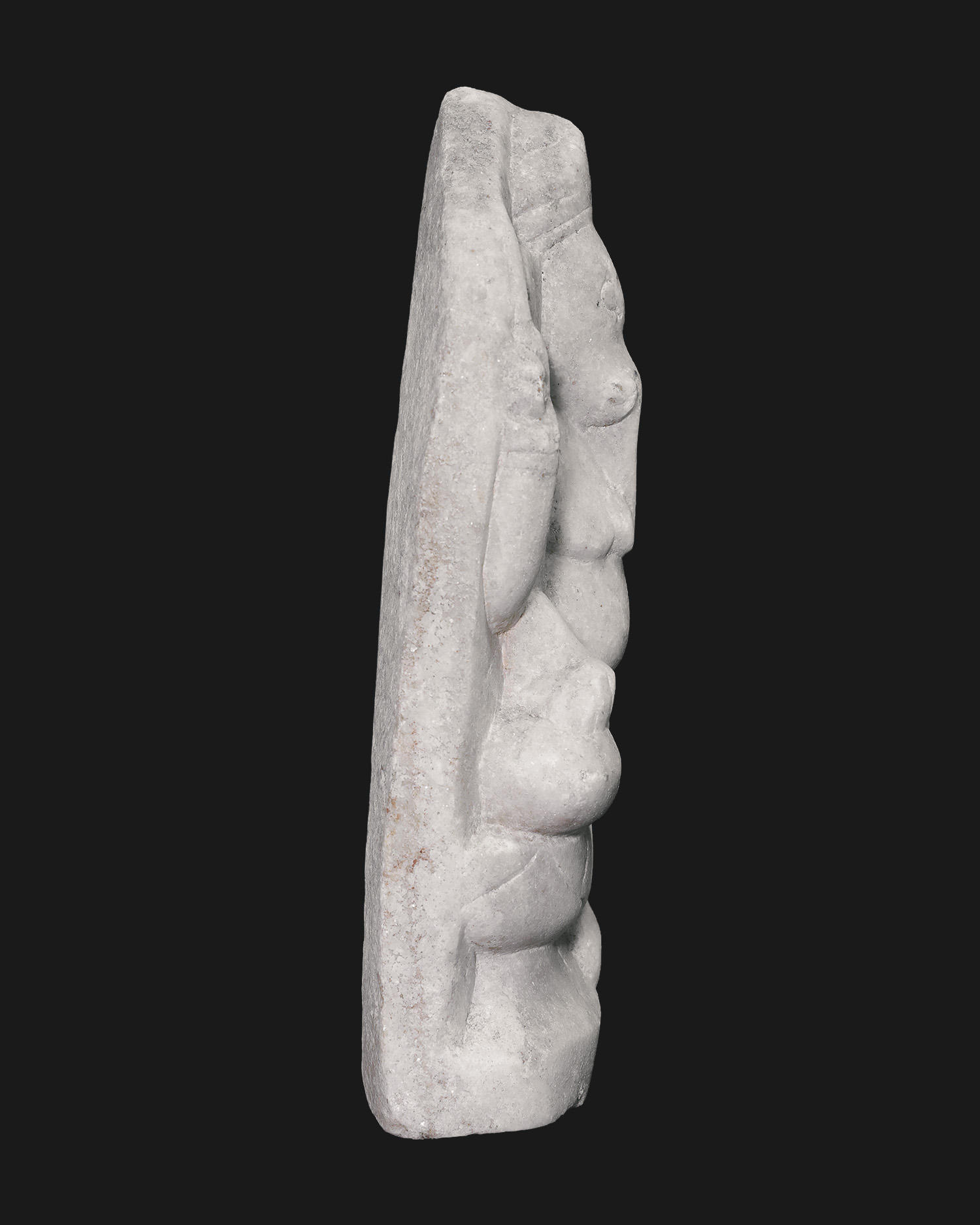
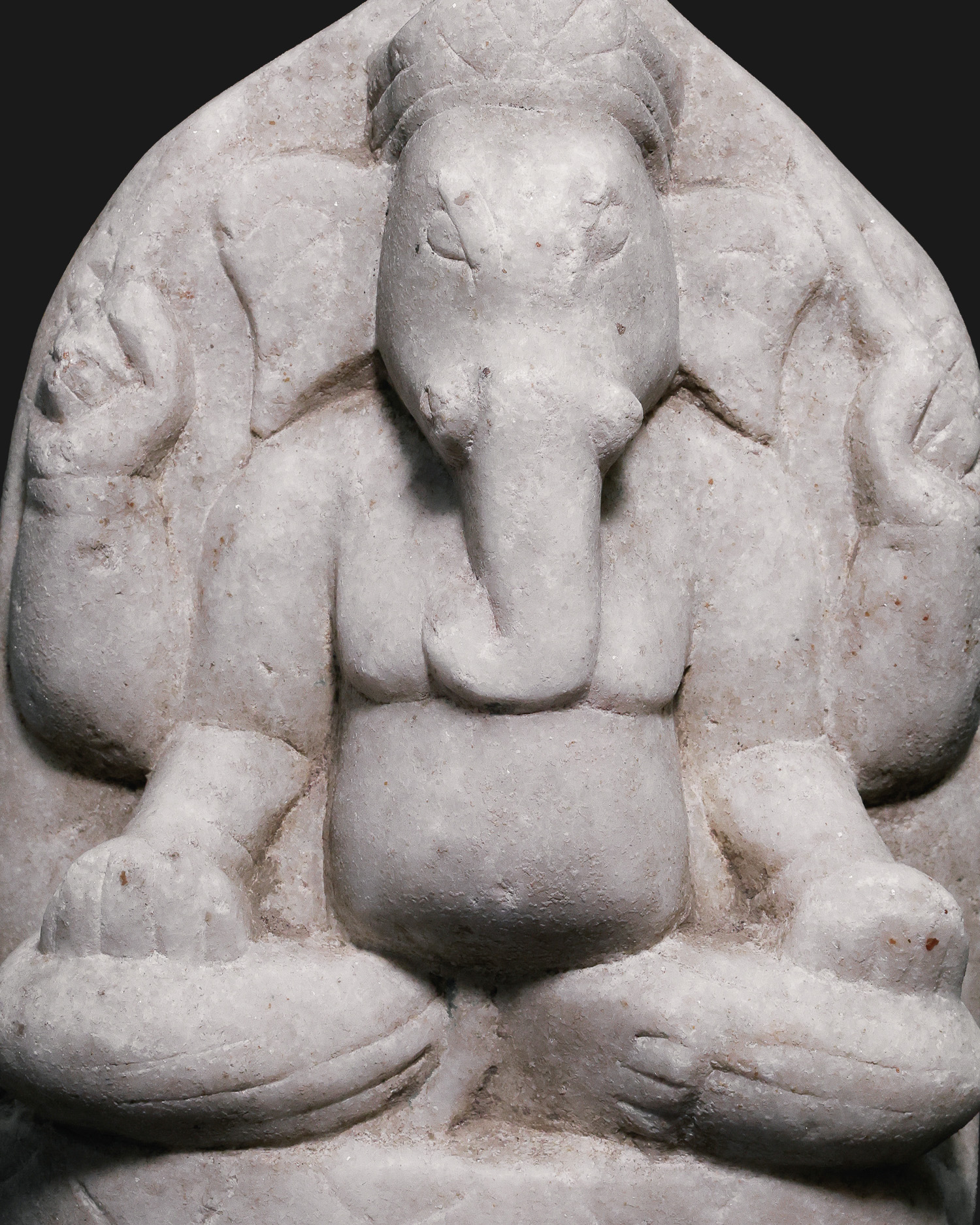
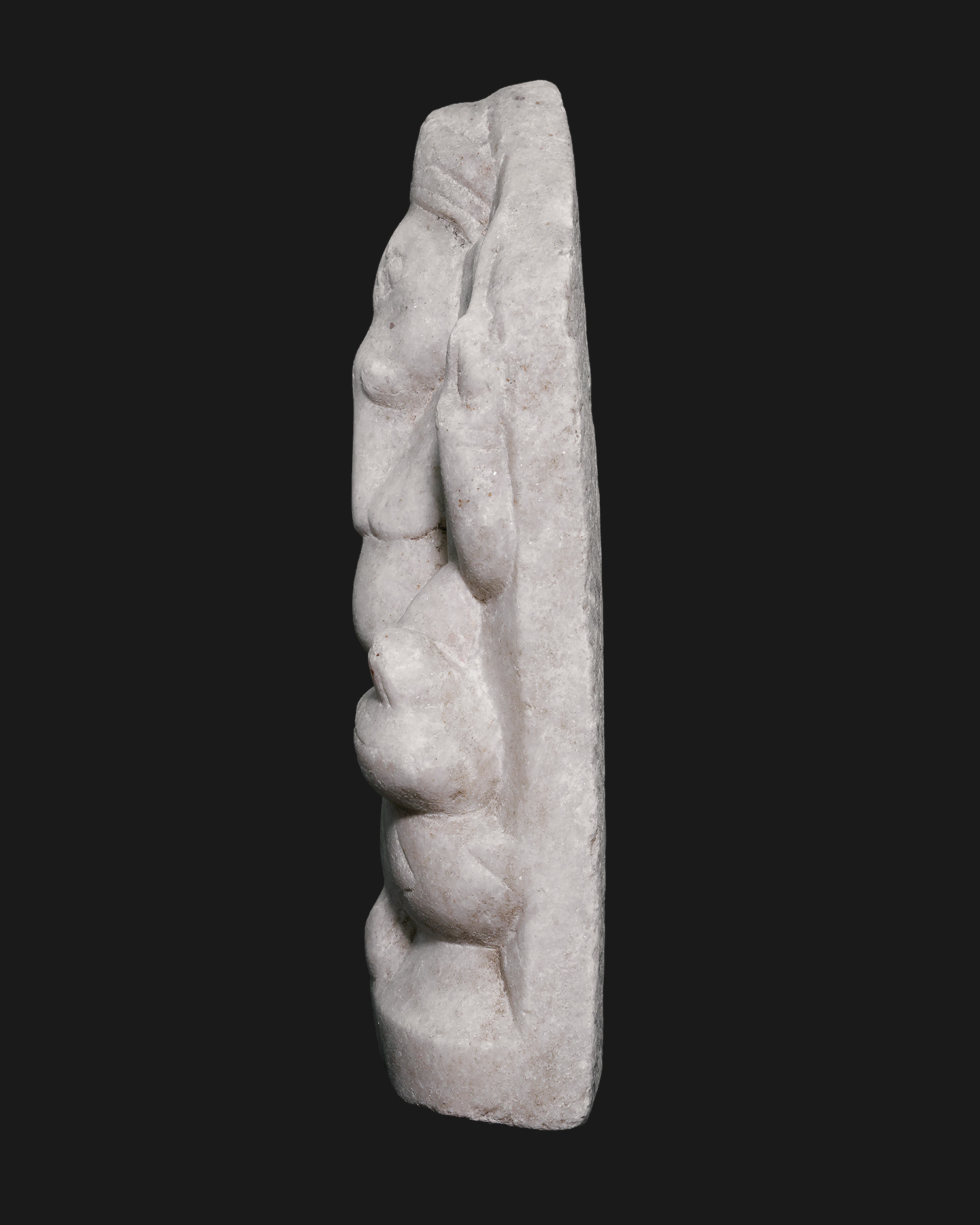
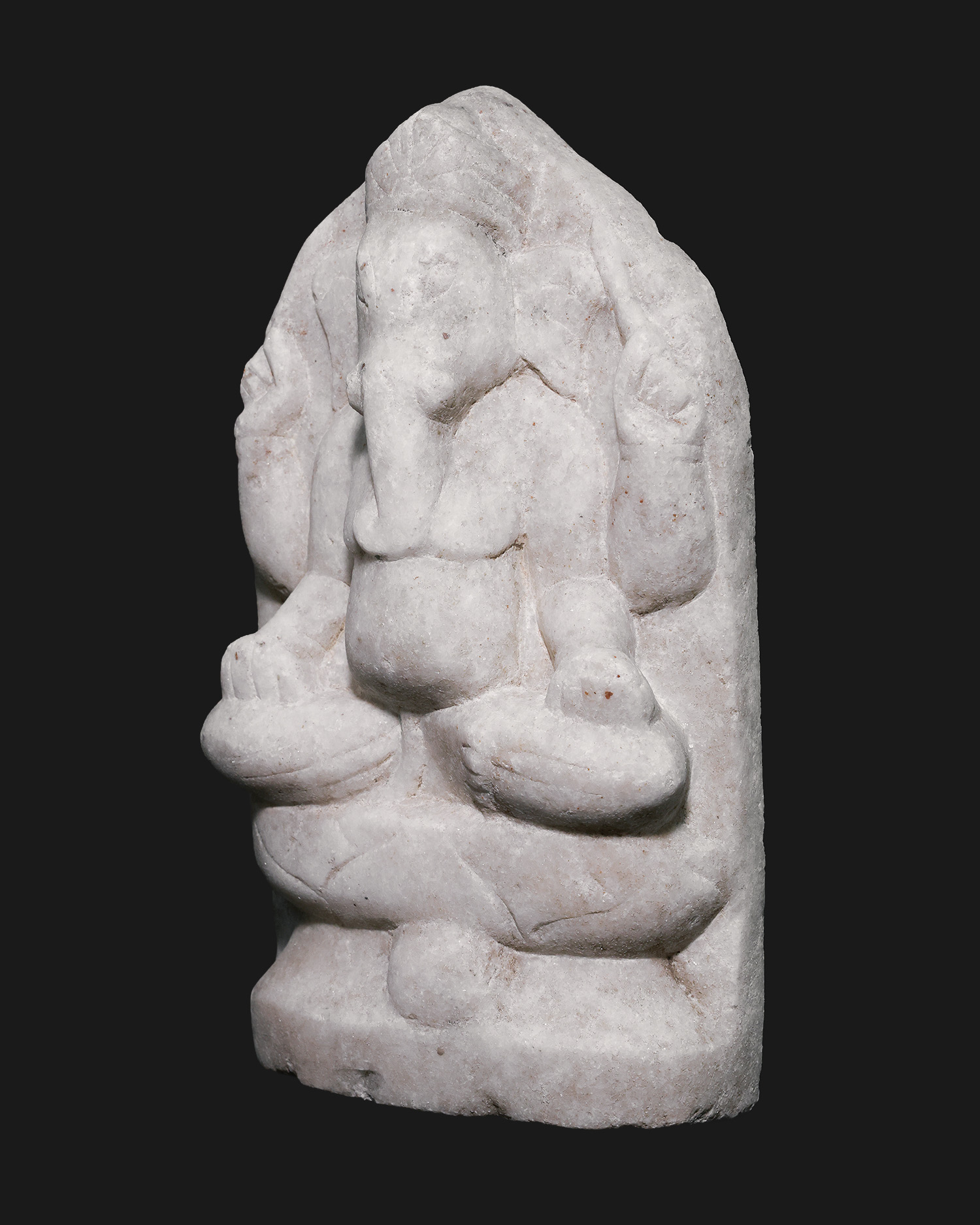
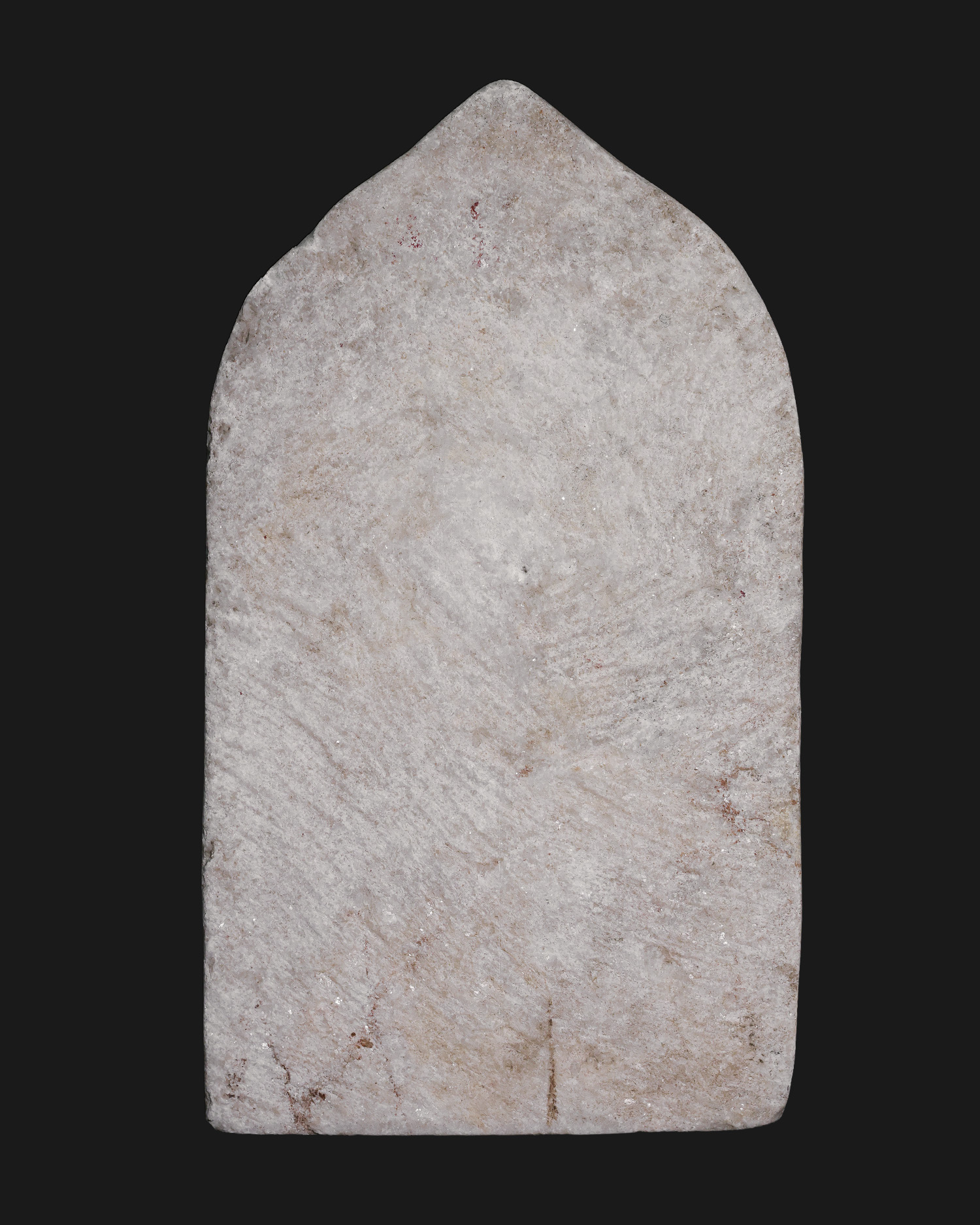
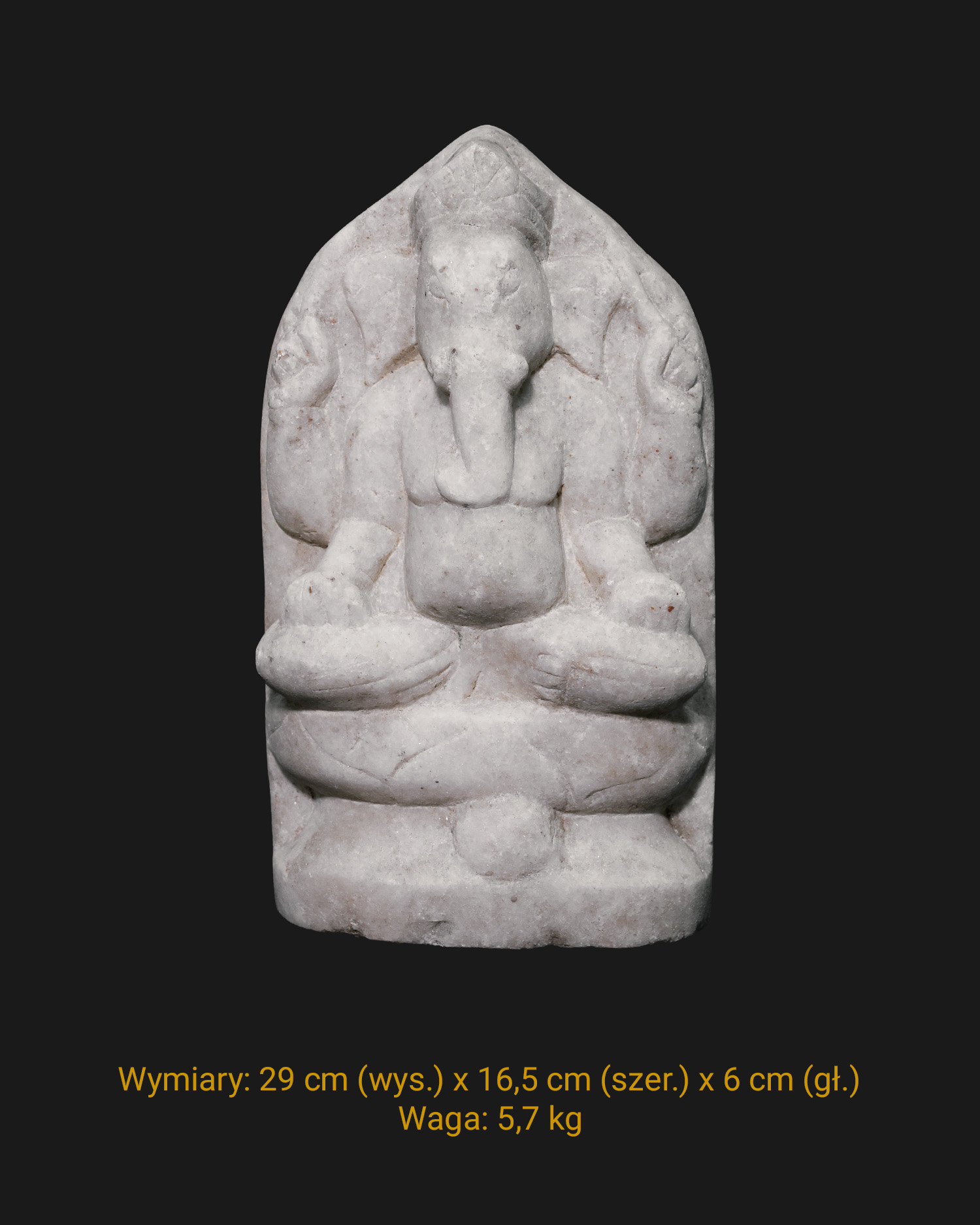

Ganesha, marble, India, 19th century.
700,00 zł
A semi-plastic sculpture depicting Ganesha, a Hindu deity with an elephant’s head, a human body and two pairs of hands. According to Hindu mythological accounts, one of his tusks was to be used as a stylus to write down sacred texts or chopped off by Parashurama during a conflict with the deity; this motif is interpreted as a symbol of sacrifice and Ganesha’s connection to knowledge and science. However, the sculpture on display also lacks a second tusk, probably due to past damage. The deity’s head is crowned with a diadem, and the entire figure is depicted against a smooth, semicircular wall (stele). Ganesha is seated on the pedestal in a cross-legged seated position, with one pair of hands resting on her knees and the other raised to shoulder height. In her raised hands she holds elongated attributes (in traditional iconography these include a noose and an elephant hook). He has a prominent belly, which symbolizes prosperity. At the foot of his seat is placed a small ball, interpreted as the traditional modaka sweet. This is the deity’s favorite sweet and symbolizes the supreme sweetness of spiritual enlightenment, pure wisdom and the inner joy that awaits a person after overcoming all of life’s obstacles and his own ego. The overall design is characterized by compactness and schematicism of representation – both the silhouette and details have been treated in a simplified manner.
Dimensions: 29 cm (height) x 16.5 cm (width) x 6 cm (depth)
Weight: 5.7 kg
1 in stock
| Weight | 5,7 kg |
|---|---|
| Dimensions | 29 × 16,5 × 6 cm |
| Type |
Sculpture |
| Form |
Semi-plastic figure sculpture |
| Materiał |
Marble |
| Kolorystyka |
White-Gray |
| Technika |
Carving |
| Czas powstania |
XIX century. |
| Kraj pochodzenia |
India |
| Autor |
Unknown |
| State of preservation |
Damaged fang, otherwise carving without major defects, with slightly worn details |
Related products
Brahma, marble, India, 19th century.
Bust of Krishna, marble, India, 19th century.
Christ Salvator Mundi, polychrome wood, Poland, 19th century.
Deity or bodhisattva, marble, India, 19th century.
Hercules, bronze, marble, northern Italy (?), 16th century (?).
Saint John the Evangelist, late Gothic wooden sculpture, ca. 1500
The work may have been part of a winged altarpiece (retabulum), most likely in the Crucifixion group.
St. Augustine reliquary with Ex Ossibus relic, polychrome wood, gilded, Italy, 18th century.
Vajrabhairava in Tantric Union (Yab-Yum) with Vajravetali, gilt and polychromed bronze, Tibet (?), 19th century
The sculpture depicts Vajrabhajrava, or more specifically, his Tantric form. The deity has three heads with angry expressions, crowned with a crown of skulls, symbolizing the direct destruction of illusion. Inside the crown, flames burst forth, a fire of wisdom burning away ignorance. Emerging from them is the head of a gentle animal - it belongs to Vajrabhajrava himself (his higher aspect).
The figure has six arms, symbolizing the multifaceted activity of the enlightened mind, and holds ritual attributes. The outstretched wings are a rarer but significant feature, representing a transcendental aspect and the overcoming of samsaric limitations. Vajrabhairava stands in a dynamic pose on a lotus base, trampling a male and female figure. These figures symbolize ignorance (avidya), attachment, anger, ego, and the illusion of duality.