


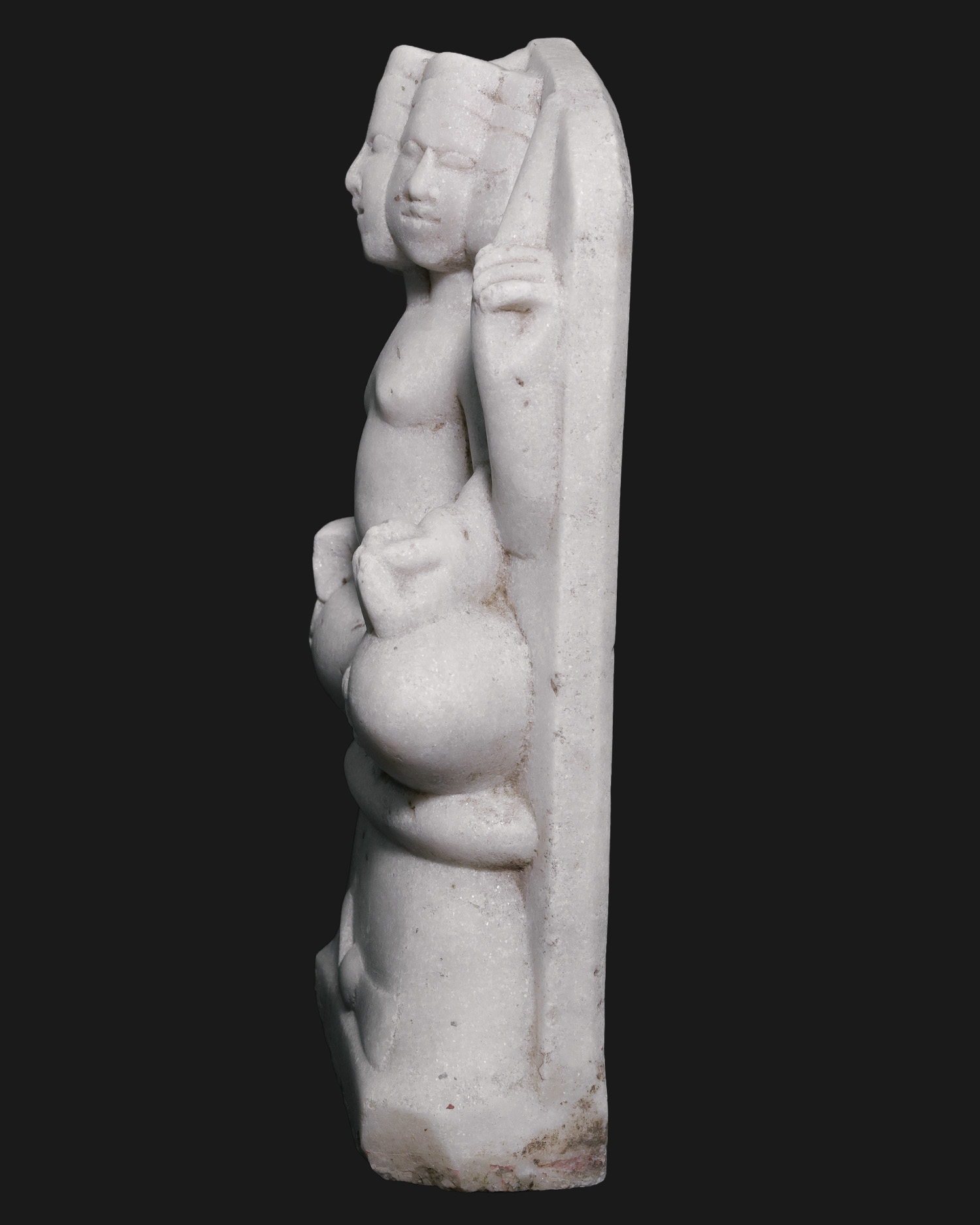
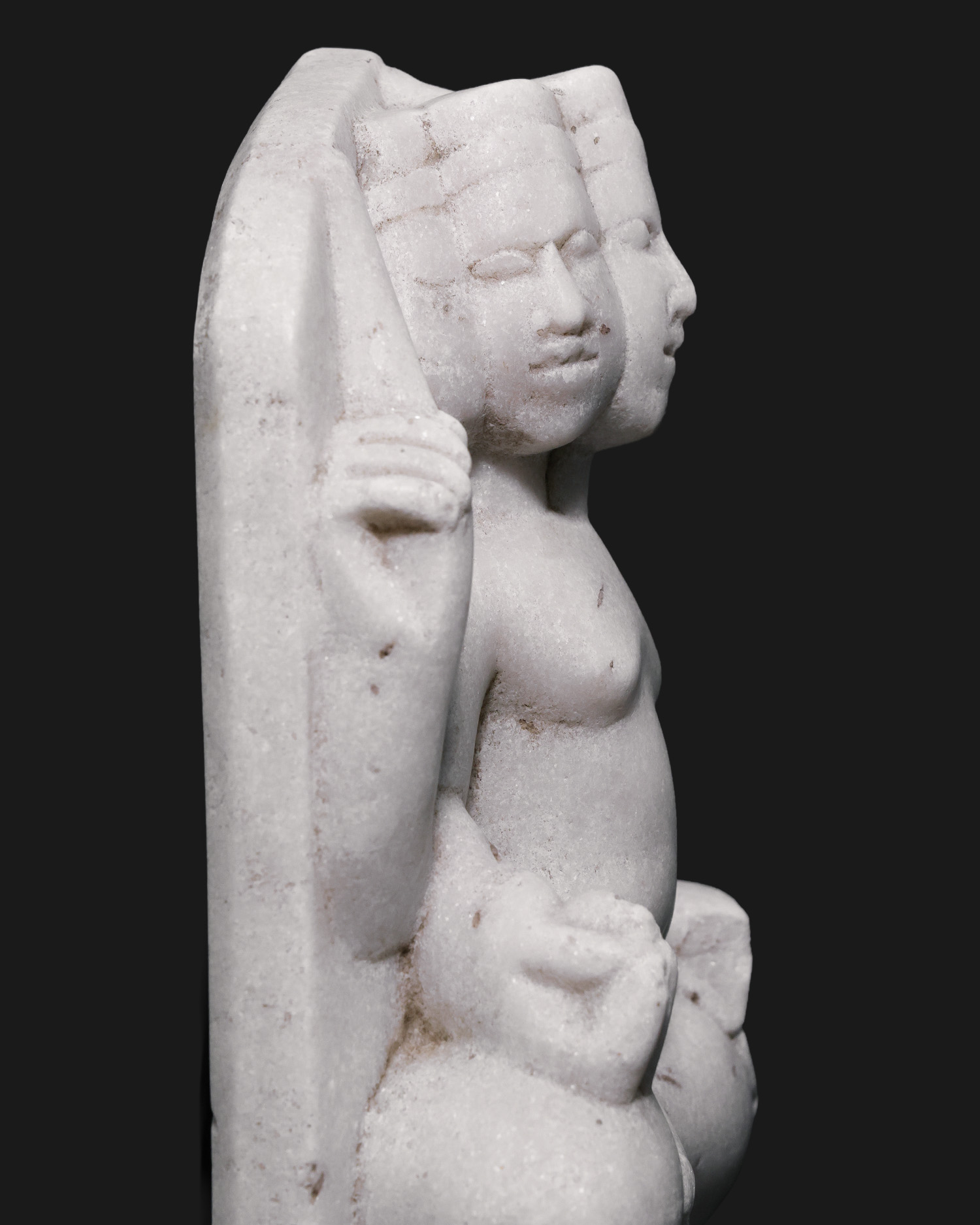
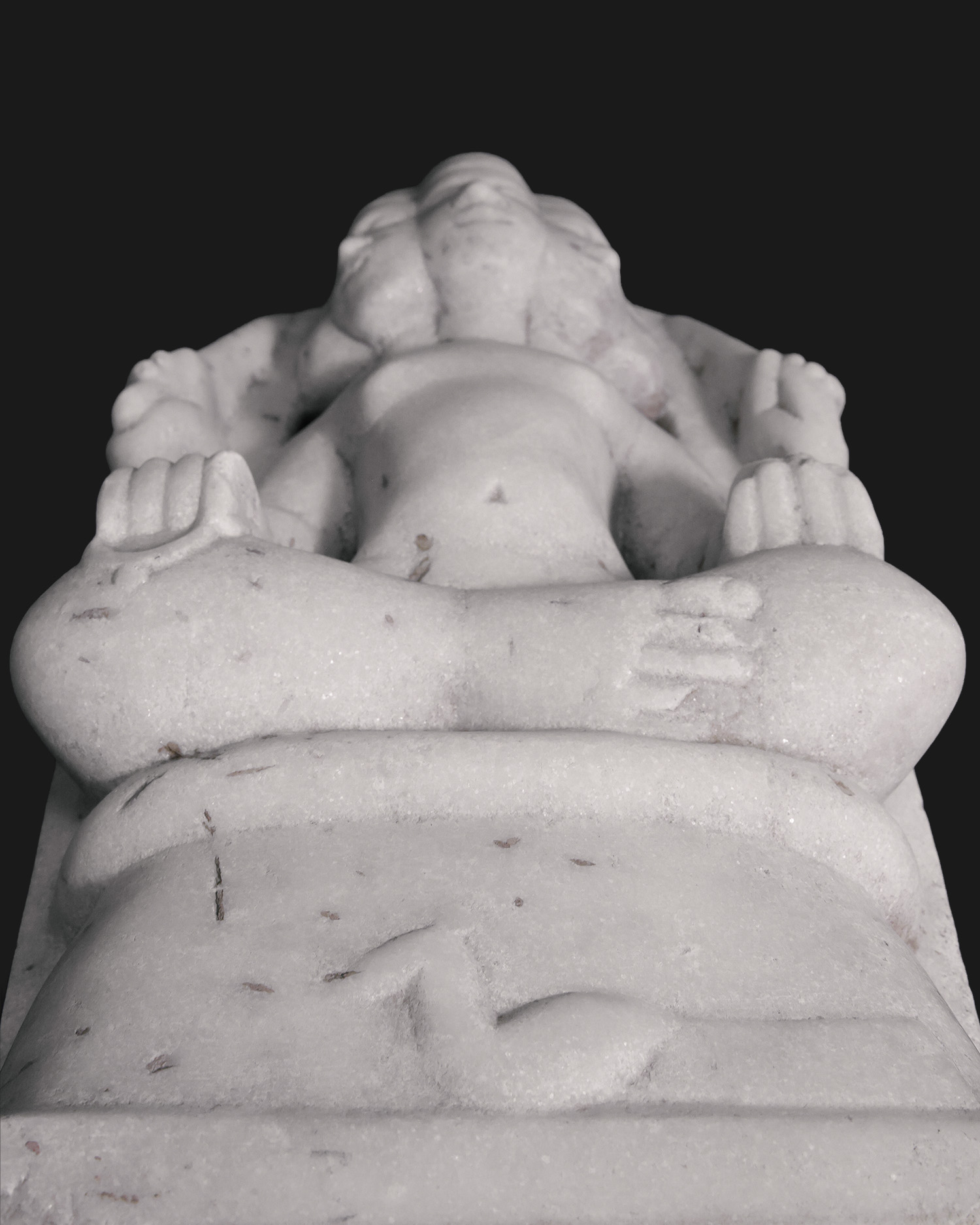
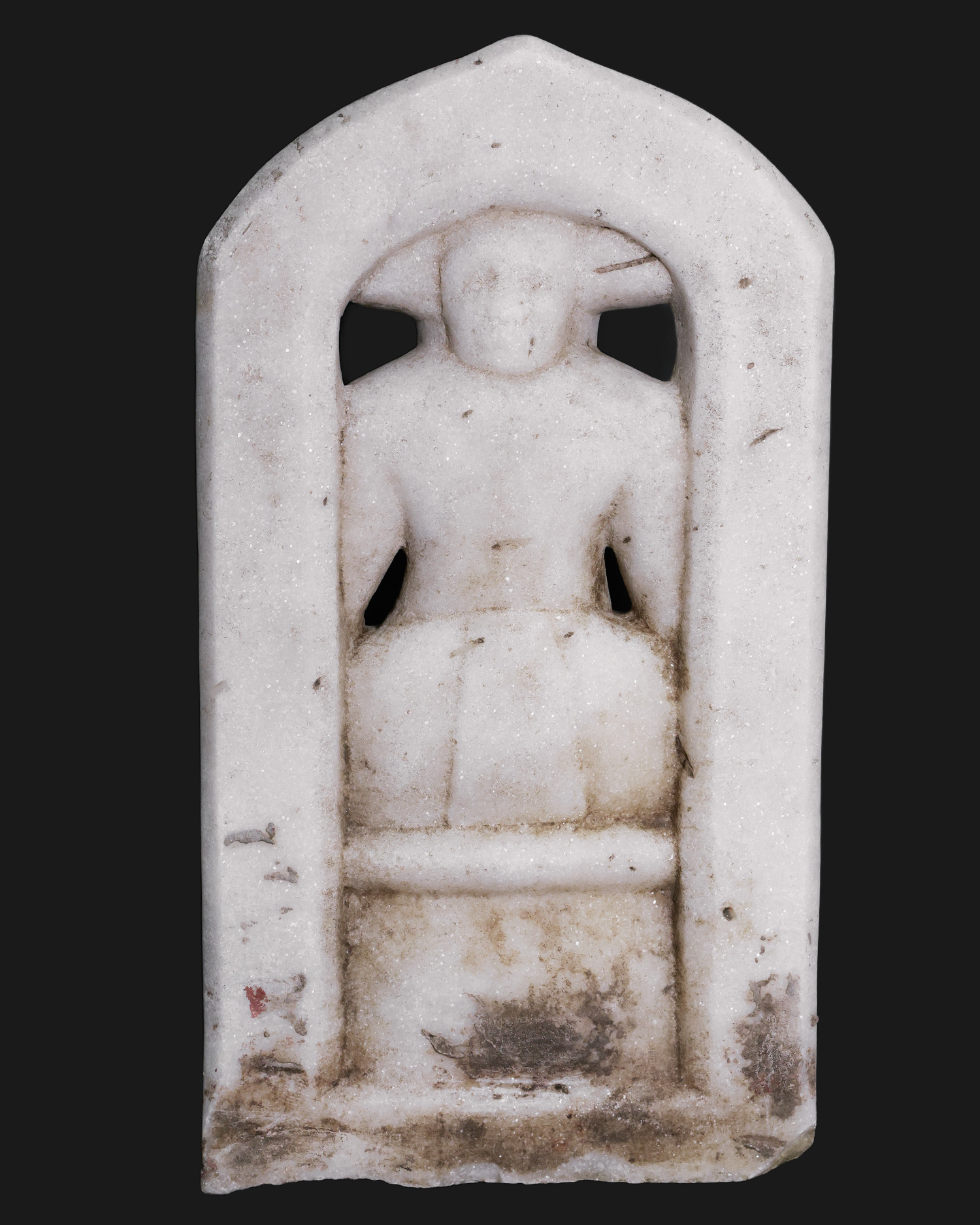
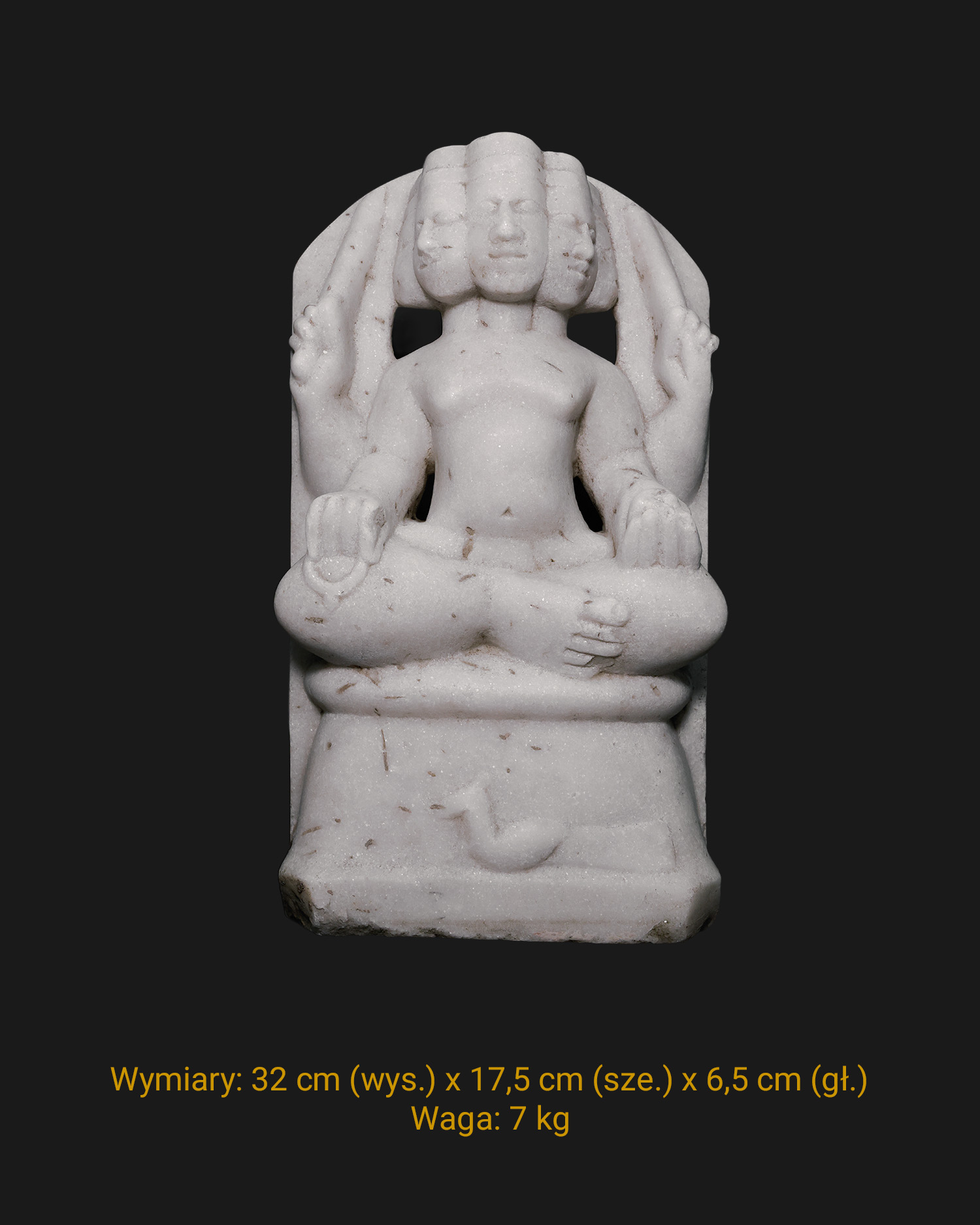

Brahma, marble, India, 19th century.
600,00 zł
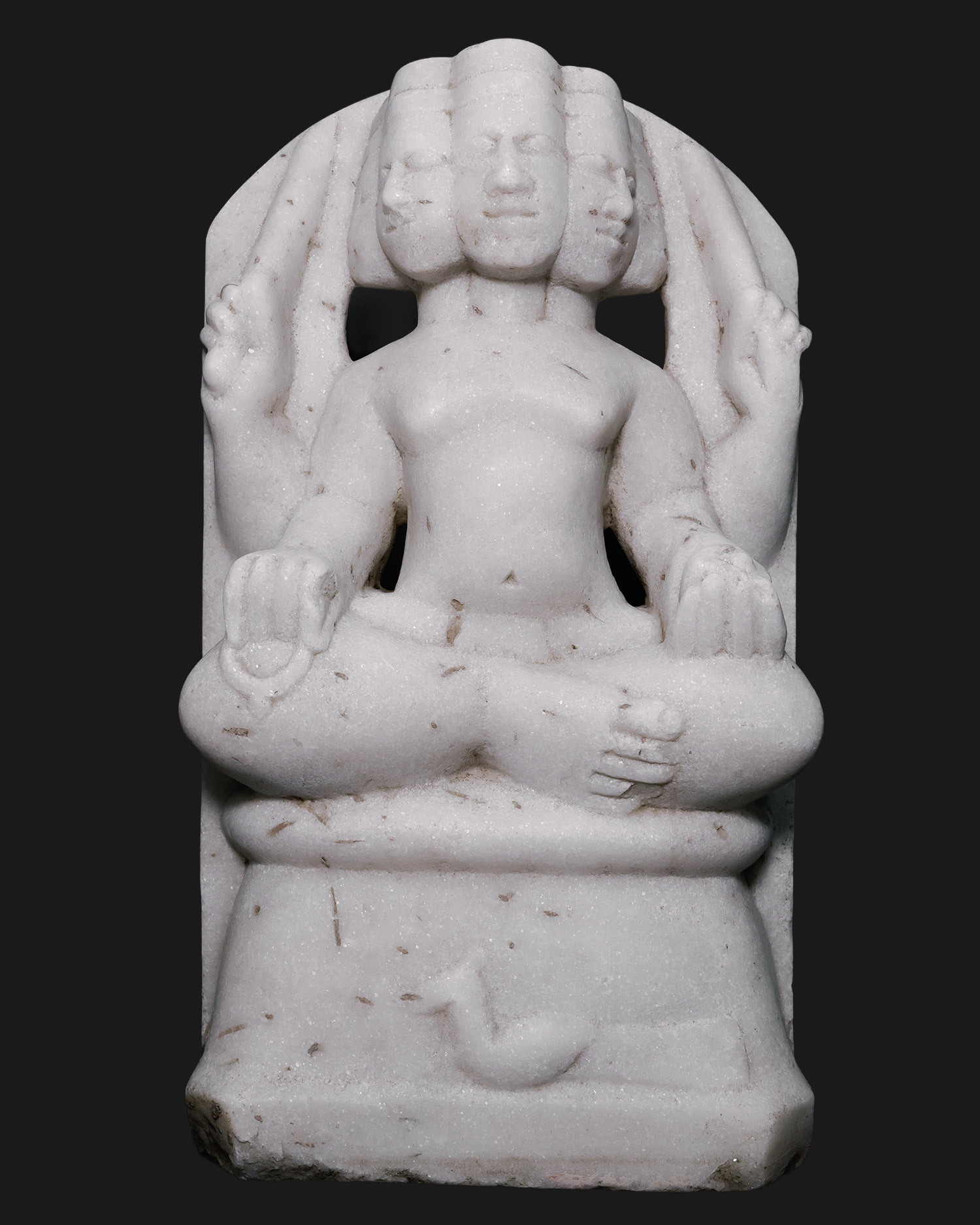
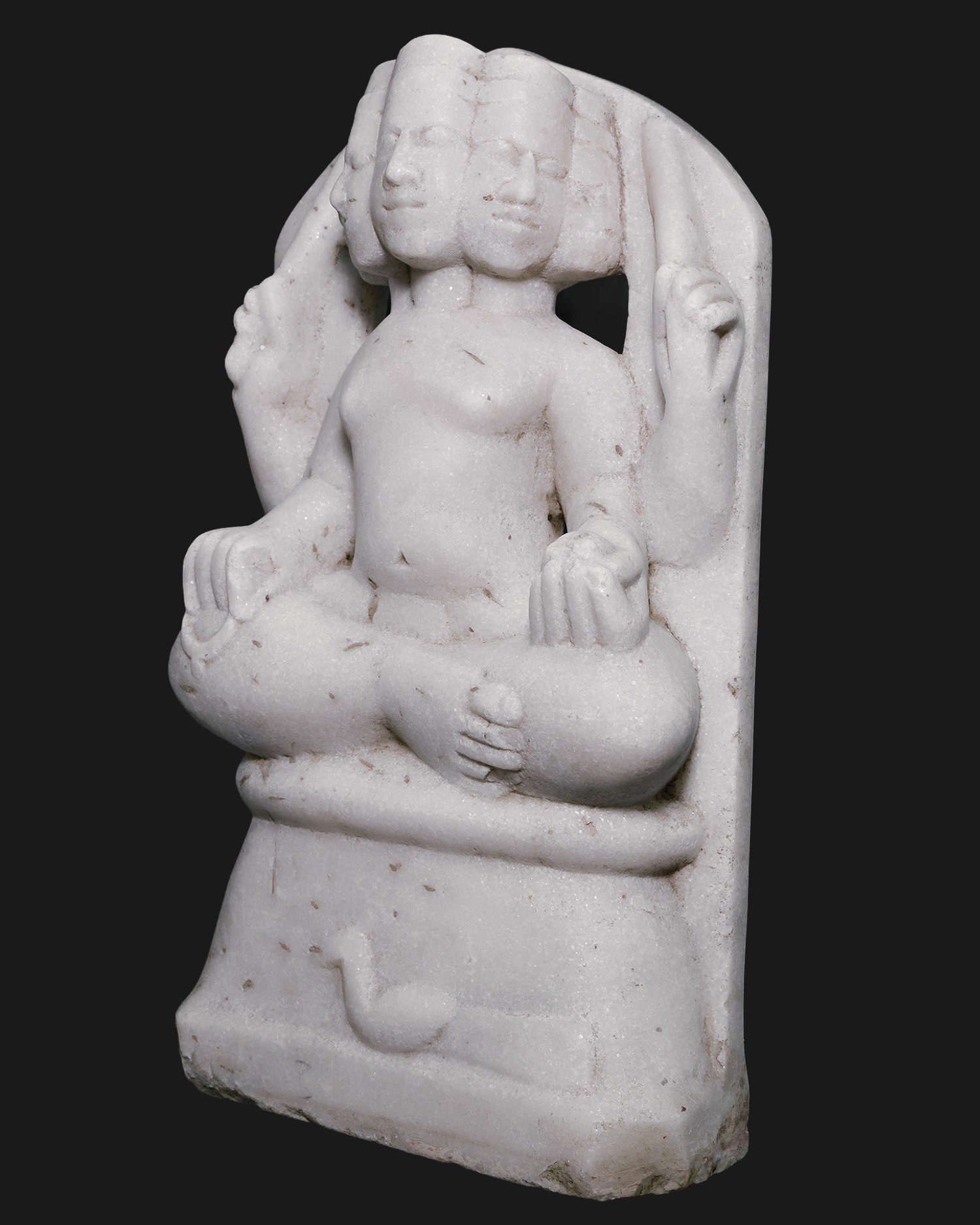
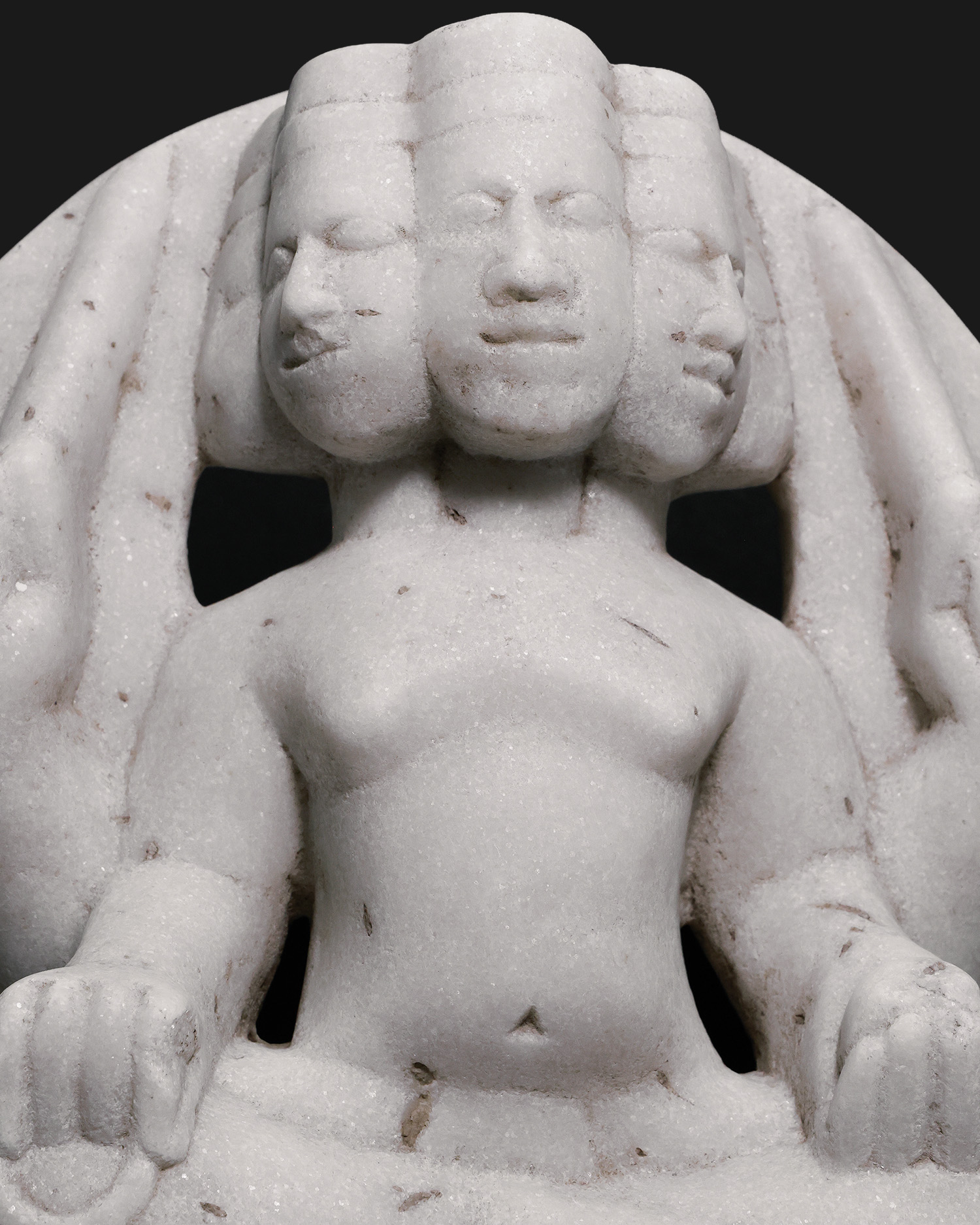
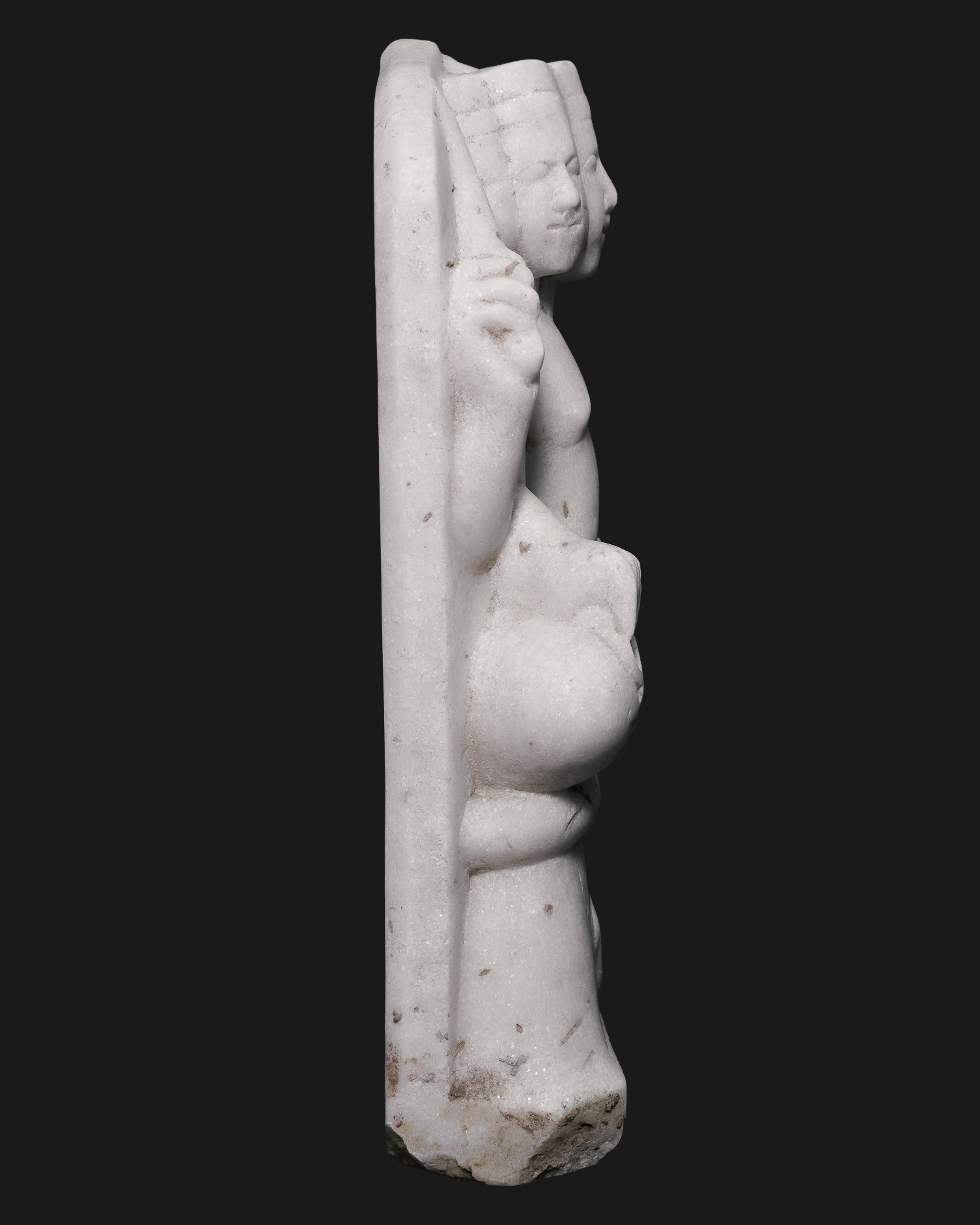
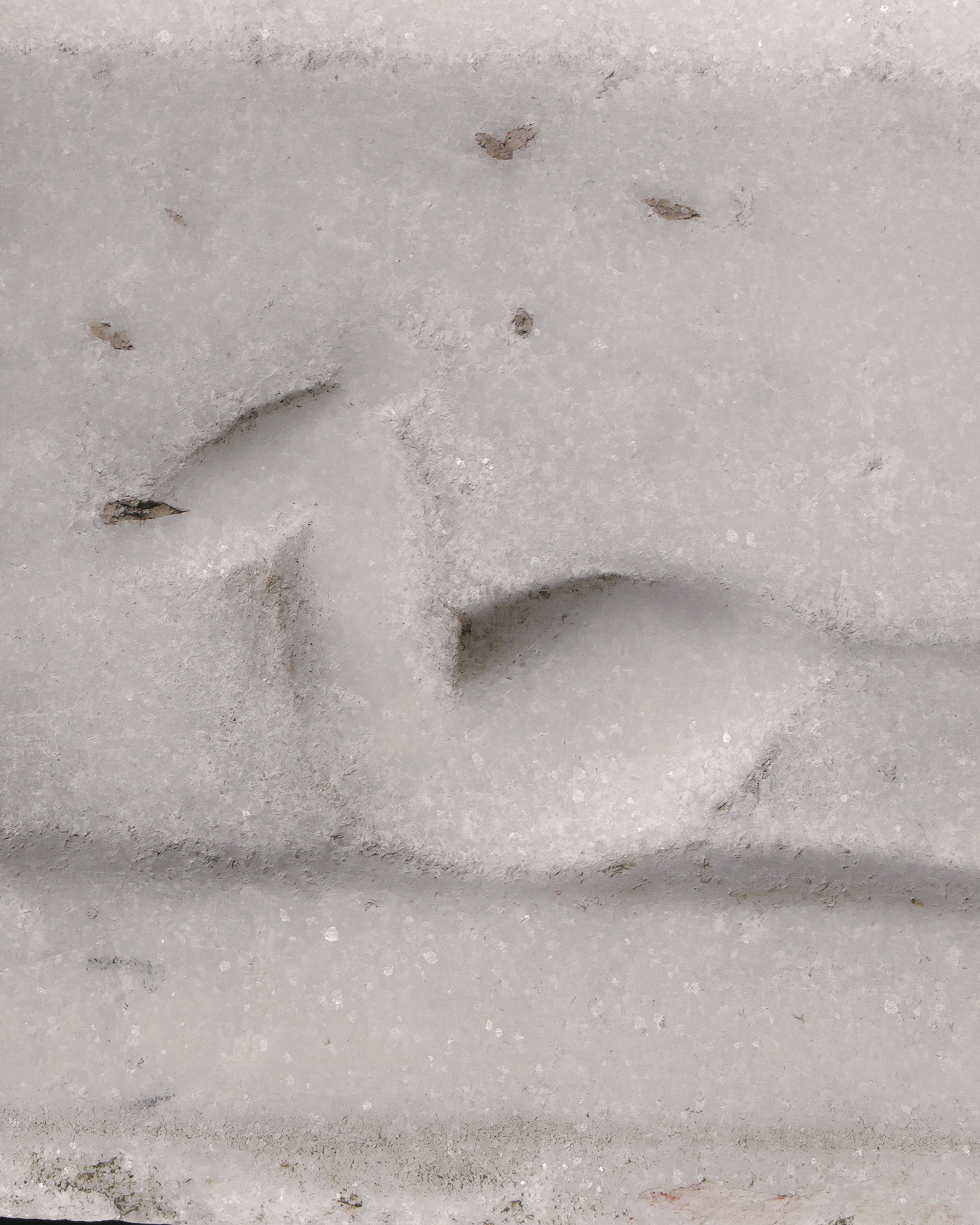
A marble sculpture depicting Brahma, the Hindu god of creation, associated with knowledge, wisdom, and the act of creating the world, who is part of the Trimurti trinity alongside Vishnu and Shiva. The deity is depicted in a seated position with crossed legs on a high pedestal. The depiction deviates from the classical iconographic scheme of Caturmukha (four faces), showing Brahma with six faces: five arranged in a fan-like pattern in an arc around the central face, and the sixth located at the back of the head. The multitude of faces emphasizes the deity’s omniscience and omnipresence. Brahma is depicted with four arms, in accordance with classical iconography. The lower pair rests on his knees; in one hand, the deity holds a sphere interpreted as a symbol of the world or the cosmos, and in the other, a rosary (akṣamālā), symbolizing knowledge, meditation, and the passage of time. The upper pair of hands, raised at the sides of the head, holds attributes whose identification is difficult due to the schematic nature of the sculpture. The figure is set against a background of an arched frame with a pointed arch. At the base of the composition, an image of a bird has been carved, likely a hamsa (sacred goose or swan), Brahma’s traditional mount. The whole is characterized by a compact, frontal composition and restrained modeling.
Dimensions: 32 cm (height) x 17.5 cm (width) x 6.5 cm (depth)
Weight: 7 kg
1 in stock
Related products
Bust of Krishna, marble, India, 19th century.
Christ Crucified, wood, Spain (Pyrenees?), 12th-13th century.
The sculpture impresses with the pronounced rigidity of the body, typical of early Roman depictions. The calm yet poignant expression of Christ's face is emphasized by huge, forward-facing eyes set in deep eye sockets.
His gaze, however, is slightly lowered, emphasized by a prominent nose and large, spreading ears that frame his face. His hair falls symmetrically on his shoulders; a peculiar hairstyle draws attention - the hair, separated by a parting on top of the head, is arranged in rollers covered with densely diagonal cuts. Very similarly arranged hair, resembling braids, has the famous statue of Christ of Mig Aran, located in the church of Sant Miquèu de Vielha (Val d'Aran valley). The beard and mustache end in artificial, volute curls.
Christ Salvator Mundi, polychrome wood, Poland, 19th century.
Gallo-Roman male portrait head, marble, Roman Empire, Province of Gaul (area of modern France), 1st-3rd century after Chr.
Head of an angel (?), sandstone, France, ca. 1300
Madonna and Child, polychrome wood, gilded, Central Europe, 18th/19th century
Saint John the Evangelist, late Gothic wooden sculpture, ca. 1500
The work may have been part of a winged altarpiece (retabulum), most likely in the Crucifixion group.