


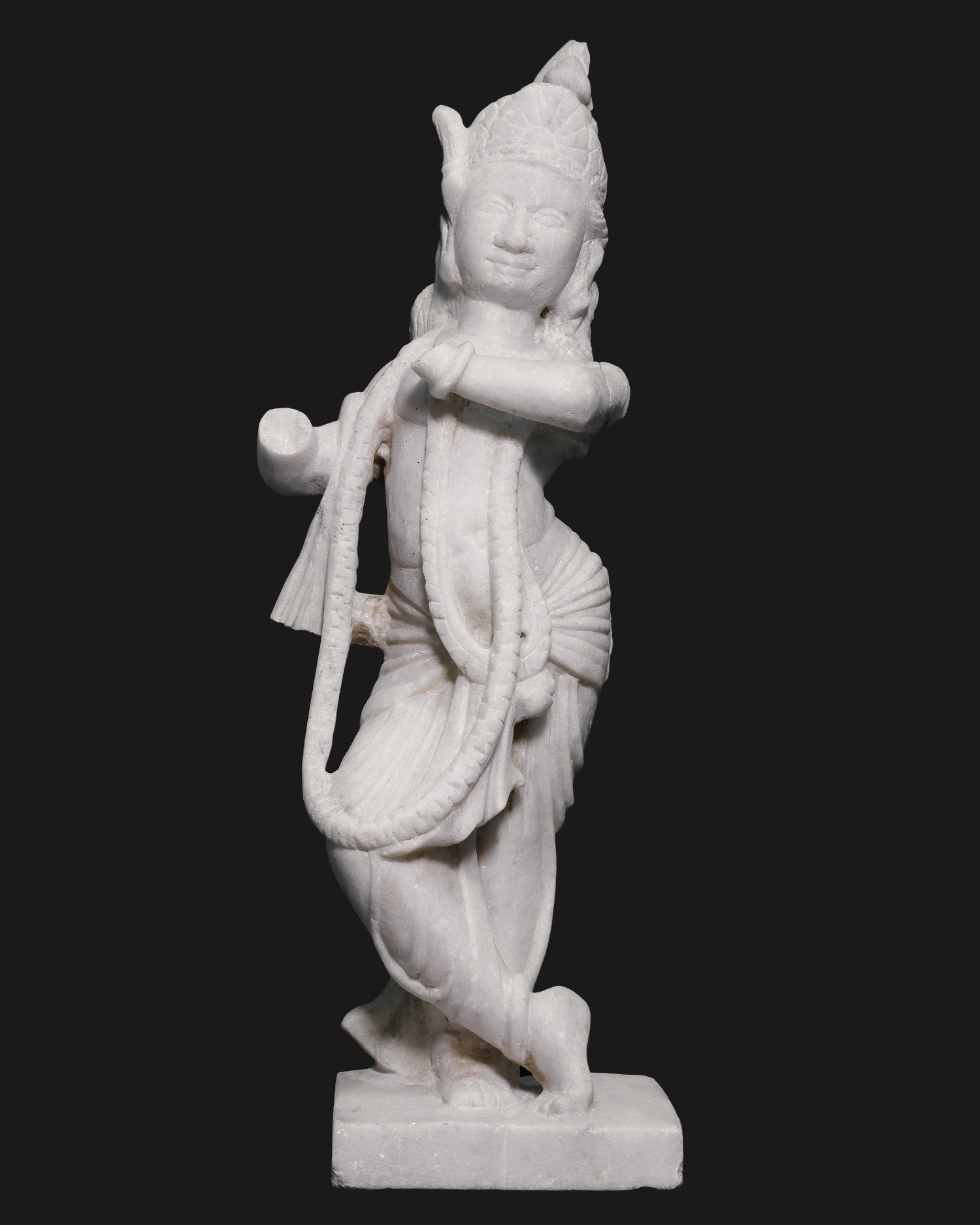
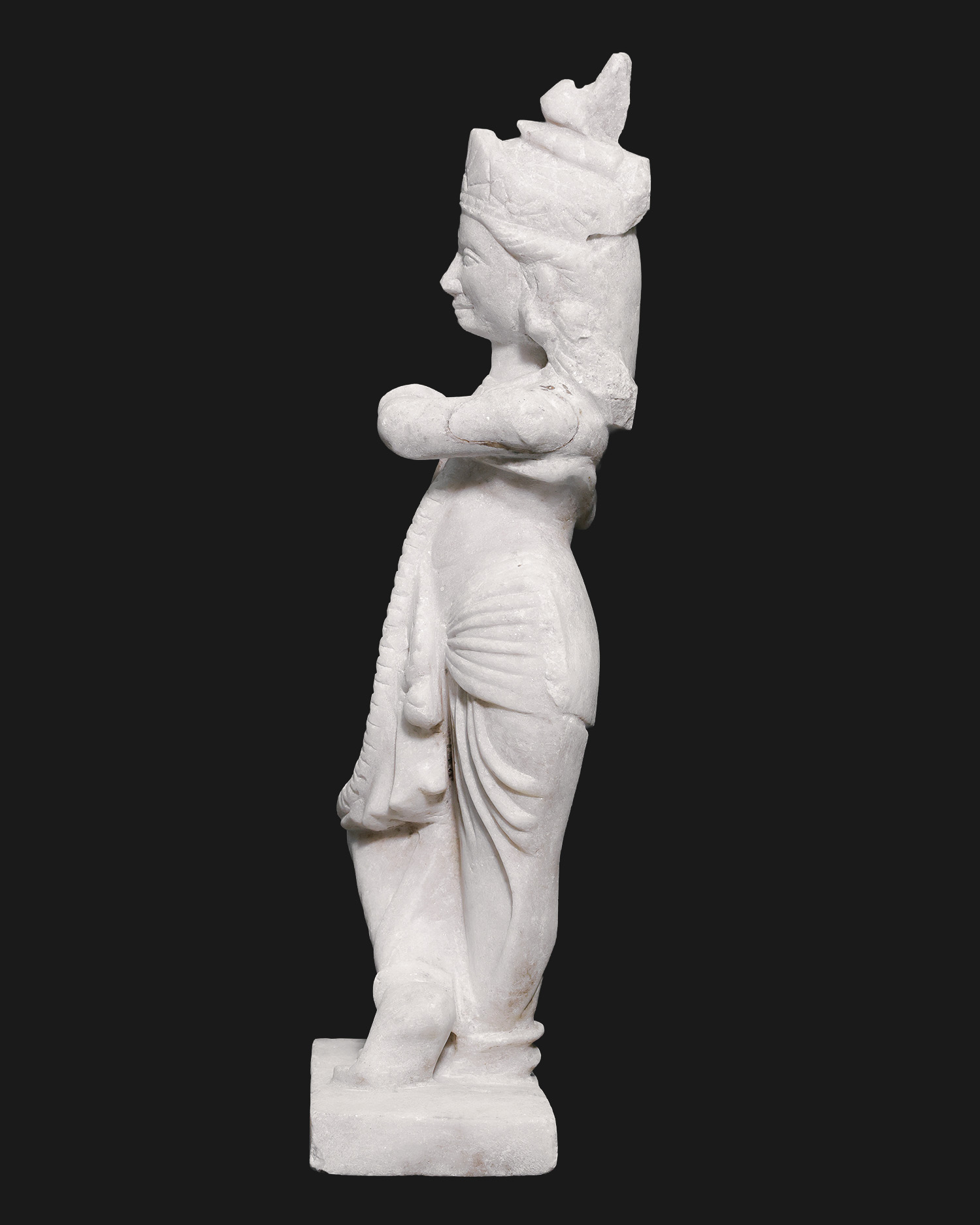
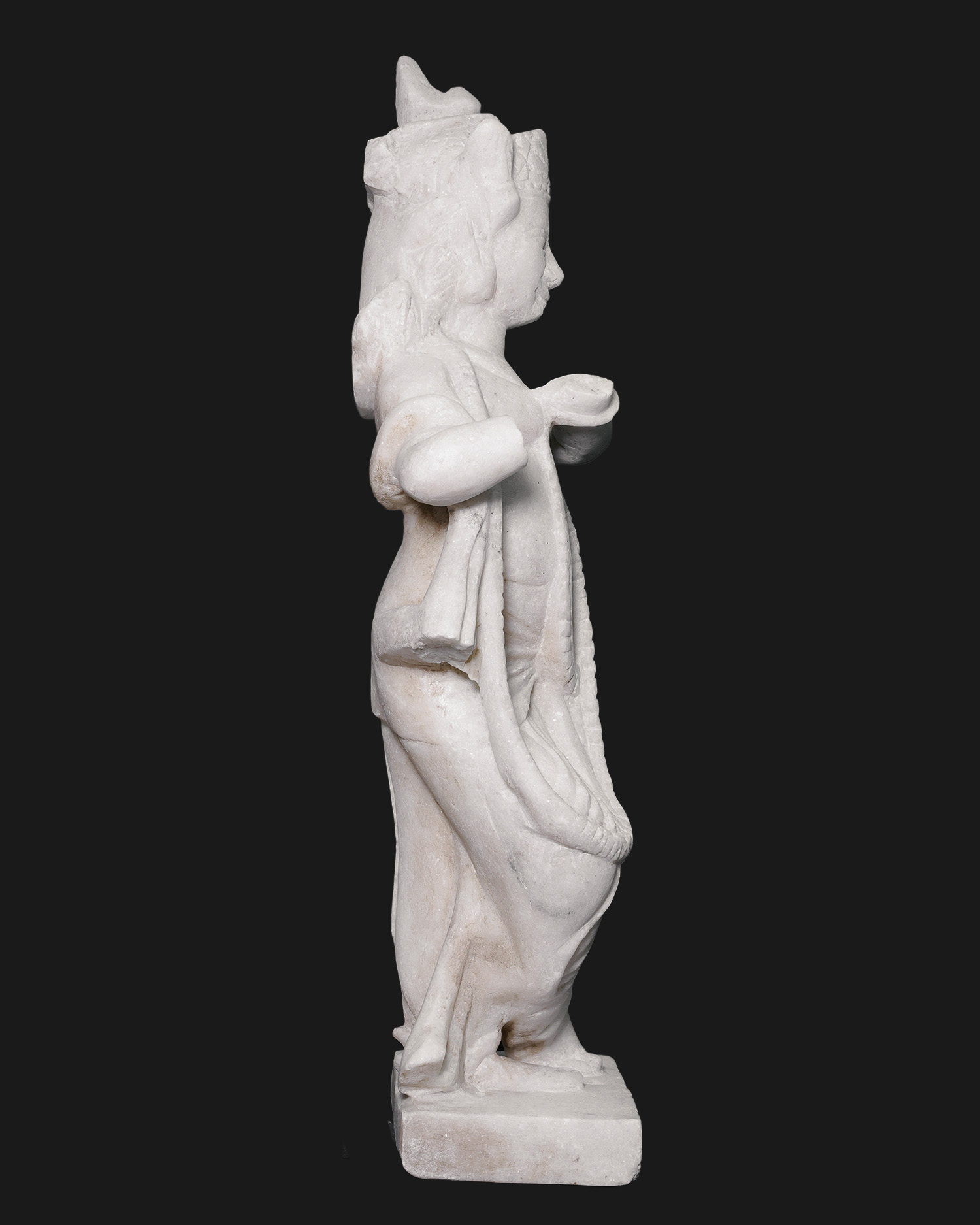
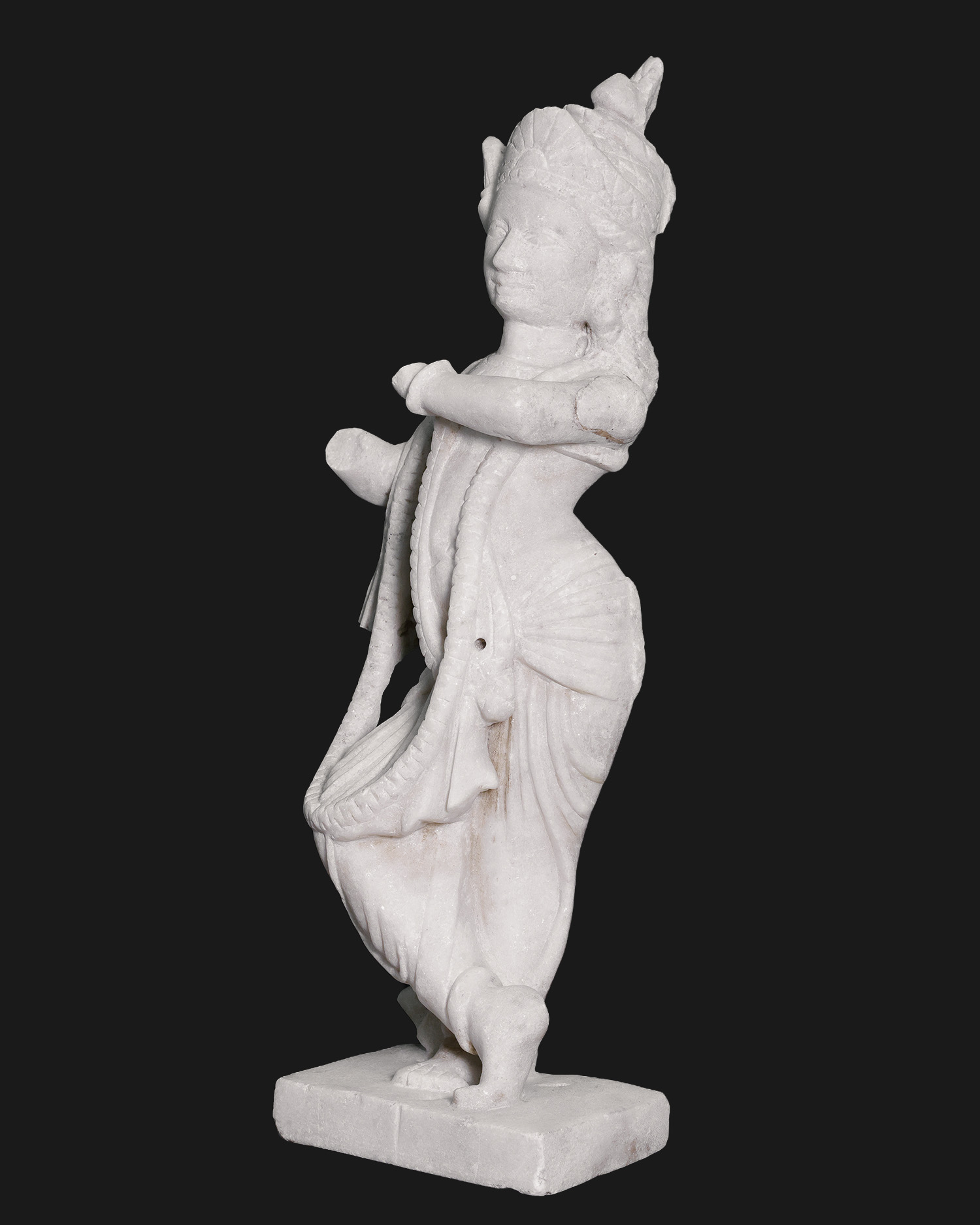
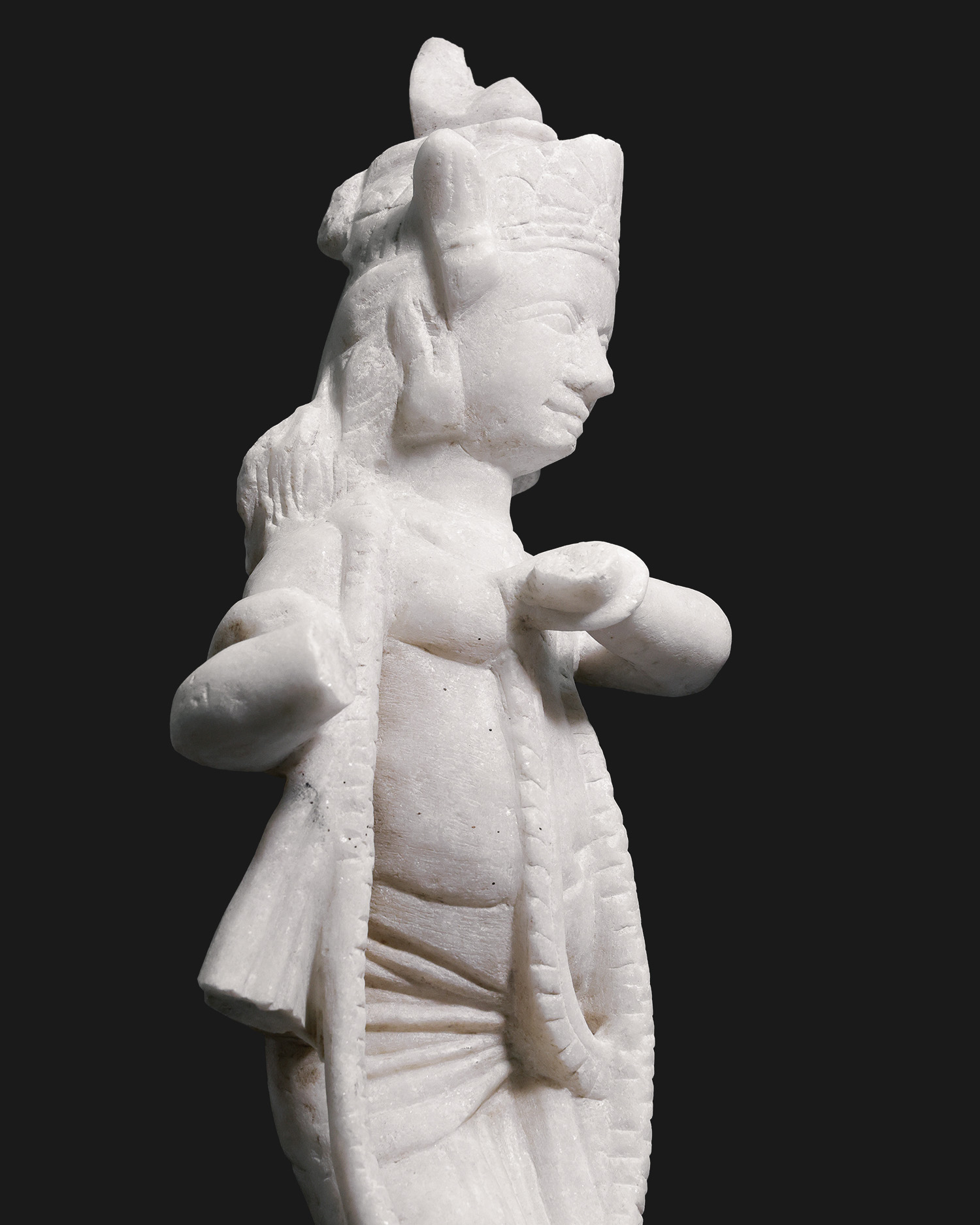
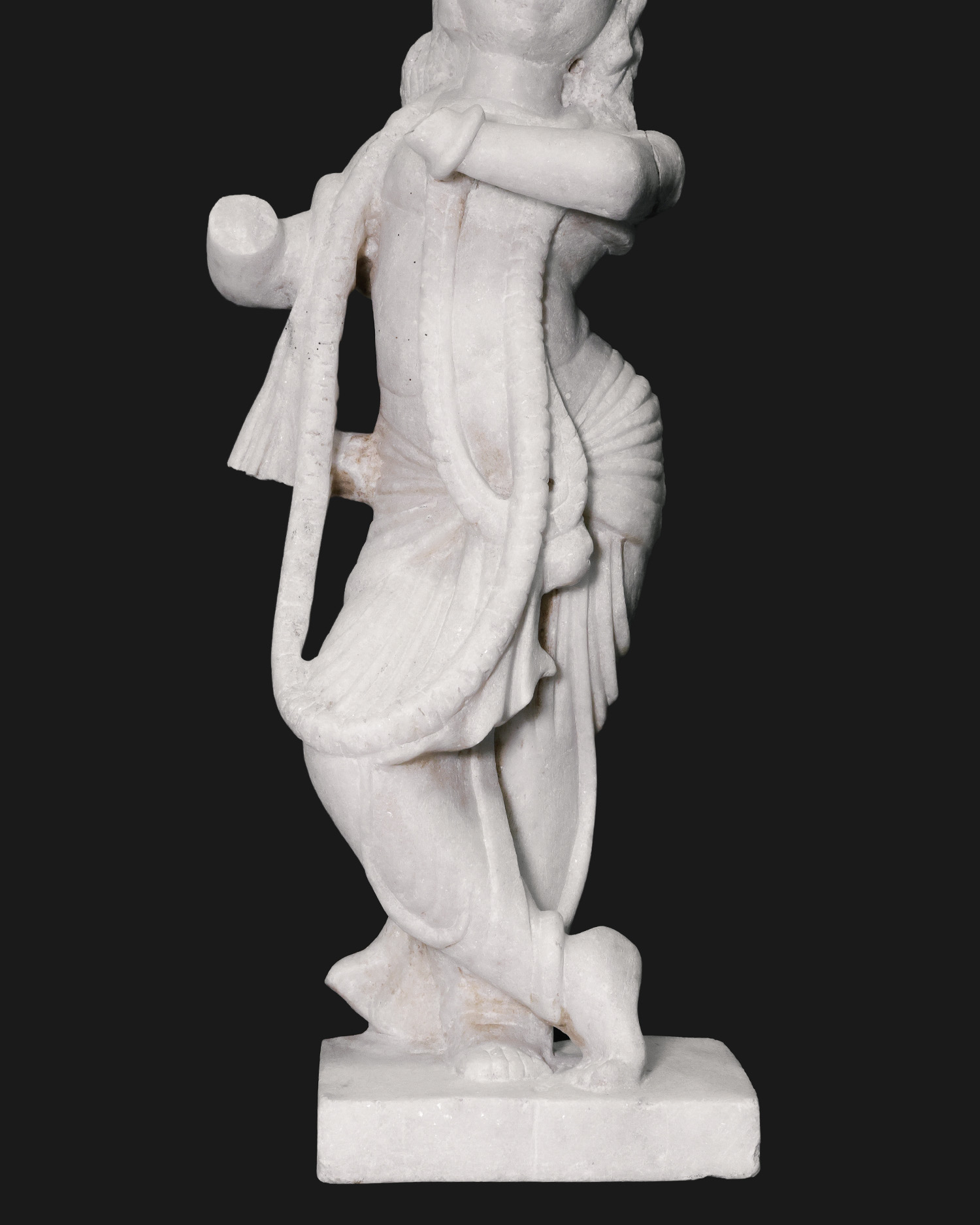
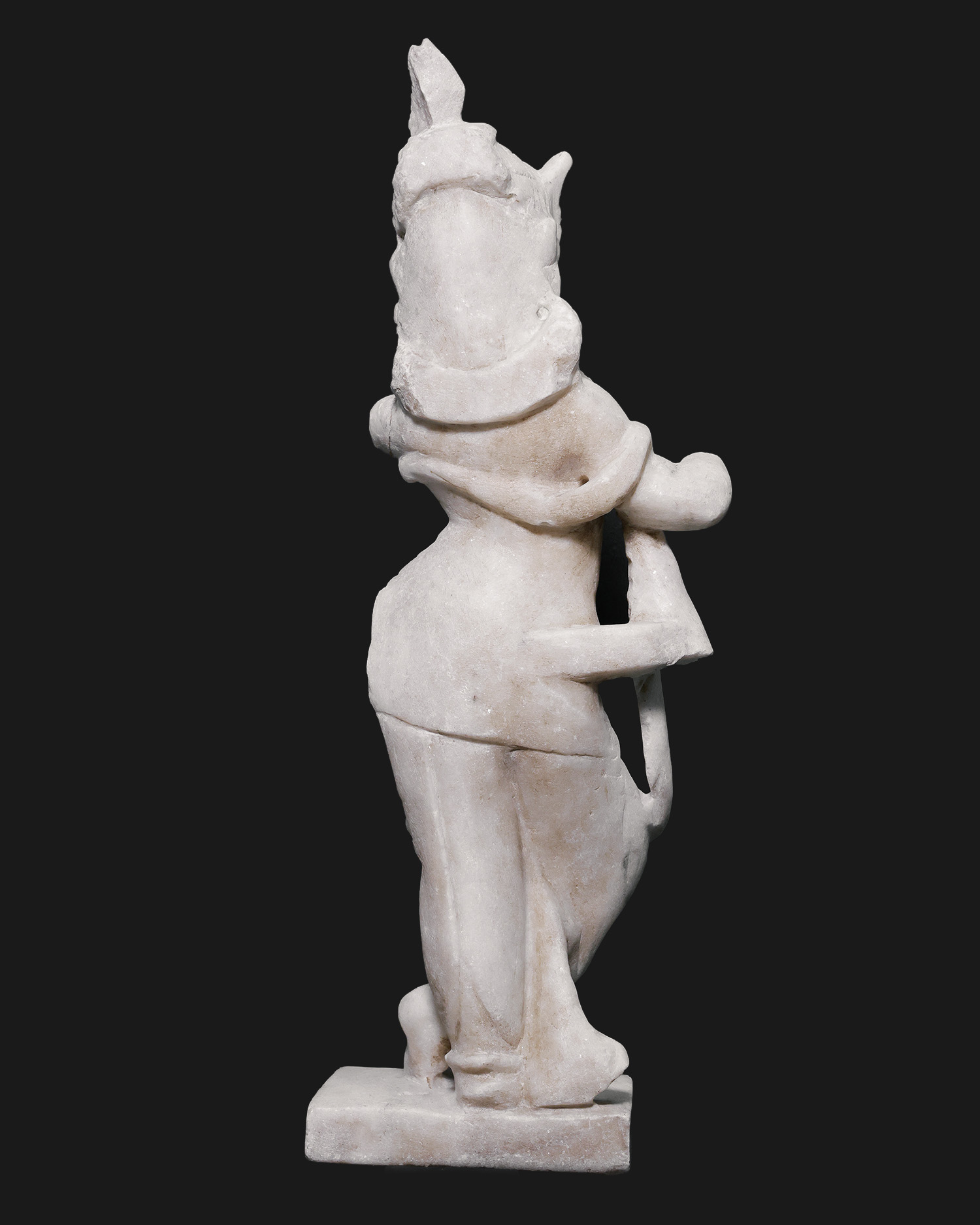
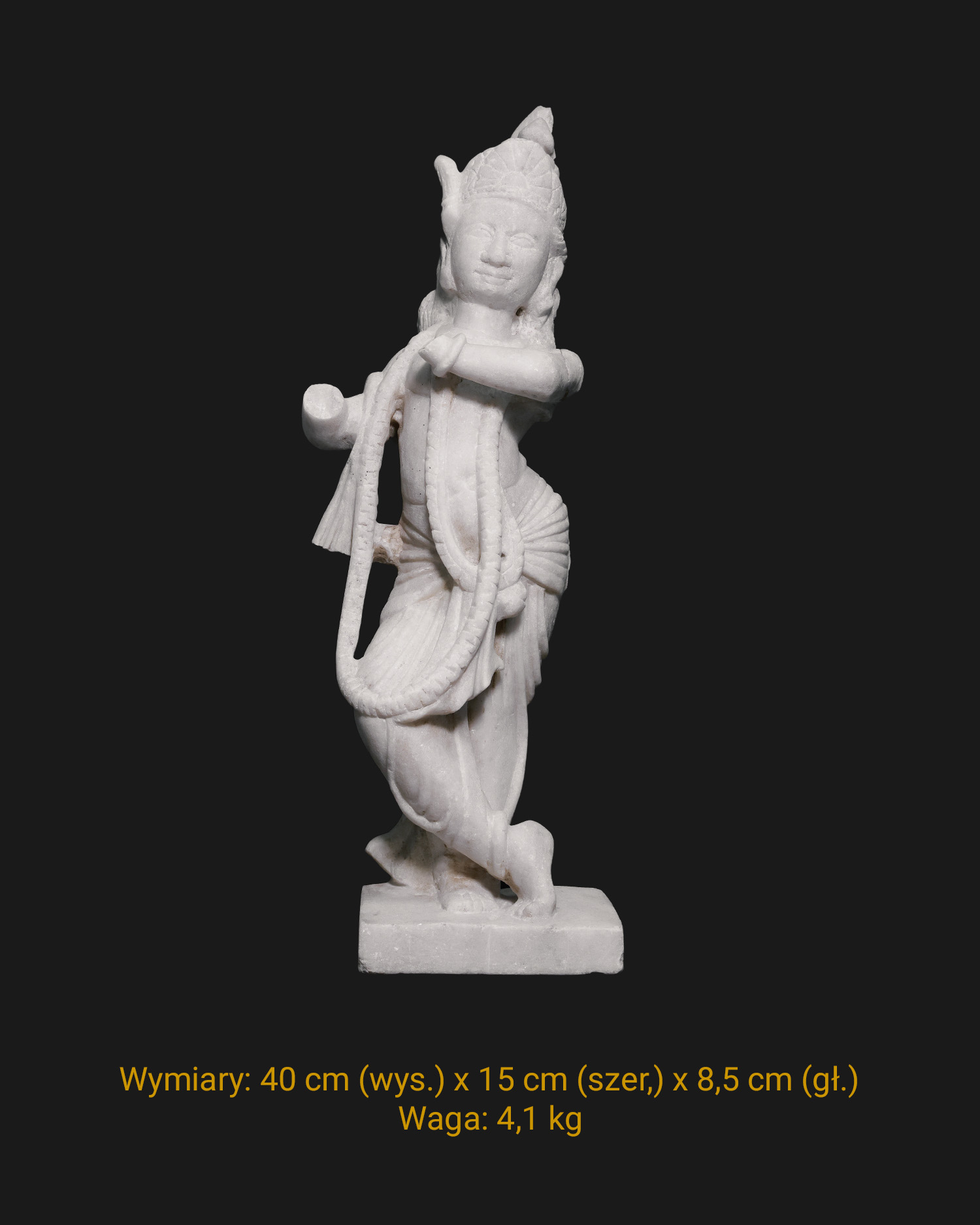

Krishna, marble, India, 19th century.
800,00 zł
A marble sculpture depicting Krishna in the form of Venu-Gopala, the divine shepherd playing the flute. The figure of the deity is depicted in the classical Indian canon of beauty known as Tribhanga (the triple bend of the body). The lines of the hips, chest, and neck form a dynamic, S-shaped curve. Krishna stands with his legs crossed at the ankles, resting his weight on his left foot while his right foot rests on its toes, which lends the composition a sense of lightness and grace. The hands are raised in front of the torso and were originally positioned to hold a flute. The deity’s face has a serene expression, with a gentle smile and almond-shaped eyes typical of traditional Indian iconography. The head is crowned with a tall crown adorned with a peacock feather motif (Mayur Pankh), one of Krishna’s most important attributes. The figure is dressed in a dhoti with schematically rendered folds. Two long, decorative garlands hang around the neck, one reaching the hips and the other the knees. These may represent a simplified depiction of the vaijayantimāli—a long floral garland traditionally associated with Vishnu and his avatar Krishna. The back of the figure is rendered in a more simplified manner, indicating that the object was intended to be placed directly against the altar wall or in a wall niche.
Dimensions: 40 cm (height) x 15 cm (width) x 8.5 cm (depth)
Weight: 4.1 kg
1 in stock
Related products
Brahma, marble, India, 19th (?) century.
Bust of Krishna, marble, India, 19th century.
Christ Salvator Mundi, polychrome wood, Poland, 19th century.
Gallo-Roman male portrait head, marble, Roman Empire, Province of Gaul (area of modern France), 1st-3rd century after Chr.
Head of an Angel (Putta), gilded linden wood, Poland, 1st half of the 18th century.
Madonna and Child, polychrome wood, gilded, Central Europe, 18th/19th century
Saint John the Evangelist, late Gothic wooden sculpture, ca. 1500
The work may have been part of a winged altarpiece (retabulum), most likely in the Crucifixion group.
Skull (Memento Mori), marble, Italy, 18th-19th century
Elegant, decorative skull made of natural gray marble, maintained in a realistic style: the eye sockets, cranial seam lines and zygomatic arches are clearly formed. The faded dentition alludes to the concept of Vanitas.
The characteristic feature of the stone used for the sculpture is irregular veining in shades of beige, cream and gray, which gives it a unique character. The surface is polished, with natural discolorations and small marks due to the properties of the material, which emphasizes the authenticity and nobility of the marble. The skull is provided with a lead pin underneath, set on a minimalist, contemporary base in black, which exposes the sculpture and gives it a museum-like character.
The object is ideal for collectors of curiosities, lovers of the art of Vanitas - Memento Mori, cabinets of curiosities and as an expressive element of interior design in classical, industrial or eclectic style. An object with a strong aesthetic and symbolic expression, which is difficult to pass by indifferently.